
Have you guys seen this photo? It’s so crazy to me.
When I first saw the controversy surrounding the image online, I had only seen the close-up of the woman’s face. Even then, I thought it was problematic. But when you zoom out, you realize that she is a disembodied head mounted on a stake. A finger has been placed inside her mouth, making the image look less like an advertisement for a gym than something created for an adults-only website.

She isn’t portrayed as a person. She’s an object on display. These Equinox ads are currently hanging on Sunset Boulevard. What does this have to do with fitness?
This image should make all women uncomfortable. The woman is depicted as helpless, manipulable, touchable, and replaceable. She cannot move away, speak, or resist the anonymous hand poking and prodding her as it pleases.
But making this woman Asian changes the meaning significantly. There is a huge history of Asian women being dehumanized in popular culture. This image participates in that history through something scholars call techno-Orientalism.
Think of the frequently unclothed Japanese robot in Ex Machina. She is desirable enough to use, but she is never treated as fully human. That is what I see in the Equinox image. The woman has been reduced to an ultra-sexualized face, severed from her body, mounted on a pole, and turned into an inanimate object.
Why is the Asian woman the only person in the campaign being portrayed this way? And again, what does any of this have to do with fitness?
Over a decade ago, I dated a white man named Liam. I was deeply flattered by his attention. He was handsome, tattooed, confident, and exactly the kind of man I had been conditioned by Western media to see as desirable.
He was one of the first white guys I dated after moving from Temple City to Hollywood. He pursued me aggressively from the moment we met, although it would be years before we finally dated because we were always in other relationships. I loved his confidence and unwavering certainty. He was tall and lanky, with full sleeves of tattoos like the rock stars I idolized growing up: Axl Rose, Duff McKagan, and Sebastian Bach.
The first night we truly connected, I was performing with my band at Playhouse, one of Hollywood’s hottest clubs. That night, I felt ethereal in an outfit my bandmate Katt had designed and sewn from scratch. It was a tiny, floating, silvery thing, and I wore knee-high black boots to match. The show was epic. The club had a massive LED-lit screen behind us with our band’s name blazing in lights.

I wished Liam could have been there to see the performance. As a fellow musician, I wanted to impress him, and that show was one of those rare, magical, lightning-in-a-bottle moments when everything flowed and sounded perfect. He arrived about an hour after the show. He managed the bar at the Roosevelt and couldn’t get off work until 10 p.m., after our set had ended.
We were finally both single, and this was only the second night we had spent together as more than friends. A few nights earlier, after dinner at a bar, he had pulled me onto his lap, wrapped his long, tattooed arms around me, and said, “I like you so much. I’m so glad this is finally happening.”
I was even more delighted when Liam arrived at Playhouse carrying a baggie of ecstasy. I was backstage with my bassist, Genn, and the three of us were so eager that we swallowed the pills without water. Liam babysat us that night. While Genn and I rolled around on the sticky, filthy club floor, Liam scoured the club looking for Katt, who had also taken ecstasy and disappeared.
After that night, we were inseparable. Although I wasn’t much of a night owl, Liam was a heavy drinker, and I began staying out late at bars and sketchy Los Angeles spots I had never frequented before, including the strip bar Jumbo’s Clown Room.
Eventually, I learned that he had dated one of the most beautiful import models I had ever known, Amy. She was half Chinese, naturally curvy, and luminous. I rationalized that if Liam had an Asian thing, at least it was for beautiful, blonde Asian girls. He wasn’t like those gross Asian fetishists who, in my mind at the time, couldn’t tell a hot Asian woman from an unattractive one.
I didn’t consider myself beautiful, but I was highly impressed that Liam had dated Amy. I figured that if he also liked me, I must be in good company. It was as though his having dated her elevated my status. It instantly gave him clout in my mind.
Wow, he dated her?
Amy’s ex was also a famous rock musician with a known preference for Asian women, and that seemed to elevate Liam to the same status. By this point in my life, I had become impressed by the caliber of men with Asian fetishes.
Growing up, the men who preferred Asian women had seemed old or gross, losers or nerds. But now hot hipster guys and scores of conventionally attractive men seemed to have an Asian thing. Somehow, a hot man who had a “preference” for Asian women felt far less creepy to me than an unattractive man with an Asian fetish.
I still recognize this way of thinking in myself. Consider the movie-star-handsome Rob Rausch from Love Island USA, who frequently talked about Beabadoobee being his celebrity crush and is now reportedly dating an Asian woman. He turned down the absolutely flawless Maura Higgins for an Asian girl?
Ultimately, Liam and I didn’t last, but years later, I was flipping through a magazine when I came across a feature about Liam highlighting his craft bartending work. I hadn’t thought about him in a long time, so I went to his Instagram. There, I discovered that he had married a tall, blonde Asian model.
She was a “real” fashion model, not a fake pin-up model like me. They looked so happy together on her Instagram. They traveled to China, took irreverently cool wedding photos, and decorated their new home. Liam had changed his profile picture to a wedding photograph of himself staring at her adoringly.
I was slightly devastated. I had been replaced by an upgraded version of myself, and it was maybe the first time I felt totally replaceable.
I had believed Liam desired me as an individual. But once I recognized the pattern, I began to wonder whether I had simply occupied a familiar role: blonde Asian model. That is one of the most damaging parts of racial fetishization. It can make you feel intensely desired. You have no idea you’re interchangeable. The attention feels personal, but the fantasy existed long before you.
With yellow fever, Asian women can become toys to be used and discarded. That is also what disturbs me about the Equinox image. The woman is not depicted as a person with a history or desires. She is reduced to an Asian face that can be handled and replaced.
While researching my book Fetishized: A Reckoning with Yellow Fever, Feminism, and Beauty, I spent countless weeks reading about how Asian women have been portrayed in Western culture. That is why the Equinox advertisement immediately felt familiar.
I eventually wrote an entire book about the Asian fetish. During my research, I encountered Racist Love: Asian Abstraction and the Pleasures of Fantasy by scholar Leslie Bow, particularly her chapter “Asian • Female • Robot • Slave: Techno-Orientalism after #MeToo.”
She explains quite eloquently and in striking detail how techno-Orientalism describes how Western culture has repeatedly imagined Asia as technologically advanced and dangerous, but less human.
Bow writes that Asianized artificial intelligence draws on familiar Western stereotypes of Asian women as submissive, sexually desirable, but lacking desires of their own.
Once you recognize this pattern, you see it everywhere.
There are countless examples, including Humans, Cloud Atlas, and the novel The Windup Girl.
This pattern is especially evident in the celebrated, visually stunning 2014 film Ex Machina. In the movie, a reclusive genius named Nathan brings a coder named Caleb into his home for a week to test the newest model of his lifelike robot, Ava, played by Alicia Vikander. During his interviews with Ava, Caleb becomes troubled by the possibility that she possesses a consciousness separate from her programming.
But another female robot in the movie is rarely mentioned in reviews: the Japanese robot Kyoko, played by Sonoya Mizuno. While the white robot Ava is portrayed as innocent, technologically advanced, and worthy of philosophical concern, Kyoko is presented as an inferior model, a domestic servant, and a sexual object.
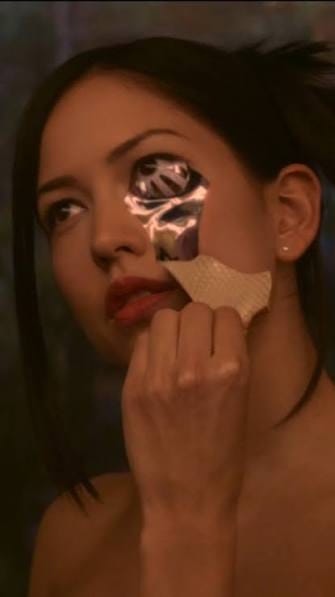
Nathan designed Kyoko as the perfect subservient woman. Although Ava is locked inside a room because Nathan fears what she might do, Kyoko roams freely through his home. Nathan has no fear that she will escape because he believes she is perfectly obedient.
Nathan also treats the two robots differently. He speaks to Ava more like a real person while dismissing Kyoko. Kyoko is supposedly an inferior robot model, but she exists to satisfy Nathan’s physical needs. Ava is the technologically advanced ideal whose consciousness matters. Kyoko’s consciousness is irrelevant.
On the other side of this same racial hierarchy, Asian women have often been presented as the sexual ideal in movies such as The World of Suzie Wong, where white women are characterized as too aggressive, difficult, or annoying compared with the supposedly docile and submissive Asian woman.
Because of the Asian fetish, white women and Asian women are frequently pitted against each other, both in real life and in popular media. The men who produced, directed, and wrote Ex Machina could have cast a woman of any ethnicity as Kyoko. Still, popular culture repeatedly uses an Asian woman as its most immediate representation of a docile and submissive woman.
Ava is never shown unclothed, whereas Kyoko is frequently unclothed. Another Asian robot, Jade, played by Gana Bayarsaikhan, is also shown naked. Of the five robot women, the two designed most explicitly for sex are Asian.
The messaging is difficult to ignore. Asian women represent only a small percentage of the overall female population, yet we appear disproportionately in stories pairing us with white men using us for pleasure.
In an interview with Ron Gluckman, referenced by scholar Sharon H. Chang, Ex Machina writer and director Alex Garland discussed his longstanding fascination with Asia. Garland also wrote The Beach, which became a movie starring Leonardo DiCaprio, and his novel The Tesseract is set in the Philippines.
His earlier stories take place in Thailand and the Philippines, countries that hosted U.S. military bases during wars in which the most egregious and flagrant violence and objectification were inflicted upon Asian female bodies by American soldiers and other Western men. Garland lived in the Philippines for nine months. He also fell in love with Thailand as a teenager and told Gluckman that he had returned at least once or twice during most years since.
His personal history does not prove why he made Kyoko Japanese. But viewed alongside his repeated use of Asian countries as settings for white protagonists’ adventures, the choice deserves scrutiny. What was it about these countries that fascinated him so deeply?
That Kyoko is written intentionally as a Japanese sex bot reveals all I need to know.
Kyoko perfectly represents how Asian women are expected to act in Western society. She is only programmed to speak Japanese and cannot communicate with Caleb in English. She never speaks a word in the movie.
Her voicelessness evokes Asian women who are gaslit and silenced when we identify the Asian fetish as a problem. It also evokes the unseen violence inflicted upon Asian female bodies around U.S. military bases during World War II, the Korean War, and the Vietnam War. Kyoko’s inability to communicate is not a problem for Nathan; it's desirable. Her feelings do not matter to him.
In one stunning scene, Caleb finds Kyoko alone and tries to ask her where Nathan is. Because she does not understand English, she does not reply. Instead, she automatically begins taking off her top. Caleb frantically tries to stop her, but she continues until Nathan enters. Nathan tells Caleb that he should dance with her instead of wasting his time trying to talk to her.
Nathan has programmed Kyoko to love dancing. He turns on music, and Kyoko immediately begins robotically swaying her hips, gracefully tossing her arms, and kicking her legs while wearing nothing but a flimsy white T-shirt. The dance is mesmerizing, synchronized, and perfect. It becomes even more enthralling because of the blank expression on her face.
To me, the scene feels like a nod to Asian women living under the programming of internalized racism: performing, dancing, and gyrating for white men without even recognizing the forces that taught us to do so.
Of every race the robot could have been, why is she Asian? Because Kyoko exists purely for Nathan’s pleasure. Asian women are the ultimate symbol of this type of self-sacrificing femininity. Add the sexual connotations frequently attached to the word “exotic,” along with the fact that Kyoko is programmed only to speak a language her programmer does not understand, and it’s obvious that nothing about her matters beyond her body and its ability to please him.
This is the same message repeated in stories such as Madame Butterfly and Miss Saigon. In Madame Butterfly, Cio-Cio-San, the Asian lover of the American soldier Pinkerton, gives up everything for him, and it is still not enough. After he is finished with her, Pinkerton returns to the United States and marries a white woman. Cio-Cio-San ultimately kills herself so that he can have their son. After being disposed of by her white lover, she disposes of herself. We are still repeating these patterns today.
Growing up, these messages shaped my understanding of how Asian women were supposed to behave. They influenced me to become a pin-up model and alter myself to please men. I wonder whether other Asian women have felt and behaved the same way.
Or was it just me?
In Ex Machina, when the Asian robot Jade resists Nathan, he decommissions her and replaces her with a newer, supposedly more obedient robot: Kyoko. This sends the message to women that if they stop performing the fantasy, another version can take her place.
That was what hurt when I saw the woman Liam married. Whether he actually viewed me that way, I felt as though I had occupied a category rather than a singular place in his life.
Blonde Asian model. One version could be replaced by another.
A similar fantasy appears in the television series Humans. A family purchases Anita, played by Gemma Chan, an attractive Asian female robot who cooks, cleans, and cares for their children. She is also treated as sexually available to her owner.
The details change, but the fantasy remains the same.
A housekeeper, caregiver, and sexual partner without possessing the needs or rights of any of those women.
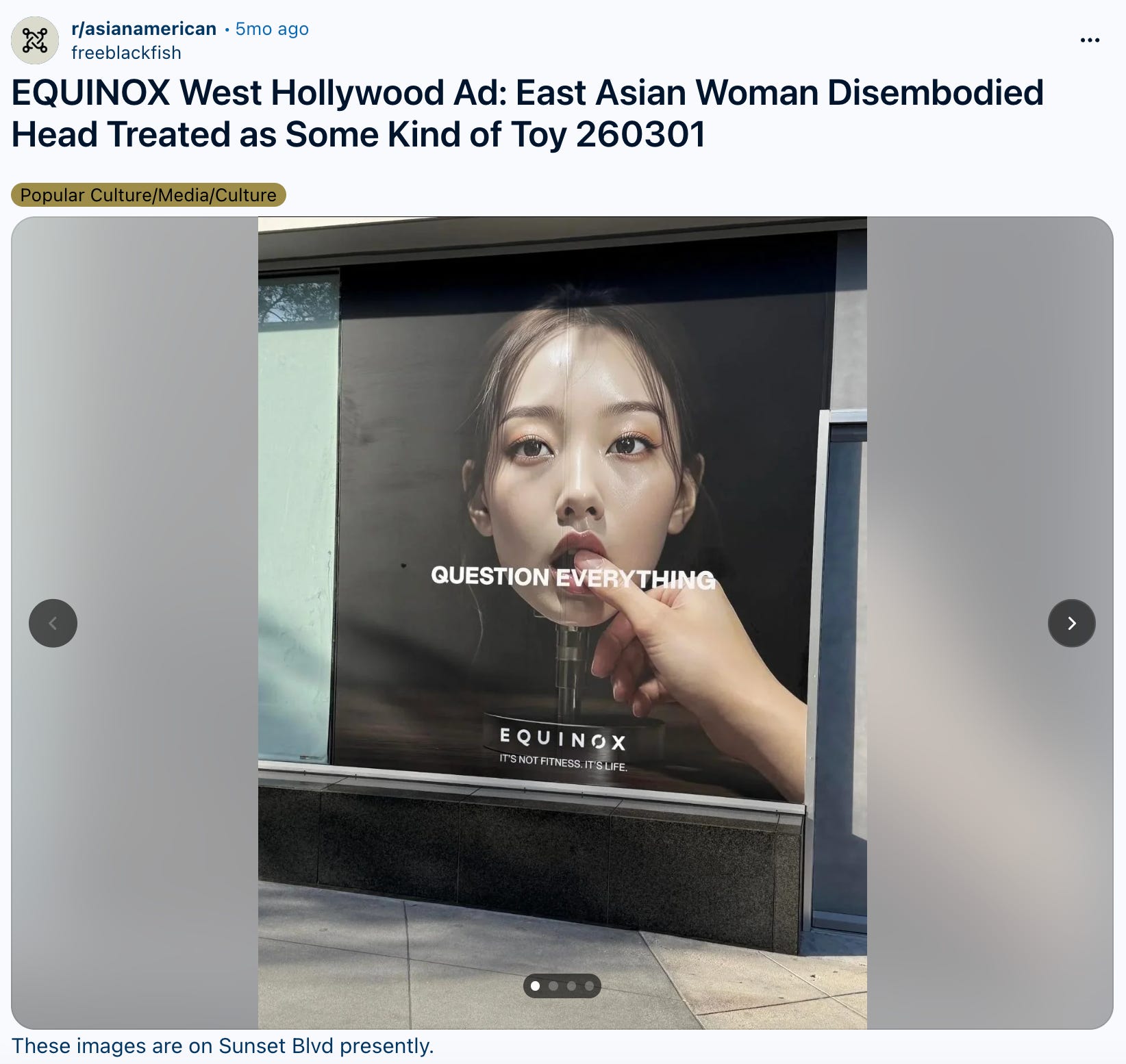
The Asian woman’s head is speared onto a stand. A finger is inserted into her mouth by an anonymous hand. She is completely powerless to resist. What makes the image even more striking is that the non-Asian people photographed for the campaign give off an entirely different feeling. Some of those images may be strange, provocative, or sexualized, but they remain sexualized in a recognizably human way.
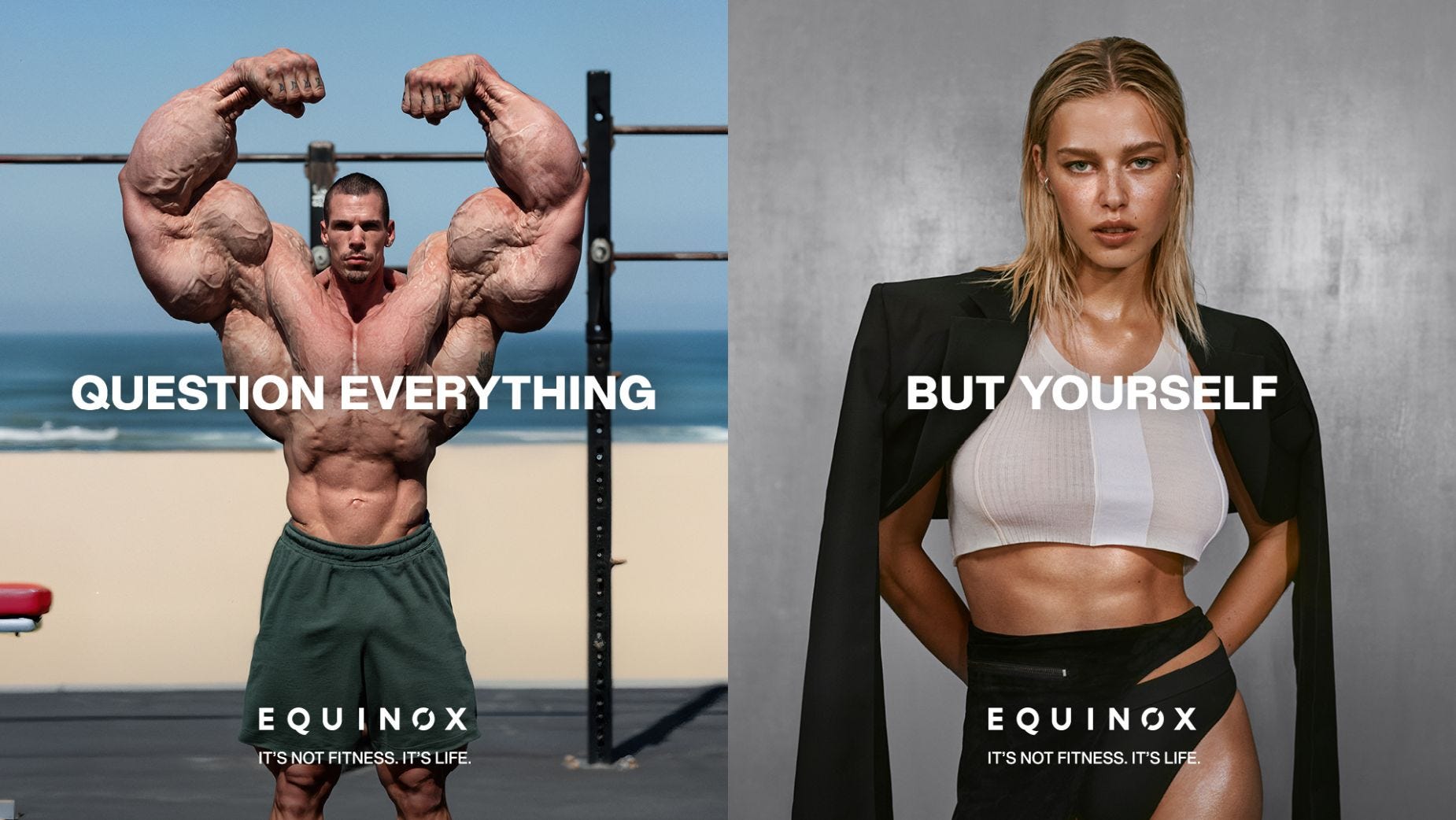
Look at this photograph and then look at the Asian woman’s disembodied head. Do you think they belong in the same advertising campaign? The objectification of women is not unique to Asian women. Women of every race are routinely reduced to parts for male pleasure.
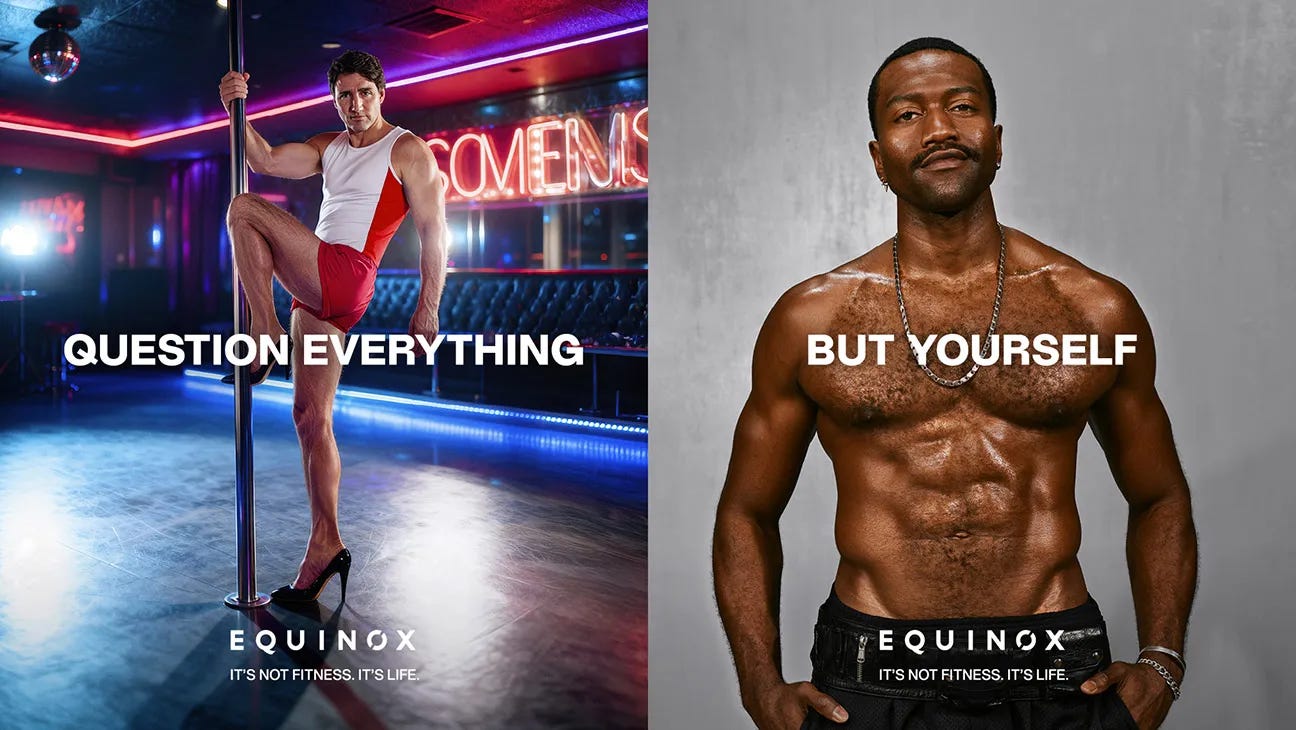
The Equinox advertisement does not invent those stereotypes. It modernizes them.
Western science fiction often imagines robots as dangerous forms of superintelligence. Think of Terminator 2 and its vision of machines as physically powerful threats capable of destroying humanity.
Asian female robots are typically portrayed so differently. They are imagined as obedient and vulnerable. They aren’t machines coming to dominate us. They are the machines men would love dominating.
Bow once showed a U.S. military man two images: a drone and an Asian female humanoid robot. She asked him a simple question. If robots in the real world look more like the drone, why do we keep imagining them as the woman?
He answered instantly, “So you can fuck ’em.”
In one sentence, he explains it all.
No posts
Comments
Nothing yet. Say the first thing.
Sign in to join the conversation.