

Earlier this month Levent Alpöge, a mathematician at Anthropic, went viral when he posted a counterexample to the Jacobian conjecture. His tone was so casual that the non-mathematician may miss out on the fact that this conjecture was posed in 1939 and remained unresolved despite many attempts by serious mathematicians (see Wiki). This is not the first time AI has solved serious math problems (e.g., an OpenAI model recently disproved a famous conjecture in discrete geometry), and it won’t be the last time either.
This viral post inspired a ton of copycats, who combed technical fields in search of other unsolved problems, and fed them to their LLM of choice. Many got as far as reaching out to researchers in search of collaborations, e.g., see below:
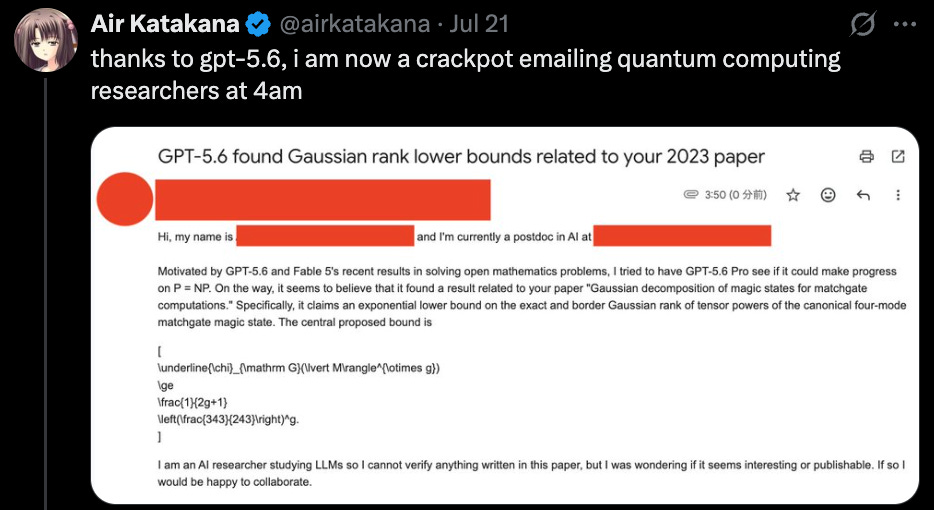
People that reach out to research institutions with crackpot ideas have always existed. What is new is that modern AI can produce infinite amounts of correct or plausibly-correct mathematics. I believe this will overwhelm our current funding institutions (government, industry, or private capital), as now nearly anyone can submit a plausible-sounding research proposal. Therefore, investors will demand to see more practical and easily understandable results before funding anything. Here is my concrete reasoning chain:
AI can generate infinite amounts of seemingly plausible text, e.g., mathematics papers or research proposals.
Institutions in charge of validating the importance of such texts (e.g., government funding agencies) will be completely overwhelmed. Anyone can now generate plausible-sounding AI slop.
Therefore, there will be an increased demand for “reality certificates”: easy-to-parse artifacts that certify a text as worth spending money or attention on.
Here are the two forms of reality certificates I predict:
Demonstrations. A clear example of the theoretical work in action. For example, a video of a robot performing a maneuver that simply wasn’t possible before. It could also be something tangible like a company or a product (that sells).
Reputation. Papers/proposals will only be looked at if written or recommended by someone with a “good” reputation. This may keep relatively unknown people from ever getting a shot at showcasing cool ideas (unless they can make a compelling demo).
I anticipate this will increase the importance of common sense. In a future with ultra-capable AIs that can build almost anything on demand, people and markets will reward those who have a keen sense for what’s worth building. It’s hard to produce a compelling demo of your product/theory/idea if you don’t have a sense for what people need, consciously or unconsciously.
I also anticipate that concise communication skills will be a major bottleneck. Now that anyone can use AI to generate infinite amounts of propaganda, only those who can communicate extremely concisely and clearly will cut through the noise.
Post 36 out of 100
No posts
Comments
Nothing yet. Say the first thing.
Sign in to join the conversation.