

Today I was reading about Albert Einstein and how he discovered the general theory of relativity. I learned that his first concrete steps towards it happened in 1907, when Johannes Stark commissioned him to write a comprehensive review of relativity. Just relativity, not general relativity—that came later. Anyways, Stark’s name caught my eye so I dug into his Wikipedia page.
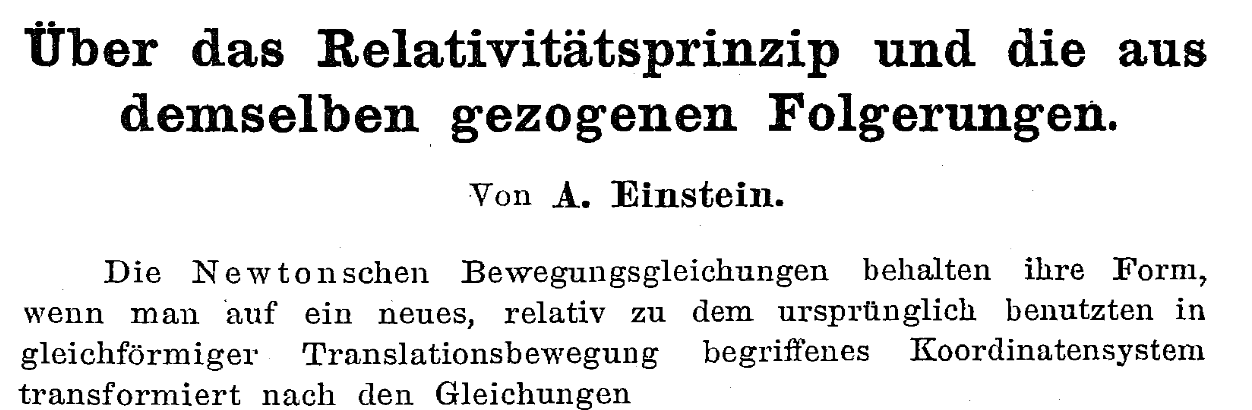
Johannes Stark (1874-1957) was an accomplished German physicist who, among other things, was the editor-in-chief and founder of a journal where Einstein published a landmark survey that expanded his theory of special relativity to accelerating frames of reference (which eventually led to general relativity).
For his contributions to physics, Stark received a Nobel Prize and a variety of other awards, including a crater on the moon named after him. That is, until 2020, when the chair of the Task Group for Lunar Nomenclature dropped his name when he found out that Stark was a Nazi sympathizer.
Reasonable, right? Nazis are bad, right? Yes, they are. My issue is with the retroactive renaming of things. I think more things should be named after bad people. Things named after bad people are a reminder that we once celebrated values we’ve since changed our minds about. They’re a reminder that we sometimes make pretty serious mistakes. And more importantly, these things can serve as a celebration of the ideas and institutions that allowed us to correct our mistakes. Because the truth is that we will always make mistakes no matter how smart, rich, or sophisticated we are. And it is one of humanity’s greatest gifts that we have the capacity to do something about this.
A culture that focuses on past mistakes (and not on how we correct them) will foster some pretty bad behaviors. A few examples:
Innovation will slow down. If every part of my past is open to re-interpretation by future generations, I am less likely to try new and strange things (that could potentially lead to incredible benefits for humanity). Remember: Gutenberg’s printing press was sacrilegious when it was first invented.
It rewards sycophancy in our leaders. If the threat of retroactive punishment always hangs over our leaders, they will only do what is agreeable or legally bulletproof instead of what is right.
It breeds dishonesty. I guarantee every single one of us has a skeleton in the closet. If not by today’s standards, perhaps by the future’s standards. In a culture that never forgives mistakes, the only survivors will be those who hide them the best.
Note that every single one of these points will become much more serious, and much more applicable to everyday citizens, with the arrival of cheap and powerful AI. If you thought that the #MeToo witch hunts were bad, just wait until AI hacks into and scrutinizes every last bit of your digital life.
We will never stop making mistakes, and any culture that claims perfection will slowly rot from the inside as its shadow festers. So, let’s keep the things named after bad people, and use them to celebrate how far we’ve come. And then, study them to learn how to get better at error-correction. Because as David Deutsch puts it, “Without error-correction all information processing, and hence all knowledge-creation, is necessarily bounded. Error-correction is the beginning of infinity.”
Post 38 out of 100
No posts
Comments
Nothing yet. Say the first thing.
Sign in to join the conversation.