
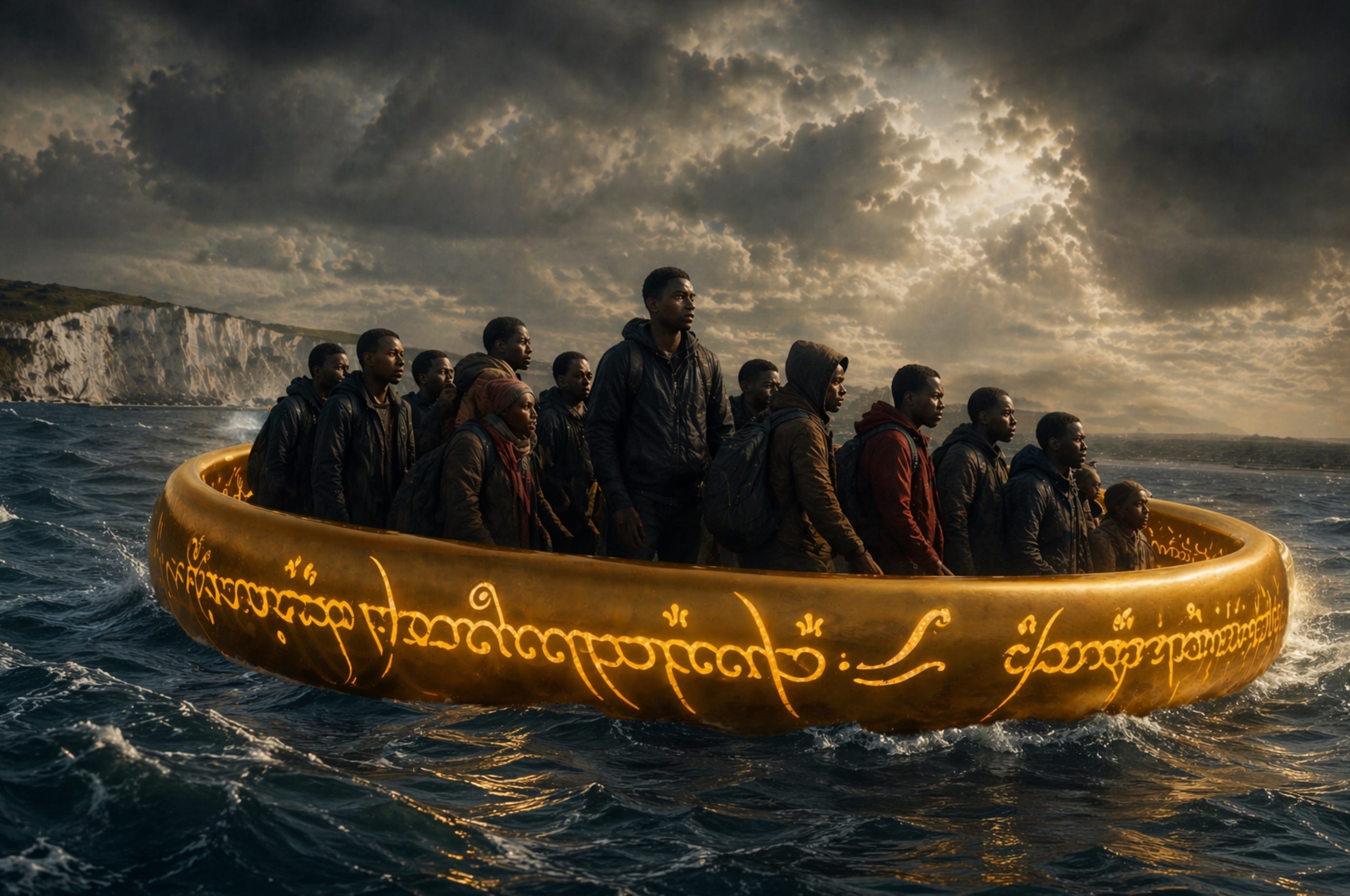
In JRR Tolkein’s The Lord Of The Rings, the One Ring crafted by the evil wizard Sauron is the key to all the Rings of Power. The wearer of the One Ring can control the nineteen other Rings (and, through them, their owners). This makes it both the linchpin of Sauron’s threat to Middle Earth and the key weakness of that threat. If the One Ring can be destroyed - the goal which pretty much the whole of Tolkein’s doorstep-sized novel is devoted to - most of Middle Earth’s troubles immediately go away.
I have to admit, it would be great if Britain’s many problems had a solution as simple as throwing a single small piece of jewellery into Mount Doom. Sadly no such easy way out is available - but that doesn’t mean our struggles don’t have a lot in common with Frodo Baggins’s. We might face many problems as a nation, but most of them - not all, but definitely most - can be traced back to one thing, one single malign element that, like the One Ring, corrupts and degrades everything it touches.
That element, of course, is mass immigration.
No, we don’t. In fact it’s the source of most of our misery.
Now, I know there are a few readers of my Substack who will be very angry with me for saying this, but that doesn’t make it any less true. It is simply a fact that many of our problems can be traced directly back to mass immigration, and that if we end mass immigration (and of course remigrate the people who should never have been allowed to come here) those problems will simply disappear. It’s true there are plenty other problems that aren’t linked to immigration, but if we can solve the ones that are we will be in a much better place as a nation. Personally, I think we can improve things enough that we’ll have a solid foundation to start fixing everything else that’s wrong.
But what are these problems that stem from mass immigration? Well, there are a lot of them. Let’s make a start on a list, shall we?
There’s no reason why housing should be so expensive, or in such short supply. After all, Britain has had no natural population growth for over five decades now. All we need to do is build 50,000 or so new houses a year to replace old ones that get demolished, and there should be plenty of homes for us all to live in. There aren’t, though - and we all know why.
Since Tony Blair took office on 2 May 1997 more than sixteen million people have immigrated to Britain. Not all of them have stayed, and of course a significant and growing number of native Britons have fled what our country has become, but immigration has still added well over eight million to the population in less than 30 years. To put this into perspective, more immigrants have come to Britain every year since 1997 than arrived in the one and a half thousand years up to 1945.
It’s no surprise we’re short of houses, is it?
Now, let’s look at why house prices and rent have become so unaffordable. This goes back to one of the most basic ideas in economics, the concept of supply and demand. Quite simply, in a free market prices are set by the interaction of how many people want a thing and how much of that thing is available. When supply exceeds demand, prices go down. When demand exceeds supply, on the other hand, prices go up. When the number of people willing to pay the new price equals the number of items that are available, price reaches equilibrium:
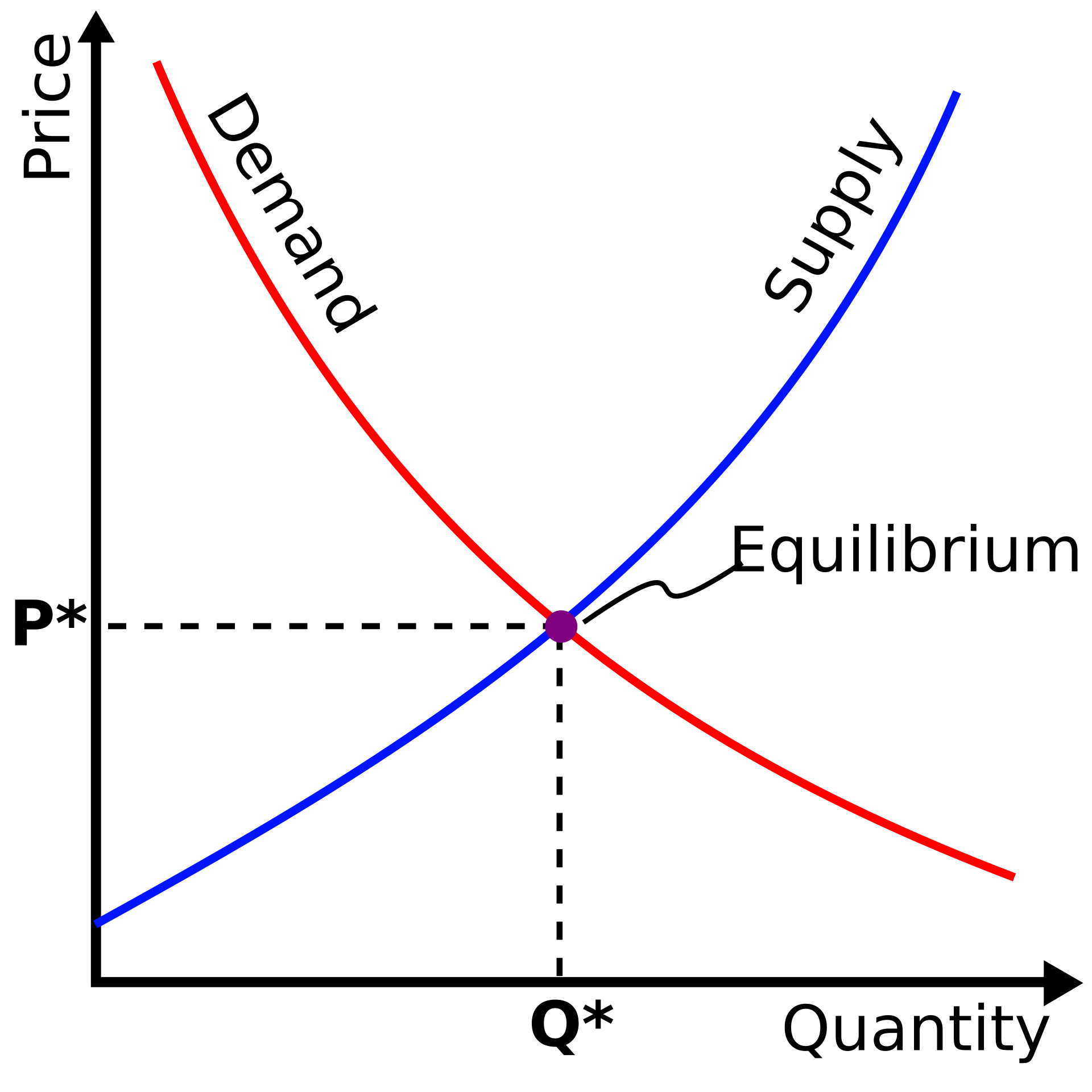
The problem with housing is that demand for it is what economists call inelastic. People can’t just decide they don’t want a home because it’s too expensive. We all need somewhere to live; it’s not like the latest iPhone, where if the price is too high we can just decide to do without it and order a refurbished Samsung Galaxy from Amazon for £39.99 instead. This inelasticity means the effect of excessive demand on price can ramp up really dramatically.
Starmer’s government says it wants to build millions of new homes to take the pressure off the housing market, but it’s never going to happen; they’re already hopelessly behind schedule. Anyway, why should we concrete over our countryside just to build houses for people we never wanted here in the first place?
And make no mistake: Immigrants are having a huge impact on the supply of housing. In London, the 2021 census revealed that 48% of council homes - “social housing” as we’re now supposed to call them - were occupied by people born outside Britain. That’s 376,700 homes. Imagine the difference freeing up 376,700 homes would make to London’s ludicrously expensive housing market.
If immigrants need to claim council housing, they should go back to their own countries and claim it there.
We’ve already discussed prices and the concept of supply and demand. Now here’s a reminder of a little fact about wages that many people seem to forget: A wage is a price. It’s the price of labour. If there is an excess of available labour, the price goes down. If there is a shortage of labour, the price goes up.
What do you think happens to wages at the lower end of the market when you dump eight million immigrants - mostly unskilled third worlders - into a country with a workforce of just under 30 million? That’s simple. This happens:
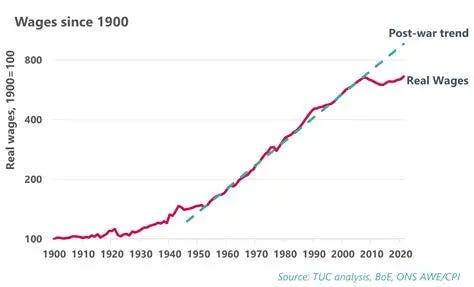
When businesses are struggling to find the staff they need, they offer more money to attract people away from their competitors - but when they have access to an endless supply of cheap immigrant workers, wages stay low.
Of course, governments love to interfere with this in various ways, such as by legally enforcing a minimum wage. Sounds good, doesn’t it? The problem is that businesses employ people because the labour they put in generates more income for the business. Right now it costs a business £14.65 per hour to employ someone on Britain’s £12.71 per hour minimum wage. If that employee generates less than £14.65 per hour in additional revenue, guess what? They get made redundant, because there is no reason to employ them.
If you want to get paid more, vote to protect our borders and deport low-skilled foreigners.
Britain’s benefits system is crushing the life from our economy. We currently spend over five times as much on welfare as we do on defence, and the cost of government handouts is spiralling out of control. A large, and growing, proportion of those handouts are going to foreigners and people of immigrant descent.
The scale of welfare spending is difficult to comprehend. In the last complete financial year we have records for, 2024/25, Britain’s defence budget was £60.2 billion. By comparison the government spent over £70 billion on health and disability benefits alone. The total welfare bill was a mind-boggling £313 billion - and by 2029/30 it’s predicted to rise to over £373 billion.
This level of benefits spending is a luxury we quite simply can’t afford. Last year the government borrowed £151.9 billion to fund its unsustainable spending spree. We’re now paying more than £100 billion a year just to cover the interest on the national debt; none of the major parties even pretend to have a plan to start actually reducing the debt itself (and, contrary to the ravings of the Modern Monetary Theory lunatics, it is a real debt).
It would be bad enough if we were borrowing ruinous amounts of money, handing it out to people who can’t work because they have “anxiety” then importing millions of foreigners to do their jobs for them, but in fact it’s a lot worse than that: Out of the 16 million immigrants who swarmed into Britain since 1997, under a fifth came on work visas. Many of those who did come to work are doing unskilled, low-paid and often frankly unnecessary jobs - let’s face it; would it kill anyone to pick up a kebab from the shop themselves, rather than paying £3.50 to have it brought to their door by a Bongolese on a bike? - and are eligible to claim benefits to supplement the low wages that were largely caused by immigration in the first place. Many more who came to work are in fact not working, and of course for every worker we have four dependants, students and other people who simply leech off our system without contributing to it.
Official data shows that the white British consistently have a lower unemployment rate than all other ethnic groups in this country. The unemployment rate among Pakistanis and Bangladeshis is three times that for the white British, and many of those who do work are solely serving their own “communities”, doing things that are of no benefit to the rest of us. Out of almost eight million people who currently claim Universal Credit more than a million were born overseas, and that million take almost £10 billion in handouts every year. This number is growing rapidly, turbocharging the unsustainable growth of the benefits bill.
Nobody is denying that there are many hard-working people from ethnic minorities who provide jobs, pay tax and contribute to what remains of Britain’s wealth; equally, nobody is denying that there are far too many white British people who could work but don’t want to. But, at a group level, the fact is it’s the white British who keep our economy more or less afloat - and all other groups are a drain on it:
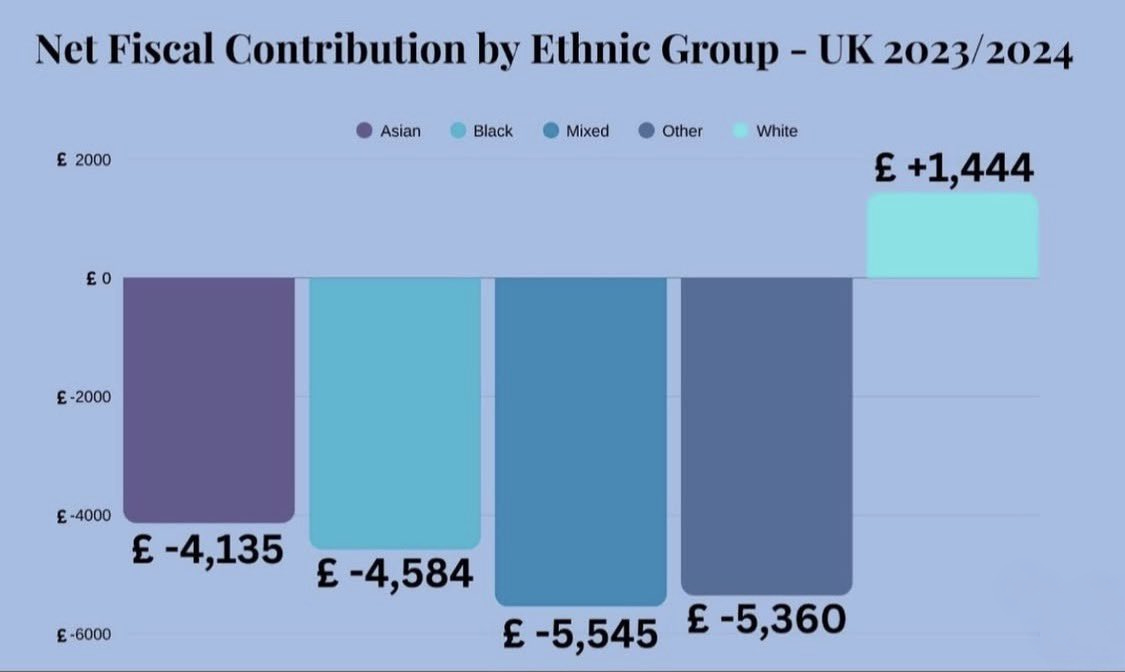
We simply cannot afford to keep paying out billions of pounds to people who come here from other countries, and there is no reason why we should. If immigrants can’t support themselves in Britain without claiming benefits, they should go home.
I can already hear the yelps of “Most crime is committed by white people!” Yes, it is. So what? That’s exactly what you’d expect in a country that, within living memory, was over 99% white. However, let’s not forget those magic words that lefties have so much trouble comprehending - “per capita”.
It is undeniable that immigrants and their descendants commit a wide range of crimes at a grossly disproportionate rate. Around 16% of the people currently in Britain were born abroad - in itself a shocking statistic; historically it has usually been 1-2%, most of whom were born in the British Empire. As bad as that is, though, foreigners and those of “unknown nationality” - so more foreigners, then - commit 23% of sex offences in this country. Afghans and Eritreans are particularly notorious in this category, committing sex offences at rates that are respectively ten and nine times higher than the white British. The same applies across other categories of crime, with Algerians 18 times more likely to commit theft than natives and Congolese almost twelve times more likely to commit violent crime. The league tables for every category of crime are dominated by third world nationals, with native Britons at or near the bottom:
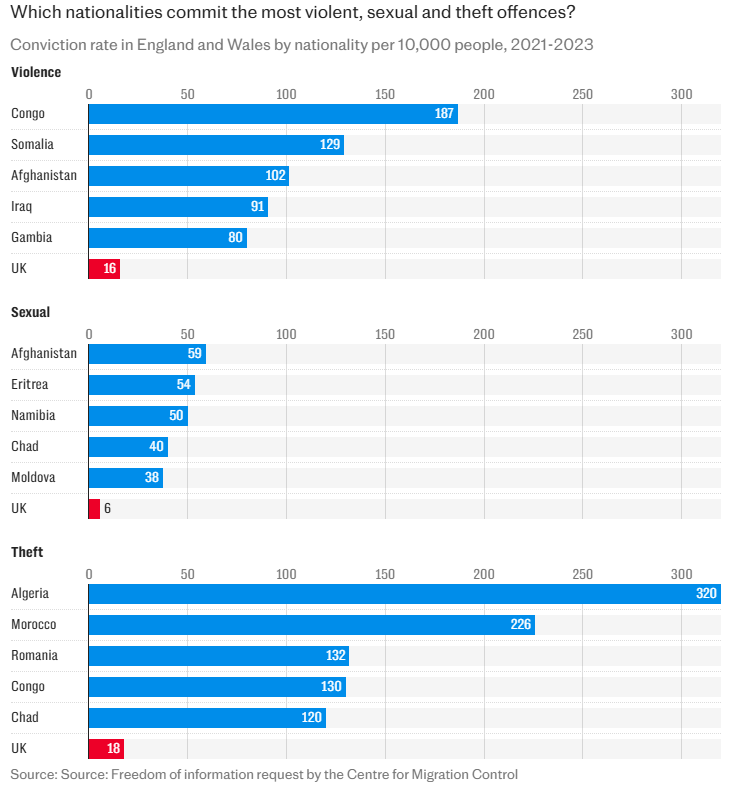
And before anyone starts squealing about racism, similar patterns emerge in every country that compiles statistics. Germany has also found a massive over-representation of foreigners in its crime statistics (A EuroFactCheck aimed at debunking claims they committed 60% of violent crimes ended up proudly proclaiming that the real figure was “only” 40%). The most detailed - and revealing - figures of all, surprisingly, come from famously liberal Denmark:
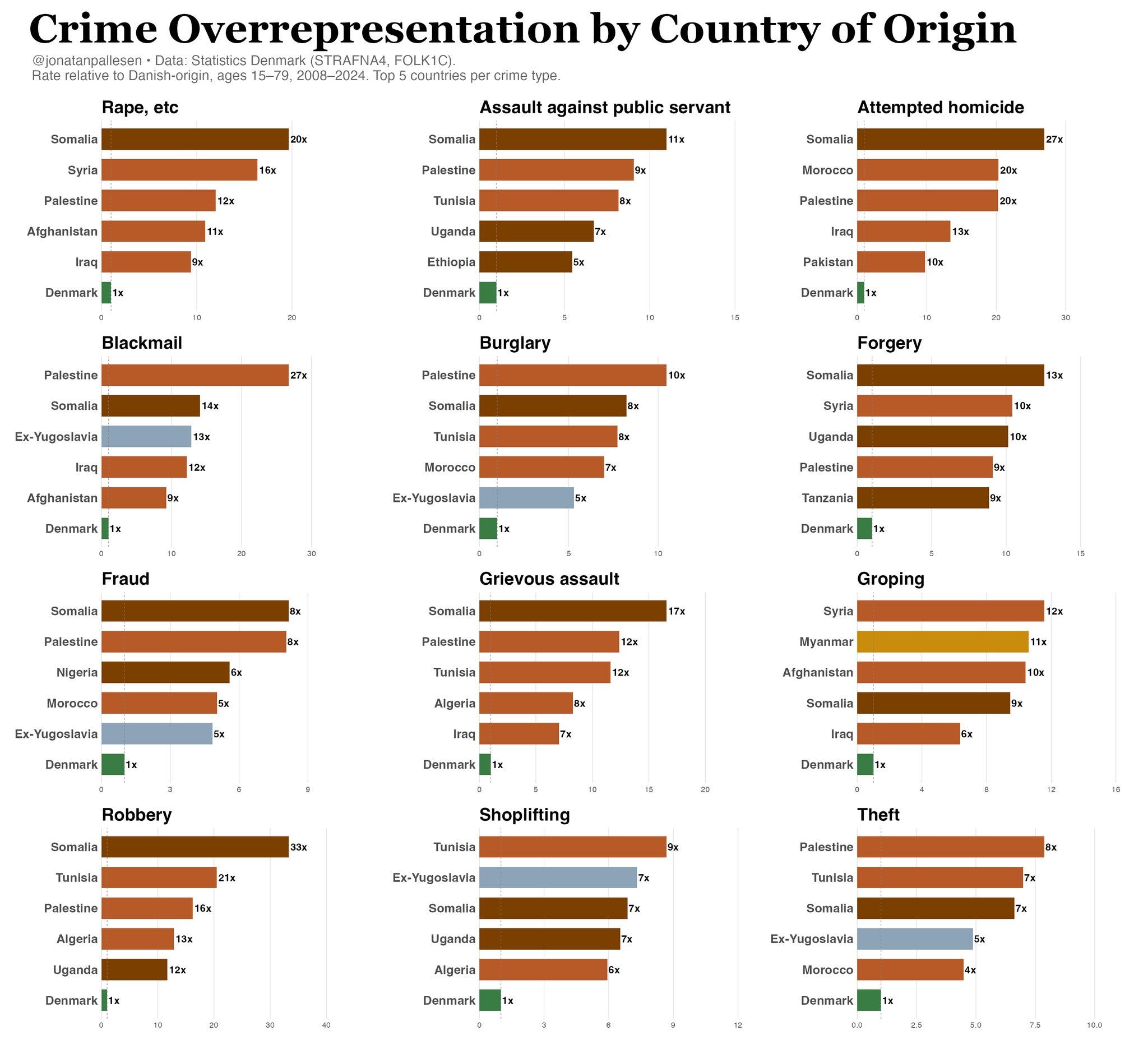
We have police and a justice system because crime occurs in every society - but as I’ve never heard a persuasive argument that the native British don’t commit enough crime, it is senseless and harmful to import more criminals. It is morally repellent to then let those criminals stay in our country because of trivial arguments about their “human rights”. Nobody has a right to come here and break our laws.
Britain is no stranger to terrorism. It took us over 30 years to defeat the Provisional IRA (and yes, we did defeat them; that’s why they’ve disarmed and disbanded, Northern Ireland is still in the UK and the Republic of Ireland amended its constitution to give up its long-standing claim on the North). Now, though, terrorism in Britain overwhelmingly means islamic terrorism - and that is an entirely imported problem.
There are currently just over 43,000 people on Britain’s optimistically-named terrorism watch list (we don’t have the resources to actually watch more than a tiny fraction of them) and more than 90% of those people are muslims. Of 104 people who have died in terrorist attacks in Britain this century, 101 were murdered by muslims. The government and media can scream about the largely imaginary “far right” threat as much as they like, but if we hadn’t imported Islam and millions of its adherents terrorism would have largely disappeared in this country with the defeat of PIRA.
Today, we suffer under increasingly oppressive security measures - and run the risk of being blown up or stabbed by some screaming maniac - because mass immigration has brought foreign ideologies and foreign conflicts to our shores.
I was born in 1970, in a country that was still upwards of 97% white British. I grew up surrounded by people who shared a common history and culture with me. While the 56 million people who lived in these islands back then had a wide - one could even say “diverse” - range of opinions on politics, sports, music and everything else under the sun, the vast majority of us were all steeped in the same traditions of democracy, free speech (remember how, when someone said or did something outrageous but not illegal, the inevitable defence was “It’s a free country”? When did we stop saying that?) and respect for our national institutions.
Just look at the mess we’re in now. From a nation dominated in every respect by its own people, and therefore able to comfortably absorb a small number of immigrants, we’re already well down the road to being a patchwork of ethnic tribes. I should note that, historically, this is not the norm. Most countries throughout history have been completely dominated by a single ethnic group: The French in France, the Japanese in Japan, the Persians in Persia and of course the British in Britain.
History also tells us that multiethnic - I’m going to say “diverse” again - countries are where most of the trouble starts. Here are a few examples:
Bosnia is a multiethnic country, and the diversity it’s been cursed with by history caused not only its own genocidal civil war in the 1990s but the War To End All Wars itself; Gavrilo Princip shot the Archduke of Austria-Hungary in 1914 because, as an Orthodox Serb, he didn’t want to be ruled by Catholic Austrians.
Lebanon is a multiethnic country; once the last remaining majority-Christian country in the Middle East, it was torn apart from 1975 by a fifteen-year civil war started by its growing muslim minority and the Palestinian refugees it had foolishly accepted. Now it’s a weak state whose puppet strings are pulled by a strong Iranian-backed terrorist group, Hezbollah, which is using it as a weapon against Israel - with, of course, horrible consequences for the luckless Lebanese people.
Rwanda is a multiethnic country. In four months in 1994 one of those ethnic groups, the Hutu, chopped up hundreds of thousands of Tutsis and other ethnic minorities with machetes. Why? Economic jealousy, historical rivalry and a generous helping of “because they could”. Somewhere between 520,000 and a million people died. The actual death toll is vague partly because of the poor record keeping endemic in the third world, and partly because many victims were so badly mutilated (and sometimes partly eaten) that it was impossible to count the dead. In fact the 1994 genocide was just the most prominent act in a long history of inter-ethic violence in Rwanda. Rwandans seem very enthusiastic about chopping people up - and, of course, we all saw the horrific consequences of allowing knife-obsessed Rwandans into our own country in the 2024 Southport massacre.
Iraq is a multiethnic country. As soon as Saddam Hussein’s brutal grip loosened in the aftermath of the 1991 Gulf War, a three-sided ethnic war broke out between Sunni Arabs, Shia Arabs and the Kurds. In 2003 this escalated into an anti-Sunni genocide by the Shia majority (when people say a million people died in the 2003 Iraq war they leave out the fact that 95% of them were slaughtered by their fellow Iraqis). The rise of ISIS expanded the killing to Christians, Yezidis and other minorities.
Britain is now well on the way to becoming a multiethnic country along the lines of Bosnia or Lebanon. We already have ethnic enclaves where the native British have almost entirely disappeared, and where the cultures - and often laws - of foreign lands dominate. The effect of this on social cohesion is obvious; increasingly the British and those our politicians have inflicted on our home live separate lives. We don’t understand each other, and language barriers make it more and more difficult to even talk to each other; in the space of my lifetime the number of people in Britain who speak English as a second language has rocketed from almost none to around six million. There are now at least two schools in England where not one child is a native English speaker. Now we see political parties issuing election leaflets in foreign languages that discuss sectarian, imported issues with no relevance to the British people - who can’t even read them anyway.
We are turning into a balkanised nation. As someone who was sent to the Balkans with a rifle in my hands three times to sort out the mess, I feel qualified to say that this is not a good direction to be going in.
And, at last, we can get back to the One Ring. Famously, if this doom-laden trinket was held in a fire, a glowing inscription would appear round its circumference. It was quite a hard inscription to read, what with being written in a wholly fictional script that Tolkien invented, but it certainly looked suitably dramatic:

Translated into English, it reads:
One ring to rule them all,
One ring to find them.
One ring to bring them all,
And in the darkness bind them.
The uniparty’s dismal One Ring of mass immigration is doing its job; it’s bringing them all, and in the process plunging Britain into darkness. If we’re going to rescue our country from the abyss of diversity, there is only one way out: Mass immigration must end.
At the next election we have to make stopping, and then reversing, the influx of foreigners our top priority. If we can do this, we can fix all the other problems later. But if we don’t do this then Merry’s grim warning, of the consequences of failing to destroy the One Ring, will come true:
The fires of Isengard will spread. And the woods of Tuckborough and Buckland will burn. And... and all that was once green and good in this world will be gone. There won't be a Shire, Pippin.
Well, I think the Shire is worth preserving.
Thanks for reading Fergus’s Substack! This post is public so feel free to share it.
No posts
Comments
Nothing yet. Say the first thing.
Sign in to join the conversation.