
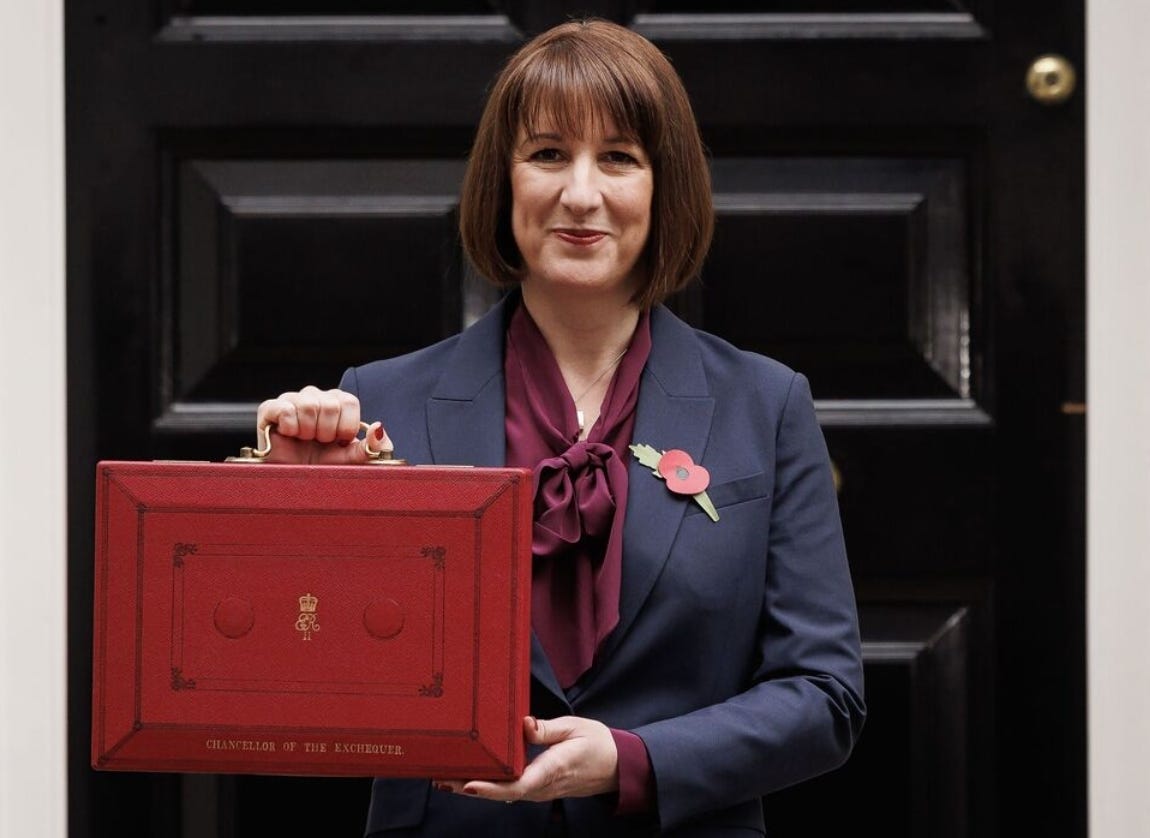
Our current government didn’t get off to a great start, and last November’s appalling budget pretty much drove a stake through the heart of Starmer’s hopes of re-election in 2029. A dismal combination of fiscal incontinence, political cowardice and poorly hidden spite made Rachel Reeves’s first attempt at rearranging the economic deckchairs one of the worst in living memory. Unbelievably, though, her second attempt was even worse.
There was a lot of bad news in last week’s budget. Reeves introduced a slew of new taxes on things as diverse as mansions and milkshake, and pushed existing ones to the breaking point and beyond. In total she plans to strip an additional £26 billion out of the economy over the next year, although it’s unlikely her clumsy grab will actually raise anything like that. In fact there was so much bad news that I’m not even going to try to cover it all in one post. Instead I’m going to focus on just one thing - the extension of Rishi Sunak’s vile freeze on income tax thresholds, and particularly how it interacts with the minimum wage.
Now, minimum wages are a complicated subject and I should probably dedicate a post to them at some point, but they do destroy jobs if they’re set at an inappropriate level. The short (and grossly simplified)1 version is that if the minimum wage is £12.21 an hour, and a worker doesn’t generate at least £12.22 an hour in extra revenue, it quite simply isn’t worth employing them. The best way to raise wages isn’t by government diktat; it’s by restricting the labour supply, for example by cutting off the availability of cheap immigrant workers, so employers have to compete on wages to attract staff. However, I don’t honestly think Reeves’s decisions in this budget were about raising wages at all.
By increasing the minimum wage, Reeves is forcing employers to move more money into a place where it’s subject to income tax. And then, by extending the freeze on income tax thresholds for another three years, she’s plundering that money as much as she possibly can.
Worst of all, this stealth tax hits low-paid workers the hardest. Let’s take three typical taxpayers to analyse how Reeves’s tax grab will affect people:
Alice is a corporate diversity manager and earns £50,000 a year. She’s a higher rate taxpayer and currently pays £9,946 per year in income tax, including £4,920 at the higher rate.
Bob is an IT technician and earns the average wage of £36,972 a year. He’s a basic rate taxpayer and currently pays £4880.40 per year in income tax.
Charlie is a cleaner in an NHS hospital. He works 37.5 hours a week for the minimum wage, earning £23,809.50 per year. He’s a basic rate taxpayer and currently pays £2,247.90 per year in income tax.
In the budget, Reeves raised the minimum wage from £12.21 an hour to £12.71 an hour, an increase of 4.1%. Good for Charlie! Let’s assume that Alice and Bob also get a 4.1% pay rise. Now here’s the situation:
Alice is now earning £52,050 a year. Because the thresholds are frozen the amount she pays in basic rate income tax is unchanged, but she’s now paying £5,620 in higher rate tax. Her total tax bill has risen by £700.
Bob’s salary has increased to £38.407.85. Much to his amazement, despite being on the average salary he’s magically become a higher rate taxpayer since his income has risen past the frozen £37,700 threshold. He’s now paying £5,229.14 in income tax, including £203.14 at the higher rate. His total tax bill has risen by £384.74.
Charlie is working the same hours and now gets £24,784.50 a year. He’s still a basic rate taxpayer, paying £2,443.14 a year in income tax; his tax bill has risen by £195.24.
On the surface this seems fair enough; Alice has the highest salary and is paying the largest amount in extra tax. Charlie has the lowest income and pays the smallest amount in extra tax. Bob is in the middle. All good, right?
Wrong.
Let’s look at the percentage increase in the actual tax paid. If we do this a rather different picture emerges:
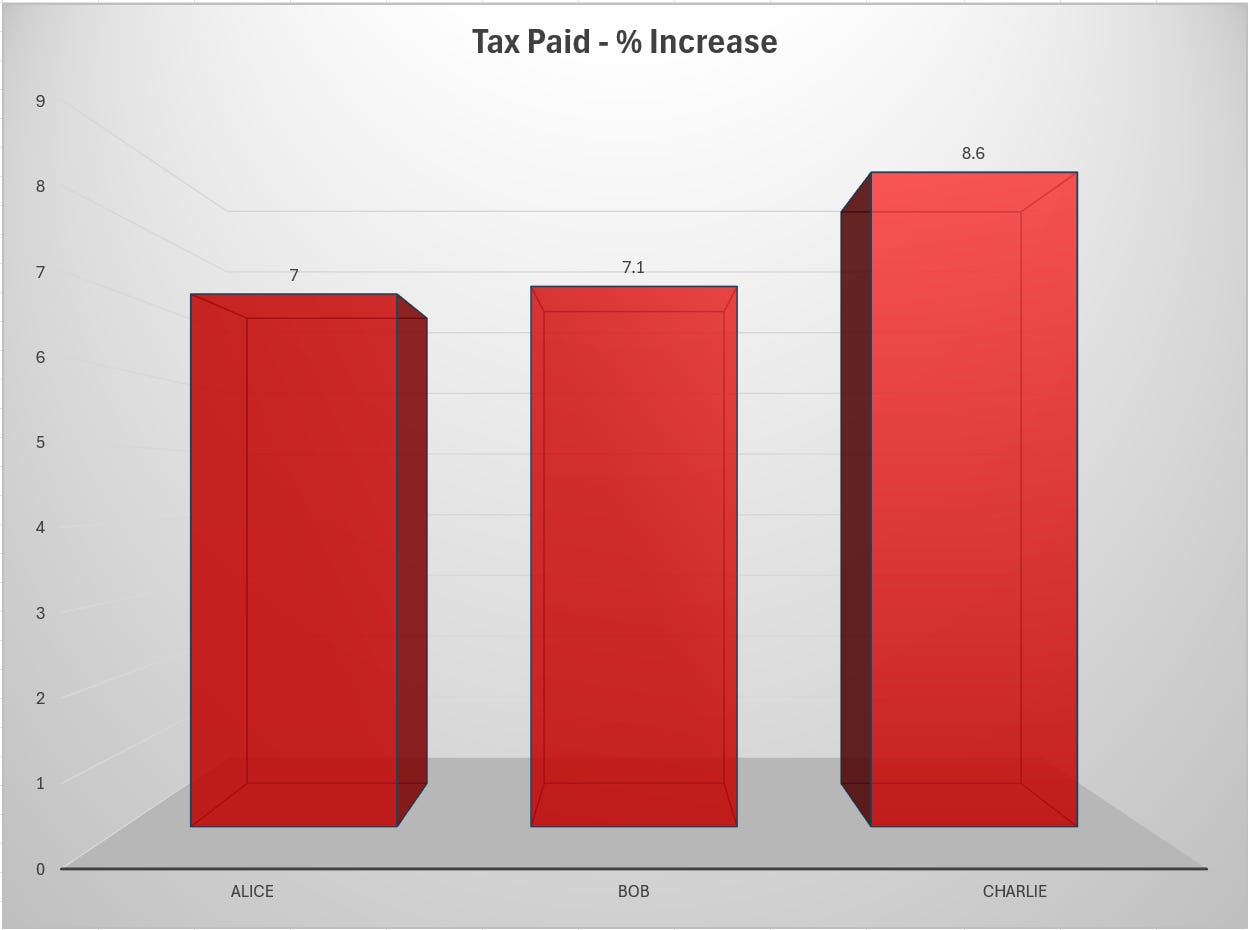
The amount of tax Alice pays has risen by 7%. Bob is facing a similar increase, at 7.1%. Charlie, on the other hand, has just seen his tax bill jump by a whopping 8.6%. The reason why, by the way, is quite simple: The frozen threshold pushes a higher percentage of Charlie’s modest income into the taxable bracket.
Reeves’s budget hits the lowest-paid workers the hardest. Those on the lowest incomes are seeing their tax rise much faster than higher earners. And Reeves must have known this would happen.
Any remaining claim that Labour had to be the party of working people has just gone right out the window. The reality is that Labour is now the party of well-paid public sector employees and benefit claimants - it’s worth noting that while the minimum wage will rise by 4.1% next April, Universal Credit will rise by 6.2%.
So Bob and Charlie, who are actual working people (and therefore probably support Reform UK), bear the brunt of Reeves’s tax raid; Alice, the leftie diversity manager, faces the smallest tax increase. And don’t even get me started on Daalmir, the unemployed mother of six from Somalia, who isn’t just getting a whacking great UC increase of one and a half times the minimum wage rise but can now claim child benefit for an additional four kids, too.
And, worst of all, this was all deliberate. Before the budget, and in her speech, Reeves claimed there was a hole in the public finances and said she was “asking ordinary people to pay a little bit more” to fill it. She insisted that “those with the broadest shoulders” would bear most of the load - which will be news to Charlie, as he looks at Alice’s new car - and says she’s asked “everyone to contribute” (except Daalmir and her kids, of course).
But none of this was true. There was no hole that needed to be filled; weeks before the budget the OBR, the government’s finance watchdog, had informed Reeves that she had more money to play with than expected. Instead, she briefed that the OBR had downgraded productivity estimates and forced her to push taxes to a new record high. That was a lie, and it was a lie made with a single purpose in mind - to buy off Labour’s new non-working support base with yet more increases to the bloated benefits bill. Workers, especially the lowest paid workers, are suffering unnecessarily so Reeves can spaff their hard-earned money on more handouts (including over £10 billion to foreigners who shouldn’t even be here; if immigrants can’t support themselves in Britain without benefits, they should go home).
Even by the abysmal standards of Starmer’s government this is an unparalleled scandal. Reeves must go. Starmer, who knew she was lying about the state of the economy, must go too. And we must be given the chance to choose a new, more competent, government at a general election.
Thanks for reading Fergus’s Substack! This post is public so feel free to share it.
In reality, once you figure in the cost of Employer’s National Insurance Contributions, pension scheme contributions and other non-wage costs, a minimum wage employee has to generate something over £16 an hour in extra revenue to be worth employing.
No posts
Comments
Nothing yet. Say the first thing.
Sign in to join the conversation.