

This in-depth travel report covers the 14th episode of wildlife travel by Henriette and Ferdy.
Our latest journey marks our 4th visit to Colombia, making it our most visited destination. For the interested, here are the travel reports of our earlier tours in Colombia from 2016, 2017 and 2018:
Why Colombia again?
Colombia prides itself for being the country hosting the most bird species in the world. Whilst this is appealing to birders, I believe this still undersells Colombia as a top notch destination for natural exploration.
The reason Colombia hosts so many bird species is its spectacular geography. It has coast lines along both the Atlantic and Pacific oceans and contains a large section of the Andes mountain range. This dramatic geography gives rise to a wide array of natural habitats, including the Amazon basin, cloud forests, wetlands, mangroves, coasts, islands, plains and the high altitude ice-cold Páramo tundra.
Once you connect the birds statistic with its underlying reason, habitat diversity, the underselling becomes clear. Colombia isn’t a birding hot spot. It’s an everything hot spot. It ranks #2 in amphibians, #1 in butterflies, #3 in plants. Even in categories where it doesn’t lead, it scores very high: #7 in reptiles, #6 in mammals.
That’s why we keep coming back. Habitat and species diversity across all categories in a country that is relatively unexplored.
Trip approach
Our approach for exploring Colombia is the same as in previous trips, because it works. Basically, we’re hitchhiking on a birding tour to put us in places where we’ll discover (and photograph) birds plus anything else we run into.
We once again put our trust in Manakin Nature Tours as our operator in combination with another critical ingredient: super guide and friend Manuel Espejo. In practice, this formula leads to a typical day as follow:
- Birding by day (very early morning session, late afternoon session).
- Sometimes owling by night.
- Macro photography (my passion) of insects, amphibians, and other small wildlife by night.
- Moth photography by night on locations where it’s possible. We bring a mobile moth light trap.
- Piggybacking on Manuel’s personal obsession with miniature orchids and carnivorous plants.
This multi-category approach is intense, but highly rewarding.
Trip challenge
Whilst our proven formula to explore Colombia’s biodiversity to the maximum would never bore us, we still challenged Manakin Nature Tours to give us extra reasons for a revisit.
They accepted the challenge and came up with a creative program that significantly differs from our previous visits:
- Rarely visited locations as well as more locations. To cope with the extra transit overhead, our trip is 4 days longer than usual.
- The trip includes a mini herping tour, with a dedicated herping guide (herping is the discipline of finding (rare) reptiles and amphibians).
- The trip emphasizes rare wildlife over maximum wildlife. Quality over quantity. Whilst we still aim to see and capture as many species as we can, there’s more deliberate effort in finding very specific birds and amphibians found only in specific locations.
Trip program

Our trip program is complicated and somewhat mysterious. It’s hard to find meaningful details about some of these locations as they are rarely visited and the program was revised multiple times. Basically, we barely had a clue about what awaited us even upon arrival.
With the trip behind us now, we can bring some order to chaos by summarizing the journey into 3 parts:
- Seeking rare birds (and other wildlife) in the Caquetá department, South Colombia.
- Herping in the Pacific/Chocó natural region, West Colombia.
- High altitude exploration in the Central Andes region.
Warning: This trip report is extensive. It serves to persist our memory, and is still only a summary of an eventful trip. Should you want to wade through it but feel overwhelmed, it can be read a few days at a time, or in 3 parts:
- Amazon (Sep 4- 12)
- Herping (Sep 13–20)
- Central Andes (Sep 21–30)
With all of this out of the way, it’s time to go to the day-by-day of our most adventurous, memorable, and absurd trip ever.
September 4
The day before our departure. A few weeks earlier, we had Henriette’s sister (Astrid) and her teenage son (Ramon) over. I half-jokingly said to Ramon:
“Wouldn’t it be cool if you’d have your own house? You can game as much as you want, eat what you want, have friends over. Imagine the freedom!”
It was a passing remark that I didn’t expect to be taken very serious, but they accepted. Everybody wins:
- Ramon gets his taste of freedom.
- We’re ensured somebody takes care of our cat, Shiva.
- Astrid gets to see her son do a trial-run of adult life, where freedom comes with responsibilities.
So on this day, they came over again for the transition. I even cleared out my man cave so that Ramon could make it his gaming room. After plugging in his PC, the regime change was completed.
We watched the F1 race together, had dinner, after which Henriette and I drove to Amsterdam to stay in a hotel close to the airport.
September 5
The day of our departure. Staying in a hotel near the airport is our standard approach for a stress-free start of a long journey, but stress-fee did not apply this year. We were first to clear a major hurdle.
Schiphol airport has been plagued by issues for months. Specifically, there’s a COVID-related worker shortage in security and luggage handling. This had led to queues so long that they sometimes extend outside the building. There’s a significant risk of missing your flight.
We got up at 5 AM and took the shuttle bus from the hotel towards Schiphol. We entered the queue 4 hours before departure, which is the maximum allowed time. This maximum makes sense, if you’d enter the queue even earlier before your flight, you’d be delaying passengers of flights you’re not on.
The departure hall was very crowded, the queue curling around it like a snake. We were first trying to make it to check-in, whilst already being checked-in. Normally we just need to drop of luggage, which on Schiphol can be done using self service machines, but all these machines were shut down.
After 2 hours in the queue, we did reach check-in. Next up in this Olympic effort just to get on a flight is the security and passport check. It seemed a short queue when starting it, but soon the snake curled around a corner into an entirely new hall of people waiting in line. Here too everything that could possibly speed things up, such as the 6 lanes of self-service passport checks (by iris scan), were disabled.
We saw people sweat and people with fragile health suffer. People were visibly agitated in this second queue, some desperately asking to skip the line as they were about to miss their flight, only to be sent back by staff who claim we’re all in the same boat.
We’re not all in the same boat. Some people in line have a flight in 30 mins, others in 2 hours. It doesn’t make sense to queue like this.
An additional hour later, we finally find ourselves in the clear, about 45 minutes before departure. We boarded. The captain announced that we would depart 10 minutes late because the luggage of passengers that are too late were to be unloaded. Five minutes later he announced that this was way too optimistic, the unloading would take 50 minutes instead.
Whilst we were happy to be on the flight at all, this truly angered me. These passengers were not too late, they made it to check-in before closing, otherwise their luggage wouldn’t be on the plane. The only reason they’re too late is because of the airport’s gross mismanagement of security and passport checks. Worse, this hour you spent on unloading their luggage would have been the hour in which they could still have made it.
Anyway, the flight departed an hour late. It was long but relatively comfortable. Henriette had invested in an economy plus upgrade using air miles and some cash, giving leg space relief. There were some decent movies to watch, wearing a mask was not mandatory, and food was good. We landed in Bogotá only 10 minutes later than planned.
Here we were to pass another hurdle: making it through immigration. Multiple queues from several international flights came together into a mega queue near immigration, which clearly was understaffed.
In the queue, airport staff goes by people to ask for proof of vaccination. The process, as we could hear from an American tourist nearby:
Staff: vaccination certificate, please?
Tourist: I don’t have any.
Staff: why not?
Tourist: I’m not vaccinated.
Staff: Oh. Ah well, carry on.
Why ask, if it doesn’t matter? In similar vain, Henriette had been worried about the so-called “MIG” form. A mandatory health declaration form you have to fill in before departure on some crappy website full of threatening language. In reality, nobody seems to care about it.
It took us two hours to get through immigration where in the luggage hall we could immediately pick up our luggage. We soon found our driver to bring us to the excellent Hilton hotel near the airport, where we found Manuel waiting in the lobby.
We were thrilled to meet him again. We put away our luggage, had dinner, and discussed the exciting journey ahead of us. We went to bed early. It had been a long and exhausting day, but the goal for the day was achieved regardless.
September 6
After a 6AM breakfast in the hotel, we were driven to the airport for a domestic flight to Florencia, the capital of the Caquetá department:

Caquetá requires some context, as even Colombians themselves frown upon visiting it. The department once was the very epicenter of the War on Drugs, and remains a hotbed of conflict, albeit very locally. It seems irresponsible to travel there, but there’s important nuances to be added:
- A lot has changed since the peace process of 2016. The area is rapidly turning from red (do not travel) to orange (possible but risky).
- Risk maps are simplifications, as conflicts are local. We’d limit travel to a single safe location under expert guidance.
- Conflict parties do not want to harm a tourist. It’s bad for business as well as politics. They just want to know about your visit in advance, as to not be surprised by strangers with cameras.
More on the security aspect later. We landed in Florencia at 10:45AM, where we soon met The Doctor. His real name is Jorge (I think), but everybody just calls him Doctor. He’s a neurosurgeon in Florencia’s hospital with hard-core birding as his passion.
This man, with an unmistakable raspy voice, is on a mission. He wants to develop birding and nature tours in the region. Not just because this is fun and the area is under-explored, also to uplift rural locals out of poverty and to give them peaceful opportunities to make a living.
From the airport, the Doctor drove us to a peculiar observation in downtown Florencia. A few years earlier, a bunch of men were drinking at an outside bar after which an owl chick came from the heavens and landed on the bar. It came from the tree above, where an owl was nesting.
Since then, the owl became a local celebrity and even made national headlines. The owl in question turns out to be a Black-banded Owl:

This beautiful owl has a large distribution throughout South America but is rarely seen. Here it is easy to locate, you just need to be lucky that it’s not obstructed or only showing its bottom.
We continued to our Florencia hotel, but our rooms were not ready yet, so the Doctor took us for lunch in town. After lunch and an additional 30 minutes of waiting, we could finally check into our room, which was enormous.
Florencia still was not our end destination but around 3PM the Doctor drove us to the outskirts of the city where some birding can be done, as an appetizer. We found ourselves in the last section of natural wetlands in the area as everything else had been drained and turned into agriculture. Even this wetland was on private land, the Doctor desperately trying to conserve it by paying the owner for visits.
Birds seen: Red-capped Cardinal, Scarlet-crowned Barbet, Blue-headed Parrot, Bat Falcon, Boat-billed Flycatcher, Yellow-rumped Cacique, Whistling Heron, Variegated Flycatcher, Spot-breasted Woodpecker, Yellow-crowned Amazon, Cinnamon Atilla, Yellow-browed Tody-flycatcher, Orange-fronted Plushcrown.
It was enjoyable and productive. Most observations were at a large distance, leading to mediocre photos at best.
We had dinner with Manuel in the hotel and once again had a relaxing night, in anticipation of the final transit hurdle.
September 7
We got picked up from the hotel by the Doctor at 5AM whom drove us to a port. He would not join in the coming days.
At the port we met Liebe. Liebe can be seen as a coordinator. Not really a nature guide, instead somebody making sure our trip is safe and enjoyable. He’s ex-military and in contact with both the military and other groups (including rebel factions) where he had coordinated and announced our visit.
We found ourselves in a quantum state of security. You might feel unsafe hearing all this, but in reality you couldn’t be more safe if you tried. Everybody knows you’re coming and is looking out for you. As Manuel explained, at the port and the various stops down the river, some rebel fighter is likely watching us, thinking: ah, there goes the dutch couple, as was agreed.
You can’t be missed, as Rio Orteguaza is the only way to get where we were going. It’s the area’s highway for people as well as cargo.
Anyway, the boat:

It looks fine, inviting even. But not if you stuff it with 25 people and their luggage. And cargo. And chickens. Each row would squeeze in 5 people which realistically would only fit 3. Space was about half of economy class. I had to hold my arms in front of me and curl my shoulder blades to fit in. Likewise, manspreading was no option, far from it.
My attempt at relief, listening to an audio book, was impossible as I couldn’t move enough to reach my pocket. About half an hour on the river, I couldn’t feel my feet. Henriette and Manuel weren’t faring any better. They couldn’t even touch the ground due to all the bags.
All we could do on this hellish transit was to try and survive to the next stop, of which there were three in total. The first stop wasn’t really a stop, rather making it through the permanent military checkpoint that is mounted on a dock in the river.
The second stop was a breakfast stop where the entire boat unloaded and made it to a local restaurant. Manuel explained how the local dish is dick soup. Colombians don’t waste any part of an animal. As I kept hearing the Spanish word for it throughout the restaurant, I was doing some free-format translation in my head:
Waiter, more dick please!
Why did I get the small dick? I want value for money!
This soup is watery, fill it with dicks!
Trust me, we needed the humor on this day. The third stop was a refuel and baño (toilet) stop. As the boat finalized its journey by docking into a port, I finally dared to check the time: 3PM. This was supposed to take 6 hours, it had already been 10. And we still had 2 hours to go in another boat.
Henriette and I were internalizing our rage, turning suspiciously silent. Manuel externalized it. He used text messaging to thoroughly roast the Doctor for screwing up this transit. He forced him to buy 5 tickets for the way back, in order to fit the 3 of us in a way that doesn’t permanently dislocate body parts.
Further, Manuel insisted on a change in plans. The original plan was to have multiple stays at locals in this area (indigenous people, settlers). We would be staying shortly at each location, typically one night. Manuel correctly assessed that we were fed up with transits by now, so the plan was changed to stay at a single location for several nights. For the intended purpose, natural exploration, it makes no difference.
We proceeded into a motorized canoe seating just the people for the final destination: a captain, Manuel, Liebe and his student assistant, and Henriette and me. The boat took us into ever narrower river sections, deeper into the jungle. A little after 5PM, we arrived.
To look back on this boat journey:

From top to bottom, we traversed Rio Orteguaza, which is barely visible in the map above. This river flows into Rio Caquetá, an Amazonian river 2,820 km long that flows into Brazil. From a point at Rio Caquetá, we deviated some 2 hours into the dense Amazonian jungle.

This little clearing in the absolute middle of nowhere is our new home for days to come. We’re at the Peregrinos project, which translates as pilgrims. The people living here have settled in this location some 50 years ago. The government has formally recognized this group of 36 families as stewards and protectors of the land, overseeing 150,000 hectares of dense primary forest. As part of this arrangement, the people are entitled to do small-scale agriculture and hunting for their own sustenance, for as long as they don’t sell it.
Including ecotourism into the project is a relatively new development, and far from successful thus far. We were only the 3rd group of visitors in 3 years. COVID obviously didn’t help, but this destination is barely known to exist. That’s what the Doctor is trying to change. This is also why I’m verbose in describing this destination.
We had a very warm welcome, the people are incredibly kind. This photo, taken a few days later, shows some of the families as well as the lodges in the background:

The lodge buildings are large and contain 3 rooms each. Since there were no other visitors, Henriette and I could overflow our stuff into a second room. The bed is fine, the toilet and shower private (not shared). Electricity is permanently available. There’s fans to deal with the heat and even satellite internet, although awfully slow and unreliable.
It took us 3 days to get here, but here we are. We had an incredible dinner in the communal area, which gave us enough energy to start with natural exploration by means of a night tour.
To reach the trail, we had to cross the river by boat. On the boat were two young men not yet introduced, Elisario and Belisario, I’m probably misspelling their names. These skillful young men operate the boat, help find wildlife, cut open paths, anything to help. They are with us on every tour.
Manuel told us that Elisario used to be part of a rebel fighter group. The patriarch of the family exploiting the lodges used to be a cook, somebody turning coca leafs into the final product. Until he decided that this is not what he wants for his family.
Reflecting on this, we experienced a breakthrough in our understanding. From these descriptions, one would imagine battle-hardened criminals. Mean men free of morals. Monsters. Instead, we found…people. Just like us, but without privilege. Kind and warm people. They don’t want any of it, they desperately want something better, a peaceful livelihood. That’s what the project is about.
This insight sharpened our purpose and goals. Our visit can make a difference. If it is to be successful, an operator like Manakin Nature Tours may decide to make it a standard destination, sending a steady flow of tourists here, drastically improving the communities’ outlook. If we weren’t motivated to explore already, we are now.
Oh yes, the night tour. The very first thing I found was an assassin bug:

They’re common insects, so far from an unusual find.
Show them the picture, Ferdy, said Manuel.
Staff gathered around my camera and gasped. Not because the picture is so incredible, it isn’t. They had simply never seen a closeup of any insect in their entire lives. And why would they? Macro photography isn’t exactly high on the list of needs for survival.
Still, this revealed an opportunity. Over the next few days, Manuel put a lot of effort into educating guides about non-bird wildlife. The broader the appeal of this place, the more likely it attracts visitors.
As for the rest of the night tour, it was highly productive. We found frogs, spiders, mantids, river crabs, wasps, giant cockroaches, whiptail scorpions, grasshoppers, beetles, planthoppers, millipedes, the typical creatures found at night in primary forests. A personal highlight is this:

This is a land planarian, popularly named a land flatworm. We’ve never seen one before. It’s not really a worm or insect, it’s a soft-bodied creature part of a separate animal kingdom. They are the first creatures to hunt at all:
These creatures already existed some 230 million years before the first dinosaur, and here we are looking at it. They are highly sensitive to their environment, only found in the most pristine of habitats. Scientists commonly declare an area a high priority conservation target when coming across them. This is a long way of saying that we’re in a stunning place that is completely unspoiled. The real wild, without compromise.
There were more highlights, but I believe this chapter is long enough by now. As we went to bed, we could still feel the aftermath of our long journey, but the grumpiness had already made way for excitement.
September 8
After a 5:30 AM breakfast we crossed the river again to traverse the same path as last night, this time by day. It’s 3 km in length, and locals refer to it as the Path of the Giants:

Just the roots of the above tree are about 3.5m tall, you can stack and hide two adults behind them. The forest is full of beautiful natural sculptures:

The above vine has strangled and killed the tree it used to hitchhike to the top. The tree must have died ages ago as only debris remains. One of many signs that we’re in an old growth primary forest.
Manuel soon noticed that we’re in antbird territory, hearing multiple species. We managed to capture two.

Here I was kneeling behind a fallen tree, the antbird unaware of me. We also found the male later on. The Silvered Antbird has a large distribution but is infrequently seen, and rarely photographed.

Above is the male of the Plumbeous Antbird, another relatively rare encounter.
Other birds seen: Lineated woodpecker, Little Cuckoo, a Trogon (species to be determined), Strong-billed Woodcreeper, Purple-throated Fruitcrow, Scarlet Macaw.
After a piranha lunch, they are delicious, we experienced the hardest siesta break of our lives. It was the hottest day of our stay, we’re exactly at the equator, and humidity is at 99%. It didn’t help that our lodge is in the open, providing zero natural cooling. Fans stop being effective as they only move hot air and drinking water soon turns to tea. Taking a cold shower is the only relief, but not really. The cold water tells your body to activate your internal heater, so you’ll be even more overheated 2 minutes later.
Around 4PM things became bearable again and we headed out with the boat to another trail, named the Cotinga trail. It’s named after the Black-necked Red Cotinga, the #1 bird target of our entire stay here.
When entering the boat, we were unprepared to find two individuals we had not yet met. Feral pigs. We cruised the river, the pigs clearly enjoying the ride as if they do this every day. As we traversed the Cotinga trail, the pigs followed us wherever we went. The backstory:

This man is the male head of the family. The one deciding that he wants a better future. He’s now a farmer, hunter, boat captain, whatever is asked.
One day the forest was flooded, as regularly happens here. These pigs were stranded and Mr Captain happened to come by with his boat. The pigs hopped on board and never left his side since. We were basically taking his pigs for a walk. These pigs could easily run into the forest, but they won’t. Sometimes they run into free roaming pigs and ignore them: we’re with the Captain now.
The man is also an innovator. When he gets really hot, he rolls up his shirt to his chest, proudly displaying his big round belly. A way to cool down. I’ve been trying to mimic the behavior throughout the trip, but it hasn’t had the desired impact yet. Please support me in normalizing this behavior.
The afternoon session had very little bird activity, which is not that uncommon. Instead we witnessed one of the most gruesome processes of the natural world:

We saw a huge insect flying which soon settled straight above us. A tarantula hawk, some of the largest parasitoid wasps in the world. It sat there patiently, as if it was watching us. Whilst they are known to produce some of the most painful insect bites, they have no business with humans.
The wasp was waiting for us to leave, which became clear as we found this near Manuel’s feet:

This tarantula is not dead, but it probably wished it was. It’s paralyzed by the wasp, which next will drag it to a burrow. There it will lay a single egg on top of it. As the larva hatches, it starts eating the insides of the tarantula whilst still alive. Worse, it will do so in a way that dodges vital organs, maximizing the tarantula’s lifespan to keep it fresh.
Perhaps we could have killed the tarantula, but we didn’t. We don’t make the rules in the jungle, we just observe them. Plus, a tarantula isn’t exactly a peaceful vegetarian either.
After dinner we had an attempt at mothing:

The structure consists of a white cloth held up with sectioned poles and rope. As it gets dark, we hang a LepiLED in front of it, a light optimized to produce wavelengths that are attractive to moths. Here’s what a maximum result looks like, from last year’s session in Ecuador:

No such result was achieved here, nor did we expect it. We could already tell from regular lights that it attracted few insects, so only a dozen or so showed up.

We looked back on a great day. We did not find the ultimate target yet, the Cotinga, but we’re not done here.
September 9
After a 5AM breakfast we were once again in the boat, this time heading to a section of mangroves. This highly specific location was pioneered by the Doctor. The Cocha Antshrike can be found here.
Indeed, it only took us 15 minutes to find both the male and the female. Here’s the male:

Like most antbirds and antshrikes, they are not particularly beautiful, just incredibly hard to find, even harder to photograph. This species was only recently discovered in Colombia, as the few dozen known observations are primarily from Ecuador.
After this early success, we tried the Cotinga path again, this time fully traversing it and back. We saw a few common birds, but no Cotinga. I compensated by photographing a few plants and insects here and there. This long hike was brutal due to the heat and mud pools everywhere, draining our energy:

Above is Henriette giving a thumbs up on the mosquito situation. They have testosterone mosquitos here. Manuel and I were covered in bites top to bottom, the mosquitos even stinging straight through clothes. Henriette’s skin was a blank canvas.
After lunch we had a much cooler siesta due to rain. This also blocked us from doing an afternoon session. Around 5PM the rain stopped. I was hoping to score in the night tour, to compensate for a relatively unproductive day. The night tour turned out to be memorable.
Not only did we find lots of cool stuff, the night was characterized by a series of reckless actions.

It’s a spectacularly stupid idea to be at a macro distance from a fully occupied paper wasp nest. They live by NATO’s article 5 code: fuck with one of us, and all of us will fuck you up collectively.
The lack of consequences perhaps emboldened me for the main event: the discovery of a massive electric eel in a shallow pond.
Go and photograph it, said Manuel.
Isn’t that dangerous? I only have my macro lens with me, which means I have to get in the water with the eel, and be only a foot away from it?
Should be fine, he insisted.
If it’s so fine, then why is everybody staring at me like this is some Hold my Beer moment? And why is Henriette filming this, knowing I’m worth more dead than alive?

Later that night, Manuel was checking online how dangerous this really is. Unfortunately the internet stopped working and never came back online during our stay. Just before that he was reading how the first guy to study electric eels threw a horse in a pond full of them. The horse died.
I didn’t, given this travel report.
September 10
A 5AM breakfast after which we proceeded to a new trail, behind the lodges. Entering it felt like entering a cave, so dark.
The density and darkness of the forest might explain why we produced almost nothing at all on this lengthy and hard hike. This being our third day to try and find the Cotinga, we were getting pessimistic of ever seeing it. This bird is really making us work.
A few hours into the trail we concluded that once again it wasn’t going to work, and decided to turn around and head back. In an act of desperation, Manuel put the Cotinga call on his speaker on max volume, as if to say fuck you, Cotinga.
Low and behold, a bird perches straight in front of us as if to say: Who said that!?

The Cotinga! Everybody’s mood instantly turned around. Rarely seen in the wild, and actively hunted for its bright feathers. And just like that, the trip’s main target bird was secured.
In ecstasy, we returned to the communal area for lunch. It was crowded as many families of the Peregrinos project were gathering for some type of meeting. A lot of the families were disappointed in the lack of success in ecotourism.
Completely unplanned, Manuel turned the situation around by launching an epic educational session of Fidel Castro length, lasting hours. Henriette and I retreated to the lodge but could hear people clapping, laughing and crying from joy.
Henriette and I were watching a bat falcon pull apart its prey. The entire forest was in alarm mode, several smaller birds launching attacks on the falcon.
Out of the blue, Manuel pulls us into the meeting. Suddenly we find ourselves sitting on two chairs, surrounded by dozens of people staring at us, and somebody recording it. We’ve been here before. In 2018, visiting Putomayo, we were pulled into a local UN meeting.
They want to hear from us because of what we represent: a possible future. The hope that more people like us will come. The hope that the new way is successful instead of reverting back to the dark old ways.
I started by saying that Colombia is the most beautiful country in the world, figuring a bit of national pride might break the ice. Followed by other niceties. The lodges and kitchen are excellent, the staff friendly and helpful, the nature incredible. There’s absolutely nothing wrong with this place, it should be thriving with tourists and researchers.
We followed up with a dose of pragmatism. If you build it, they will come doesn’t apply. Nobody visits a place unknown to exist. That’s exactly what the Doctor is trying to change, and we see no reason why this can’t improve. It already happened, we’re here because of the Doctor-Manakin connection.
We concluded by saying that we would do whatever is in our power to help. Our visit may pave the way for Manakin to send more guests. This travel report might lure somebody in, and I offered to share our full set of photos for whatever purposes they might find useful.
They responded with deep gratitude and the meeting ended with everybody hugging each other. I think some people hugged us about 3 times. It was a healing session ending in optimism. Our dutch stoic culture (don’t talk about feelings) didn’t stand a chance.
Very late in the afternoon we did some casual birding in the farm area of the clearing. Highlight was this immature Rufescent Tiger Heron landing near us:

Manuel was exhausted from the eventful day, so we skipped a possible night tour. I spent the night talking with Henriette on the porch of our lodge. The main topic was the normalization of belly-flashing.
September 11
Our last full day here, so let’s give it our everything. After a 5AM breakfast, staff got creative. We’ve already scored all primary targets so we might as well try something new. The boat steered towards a trail that had not been visited in ages.
The first section turned out to be flooded. We took a detour by docking the boat at some indigenous farmer, asking permission to cross their land. Negotiations took a while and as we waited, Manuel spotted this:

This bird is uncommon to occur and very rare to see in the open. Here it was just watching us. It is so discreet and secretive that scientists struggle to study the species at all.
We finally got permission and crossed the farm land, making it into the trail. Nobody had been here for a while as lots of machete action was needed to renew the trail. It was claustrophobic to navigate, and not really useful to find birds. Luckily, the forest had a solution:

This is a Devil’s Garden. Primary forests do not have clearings. Every ray of sunlight hitting the floor triggers a plant to seize the space. So when there is a clearing, it’s either man-made or this wonder of nature. These thin trees in the middle are in a symbiotic relation with a particular species of ant that destroy every competing plant in the area by poisoning it. In return, the trees provide food and shelter for the ants.
This natural clearing gave us some space to try and spot birds. Who decides to show up?

The female of the Cotinga! Allegedly, nobody ever completed the pair here. Admittedly, nobody actually comes here.
We were happy and figured that this narrow path would not produce much else, best to head back. There was just one more thing. Elisario saw something large flying over the forest and went ahead to check it out. Probably a Black Vulture, extremely common across Colombia.
As we were packing up, I hear Manuel with his typical Feddy Feddy Feddy FEDDY FEDDY! sequence commonly heard when he finds something exciting. Somehow it sounded much more intense than ever. His eyes doubled in size and he was trembling. He made no eye contact as to not lose track of whatever he was looking at. This seems urgent.
It turned out not to be a vulture:

We just couldn’t believe it. It’s the God of all Birds, the Harpy Eagle! Some people spend a lifetime trying to find one. People living in their territory might see it once. Most people can only reliably see it by stalking a known nest location. To spontaneously find one is an extraordinary case of luck.
Beyond rarity and this observation being another reason for people to visit, this bird’s biology is what really makes them special. They prey on monkeys. Have you ever watched monkeys in a forest? They’re like first responders, nature’s alarm call of impending danger. To be this large and still surprise a monkey whilst flying through dense canopy defies belief.
Guess which lodge Manuel, Henriette and I were staying in:

Coincidence? Well…yes.
We spread the news and excitement over lunch. All credit to Elisario for this amazing discovery.
Speaking of formidable hunters, the Captain showed some hunting trophies, in particular a leopard skin, its paws and testicles. Controversial, if no context is given.
The leopard had killed some of their dogs. The remaining dogs immediately panicked as he showed the artifacts, smelling the leopard. The leopard would surely come back for more of this easy prey, which might include children, so it had to be killed. Tragic, but we’re in no position to judge.
After lunch we had another hot siesta and nothing remaining on the program, so Henriette proposed to do a golden hour boat tour. An excellent idea. It’s a mesmerizing experience to be low on the river during the best light of the day. The calm atmosphere is deceitful as it’s really nature’s rush hour. The last moment for diurnal wildlife to feed, do nest construction and find a safe place to retreat. Meanwhile, the vast majority of wildlife is to start their day, as they are nocturnal, bats initiating the transition.
We saw several common Amazonian birds, a Capuchin monkey, and hilariously, another Agami Heron. This bird is rarely seen and never displays in the open but we seem to keep finding it exactly like that.
This day’s dinner was our last to be had here. We prepared a short speech where we thanked all staff for their kindness and hard work in making our experience so unforgettable. We tipped heavily and soon learned that they never were tipped before.
They returned the thanks and came up with some custom made gifts. Wood carvings made by the children with our names engraved in it. And a puzzle consisting of a wooden stick with two threads, one connected to a sphere. The challenge is to get the sphere to the other thread. They demonstrated how to do it, and explained how this was the only toy they had when they were young.
The kitchen assistant, a young woman that is the girlfriend (or wife) of Belisario wrapped it up: You’ve given us so much hope.
Spoken with such innocence and optimism. I cannot stomach for her hope to be in vain. Which is why you should go and visit.
September 12
Departure day. We got up at the ungodly hour of 3AM because we had to reach the big boat in time. The Captain had noticed earlier that some of the narrow rivers leading to the port had a very low water level. At the beginning, we even had to get out and cross some sand banks on foot, whilst staff dragged the boat across it. All of this in full darkness.
We arrived at the port well in time, ready for the giant transit back to Florencia. The Doctor had kept his promise to buy 5 tickets, so Manuel, Henriette and I had a row to ourselves. The boat was less loaded in general, in particular with less cargo.
We were mentally prepared for the length of the trip this time, and had plenty to process from the previous adventure. We zoned out and let the boat do its work.
Earlier than expected, we arrived in Florencia where after a small wait the Doctor appeared. We said goodbye to Liebe and his assistant. We soon found ourselves back in the Florencia hotel where for the first time in days we smelled nice.
At night, the Doctor took us to an excellent Italian restaurant where we discussed our adventure at length. We hope he succeeds in further developing ecotourism here. Given that this is a man known to do 20-hour birding sessions without sleep or food, he’s not somebody to easily give up.
September 13
Another day of travel to take us to part 2 of our trip. After a 7AM breakfast, the Doctor picked us up at 8:30AM to drive us to Florencia airport, where we said goodbye.
The flight to Bogotá was delayed, but not by much. In Bogotá, we waited for another flight, to Pereira, situated in west Colombia. Landing there around 5PM, we met two important characters for the coming days: Alejo (herping guide) and Rene (driver).
Alejo is a biologist fully dedicated to the study of amphibians and reptiles, whilst his wife (not here) specializes in birding. Together, they run a company called “Birding and Herping”. Here’s Alejo’s instagram account.
Rene came with a luxurious and spacious mini-van, making the next few hours of driving very comfortable. At 7:45PM we arrived in a trucker’s motel, which was surprisingly good.

We had to rush to the restaurant to get dinner as they were about to close. Over dinner, Alejo laid out the program for the coming days. He came exceptionally well prepared. Checklists of species per day and location, trails, elevations, everything was there.
Henriette and I were shocked, in a good way. We had no idea any of this was going to happen. Our mysterious program only listed a few days of finding frogs. We figured it’s a nice break from birding. We didn’t expect this to be a dedicated program under the guidance of a top notch specialist traveling with us.
I guess we’re herpers now. This trip keeps surprising us. Resistance is futile as Alejo shows every rare frog he ever found on his phone and pushes it into your face. It’s a type of reprogramming, an injection of the frogging virus.
September 14
A 6:40AM breakfast where we also met Blas, a local guide to help us with the tour today. A Morgan Freeman kind of character: old, calm and wise.
Very close to our motel, we were driven up a very steep hill by car. The idea was to bring us half-way to the top, after which we walk the rest. Behind us, partially obscured by clouds, we look at the buffer zone of Tatama National Park in the distance (which we visited in 2017):


After the car parked, our boots were disinfected with anti-fungal spray, to not introduce any problems to the fragile frogs in this area.
What followed was a 90 minute climb. Most of it is grassland, the forest only begins near the top. Still, Manuel found a few miniature orchids on the way.
Arriving at the top fairly exhausted, it didn’t take long for Alejo and Blas to find the first target: Oophaga histrionica, the Harlequin poison frog, a poison frog endemic to the El Chocó region of western Colombia.
An interesting target, because we thought we photographed it already during our 2017 visit:

It remains the brightest thing I’ve ever seen in nature. Like fire on the forest floor, the camera struggles to capture the tones. Since 2018, Oophaga histrionica is split into 4 species, our earlier observation shows Oophaga solanensis.
In other words, finding Oophaga histrionica would be new to us. Yet Oophaga histrionica still has different morphotypes. Frogs are complicated.
Here’s the orange morphotype:

And the yellow-one:

We even found a cross-over, partially orange and yellow. Heavy rain started, forcing us to take a break:

We soon learned that if you want to find the frog elite, it is on their terms. The wettest places on the planet, heat and humidity, relentless swarms of mosquitos.
Whilst taking shelter, mostly to keep our gear dry, Blas continued to search for a second target species. After a long while, he came back with a disappointed look on his face. He was playing us, as he soon presented this:

The epic Black-legged Poison Frog, the 2nd most toxic poison frog in the world! Another endemic with a tiny distribution.
As luck would have it, before this trip I spent a lot of time researching diffusers:

I could probably dedicate a full article to it, but I’ll summarize it here:
- The diffuser itself is attached to the lens, the material is 0.8mm white polypropylene. A french man (Julien) I found on Facebook has made it for me. It’s attached with a cord that can be tightened, which means it fits any lens.
- The flash unit is an ordinary speedlight with the diffuser cap down, forcing light to spread instead of beaming.
- A simple flash bounce card directs most of the light downwards, in the direction of the diffuser.
- Inefficient as it may be, the headlamp mounted to the flash unit with a strap is so powerful that it shines through the diffuser, acting as a focus light.
Some people have far more sophisticated setups, but the point of this design is to be field-proof. It’s inexpensive, fits in a bag, it can get wet, and it doesn’t break if I bump into something. The point of it all is demonstrated in this photo:
Shadows are soft and despite this being a wet subject, there’s no ugly harsh reflections, other than a beautiful catch light in the eye.
I’ve taken this little detour to highlight a particular aspect of herping: the photography aspect gets a lot of attention. With wild birds, we don’t have any say in distance, angle or light conditions. With macro subjects, I do have this control, but I can’t keep the others waiting 20 minutes for every single thing we find. So I have to rush and compromise.
Not so with herping. You find few things and spent a lot of dedicated time photographing it. Playing with light, angles, backgrounds. Alejo is an absolute expert in guiding this process. He simply refuses to let you take a crap picture:
Ferdy: <click>
Alejo: Let me see.
Ferdy: <zooms in to 100%, which is really very far on a 47MP photo>
Alejo: No focus?
Ferdy: err, I think it’s pretty sharp!
Alejo: Try again.
Ferdy: <click>
Alejo: Let me see.
Ferdy: <zooms>
Alejo: No light?
Ferdy: Seems pretty well exposed?
Alejo: Again.
Ferdy: <click>
Alejo: Let me see.
Ferdy: <zooms>
Alejo: OK.
Ferdy: OK? <relief>
Alejo: Different background!
I loved it. I don’t care about ego. His merciless tough love approach dramatically improved our shots.
Having secured the target species, we walked down back to the car and were taken to the hotel. After lunch we used the siesta break to get ourselves, our clothes and our gear dry. Manuel helped out by lending us his hair dryer.
At 7PM we had a second tour for the day. Behind the town’s gas station is a bridge where after crossing it you find yourself on a flat and open path next to a stream. The idea was simple: find as many herps as possible, to fill the checklist.
There were plenty of finds: tree frogs, glass frogs, rain frogs, the like.

A second detour on the photography, I swear I’ll shut up about it after this. On this night, we used off-camera flash. The hotshoe of my camera holds a commander unit, which triggers my speedlight (which somebody is holding), with a softbox attached.
Whilst my diffuser setup discussed earlier gives pleasing soft results, it only does so from one angle: frontally. Herping pros typically use off-camera flash, as this photo from Alejo’s Instagram account demonstrates:

In the above scene, there’s two off-camera flash units being triggered, each having a softbox. The girl aims for a frontal scene flood light, whilst the guy creates a rim light behind the subject. A rim light would have improved my Tree Frog photo, but I only have one flash unit.
There’s also downsides to this approach:
- It‘s time consuming. Just because light is coming from a different angle, doesn’t make it better. It can take a lot of tries to find the angle that would be superior to frontal flash.
- It requires an assistant. Which creates the social dynamic where after a few tries I’d say Yep, perfect. Whilst it wasn’t. I just don’t want to bother the person for too long. Sociopaths won’t have this problem.
And so our first day of herping came to an end. It was fun, eventful and educational. Back at the gas station, Manuel realized that he lost his phone. The team did the entire trail again to help find it, but we never did.
We tipped and said goodbye to Blas as we would leave this location the next morning.
September 15
A 3:15AM alarm clock, making for an ultra short night.
After a few hours of driving, we were at Manuel’s home in Pereira. A luxurious villa where his father, aunt and uncle (a British guy) lives. We got to know his family, had breakfast, and played with the dogs. Manuel proudly showed his collection of carnivorous plants.
We continued for a few more hours of driving until we reached Reserva Forestal Bosque de Yotoco.

The above map shows the distance we traveled in southern direction, whilst also climbing in elevation to 1,200–1,700m.
From the front, Bosque de Yotoco looks like a fancy botanical garden but as you continue to the back, the trail to a section of preserved forest starts. We’re here for a single frog.
On the trail, I photographed a scorpion after which I continued my way up. A young girl came after me and handed over my viewfinder eye cup. I had dropped it somehow, whilst it normally is firmly attached.
This made me happy but also slightly sad. I was planning to roast Manuel for his careless handling of gear. He keeps losing his phone, speaker, recorder, it’s an almost daily event. It would now make me a hypocrite to lecture him.
Anyway, the frog was found:

Endemic, rare and vulnerable. The common theme of all our frog targets.
We weren’t done traveling yet, far from it. After 2.5 hours of more driving we had late lunch at a road side restaurant, at 2:30PM. Henriette and I were getting moody from another painful transit day, but as Colombians say: almost there!
After 30 minutes of more driving, we arrived at a train station. Not an ordinary one, no train comes here anymore. Locals cleverly reuse the abandoned tracks by inventing an entirely new mode of transport called a Brujita:

It’s a motorcycle mounted to a wheeled platform that exactly aligns to the rail’s width. We said goodbye to our driver Rene whom would be staying at a hotel here whilst we continued towards San Cipriano Reserve using our fun mode of transport.

Arriving at the end of the track, we were in a crowd. This is where the town begins and also where people leave it. Heavy rain started, so we put on our ponchos and applied rain covers to luggage. Locals did no such thing, it rains so often here that they stopped caring.
From here it was a 1km walk to reach our lodge. We got help with the luggage from strong woman, later we learned her real name is Adriana. She put all our luggage in a wheelbarrow and sped away in heavy rain, us following her. She seems to run this town on her own. Have lunch at a random restaurant? She’s the cook, and possibly the owner. On a night walk? She’s the local guide. We also saw her deliver groceries across town using the wheel barrow. And she’s a mother.
As we had already experienced in 2017, visiting the Pacific/Chocó region is like visiting another country. The people are of the Afro-Colombian community and generally tall. They have different ways, music and habits compared to other Colombians. In general they are also more poor.
Indeed, as we walked through town, which is laid out like a simple Main Street, it has a slum-like state. But not fully. Simple sheds are intermixed with fancier structures. During our stay here we learned that the people are very resourceful, they make the best of their situation. They’re optimistic and cheerful.
We soon made it to our lodge, which was large and quite new. It’s situated right next to the town’s main street in a clearing. There were more lodges, but we were the only guests.
After refreshing ourselves, we had dinner, which was great. Next we did a small night tour, basically a practise session close to the lodge.

Local guide Juan joined us, as he did on all our tours here. We found a handful of frogs, a basilisk, as well as some interesting insects. It was short and sweet. Alejo had wanted to push for glass frogs, but the river was too wild to enter it.
September 17
A 7:30AM breakfast, because unlike birds, frogs don’t care about early mornings. We were awake far earlier though due to a group of 6 hens near our lodge.
We started a 5 hour hike covering very steep paths and river crossings.

The above rainfrog was one of the highlights, for being unusually colorful, they are normally dull. We also found another basilisk but not much else. The main target, Silverstoneia nubicola, was missed. This Rocket Frog was seen twice, but rocketed away.
We headed back for lunch, which consisted of shark soup. No session was planned for the afternoon. Continued rain would have made it very difficult anyway.
Around dinner time, I was having doubts. Most of the day was over and we produced very little. It took a long while to get here and we’re in a beautiful habitat. Why isn’t it working? I don’t mind if we miss a target, but even our normal strategy to just switch to something else (birds, insects) wasn’t working. So far.
The night tour, which was very long, turned things around completely. We found several frogs, extraordinary insects, tarantulas, a banana spider (dangerous), miniature orchids, more basilisks, and our first snakes.

The Fer-de-lance is a pitviper responsible for the most snakebites in Colombia. This is largely due to its tendency to be close to human settlements. It’s a snake that avoids confrontation, but irritatable when accidentally found.
Henriette found a snake on her own:

In other news, Manuel got bitten by a Bullet Ant, one of the most painful insect bites in the world. One of his hands was significantly swollen.

The night ended with a remote observation of a Crested Owl.
As we returned to the lodge around 11:30PM, our guard wished us a good night. Every time we would leave our lodge, this old man would sit in front of it, throughout the entire stay here. I suspect the lodge’s proximity to the main town brings risk in your stuff getting stolen. It show’s the staff dedication to deliver an experience free of incidents, which is obviously appreciated.
September 17
Another 7:30AM breakfast after which we took a different trail. Before reaching it we had to cross a river too deep for our boots. We crossed with sandals, dried our feet, next switched back to boots.
The reserve is beautiful but the trails difficult. They’re not very long but very steep and covered in very sharp rocks. You can feel it through your boots. All this while I have to try and not damage my camera.
We had some important successes though:

This species, Phyllobates niche sp. nov, is still in the process of being scientifically described. Its final name is likely to become Phyllobates niche. Hard to see, but it has some beautiful green, blue and yellow speckles on its legs. According to Alejo, this is the hardest frog to find of the entire tour.
And yes, the Rocket Frog we failed to capture the day before was added to our growing list of very rare frogs:

We felt accomplished. These two frogs were the primary targets of this location and it took a monumental effort to find them.
We could see the reserve getting more crowded. It’s a popular swimming destination during the weekend. Guests rent a swimming ring from town, an important source of income, after which they make their way to the many beautiful clear waters and waterfalls.
On the way back, I misstepped and filled my boots with water. I had to switch to sandals early on. It made my feet soft and ultimately the sandal broke in half from the sharp rocks.
We ultimately made it back and had a heavy lunch of fish, one we hand picked the day before. Below the dining table, a horse fly feasted on my exposed ankles, stabbing me 4 times.
Then there was rain and siesta again, followed by a 7PM schnitzel dinner. I had been agreeing with Manuel that tonight we’d only focus on the owl and let the frogs be.
Sharing this with Alejo, he wasn’t disappointed, he was in disbelief. Why would anybody not want to dig into dark bushes at night for 5 hours to find a frog? What strange people we are.
Tough luck mate, that’s how it’s going to be. I of course did have my macro gear with me, just in case, but didn’t tell him.
We heard the owls but never got them into view. We did find a Blunt-headed Tree Snake and this gecko:

As we returned to our lodge, we tipped and thanked the guard as this was his final shift. We would be leaving the next morning.
A solid session of sleep was not to be had though. It was Colombia’s version of Valentine’s day and all day long a speaker was blasting from the neighbouring street. As we returned from the night tour, we passed by the bar producing all this noise, and there was absolutely nobody in there.
The music keeps going regardless, as loud as possible. Every hour of the night Henriette and I wondered, surely they must stop at one point, but they never did. Just completely pointless blasting.
September 18
We didn’t wake up because we didn’t sleep. Even the hens outside our lodge were upset. Normally they start calling at 4AM, but were robbed of this opportunity.
We continued for the 7:30AM breakfast where we tipped and said goodbye to the kitchen staff. We walked the 1km to the Brujita station where we said goodbye to other staff and hit the rails.
At the end of it, a group of drunk men were standing on the rails, implying they were going to block us. At the last moment, they reconsidered. Here we reconnected with Rene, our driver. He had been facing 3 nights of non-stop speaker blasting and drunk people near his hotel.
Next we drove for x time to a place. I have to be cryptic here as this next frog’s location is not to be shared, it’s under heavy pressure from poaching. The less they know, the better.
I can tell though that it was quite the climb. Manuel advised Henriette to not join, she struggles with very steep paths. She happily rejected and was chilling with Rene.
Now I have a problem. Four men on a mountain (Manuel, Alejo, local guide, me) creates a bro dynamic. None wants sympathy or to be the weakest link, although it was obvious that it would be me. The time between breaks to catch my breath became ever shorter and the breaks longer. At one point I almost fainted. Nearing the top, I was on my knees.
“Sorry guys, I’m a bit out of shape!”
> “Sorry? You’re very strong. Normally we bring people here on a horse.”
Good to know. At the fucking top. Manuel’s outfit looked like he took a shower and Alejo was close to puking from exhaustion.
Worth it? Yes:

Oophaga anchicayensis, another species split from Oophaga histrionica in 2018. I find it absolutely stunning, this flame frog.
We came down, had lunch, and continued our way. After a few hours of driving, we were in Cali. Manuel had to visit a bank to wire money to his mother, whom had in the meanwhile purchased a new phone for him.
A few navigation errors later, we were in a Cali hotel, where check-in was slow. After some relaxing, we headed out into the city to meet Manuel’s mother.
Manuel referred to his mother as a fancy lady. Manuel’s political views are entirely opposite from the rest of his family. They are wealthy, urbanized and conservative, whilst Manuel embraces a life of simple means and wading through the mud.
Anyway, his mother routed us to an excellent Italian restaurant in the city, where we chatted. Knowing that Manuel is the odd problem-child of the family, I touched his shoulder, looked at his mother and said: Best guide in Colombia, you should be very proud.
Food was the best we had on this trip, but a lot. Leftovers were bagged after which Manuel searched for a homeless person to give it to. He’s not about performative politics, he takes action.
September 19
En route to our last herping location, Timbiquí, in the Cauca department, not to be confused with Caquetá.
After a 6AM breakfast, Rene took us to Cali airport where we tipped and said goodbye to him. From Cali, we had a one hour flight to Guapi. Normally, it should be possible to fly to Timbiquí directly, but not today. The difference is an extra boat trip.
Landing in Guapi, we saw lots of military presence, many soldiers next to the landing strip. Manuel proceeds to walk to a soldier, scanning the grasses next to the air strip. He then goes on to pick a flower directly next to a soldier’s boot.
What the absolute flying fuck are you doing!?!?
Carnivorous plant, he replied. Half the airport was holding their breath but he casually walks away from the agitated shouting soldier, unbothered.
After a break and refreshing drink, a tuctuc brought us to a port. We had tickets and were waiting cleanly in line, until boarding turned into an everyone for themselves process, the people being quite rude. It upset Manuel, but I figured to let it go, it’s only a one hour cruise.
It was just as tight as in our Amazon adventure. I was squeezed into a side, producing a lobster-red trucker-arm. Henriette and Manuel were sitting in opposite direction of the boat, which is equally shitty.
Arriving at the port, there were no tuctucs to take us to the hotel. The reason being, on this day the vice president of Colombia would visit. An historic event, as this ass of the world (as Manuel calls it), a forgotten place, had not been visited by a high ranking politician in decades. Due to this, there was a heavy military presence.
Luckily, it was only a 5 minute walk to the hotel, so no issue. The hotel was small, but quite decent. Clean, functional, the first on our trip to have AC, and even internet works decently.
We met our local guide for Timbiquí over lunch. He explained how we cannot head out today due to the lack of tuctucs. The place where we need to be is too far to walk.
The man showed a video on his phone where he’s on national TV, talking about his frog conservation efforts. Which are entirely voluntary, he simply cares about them. Pride soon turned to bitterness though as he explained how the people in town think he’s a crazy old fool. Nobody cares about the frogs or believes many guests would come to see them.
Alejo proposed visiting the landfill. The town’s dumping ground attracts many rats, in turn attracting snakes. This too the local guide rejected, as it’s not safe to visit at night.
The security situation in this place is hairy and dynamic. Where since the peace agreement of 2016 the situation in Caquetá has improved, here in the Pacific area it had only gotten worse instead. We were ensured though that tomorrow’s tour was safe and well coordinated. A place where nobody else comes, and all authorities in the know of our visit.
So that settled it for the day. Whatever we were doing here, has to happen tomorrow, our only full day here.
September 20
The goal of a Timbiquí visit is to find the ultimate poison frog. Phyllobates terribilis, the most poisonous frog in the world. It would be an epic conclusion of our series to find it.
Before starting, the local guide commented on Manuel’s footwear: sandals. He has to wear boots or he can’t come.
This hit a nerve. Manuel has a permanent painful injury on one of his feet, it ended his mountain guide career. That’s why he can’t wear boots. Plus, he spent a lifetime in forests and isn’t to be lectured about how to move in one.
The two men erupted. Started shouting at each other in the street. Bystanders were wondering if any real violence was forthcoming. It was an explosion of latin temperament.
I found it hilarious. Because I know it comes as quickly as it goes. I think it ended something like this:
I’m tired of your face!
Yeah, whatever. Let’s just go.
And the men cooperated peacefully from then on.
After a 7AM breakfast, we hopped into a tuctuc. En route to our destination, we saw the landfill by day. A dystopian horror scene, with dozens of Black Vultures picking from the trash. The smell was unbearable.
Not much later, the paved road ended, and we got out. We first had to cross a stream that we could barely manage with boots. The trail was narrow but relatively flat. After a while we arrived at this open space in the forest:

Appearantly, the frogs are often heard, seen and found near this location, so it acts as a convenient base to start a search and park bags.
Manuel kickstarted our success by finding the smallest poison frog in the world:

It is a mere 13–16mm in size. We had to watch our step here, they are easy to miss.
Without further delay, we soon had our poison frog climax. The ultimate poison frog was found! We first let Henriette take a photo with her phone, as we were told she’s the first female visitor to do so:


It is large, much larger than other poison frogs. It’s also much bolder. It doesn’t try to escape, it insists that it is you that should be escaping. Armed with enough poison to kill some 10–20 grown men and over a 1,000 small rodents, it may have a point.
This is the mint morph of the species (light yellow), which I find more fitting than the vivid yellow morph, especially in combination with the dirty black mouth. No need to pick though, because the yellow morph was also found:

And we even found a third one, one carrying a tadpole on his back. We let that frog be, carrying the tadpole to still waters is a critical lifecycle event that we don’t interfere with.
We spent an enormous amount of time photographing these frogs from every possible angle, whilst the mosquitos enjoyed us standing still for so long, gathering in ever larger numbers.

Above is Henriette assisting Alejo in photography. Alejo has handled the frog and should probably not wipe his forehead. Or touch anything else that needs to continue to live. Henriette also helped to keep mosquitos away.
You can’t have a main dinner without dessert:

A spectacular morph of Oophaga sylvatica, a highly variable species. It was a true feast of high value frogs. We did not just feel accomplished, this was a herping mission accomplished.
We returned on the path in full sun, where we waited for the tuctuc to bring us back to the hotel. After cleaning ourselves up, Alejo came with a surprise: we were to visit the nearby ProAves reserve at 4PM. We didn’t dare to tell him that this wasn’t a surprise, it’s mentioned in the program.
So we went. Getting there is as simple as crossing the river diagonally from the port, where we connected with the reserve’s guide.
We were in anything goes mode, with no specific targets in mind. We found a reasonable amount of things, one highlight being this unexpected poison frog:

New for the tour, it’s not on Alejo’s checklist. We also found this awesome tree frog:

This frog too is highly variable, sometimes way more colorful.
As the heat and humidity became unbearable, we returned. At about 8PM we feasted on greasy burgers in a restaurant, where Alejo guided us through a questionnaire to evaluate the herping tour.
We had nothing but positive feedback. We’re not herpers, but the experience has enriched our travel career. We obviously cannot complain about success, we hit every target and some more. We learned a lot about the subjects, as well as how to photograph them. And plain as can be, Alejo is a top notch professional and general good guy to have made it all possible.
Back at the hotel, we were watching extremely heavy rain from the balcony. Manuel was a foot away from me but I had to scream to talk to him, the rain was so deafening.
September 21
At 6:30AM, we checked out of the hotel. Rain was still ongoing so a tuctuc was arranged to bring our luggage to the port, whilst we walked there with umbrellas.
It took a while for the boat to arrive, but boarding was less chaotic this time, and there was more space. The water was very rough though, the boat moving at high speed against the waves. It kept launching us into the air, the landing feeling like hitting concrete.
Making it to the Guapi port, another tuctuc took us to the airport. The wait was long. Check-in was closed because they were first clearing and checking the air strip due to last night’s heavy rain. There was also controversy, as a gun had been found in luggage. It turned out to belong to a private security worker that had failed to mention it.
After a short flight, we were back in Cali, where we said our final goodbye to Alejo. This concluded part 2 of our trip. Henriette and I were overwhelmed by that realization. The first two parts were each so intense, unique and adventurous that they felt like full journeys on their own.
And now a third one was to be had. The easy part, according to Manuel. No more heat, humidity, steep paths, mud or mosquitos.
We met our new driver, Jose. An incredibly humble and kind guy, with a questionable car. It’s a 4x4 on life support. Fairly small, too low on the wheels to navigate difficult roads, and half its features no longer work. In fairness, the car never got us into any serious trouble.
After a few hours of driving, we once again found ourselves at Manuel’s home. He needed to download some extra bird calls as well as add the carnivorous plant to his collection.
Next, we needed to cross Pereira to start on a bumpy road towards our destination. Crossing Pereira took two hours due to a massive traffic jam. Next, we navigated the bad road. I don’t even remember how long it took, all we remember is that this was once again a massively long day of transit.
In darkness, we arrived at Otún Quimbaya Fauna and Flora Sanctuary, a high-Andean forest, elevation 1,750–2,276m.
There’s something quite incredible about it. It didn’t exist 40 years ago. These were agricultural fields. It’s a reforestation project. It wasn’t even done properly, they planted cheap pines and eucalyptus trees from China. As Manuel said, birds and time will do the rest.
We’ve been in many cloud forests, and can’t tell the difference, except for the few pine trees remaining. My belief in reforestation as a conservation tool got a major boost. Nature is resilient, it just needs space and some time. As a second example of this:

Above is the Netherlands’ newest island: Marker Wadden. Man-made, uninhabited (visitors only). It took a mere 6 months for a basic ecosystem to form.
I digress. We arrived in a cool place, at about 14C. A kind lady welcomed us, showed us our room, and together with Manuel prepared dinner. Manuel made hotdogs for us, which he bought during a shopping stop along the way.
From the lights in this area and the bugs it attracted, we saw potential in doing mothing here, tomorrow. It’s one of the things we were unable to do much thus far.
September 22
We started birding at 6AM, a little pre-breakfast session. Birds seen: Black Phoebe, Bronze-olive Pygmy Tyrant, Marble-faced Bristle Tyrant, Montane Woodcreeper.
After breakfast, we continued. A questionable photo, but we were happy to find one of the most important endemic target birds in the area:

Seen in Ecuador, found again here is the White-capped Dipper:

This bird doesn’t care about the raging river. This is its home, where it lives, forages and breeds. A specialist.
We took a small break from birding because Manuel wanted me to make some macro photos of miniature orchids and other plants he had found. It soon escalated into a nerdy lecture on how insane carnivorious plants are:

I had brought my 5:1 macro lens on this trip. It’s useless in the field, this table top session the only time it was used.
Note: if you’re interested in extreme macro, consider reading my Journey into Extreme Macro article:
Back to the plant. The paper clip is pointing at an appendage ~1mm in size, magnified here:

This tiny chamber contains negative pressure. The hairs trigger the mechanical trap. The trap door opens, sucks in the insect due to the pressure difference, and closes. This process take milliseconds and if extrapolated to human-scale, would amount to several hundred’s Gs of force. The insect is consumed and digested in mere hours. The most sophisticated trapping mechanism in the plant kingdom, and you can’t even see it.
Now you know. Manuel forced me to write this.
Continuing into our third birding session before lunch, we hit the absolute jackpot:

A rare antpitta known only from a few scattered sites. The ultimate target of the area. I don’t know why we’re blessed with this string of extraordinary luck, but we’re not complaining.
After lunch, nothing was scheduled so I did a casual solo tour that led to a Slate-throated Redstart, after which Henriette and I prepared the moth light for the night ahead.
Just before darkness set in, the three of us checked the bridge again, to look down on the river below. It’s close to the lodge and we had been continuously checking it for another target: Torrent Ducks. Our very last attempt led to success:

Just like the Dipper, specialists in fast-flowing Andean rivers. After dinner, it was moth time:

It was a decent result. Not a session to break any records, but reasonable. My favorite of the session:

Needless to say, our single full day here was highly interesting and productive. Late at night, Manuel was keeping watch in anticipation of a Mountain Tapir. It is known to occassionally visit the back of the lodge, where there’s an outside kitchen. It didn’t come this night, but this made us realize that the noise rudely awakening us the night before (dropping pots and pans) were not coming from the hostess.
September 23
After a 6:30AM breakfast, we packed up, thanked staff and departed. We were on the bumpy road again, this time taking it slow. We occassionally would proceed on foot in search of birds.
One of the highlights:

Similar to the Andean Guan, but much larger. Endemic and vulnerable. It is generally rare, this is the only known location where they are relatively easy to find. Seeing them in the open is another matter, it look us a long while.
Henriette’s favorite bird made an unexpected appearance:

The only target we failed to see was the Red-ruffed Fruitcrow.
At around noon, we had lunch in a road-side restaurant. Manuel was glued to the TV behind me. Gustavo Petro, Colombia’s first left-wing president, was providing an update on this Paz Total project. To the best of my understanding, this “Total Peace” project is a new initiative to come to a peace treaty with Colombia’s remaining armed rebels groups, where 22 had already commited to join. The failure of the previous treaty was it’s secrecy and lack of input. It was just suddenly there, and didn’t take complicated needs into account.
After an hour of driving, we found ourselves at altitude 3,200m, at Hacienda El Bosque. It’s one hour away from Manizales, Manuel’s place of birth.
Most of this area consists of meadow fields, where a dairy farmer’s son came up with the idea to dedicate part of his land to birding. Specifically by installing feeders and building lodges. Birders primarily come here to see two species of antpitta.
We had coffee in the restaurant, which is excellent. This place is luxurious, 4 stars at least. We were given the key to our room, which was even more incredible. A large wooden structure with enormous glass panels all around. With a rare feature in Colombia: actually working warm water in the shower with water pressure.
AC is not needed as it’s freezing up here. There’s an electrical heater, but it doesn’t do much given the size of the room. Staff provide jugs of hot water to warm your bed, upon request.
Around 4PM, we visited one of the hummingbird feeders for a casual session. There was a lot of activity and several species. None especially rare, but I enjoy mixing natural observations with some better closeups from a feeder.

After a 6PM dinner, we spent the rest of the night enjoying our luxury environment. After all, they are anything but a given during this trip.
September 24
Antpitta day. To non-birders: antpittas are the holy grail of birding. They are near impossible to find in the wild as they spent most of their lives hopping around a dark forest floor, amidst impenetrable vegetation.
Due to the obsession to still see them anyway, in recent years people have been trying to get them to show up at feeders. An ideal scene of antpitta habitat, a fat worm every day, and the same human being making the same sound and movement every single day: the antpitta whisperer. It takes an incredible amount of time to develop the trust. And they’re still not guaranteed to come if they found their own worm.
We had a 6:30AM breakfast after which we waited for a group of Hungarian birders. If an antpitta comes, it comes once per day. So every guest has to be there at the same time.
The waiting area was designed with care. It had a seperate section for photographers (whom want a low angle on the bird) and spectators (any visibility on the bird is fine). No need to compete for space. There were just 4 photographers, and perhaps 8 spectators. These other people are actual birders. They see (or hear) a bird and fill this out on a form. Silly hobby.
It took about an hour and lots of antpitta whispering for anything to happen. The wait is tiring as you have to stay on high alert. An appearance is typically very brief: pose and check for danger, snatch worm, have a nice life.

This species used to be called the Rufous Antpitta, but in 2020 was split into a whopping 13 separate species. All looking similar, but separate species.
The next target was the Crescent-faced Antpitta, a species that is almost exclusively photographed at feeders, rarely ever in the wild. This antpitta did not show up. Manuel assured us that there would be two more opportunities to see it. We can return here tomorrow, and later in the journey there’s one shot to see it in the wild.
The third main attraction of this place is the Grey-breasted Mountain Toucan. I happened to be the first arriving on the site and saw it even before the feeding ritual began:


We soon left to make it to our next destination: Termales del Ruiz.
Half-way there, we stopped at the Black Lagoon resting point. The black lagoon itself was invisible due to a thick soup of mist. This mountaneous environment is very popular with cyclists and bikers to cruise due to the stunning landscapes.
At the rest stop is a little coca store. Manuel uses coca leafs as stimulant. It’s hardly controversial and perfectly legal:

We’ve never tried it, but it seems to have a mild effect only, like drinking strong coffee. Consider that Coca Cola used to contain actual coca. Henriette and I tried the coca tea and coca cookies from the store. According to Manuel, this should make our mouth numb. It didn’t have any effect, which I find slightly concerning.
We continued driving and passed by the exit leading to our hotel, as we first were going up further (altitude 4,090m) for a target bird: the Buffy Helmetcrest, a high altitude hummingbird. We did see it, but far in the distance. We would return for a better shot tomorrow.
A 7km road brought us to our hotel:

A hotel that reeks of rotten eggs (hydrogen sulfide) but only outside. It’s due to the geothermal hot springs here, popular for swimming. The hotel is surrounded by a beautiful botanical garden, some bird feeders, and some small patches of preserved Páramo forest. Rooms are tiny but OK. Except for the heater, which has just two modes: inside a vulcano or inside a glacier. Food is excellent.
After lunch, we did some casual exploring around the hotel, in new attire:

Four layers of clothing. Despite oncoming ice cold rain, there were several birds around the feeder.

The above hummingbird is famous for the male having a rainbow shine, but it only shows at the correct angle.
I even made a new friend:

This is Huppel, dutch for Hop. Huppel is a Tawny Antpitta, one of few antpitta species known to not be shy. The exception. It regularly hangs out in this same area, sometimes its even staring at us from a fence. Each time we saw it, we hung out together for a few minutes, just chilling.
Sometimes, Manuel would be working hard on a way more important bird and I’d say no: I want to go to Huppel. Don’t say he’s unimportant, he’s my friend. He did nothing wrong. He’s just huppeling.
Besides birds, I quickly snap pics of every plant I find in this area. Páramo plants are extraordinary, uniquely adapted to extreme conditions.
After photographing some miniature orchids Manuel found, we headed for dinner. Over dinner, Manuel shared that he learned that the Crescent-faced Antpitta that did not appear earlier today, had not shown itself for weeks. It shows the fragility of building a business around it. So that means that we would not return to the site tomorrow, and had only one shot left.
September 25
After a 6AM coffee, we headed out by car. The goal was to reach a section of road nicknamed “Birder’s Valley” early on, to be there before the many road workers here start their day.
Some scenery on the way there:

We soon found our main target:

Found only at high altitudes, if found at all. Manuel lost his mind when this unexpected guest appeared:

This mouse-like bird rarely shows itself and can also only be found at very high altitudes.
In a good mood, we had a field breakfast from the back of the car. Whilst eating, I kept checking plant life. Because nothing is what it seems here.

These 5m long plants that look like grass…are orchids.
Next, we continued to the place where we were trying the helmetcrest the day before. No need to delay the inevitable:


And this is how already by 10AM we were back at the hotel with all target birds secured. We continued exploring around the hotel, attended the feeders, followed by lunch.
The weather completely turned around: mist, heavy rain, even hail. It happens in these mountains. It kept us locked indoors for most of the afternoon. Around 3:30PM we did take one more stroll around the hotel, of course to visit Huppel. Henriette and I noticed how easily we were out of breath, despite the hikes being short. It’s due to the high altitude.
There’s no real night tours here, so after dinner we mostly relaxed.
September 26
Today’s plan was to reach our final destination: an epic drive from our current location, down to 300m altitude, and then up again.
We had our last 7AM breakfast in the hotel and then left. Bye, Huppel!
The main plan was to distract ourselves from the pain of a lengthy transit by enjoying the epic scenery around us.

I’m not a landscape photographer, but if you are, you should go here. It has an icelandic quality to it. We stopped regularly to look at scenes, whilst I continued to photograph plants. But it truly hurts how much we had to skip, simply too much beauty and not enough time.
We made a stop in the town of Murillo. It has beautifully vivid houses and really short people. No offense, just an observation. The town seems to be used as a base by many tourists to start mountain exploration.
At around 1PM, we had lunch at a roadside restaurant. Here we were at 300m, it was unbearably hot.
After several more hours of driving, we arrived at Urapanes del Bosque at 4:30PM, a gorgeous lodge in the middle of a forest.
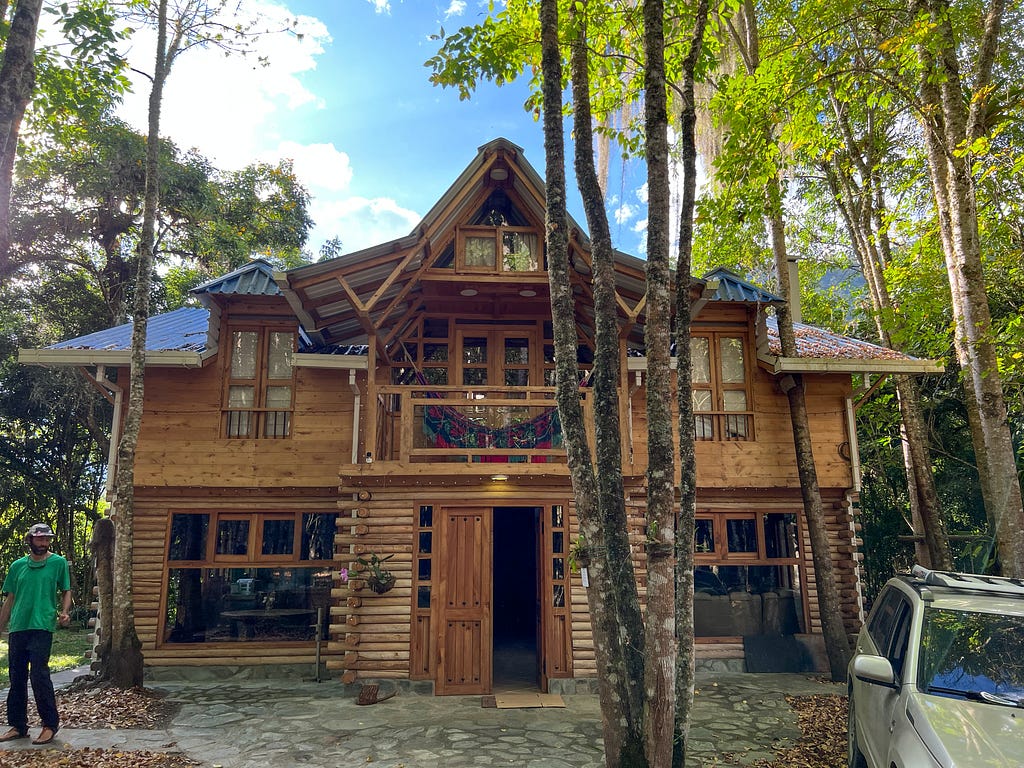
We were exhausted and grumpy from the long drive, and the upcoming program did not help. The idea for tomorrow was to head out and drive 3 hours to search for some birds.
It didn’t make any sense to me. We spent the entire day driving to get here, only to immediately escape it on the only day we would stay here (tomorrow).
Manuel ensured us that the targets are worth it, and that we would be back by lunch. Of course we would go, we just needed to vent a little. He knows.
Dinner was excellent. We went to bed early because it would be a very early morning tomorrow.
September 27
Coffee at 4:30AM, after which we started a 2.5 hour drive on a very bad rocky path. We then parked in an open windy place and had breakfast from the back of the car. It was freezing.
I still had not snapped out of my bad mood. Silently protesting this activity whilst already doing it.
We entered the Giles Fuertesi ProAves Reserve where we met the ranger, a very kind and helpful guy. After another coffee, we started the trail into the forest.
The first target was the Indigo-winged Parrot the park is named after, one of the rarest parrots in the world. We heard them and saw them in the distance, but they never got closer. I have one awful, remote, blurry in-flight shot should you really insist on evidence:

The next target was the Crescent-faced Antpitta. The Antpitta we failed to see earlier. But here we’re not at a feeder, which makes this a mission impossible.
Indeed, our attempts failed. No sign or sound of the antpitta. We tried for a long time.
What is this bird?
Says a humble man. The man being Jose, our driver. He never joins in our walks, but this time figured its too cold to wait in the car, and this reserve is easy to walk with normal shoes.
Nothing of importance, Jose. It’s just a. Wait. Is that? Is that a? WHAT!?

Jose, a guy that normally drives around mountain climbers, walks into this forest and casually points out one of the hardest antpittas to see in the wild. Scrap that, one of the hardest birds to see in all of South America.
This is like picking up a football for the first time in your life to go on and win the Champions League.
Insane. It was jumping around in a thick dark bamboo forest though, extremely hard to focus on. Ferdy, do the TRRRRRRRRRRR!, said Manuel, referring to the rapid camera shutter when I did manage to focus.
He was jumping from joy. I didn’t know what to do with myself. I was still in my told you this was a bad idea vibe, and this turnaround was too sudden.
After calming down, we went back to the start of the reserve where we celebrated with coffee and very tasteless cake. It wasn’t bad cake. Because bad cake has a taste.
We happily exited the reserve and made the slow way down. This time we would occassionally check for the 3rd target: the Masked Saltator. We heard it once. It was when I played its call on my phone and slid the phone into my pocket.
Manuel: The masked saltator, it is calling!
His eyes scanning the forest like a maniac to find the direction. It’s one of the lamest birding jokes ever, but a good way to test the quality of your bird guide. I think Manuel’s body froze at about 0.3s into the call.
So yes, Manuel was right. It was worth it and we were back in time for lunch.
The entire afternoon was free to enjoy this beautiful place. I did some small solo tours in the area, capturing birds and butterflies.

At one point, I took a step back and tripped over something large. The hotel’s Husky, sneaking up behind me.

As the sun was about to set, Henriette and I were setting up the moth trap where the owner of the hotel said Mi Casa, refering to his personal cabin down the road as a better location. He would even shutdown all other lights. How kind of him.
In full darkness, I headed to his cabin for the last step: attaching the light and turning it on. Arriving there, it turns out I wasn’t carrying a light, instead a lens in my backpack. So I had to do the entire trip once more.
After dinner, we checked results. They were meager, about two dozen moths. Not an issue, mothing is a long game. They add up. The favorite of the night:

Meanwhile, Manuel was doing some owling, but none came into view.
September 28
The day with destination Bogotá, but we were looking to squeeze some last minute value out of our trip. At 6:30AM, we did a small birding tour around the hotel in search of this endemic:

At 7:30AM we had breakfast, packed up and hit the road. We were en route for an unplanned destination. The hotel’s owner had advised to check out a feeder site nearby. One we did not know existed.
We came into a charming hacienda with friendly people and several feeders buzzing with hummingbirds.
A rarity we found here is the Tolima Dove, only known to occur in cloud forests of Central Colombia.
Henriette pointed out how they have a dedicated moth light trap here. How cool, I agreed.
It’s because of you, said Manuel.
The photo of the Ecuador session shared earlier in this report had been spread on Manuel’s network, inspiring this owner to build one.
As for the hummingbirds, I realized that this would be the last photography moment of our journey and just blasted away. I’ll figure out later if I actually hit anything.

As I had the camera bag packed up, it turned out to not be the last moment. The owner suddenly remembered how he has a rare frog in an enclosing. We waited for him to fetch it, but it turned out that the frog had escaped. Next, he fetches a new one from the botanical garden:

With that, we started the journey to Bogotá. It was a long and boring drive, with 2 stops. It ended in a frustrating Bogotá traffic jam, but at around 5PM we were at the Hilton hotel again.
Over dinner, Jose looked like a kid in a candy store. A man of humble background, he’s never been on the inside of a luxurious hotel. I’m pointing this out as Manuel regularly upgrades the hotels and restaurants of drivers. Out of his own pay. That’s the kind of man he is. He spreads wealth and educates poor people wherever he goes.
Guess who’s dining next to us? Rob Hunter. The coincedence. This man is unavoidable if you follow Colombian birding on Facebook, he seems to be permanently here. He’s a Belgian guy living in Washington. He was on his 17th tour, should you consider our 4 visits a lot.
We prepared a speech and tip for Jose, thanked him for his hard work and friendship. He would be driving back home in the middle of the night. This plan was then changed, instead he and Manuel would drive back all the way to Pereira together, tomorrow.
September 29
A late 8AM breakfast, how exceptional. We relaxed for a few more hours, after which we had a drink with Manuel. The speech and tip moment.
Manuel looked exhausted, completely worn out. We concluded that if you manage to do that, you’ve been on one epic journey. We cannot emphasize enough the importance of Manuel. We would experience but a fraction of what we experienced without him.

When Henriette and I consider a new trip with Manakin Tours, we open with: give us Manuel, or there will be no trip. I think that says it all.
After bringing us to the airport, we had our final goodbye with Manuel and Jose. Henriette had already checked us in and the bagage drop-off was smooth. There was a significant queue at immigration yet it cleared up pretty quickly. Security did a chemical test on the outside of my camera bag, but it triggered nothing.
We did some duty free shopping. Cigarettes (yes, I’m ashamed to say that I still smoke, my one guilty pleasure) and whiskey for my brother’s upcoming birthday.
We had lunch at the airport and proceeded to the gate. The flight departed with one hour delay. We first made a stop in Catagena, but luckily could remain seated. Unfortunately, a pretty gross man seated next to Henriette. Sweating, smelly, coughing, snoring and full of mysterious small wounds.
Onwards on a 9 hour night flight.
September 30
We landed in Amsterdam after which the plane had to taxi for a significant while. Not towards a gate, just to a random point where we got out of the plane and hopped into a shuttle bus. Unusual for Schiphol.
We made the long walk to the luggage hall, on the way there we saw piles and piles of luggage marked delayed luggage. This place is truly falling apart. It used to be a reputable airport.
It took 30 mins for our luggage to appear. Finally, we saw the exit sign. Customs rudely interrupted our dream. Random check. It turns out we bought too many cigarettes. I said that he can keep the surplus, just throw it in the trash. Nope, he insisted I need to pay taxes on the surplus. Which is more than the cost of the surplus. Airport logic.
Unimportant. We exited Schiphol and hopped on the shuttle bus to take us to the hotel to pick up our car. Driving home, we appreciated the weightless experience of driving 100km/h whilst seemingly standing still. Not a single bump in the road. We did face a small traffic jam near the end.
Ramon called that he had already exited our home, and how it all went. Everything went fine, except that he did not bond with our cat Shiva. She’s a picky cat for sure.
We soon were reunited with Shiva. Over the next few days, she would not leave our lap. She did miss us, as we missed her. Our beloved introvert cat.
Closing words
As mentioned in the opening, this has been our most adventurous, memorable, and absurd trip ever. It’s remarkable how radically different it was from earlier visits.
Three trips in one. Cultural insights. The new discipline of herping. The emphasis on rare wildlife. The extraordinary luck factor. Odd locations. Funny and unlikely events. And of course, lots of pain and suffering. The price to pay, but we pay it gladly.
Special thanks
Thank you Henriette, love of my life, for tolerating me and my obsessions. For the beautiful new memories that we created together.
Thank you Manuel, Alejo, all drivers, and local guides. Without you, we’re just a bunch of clueless fools that wouldn’t find much. Every single one of you was essential.
Thank you Manakin Tours for another trip well organized.
Thank you Ramon, for taking care of the house and Shiva.
Thank you Christine Young, for taking care of JungleDragon administration whilst I was away. You’re an amazing friend. Thank you to all others that helped to keep things running.
Thank you dear reader, if you made it this far.
Thank you Huppel.
The photos
https://www.jungledragon.com/tag/87690/colombia_2022.html
“A ship in harbor is safe, but that is not what ships are built for.” — John A. Shedd

Colombia 2022 Travel Report was originally published in Ferdy Christant on Medium, where people are continuing the conversation by highlighting and responding to this story.
Comments
Nothing yet. Say the first thing.
Sign in to join the conversation.