
This post contains the text and slides for a lecture that I gave this past Thursday in my high-school hometown of Amarillo, Texas.
The lecture was the keynote address for an interdisciplinary series of conversations about the relationship between the arts and sciences organized by my brother Robert Fulton for the community college where he teaches.
The Q&A after my lecture lasted nearly as long as the lecture. I hope you have questions, too!
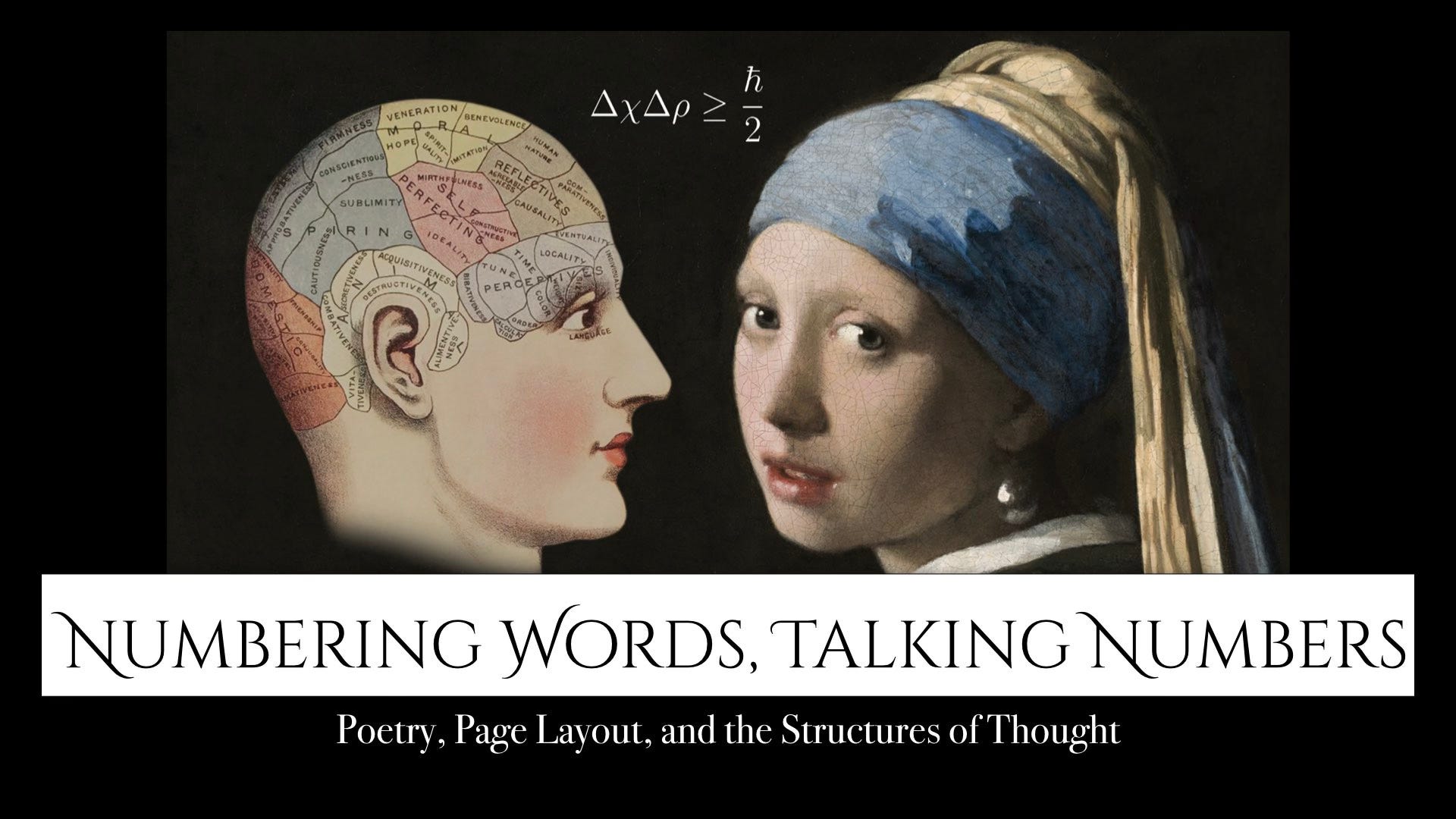
I am very happy to be here tonight to talk with you about numbering words and talking numbers! I am especially grateful to my brother Robert for including me in your conversation, and I hope what I have to say tonight helps raise some new questions for you as well as tying together some of the things that you have already discussed.
When Robert told me his plans for this meeting of the minds across the “two cultures” of the arts and sciences, I was immediately intrigued. I have been teaching at the University of Chicago since 1994, and we are famous, among other things, for our undergraduate “Core” in which students are required to take a series of year-long courses in our four major divisions: Humanities, Social Sciences, Biological Sciences, and Physical Sciences. Staffing these courses requires regular conversations among the faculty about the “core” of our respective disciplines, with predictable results.
Cats, herding, you know the drill.
Predictable results, not, to be sure, across disciplines—we social scientists and humanities faculty do not talk nearly enough with our colleagues in biological and physical sciences—but within disciplines. If we can’t find a “core” in our study of English or History, how do we expect to bridge the gap between the talking disciplines and the number disciplines? Between the disciplines that take quantity as their focus and the disciplines that take description or quality as their theme?
Except, of course, what I have just described is the split within each discipline, not across the divisional divides. Within History, is it our job to collect as much data from the archives as possible so as to discover large-scale patterns in the structures of human behavior and institutions? Or is it to pay careful attention to the images and metaphors by which past cultures describe their ambitions and anxieties, so as to develop empathy for their worldview, however much it might challenge our own?
Which side are we on when we study the past? Or talk about the present or future?
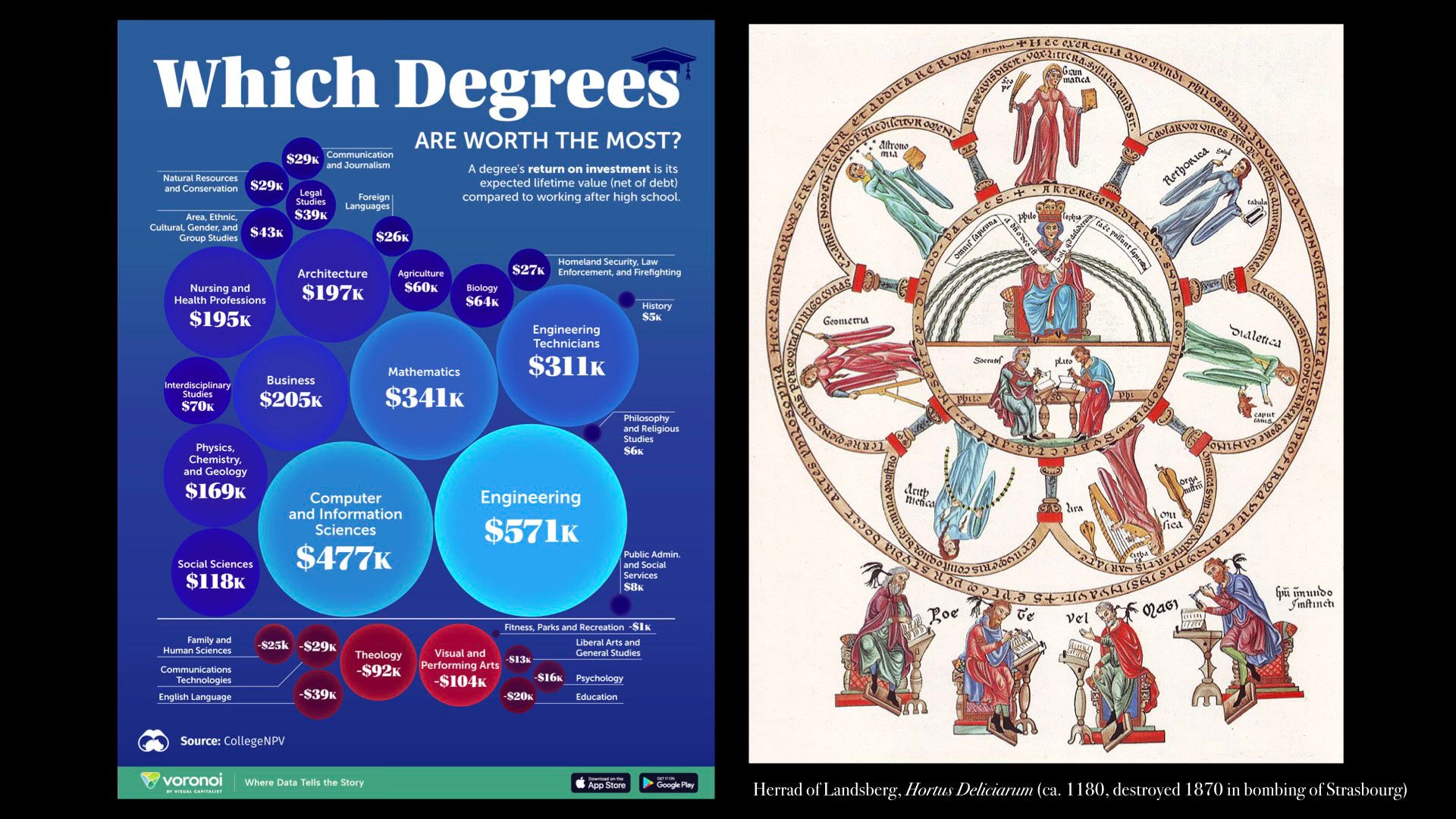
Everything depends on how we answer this question. Do we think in terms of numbered outcomes—how much money our students will make after taking particular degrees—or in terms of wisdom and understanding? Which modes of engaging with the world and each other do we privilege in our educational institutions and reward with authority and prestige? And which do we cast into the outer darkness as dangerous and/or a waste of time?
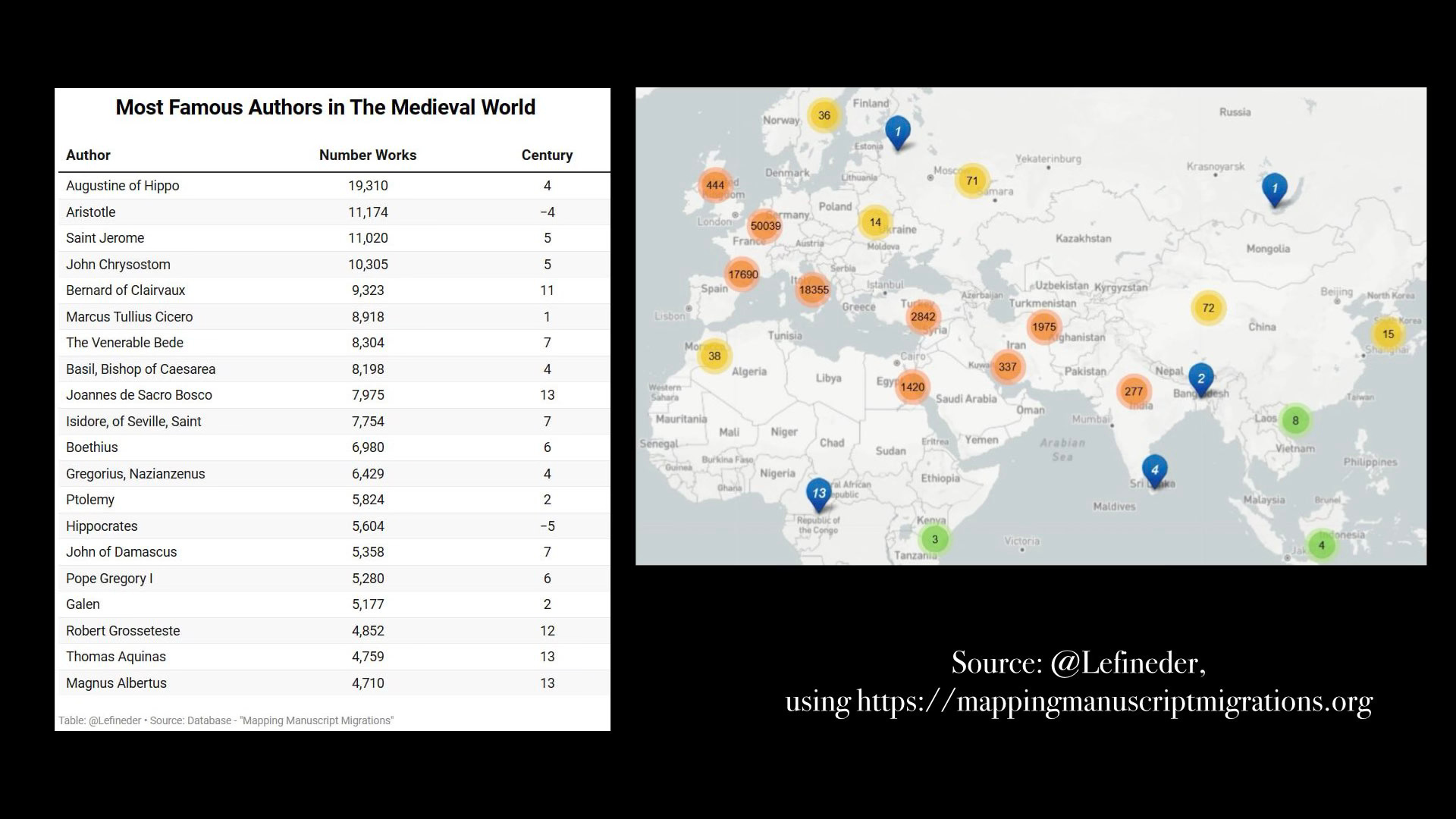
Today, for example, as the Visual Capitalist shows, we privilege engineering and mathematics and cast theology into the darkness along with English, psychology, and education. Those of us in these fields might long for the Middle Ages, when Philosophy and all the Liberal Arts—grammar, rhetoric, dialectic, arithmetic, geometry, music, and astronomy—served Theology as queen. And yet, even Abbess Herrad in her elevation of Philosophy had arts that she cast outside the privileged Wheel of Study.
Can you see what they are? Poetry and Magic. Aka Visual and Performing Arts, and Engineering.
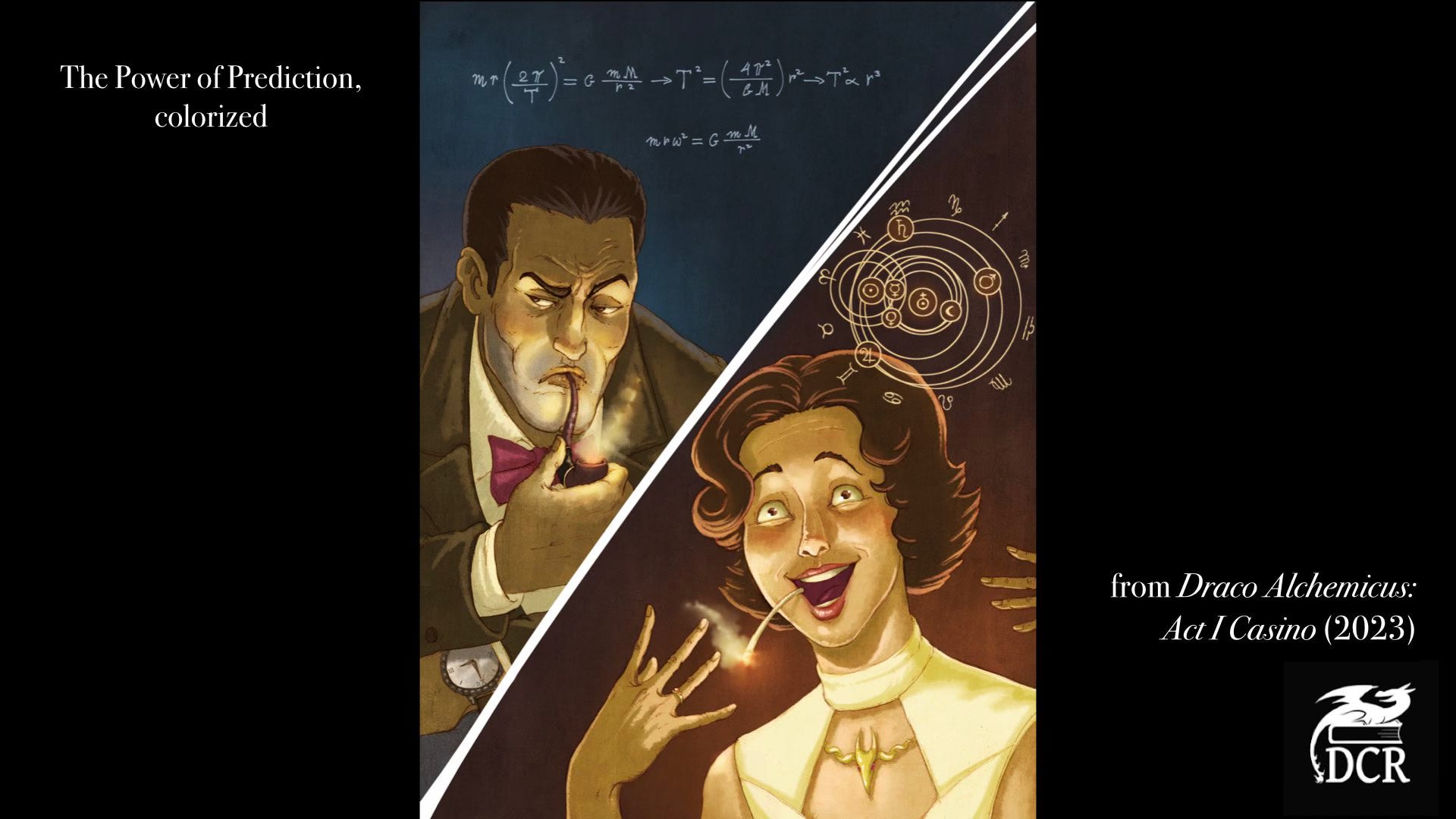
This is the kind of clue I look for with my poets in the writing group I founded four years ago, the Dragon Common Room.
What are the tensions in the categories we live by?
Arts vs sciences?
Mathematics vs symbolism?
Medieval vs modern?
Masculine vs feminine?
Technology vs contemplation?
Worship vs warfare?
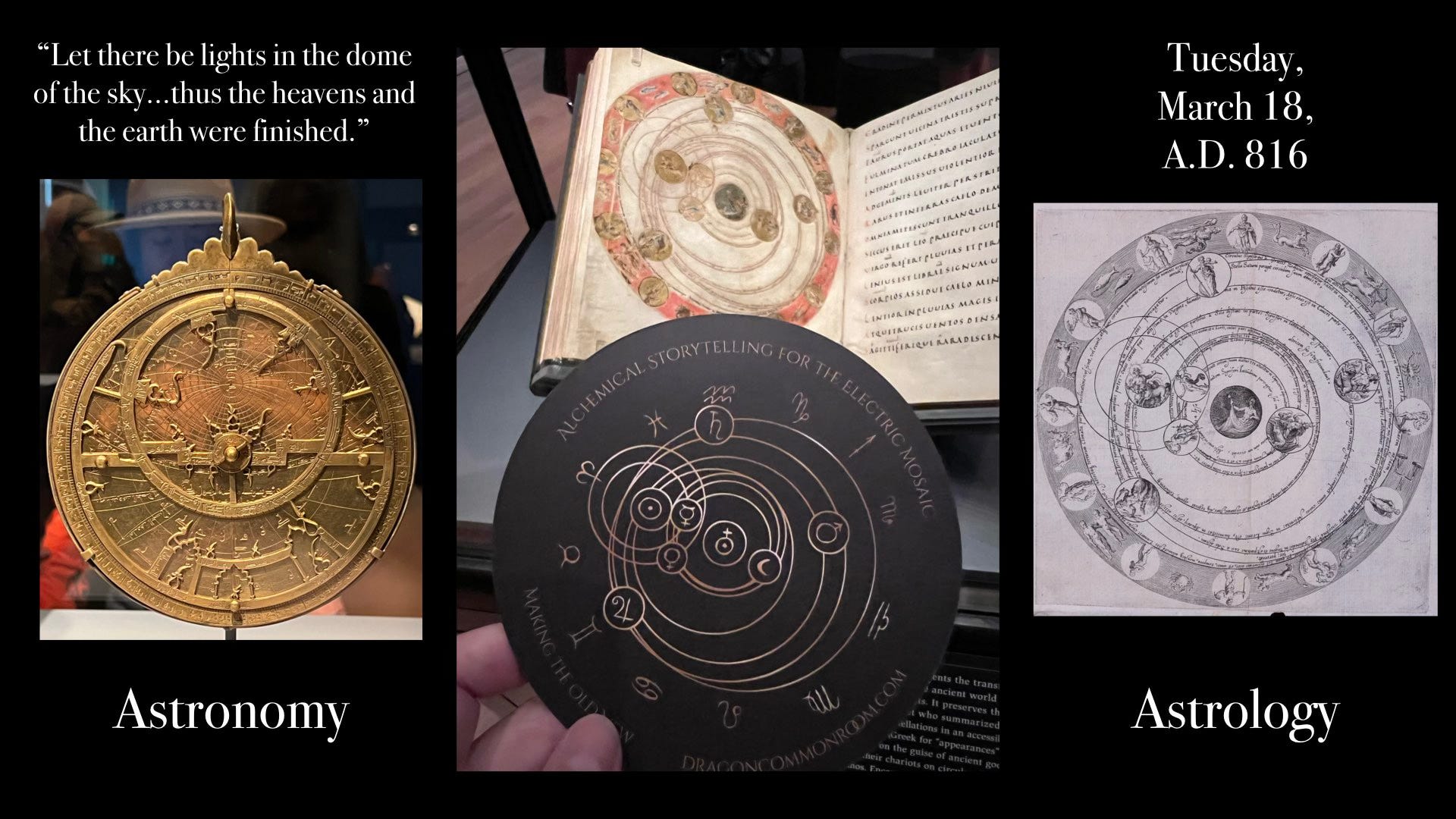
The tensions are always there, imbedded in our desires to predict the future and know about the past.
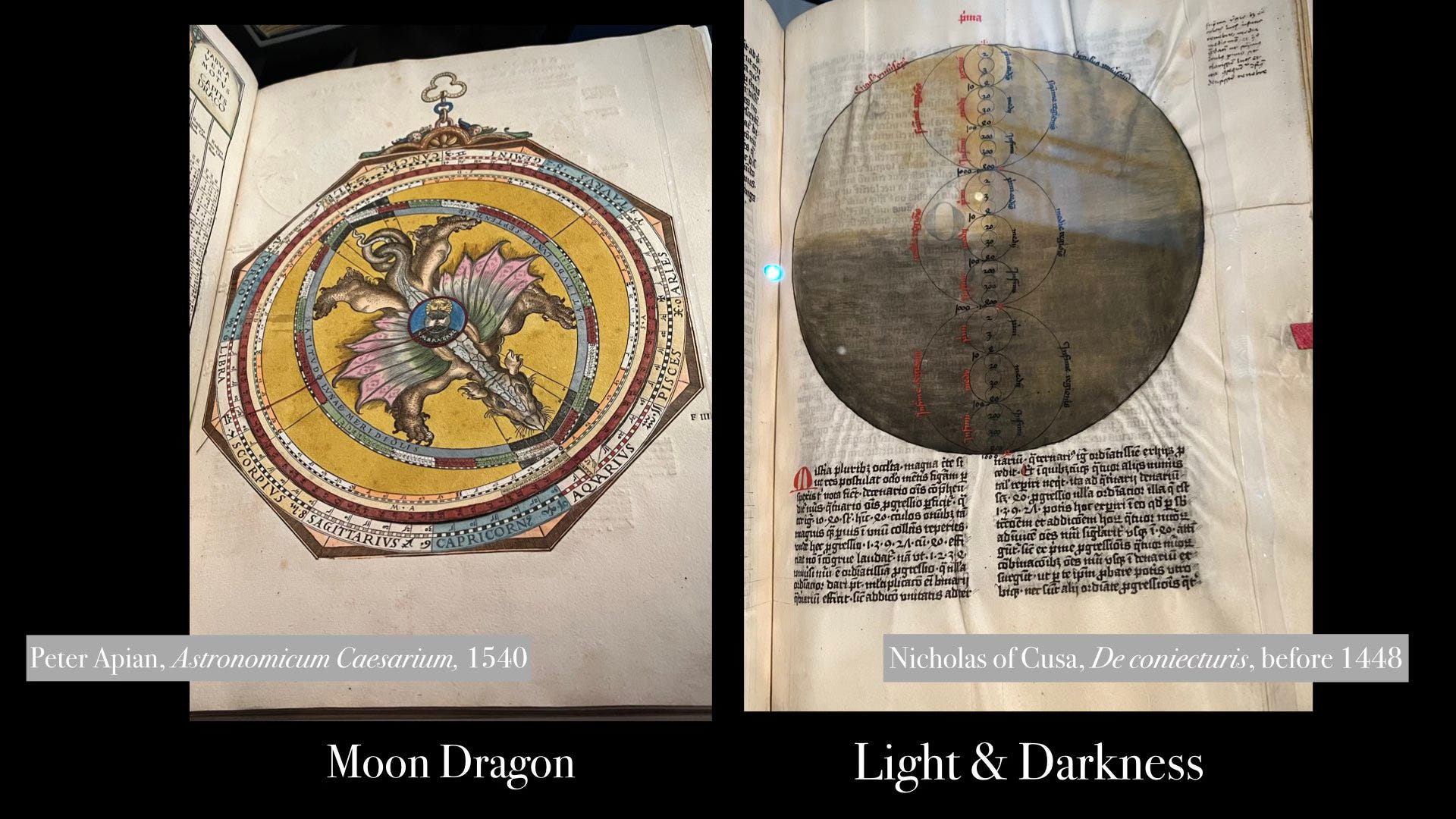
Think about it: we, in the modern world, credit Astronomy with the origins of science—making mathematically precise predictions about the behavior of the physical world. But why did Greek, Arab, Persian, Hebrew, and Latin scholars of the ancient and medieval world find astrolabes so fascinating? Because astrolabes enabled observers to observe the heavens and predict the clock and calendar by which to pray. — Astrolabes were tools of Scientia, or Contemplation.
Conversely, we now think of Astrology as a pseudo-science at best, but who was the biggest market for astrolabes in the middle ages? You guessed it: physicians—because they needed to know the position of the planets in order to know how to treat their patients, and they used astrolabes to know which planets were influencing what parts of the body and mind. — Astrolabes were tools of Techne, or Art.
Where does art begin and technology end? Where does science begin and contemplation end?
Are these even the right questions to ask?
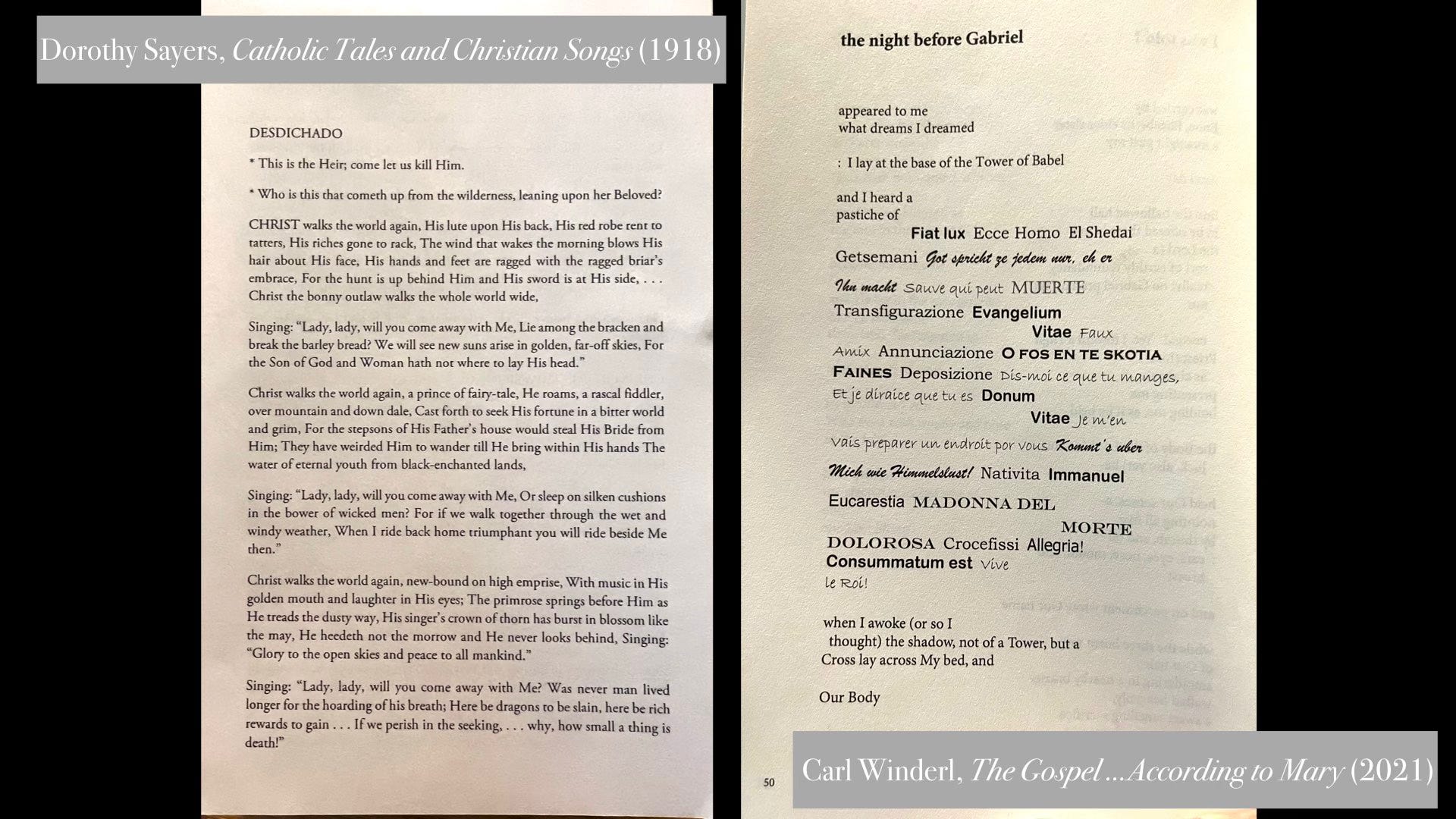
Who here likes poetry? Y/N? Why or why not? Boring? Inaccessible? Affected?
Look at the screen: which of these texts would you say is a poem? How can you tell?
One looks like paragraphs of prose, with odd capitalizations every so often.
The other has line breaks. Plus lots of different fonts.
What happens if we read them out loud?
Text within this block will maintain its original spacing when published
CHRIST walks the world again, His lute upon His back,
His red robe rent to tatters, His riches gone to rack,
The wind that wakes the morning blows His hair about His face,
His hands and feet are ragged with the ragged briar's embrace,
For the hunt is up behind Him and His sword is at His side, . . .
Christ the bonny outlaw walks the whole world wide,
Text within this block will maintain its original spacing when published
Singing: “Lady, lady, will you come away with Me,
Lie among the bracken and break the barley bread?
We will see new suns arise in golden, far-off skies,
For the Son of God and Woman hath not where to lay His head.”
Now which would you say is a poem?
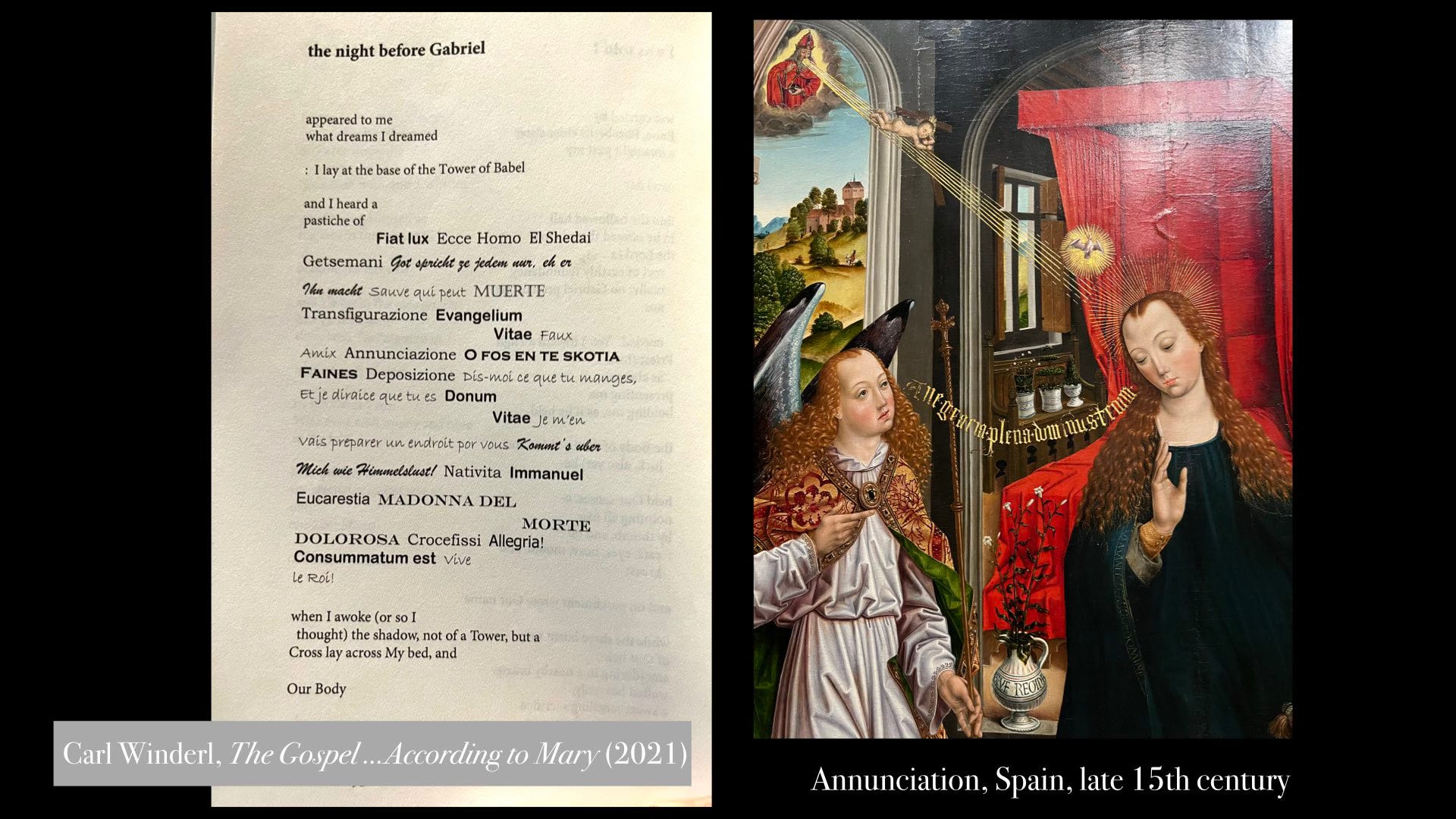
Note alliteration, meter, and rhyme in Sayers’s poem. None of that in Winderl’s.
Winderl has given us a word picture, while Sayers gives us a song.
Winderl’s only works if we see it on the page. Sayers’s only works if we read it out loud.
Did the page layout “trick” you? Why do you expect poetry to look a certain way on the page?
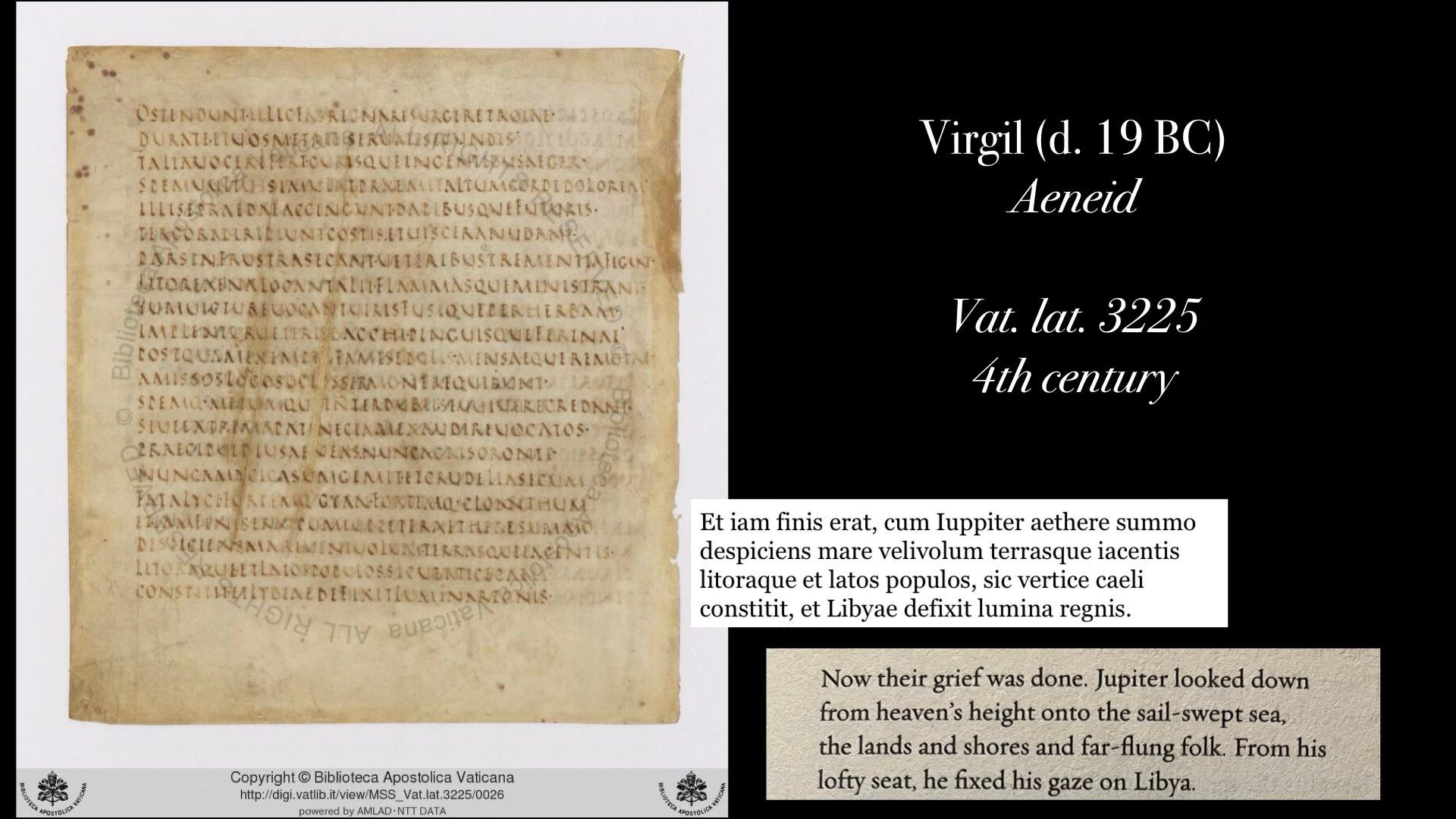
Here’s a poem. Can you tell from looking at the page? How easy do you think 4th-century readers found this text to read? Yes, it’s in Latin, so that’s a challenge for us. But notice the page layout: some little dots, but the letters are all capitals, and there are no spaces between the words.
This is what elite texts looked like in the early 4th century: nobody sat with them reading them silently—they couldn’t. These were transcripts for slaves to read out loud—more like the transcripts you get on a YouTube video than something you would expect to find now in a book. All books were “audiobooks,” they just had human readers.
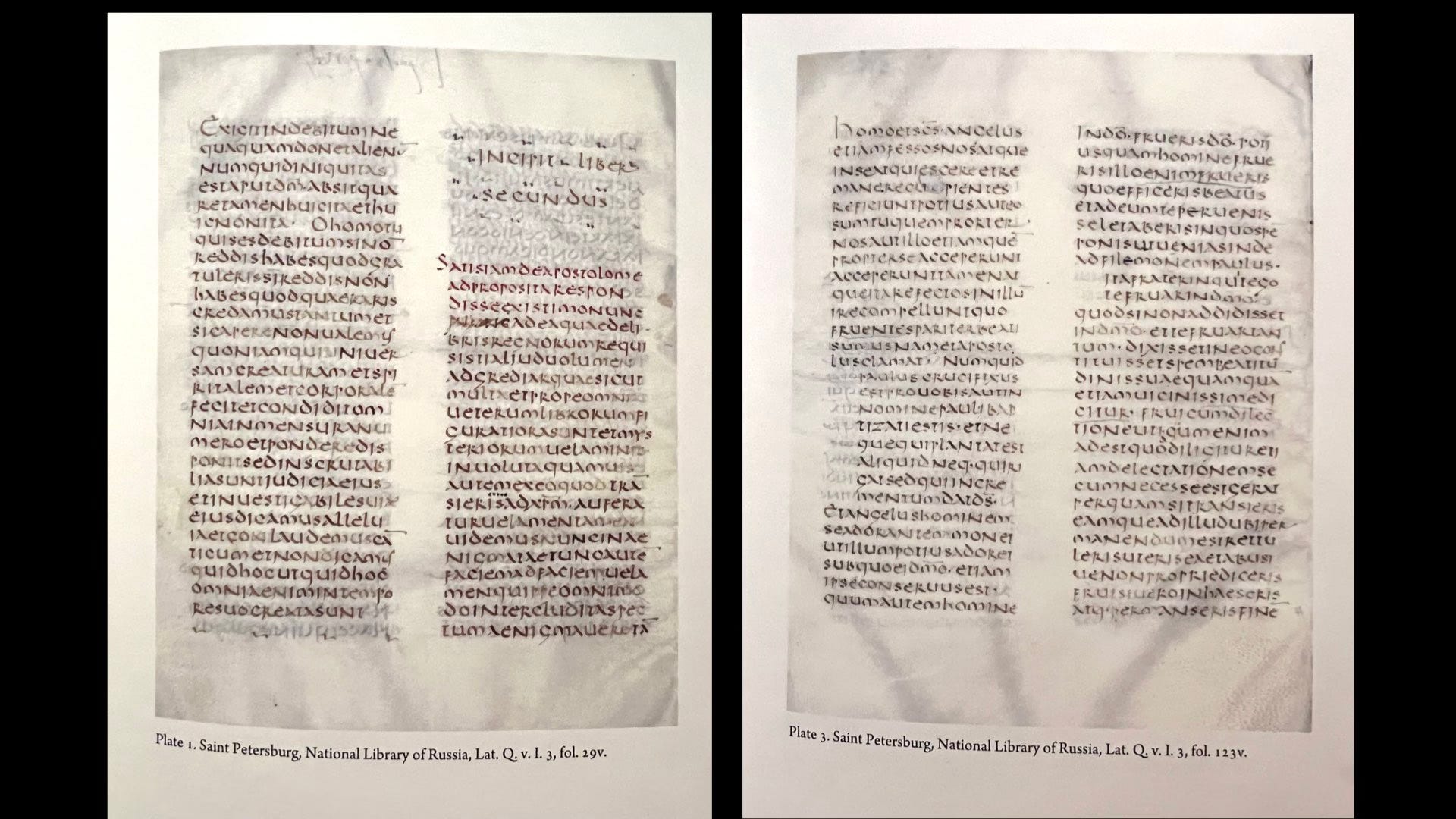
What do you notice about this page layout? There are columns! And indents! And different colors of ink! The letters are still all in capitals, and there is no space between the words, but there is help for the reader that hadn’t been there before.
What happened? In a word: Christianity.
In a name:
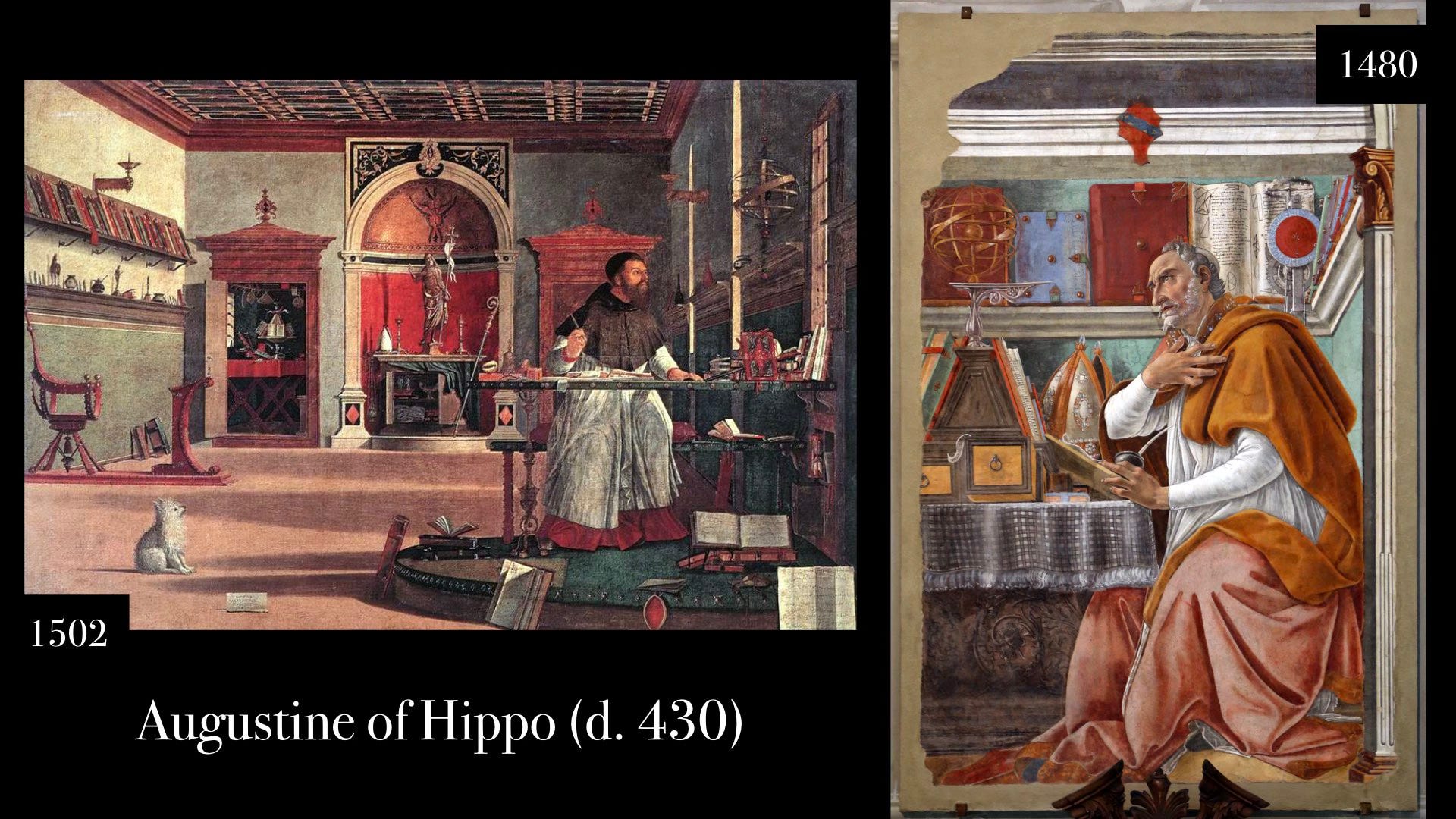
Augustine is famous for lots of things: confessing his sins as a teenager, describing his conversion as triggered by a book (“Tolle, lege!”), writing treatises on scripture and on teaching Christian doctrine. He was also very impressed when he saw Ambrose, the Bishop of Milan (d. 397), reading without saying the words out loud or even moving his tongue.
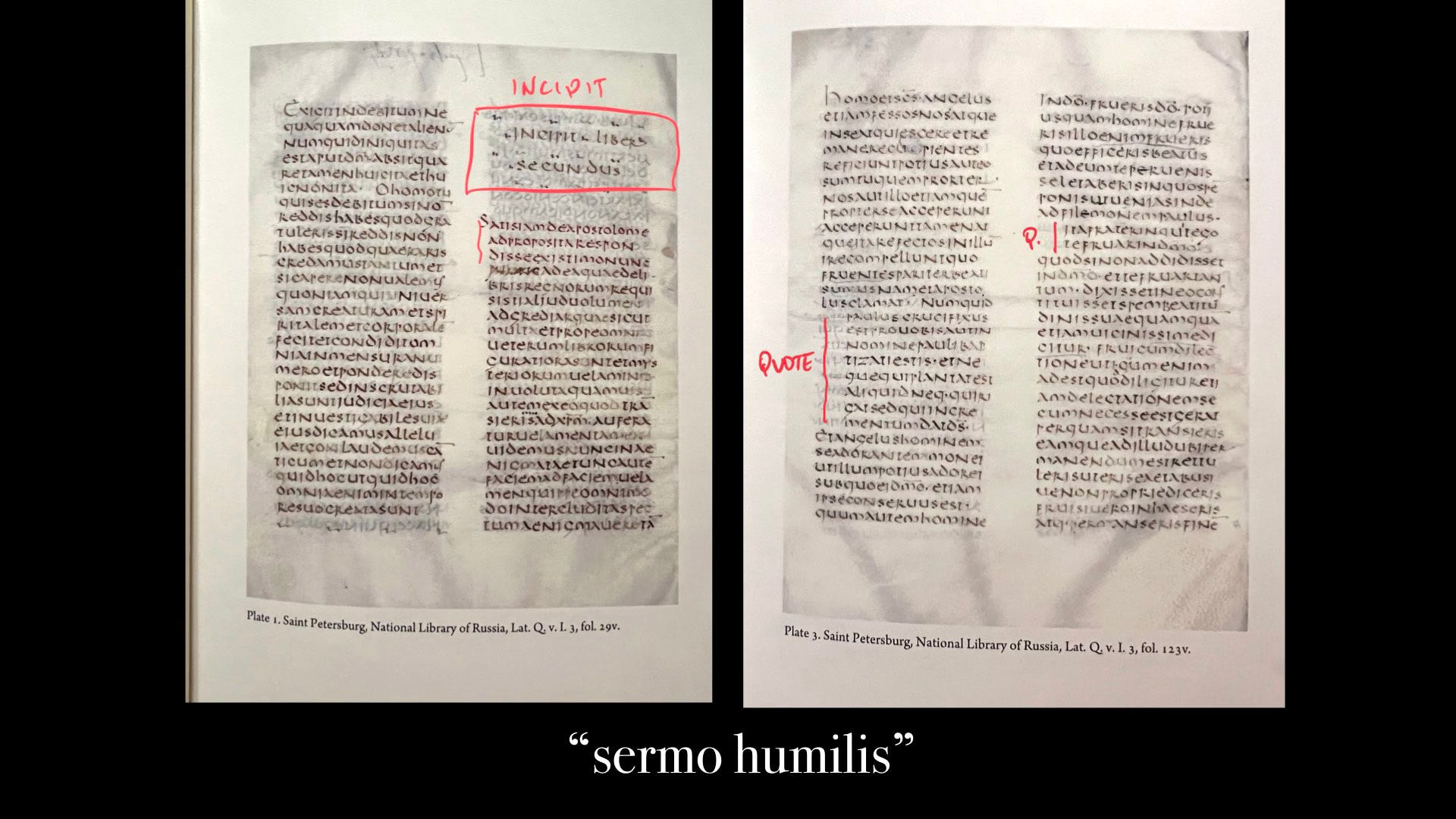
This manuscript of Augustine’s works (including an early version of his De doctrina Christiana) is very important because it was most likely made to Augustine’s own specifications for the page layout:
columns of seventeen to nineteen letters each,
headings or incipits written with clear word separation, highlighted in colored ink,
divisions of the text into chapters (capitula), with their beginnings marked in red ink,
points of punctuation setting off units of meaning,
line breaks following Jerome’s use of cola et commata (line breaks complimenting sense=sermo humilis),
and indents for quotations from Scripture. (Here, quotations are from the letters of Paul: 1 Corinthians 1:13, Philemon 1:20)
Augustine was not only one of the greatest rhetoricians of his era. He also understood the cognitive power of graphic design. To make the texts accessible to readers, they needed to include instructions for reading in the layout, font, color, punctuation, and spacing of words.
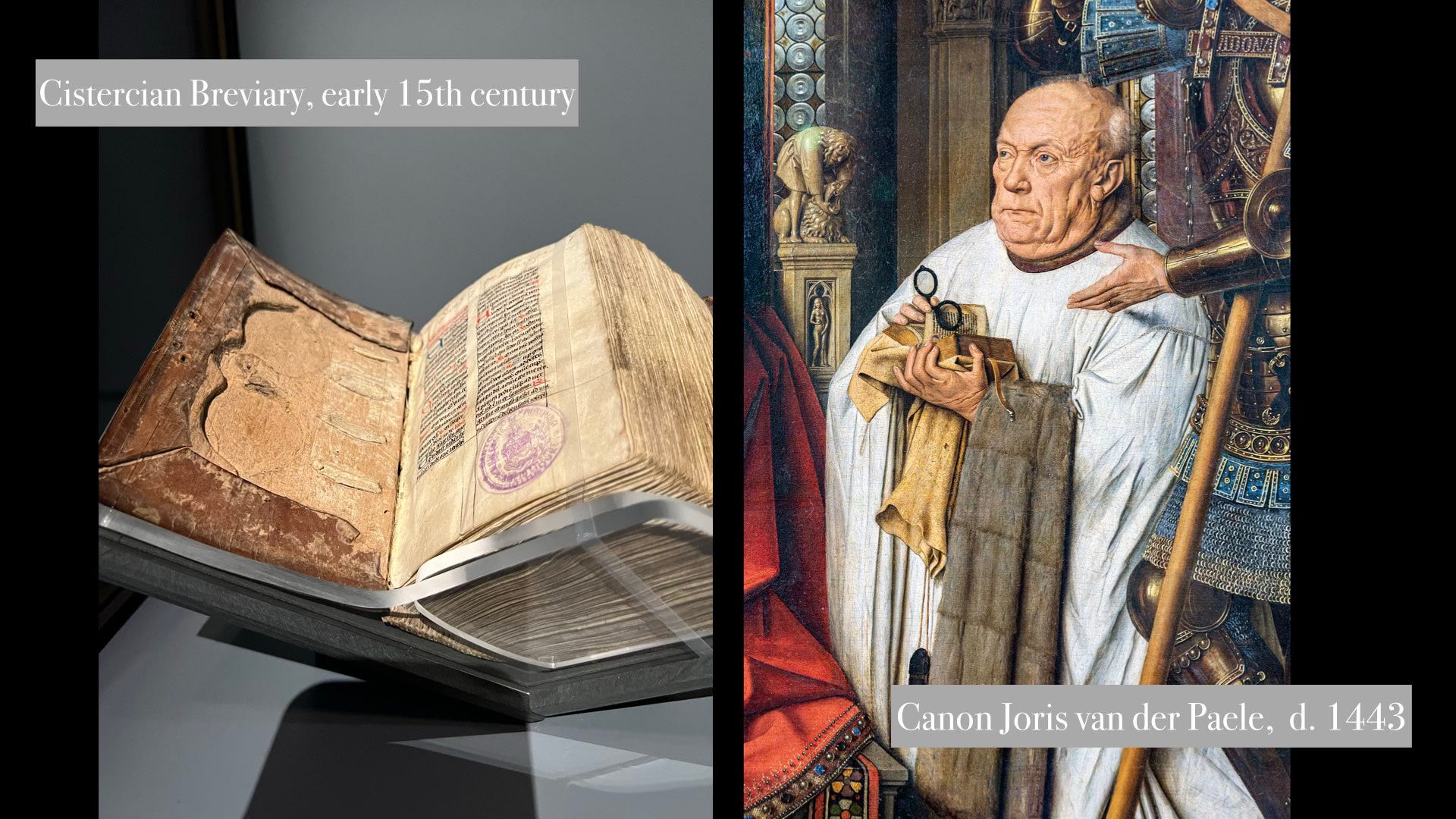
Over the following centuries—what some people persist in calling “the Dark Ages”— monks copying the scriptures and other ancient texts added further refinements to their graphic designs (see Paul Saenger’s Space Between Words [1997] for details):
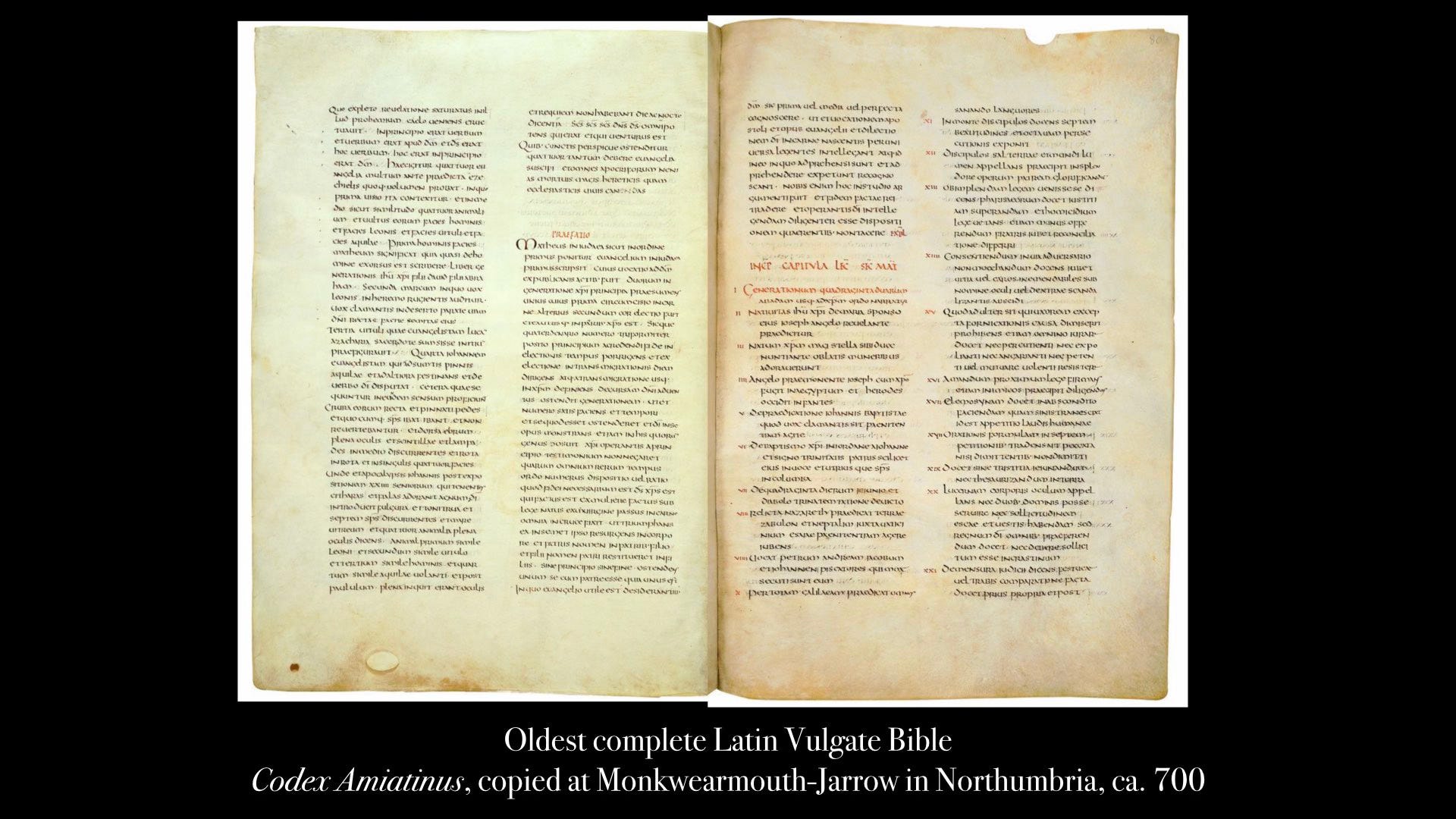
ekthesis, or hanging indentation at new units of text,
diple to mark quotations
numbering of textual units, marked in red ink,
tables of contents with chapter divisions,
punctuation marks,
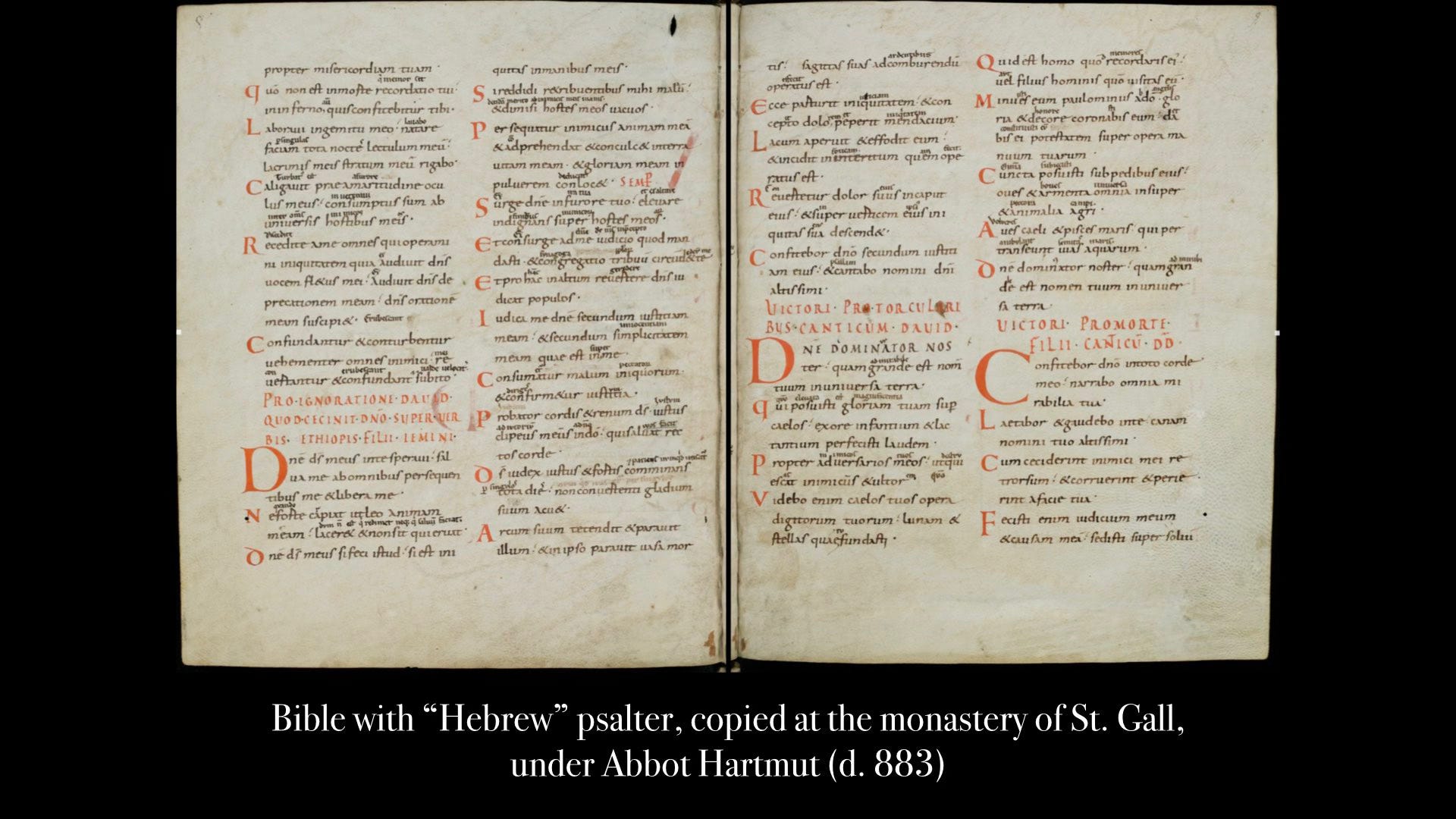
minuscule letters,
word separation,
further use of colored ink (blue, green, yellow) to mark units of text, down to individual verses of scripture,
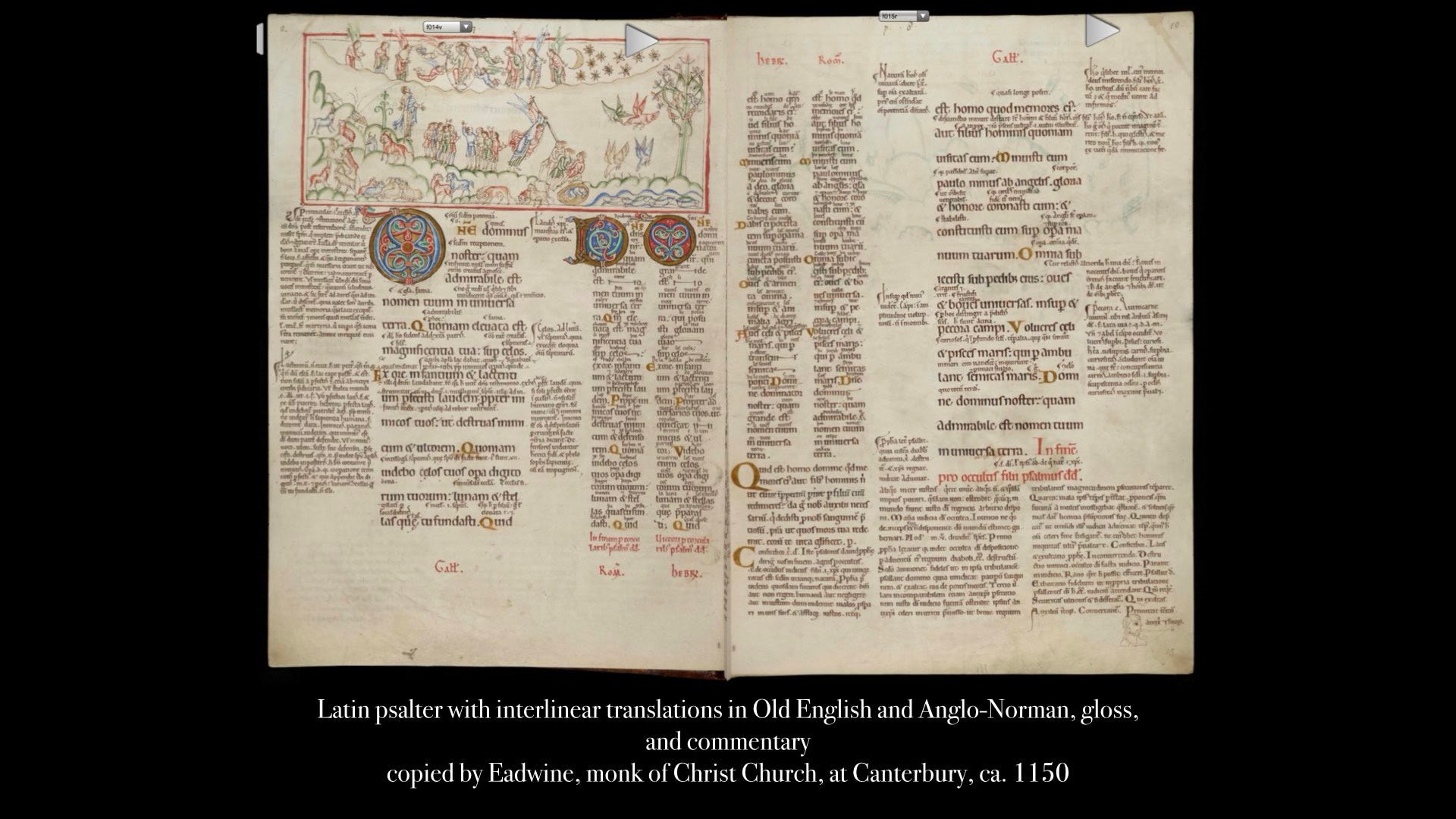
more and more elaborate column layouts,
and enlarged and ornamented initials for major units of text.
A full-blown version of these layouts could incorporate information at multiple levels, just like a newspaper or webpage layout:
larger fonts for main text, with glosses and commentary between the lines and in marginal columns,
verses marked with colored gold capitals,
rubrics for different versions of the text (Gallicanum, Romanum, Hebraicum),
tags to show where comments and glosses apply,
plus hands and heads to mark significant portions of text.
And that’s just the page layout—never mind what it took to make the parchment and inks!
Where does the technology end and the art begin?
Thus far we’ve been thinking about making words visual and the cognitive effects of putting them on the page. But words are also oral and aural, something we say out loud and experience through our ears.
Further: like music, spoken words are something we experience in time.
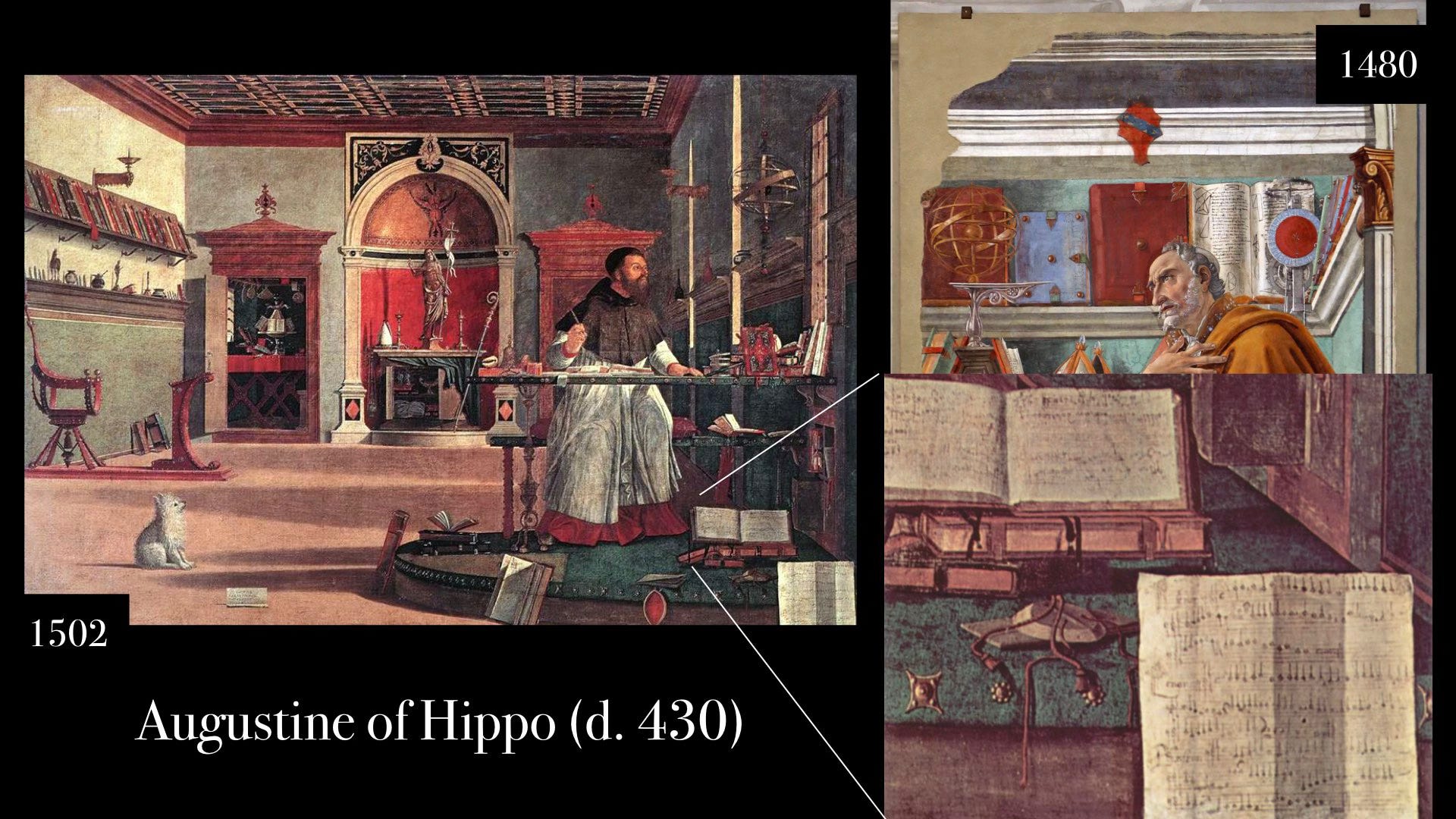
Augustine, the professor of rhetoric, had something to say about music, too.
In his words: “Music is the science of mensurating well.” (Modulandi. He means “measuring.”)
Again: “Music is the science (scientia) of moving well … because whatever moves and keeps harmoniously the measuring of times and intervals can already be said to move well” (De musica, 1.2-3, trans. Schopp).
Not quite what you think of when you hear music? According to Augustine and other ancient philosophers like Boethius, music was a mathematical art. It was part of the quadrivium along with arithmetic, geometry, and astronomy.
As a science, it therefore had to do with numbers.
Augustine was quite withering about music in the way we tend to think of it: as a performing art, something you do for money or glory.
Rather, according to Augustine: music as a science has to do with ordered movements and proportions (analogia) which we apprehend through the intellect with reason.
More specifically: it has to do with meter or “measured feet,” what in English we call “poetry.”
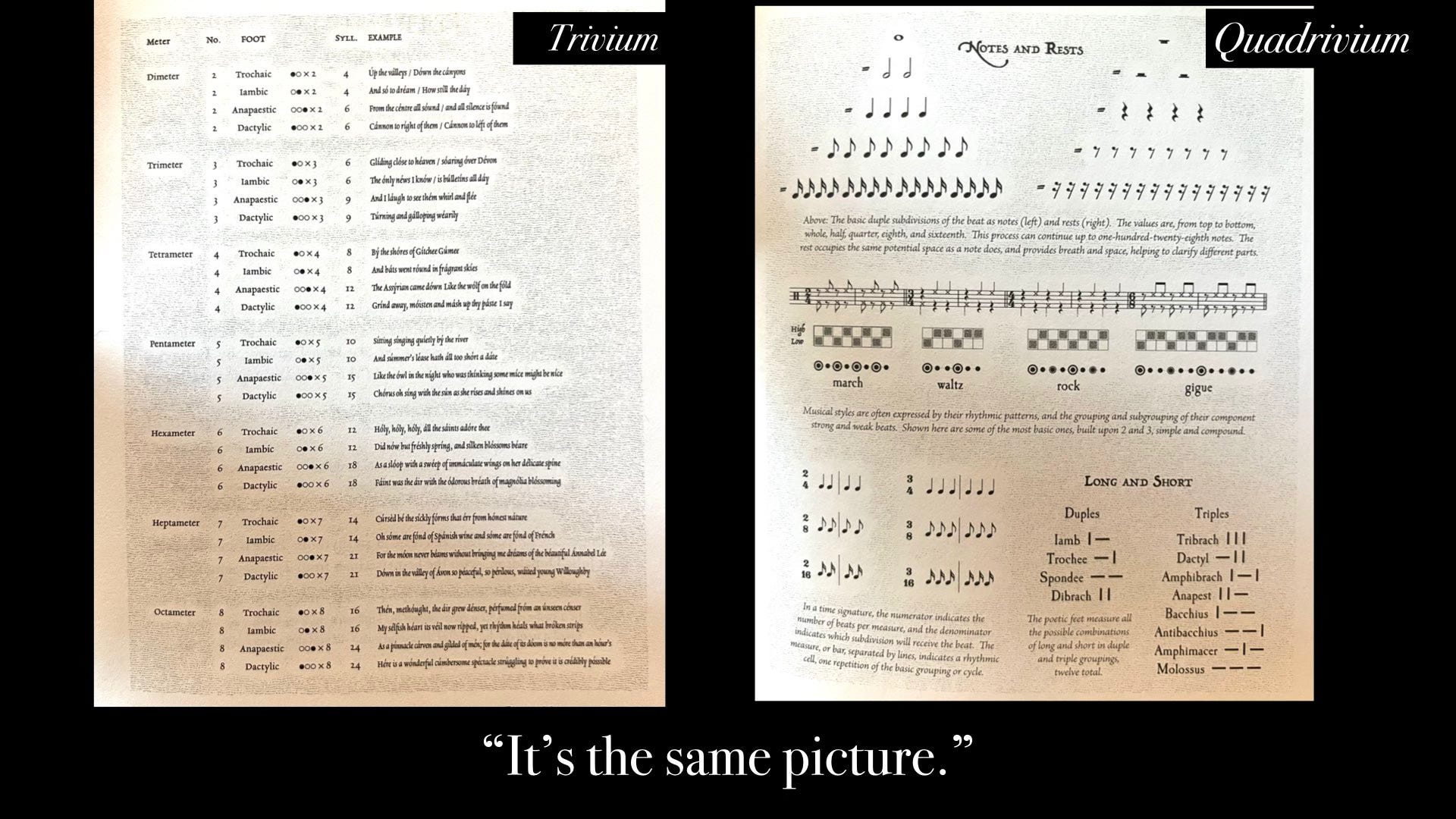
Meter has gone out of fashion in modern English poetry, but it’s still there in song lyrics. It’s what you could hear in Sayers’s poem, even if you didn’t realize it was there:
Text within this block will maintain its original spacing when published
Christ WALKS the WORLD aGAIN,
his LUTE uPON his BACK
His RED robe RENT to TATters,
his RICHes GONE to RACK.
Do you hear them?
daDUM daDUM daDUM daDUM daDUM
These are iambs, the meter of the greatest English poetry: Chaucer, Shakespeare, Milton. Iambs are also something the English learned from Augustine—and reading Latin.
Why is meter important?
Remember what Augustine said about music: meter is about measured time.
This means it is about movement, but as we experience it, it is also about sound, which means it is about embodiment and the movement of our bodies in time, starting with our heartbeat (Augustine says “vein beat”) and breath (“respiration intervals”) “created [by the operation of the soul] for the equilibrium of bodies” (De musica, 6.3).
daDUM daDUM daDUM daDUM daDUM
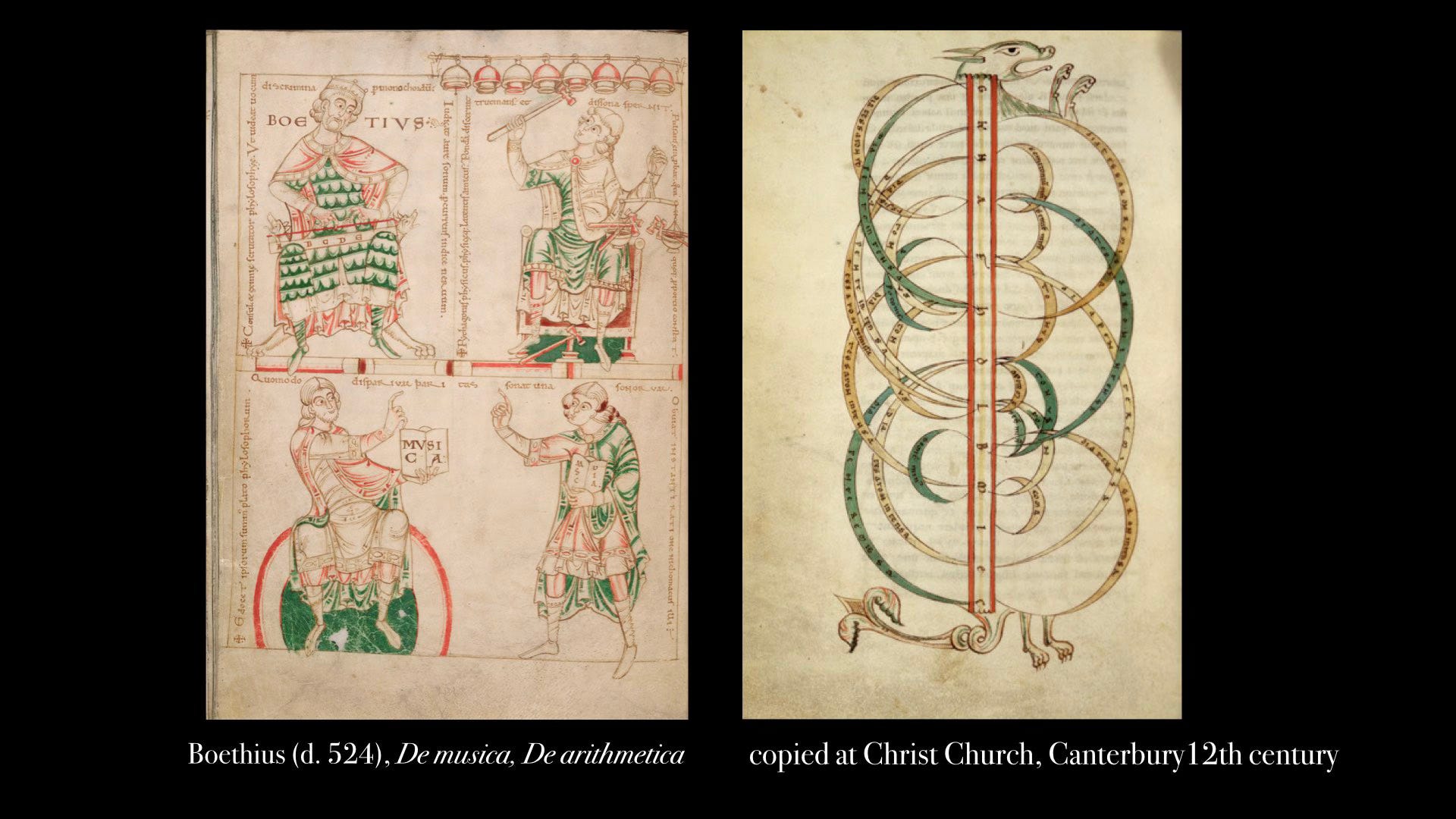
This argument is made even more clearly by Boethius, whom you may know as the author of the Consolation of Philosophy. He was also the author of a very famous treatise on music, shown here in a copy from the same monastery at Canterbury that made our tri-lingual psalter.
According to Boethius: the study of music is the study of the structure not simply of number and time, but of the whole structure of the universe.
If we find music pleasing, he argues, it is because we recognize ourselves in its harmonies and are attracted to them.
More to the point: “Whoever penetrates into his own self perceives human music. For what unites the incorporeal nature of reason with the body if not a certain harmony and, as it were, a careful tuning of low and high pitches as though producing one consonance?” (De Musica, 1.2, trans. Bower).
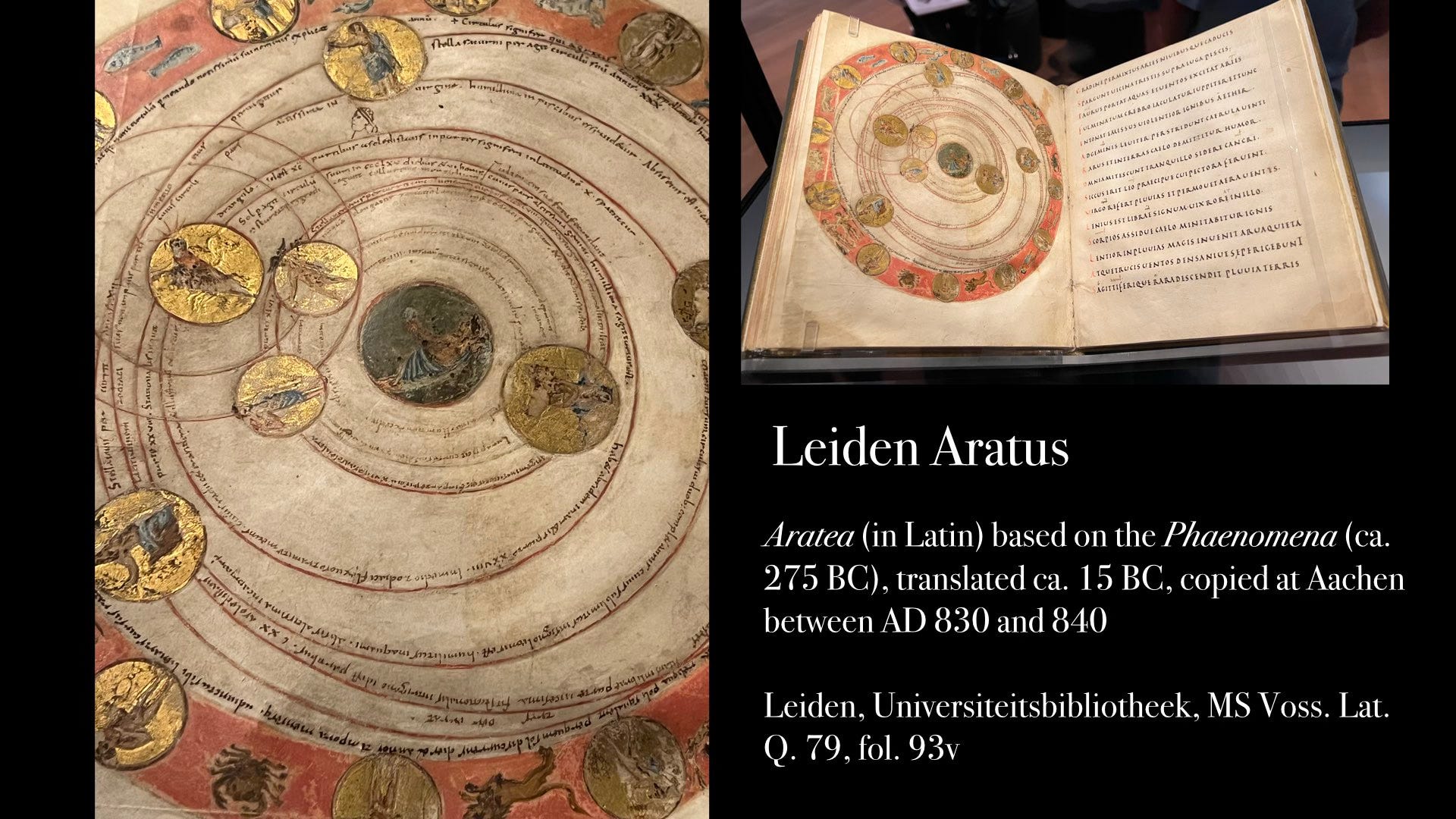
The same musical consonance applies to the structure of the cosmos: music is made by motion. The stars and planets move. Therefore, the heavens make music: “For how can it happen that so swift a heavenly machine moves on a mute and silent course?”
But not only do they move: we know they move in harmony, because otherwise how could the cosmos stick together? Likewise, the four seasons arise from the movement of the four elements joined together by “a certain harmony” to give birth to the variety of fruits that makes up the structure of the year.
Even more to the point: all of these harmonies or consonances that govern both the structure of the human being and the structure of the cosmos are wholly rational, which can be demonstrated by the pitch intervals generated by different weights of hammers (the way Pythagorus figured it out) or bells (shown in the picture).
Technically, music was, therefore, both a question of biology and of cosmology, but philosophically, it was a question of mathematics. Put another way: scientifically, music was a problem of quantity and proportion to be studied rationally; but artistically or technologically, it was a problem of medicine, meteorology, and mental health.
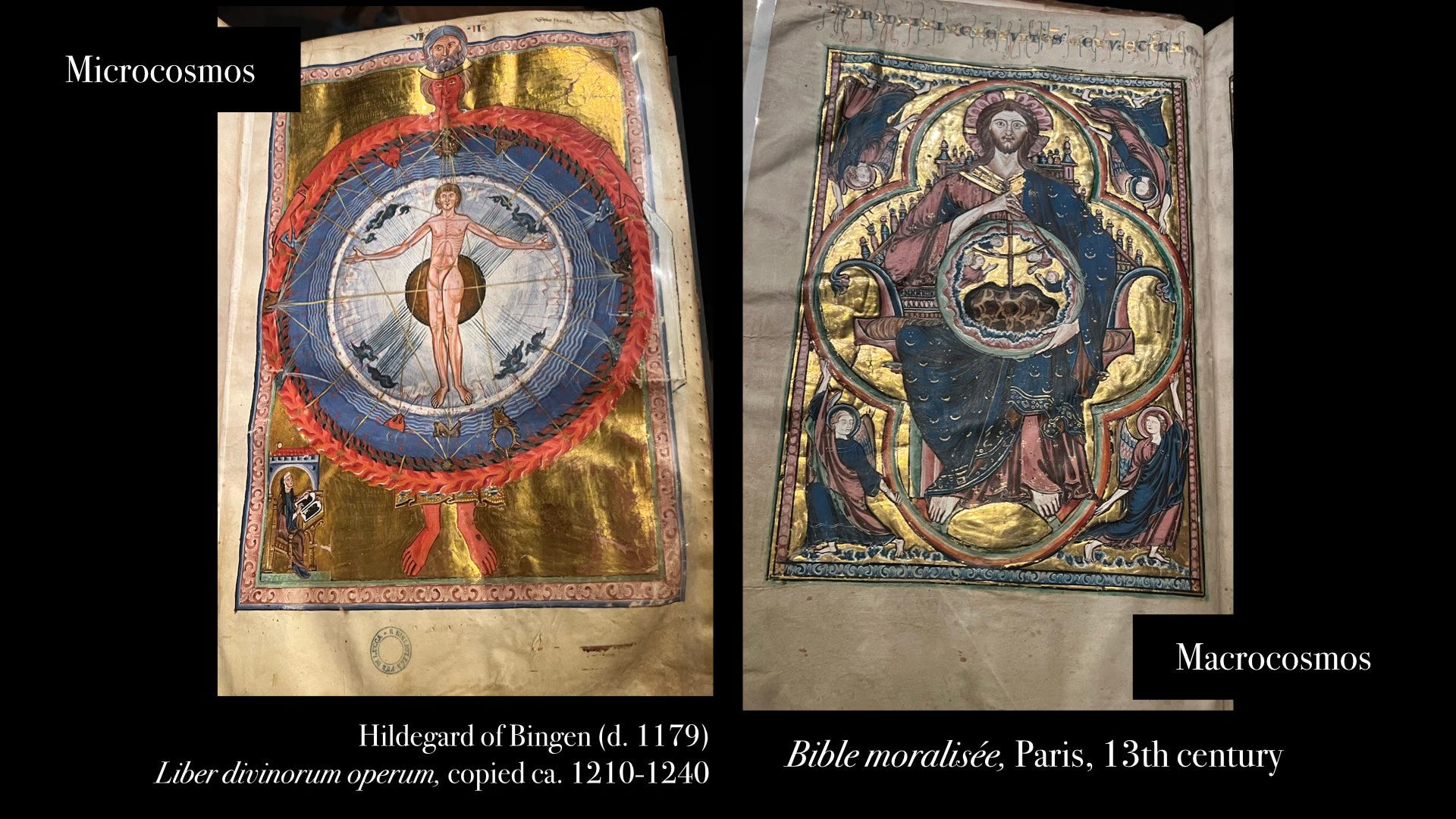
There are lots of entailments in this definition of music for our understanding of the history of both the arts and the sciences, not to mention philosophy, theology, liturgy, contemplation, and prayer.
Everything changes when we re-imagine the way in which we see the structure of the world according to measure, weight, and number.
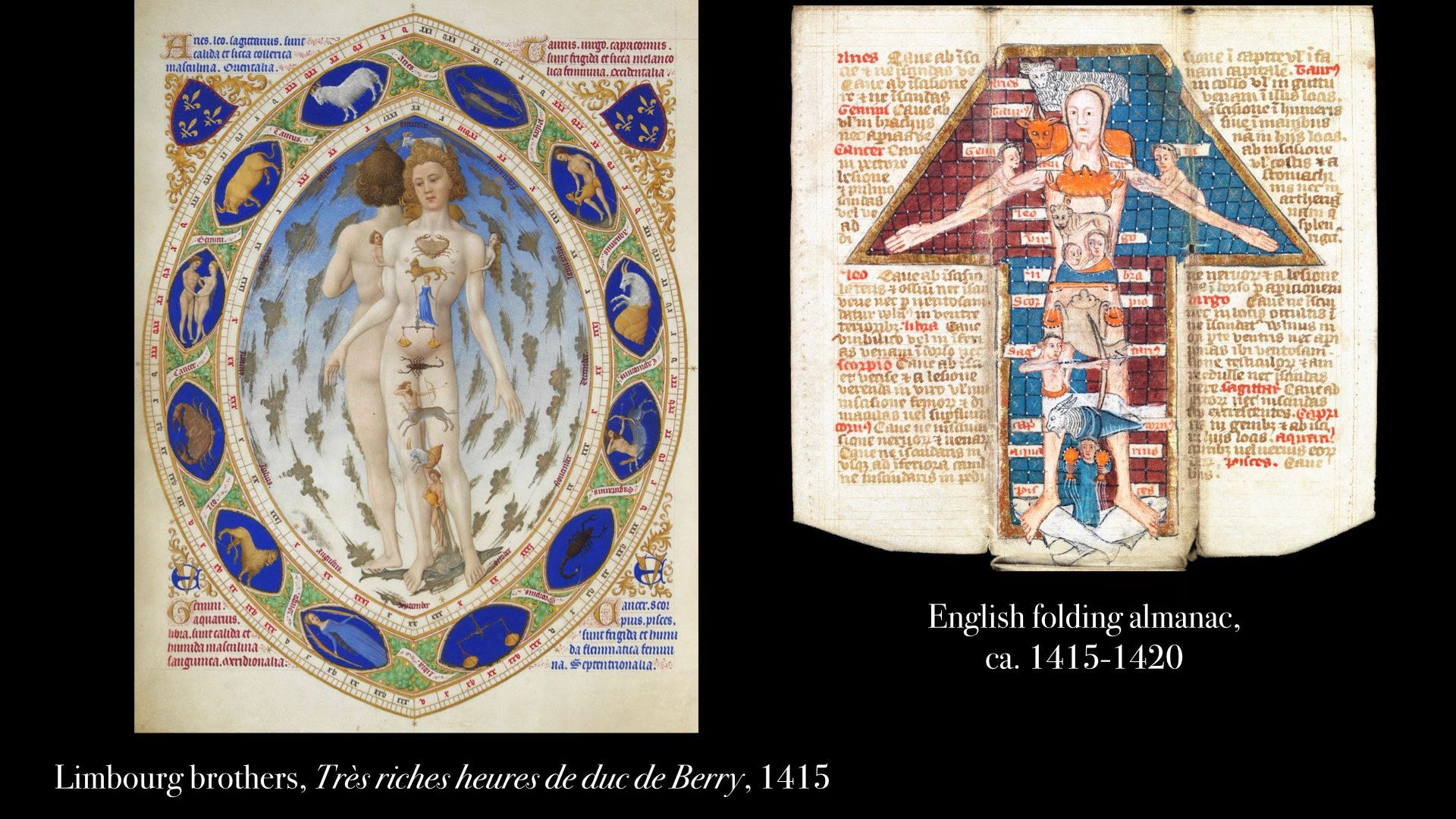
For example: medicine, for which the physicians in the fourteenth and fifteenth centuries needed all those astrolabes, so as to prescribe the right drugs, surgeries, and blood lettings at the right times for different parts of the body, depending on the position of the Zodiac.
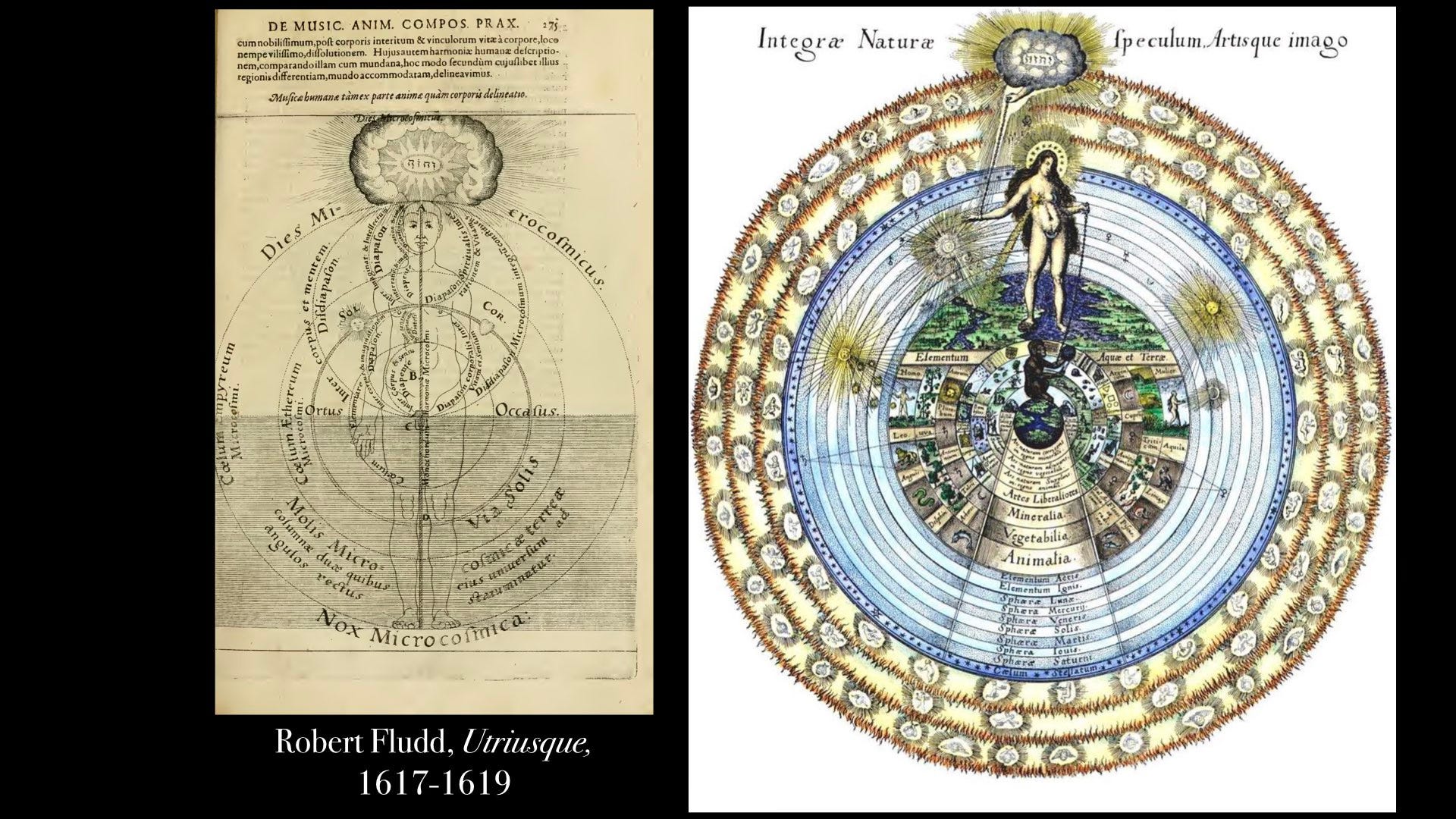
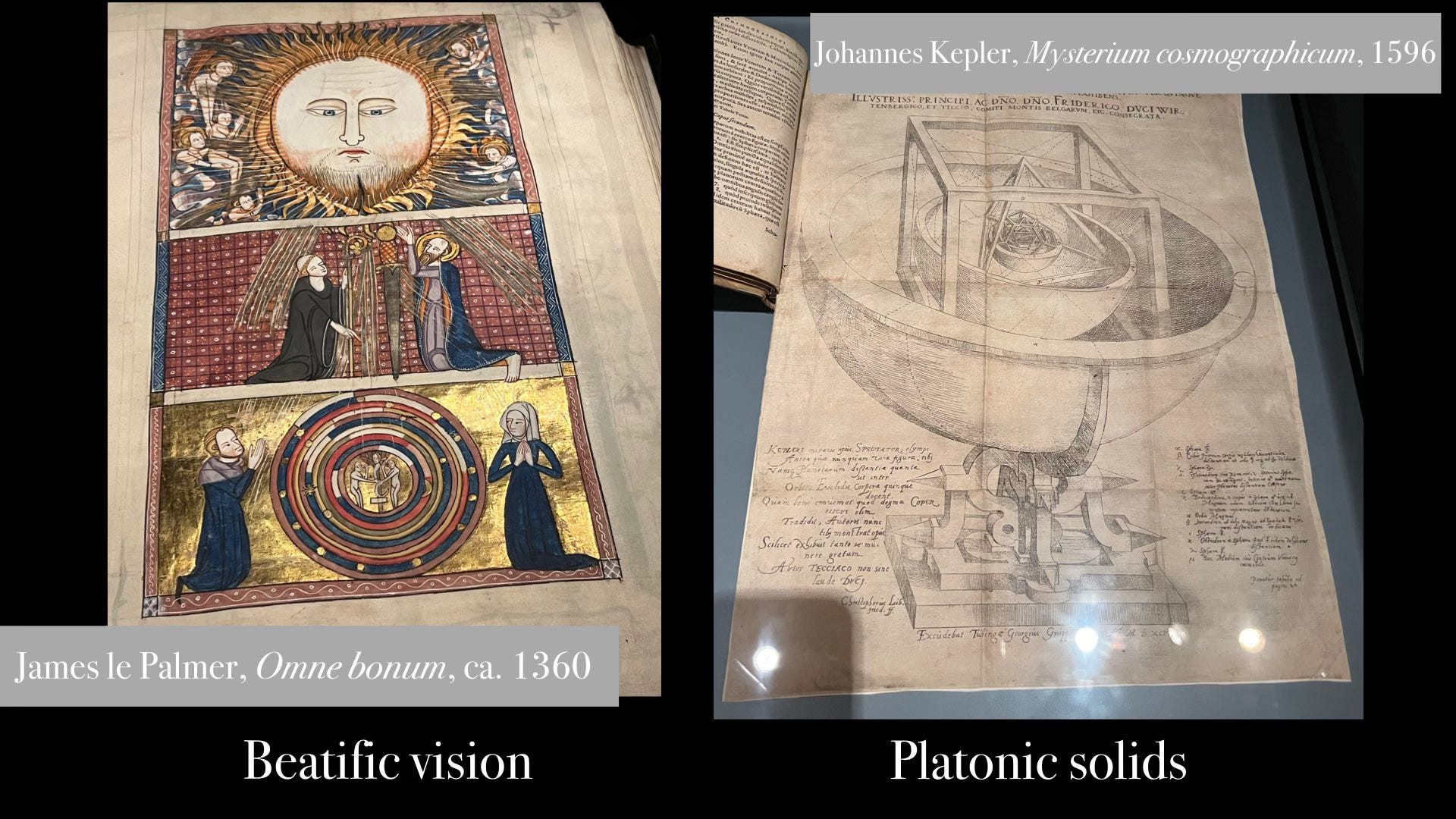
It also affects the way we view astronomy, as well as explaining why the “scientific revolution” is said to have begun with the re-description of the cosmos.
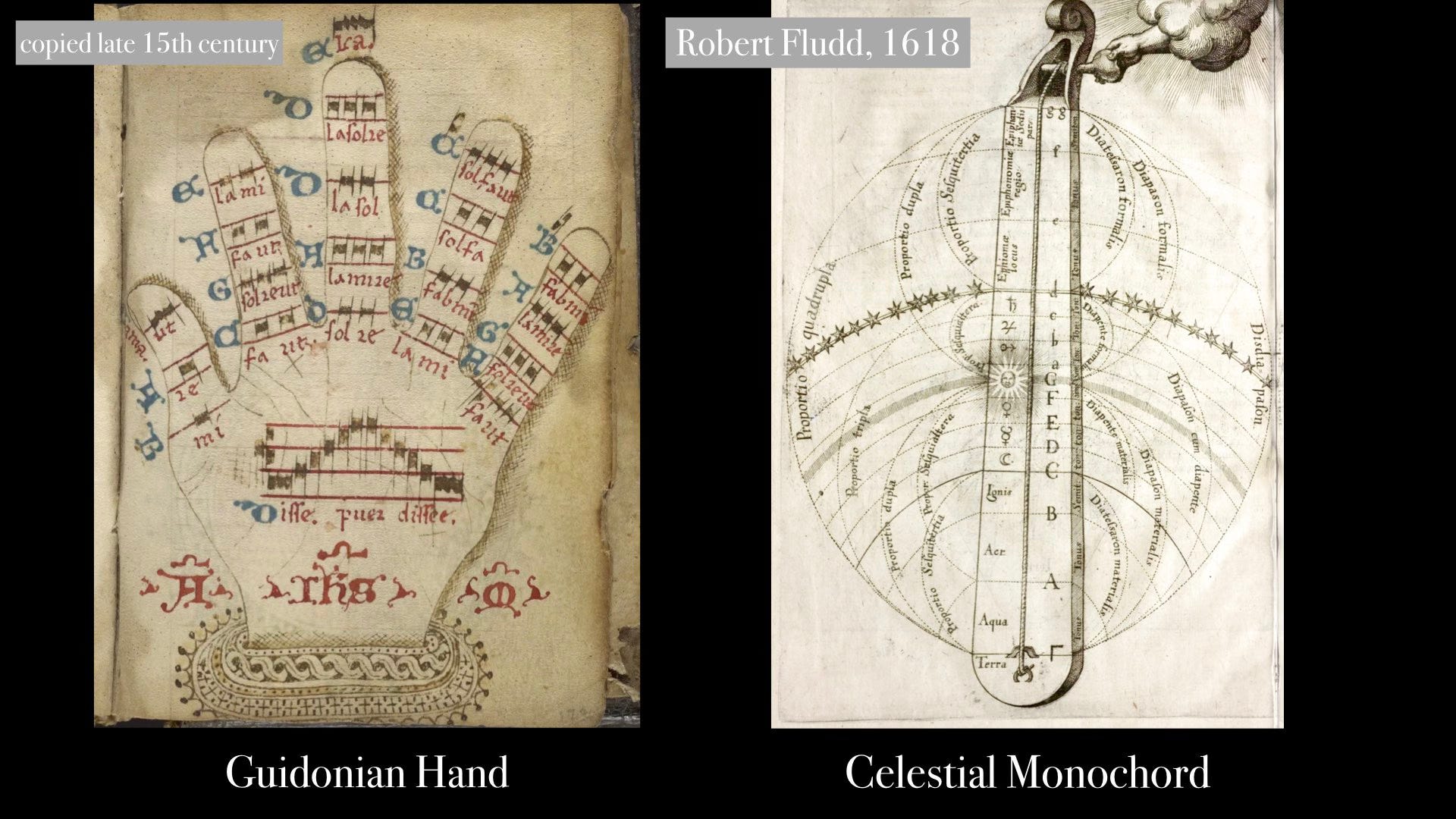
Music—numbers—are in our bodies and minds, turned by the Hand of God.
NB: Musical notation also developed during this period along with even more elaborate page layouts.
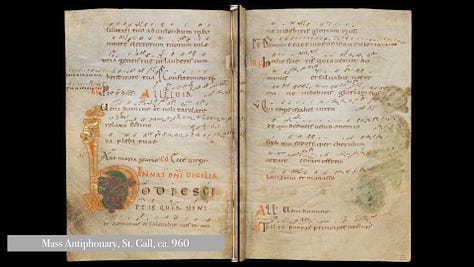
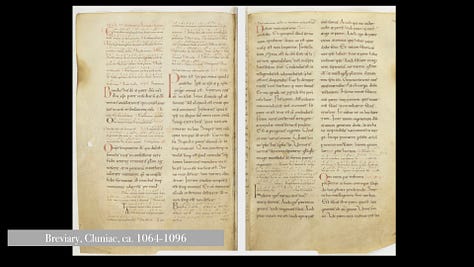
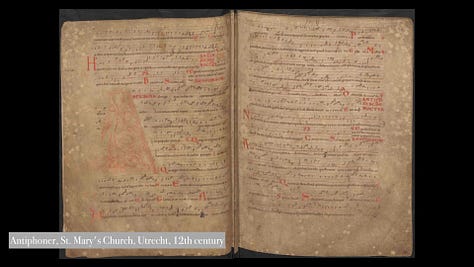
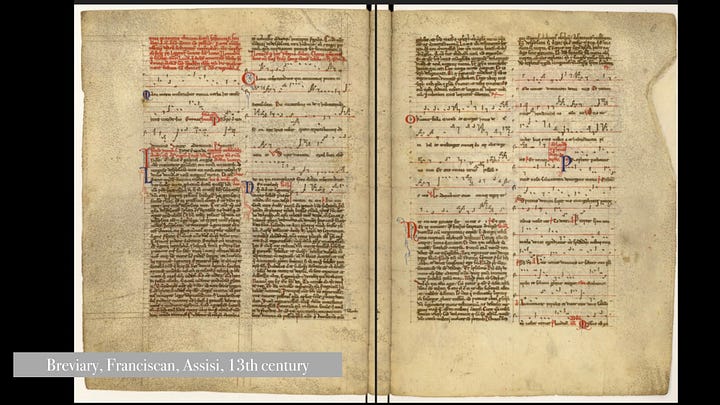
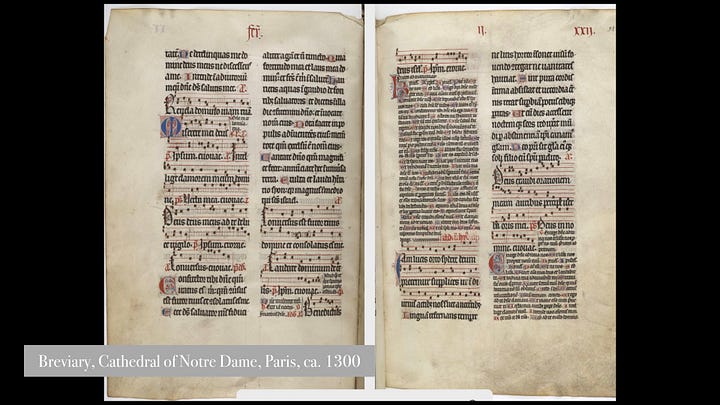
Writing in 1959, C.P. Snow, the novelist, complained that Anglophone readers did not have enough mathematical and scientific training to appreciate the details that C.P. Snow as chemist and physicist put into his storytelling. And, conversely, he complained that scientists in his day only enjoyed listening to music, not reading novels or poetry.
Maybe scientists would like poetry better if they read it out loud? What would poets write if they could include scientific thinking in their stories?
I'm so happy you asked!
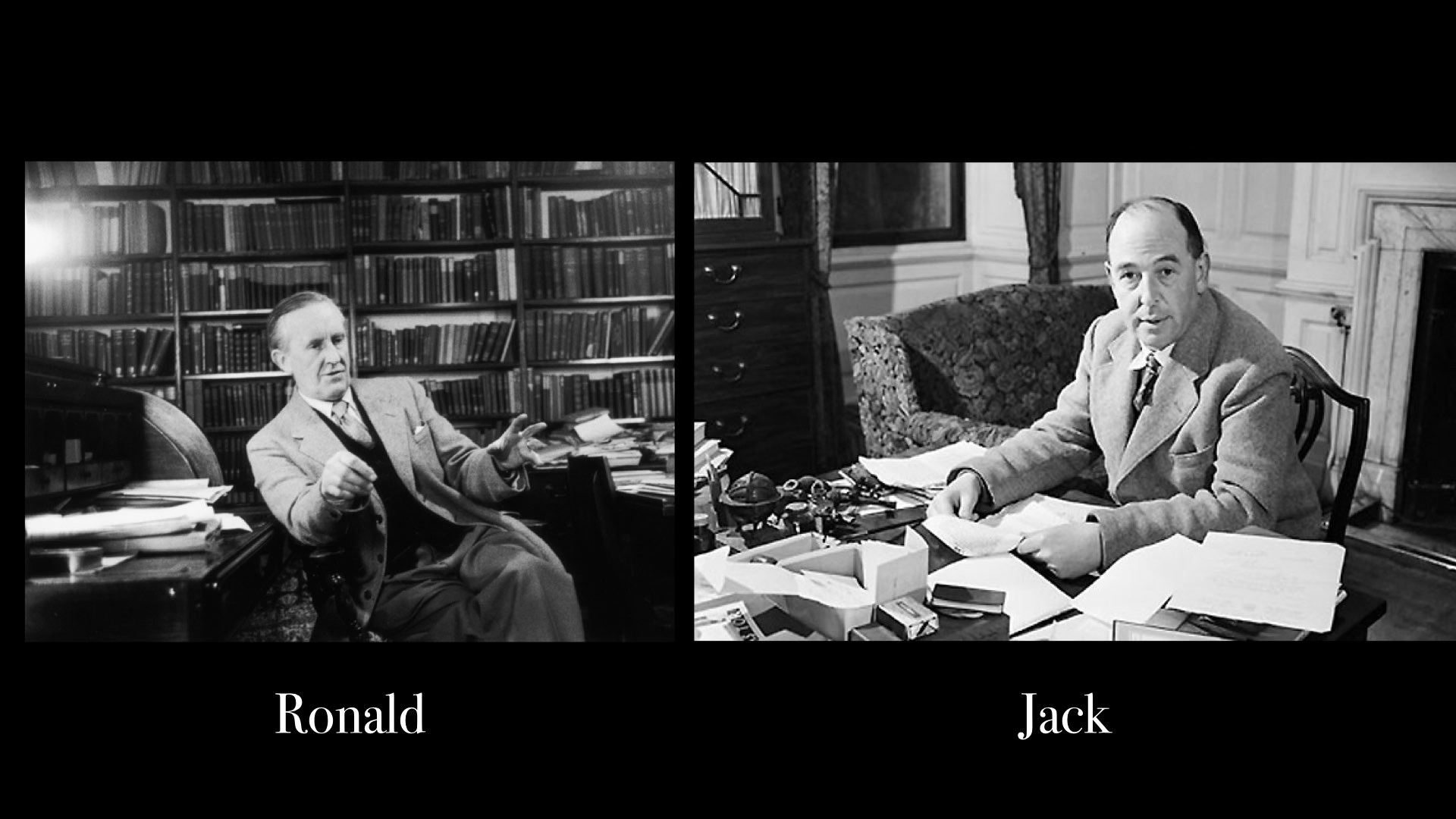
If you are readers of C.S. Lewis (Jack) or J.R.R. Tolkien (Ronald), much of what I have shown you tonight will hopefully be familiar “scientifically” as an example of what Lewis called The Discarded Image and “artistically” as an invitation to “sub-create” (as Tolkien put it) within the world created by our Artist.
Lewis and Tolkien are typically described as writing “fantasy,” but in their own terms they were writing “fairy stories” and “scientifiction.” I would rather describe both of them as “poets,” not only because they both wrote what we now call poetry (technically, lyric verse), but because they were “makers” of stories in this cosmological mold.
If you are at all familiar with their works, you will know the sensation their stories give of always bumping into things you didn’t realize were there until they named them. Of finding yourself in “middle-earth” and realizing you live there already; or longing to hear the music of the spheres if only you could get “out of the silent planet.”
Tolkien and Lewis “invented” much less than people realize; most of the time, they were simply drawing on the books they had read, trying to write the kinds of stories they enjoyed reading and teaching as scholars of medieval and Renaissance philology and literature.
They were also both quite skilled in the use of iambic pentameter, which is why their prose “sings.”
And they were both scathing about the way in which their fellow literature professors refused to learn the art and science on which their discipline was originally based (Tolkien loved philology, the scientific study of language; Lewis particularly enjoyed astronomy), while at the same time insisting that the arts were necessary to wonder and worship within the world that that science described.
Dangerous? You betcha! But far less dangerous than splitting the language arts off from the arts of number and pretending they are two separate things, the verbal and the mathematical, the humanities and STEM.
What would our educational culture look like if we were to think of it as integrated, involving both numbers and words, meter and rhyme, minds, bodies and stars?
Spoiler alert: I think “medieval” is a good thing, but I’m pretty sure you guessed that.
Let me end with some concrete examples—two masterpieces, both poems, both written by laymen (not churchmen) in their respective vernaculars, both now more typically taught in language departments, but for which there are good arguments for using as introductions to the “sciences” of their day.
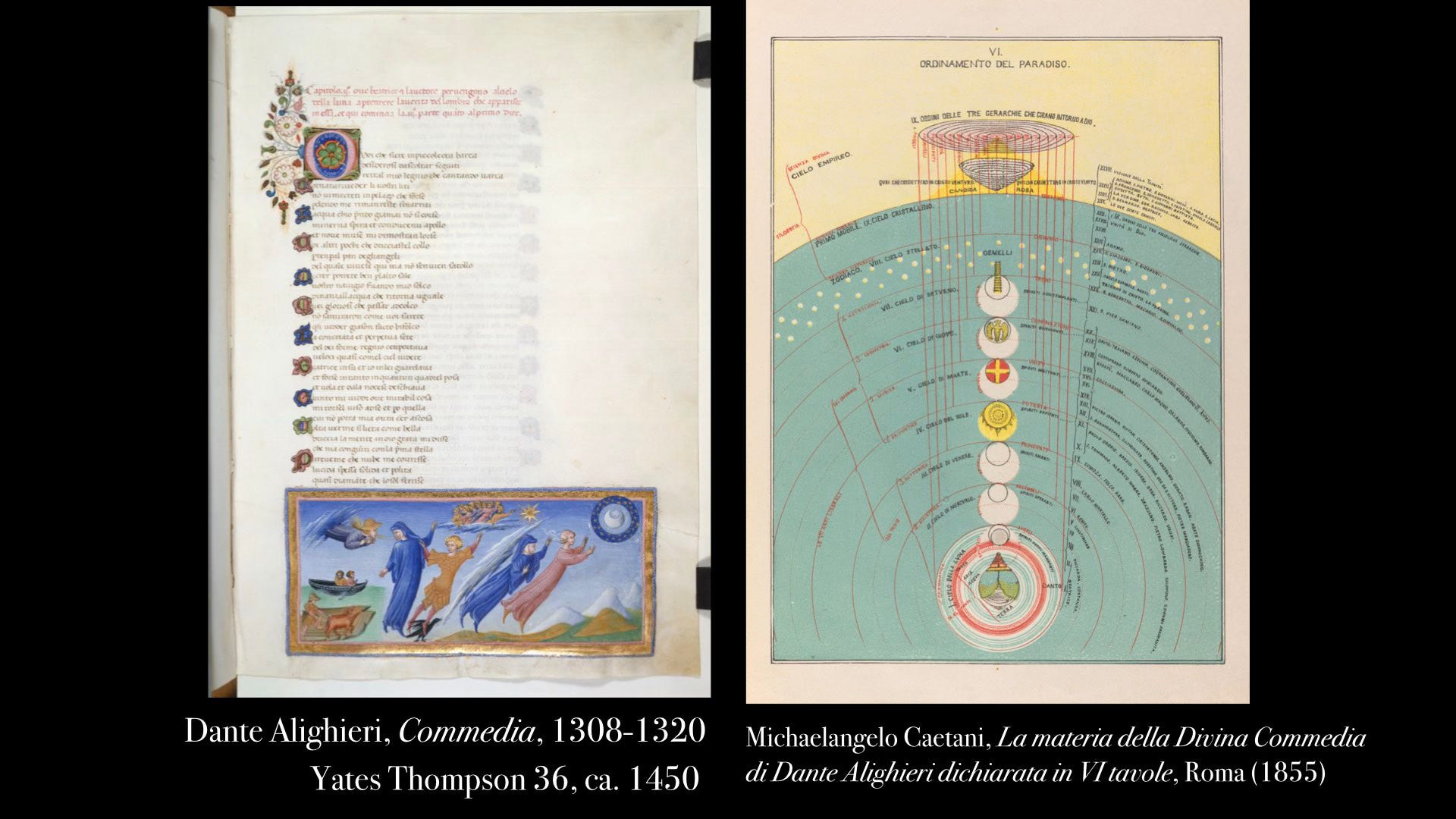
1) Dante: If you read Dante in high school, like I did at Amarillo High, there’s a good chance you read only the Inferno. Because who doesn’t want to imagine their political enemies in Hell?
But if you are interested in the history of astronomy, like C.S. Lewis, you should keep reading: because once you have climbed down Satan’s hairy flanks through the center of the earth and up the mountain of Purgatory on the opposite side of the earth, you get to the Earthly Paradise—at which point, if you are still with Dante, having been purged of your sins, you may ascend through the heavenly spheres of the planets beyond the circle of the fixed stars and catch a glimpse of “the love that moves the sun and the other stars.”
Translations of Dante—I can recommend Dorothy Sayers’—typically come with diagrams and lots and lots of footnotes to explain both his historical references and his theology, but arguably the hardest part for most modern readers is realizing that he took his science, particularly his study of light and optics, very seriously—as he should, having studied with the Franciscans in Florence before he was exiled for supporting the wrong side in their local politics (it’s complicated).
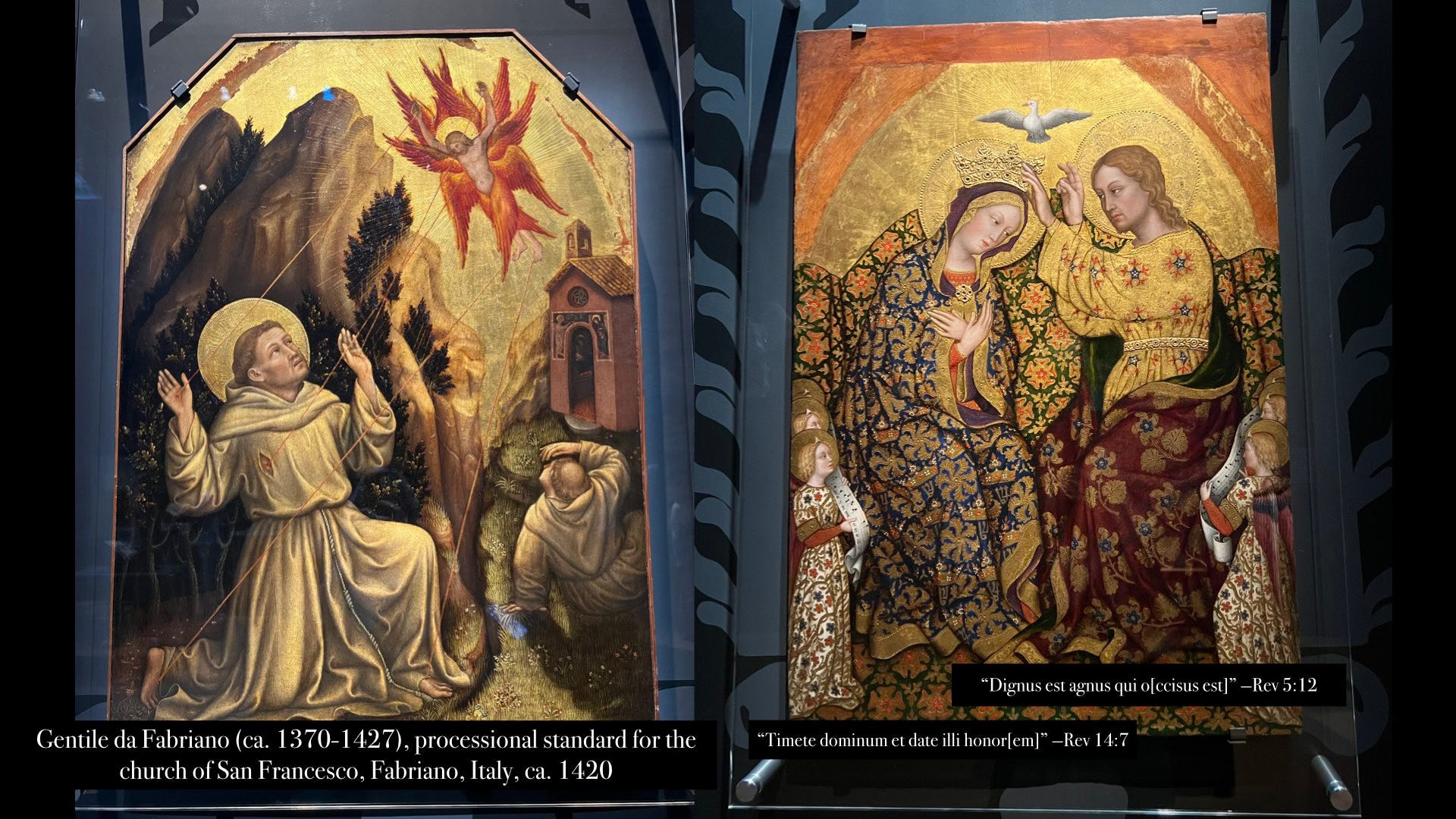
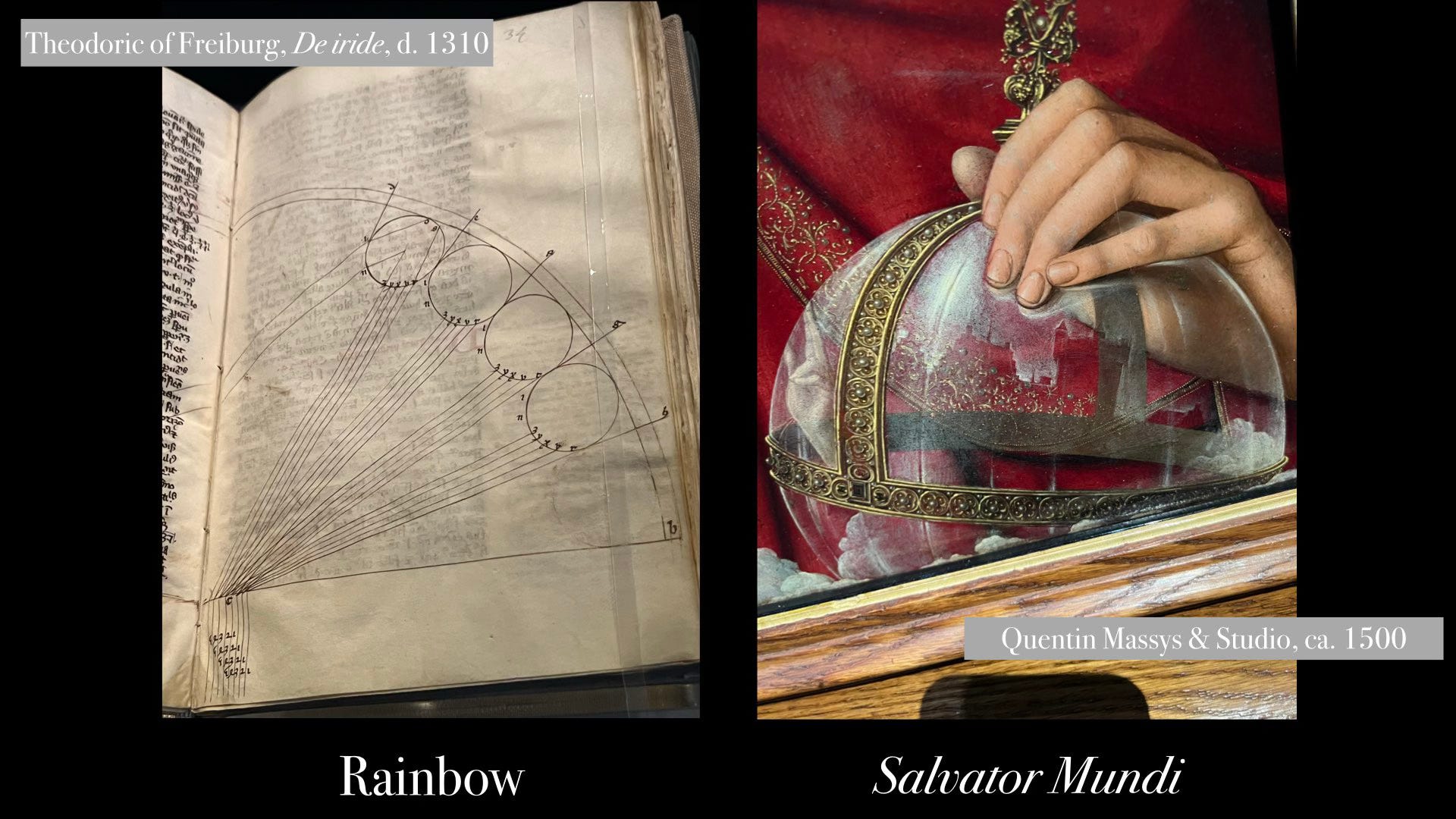
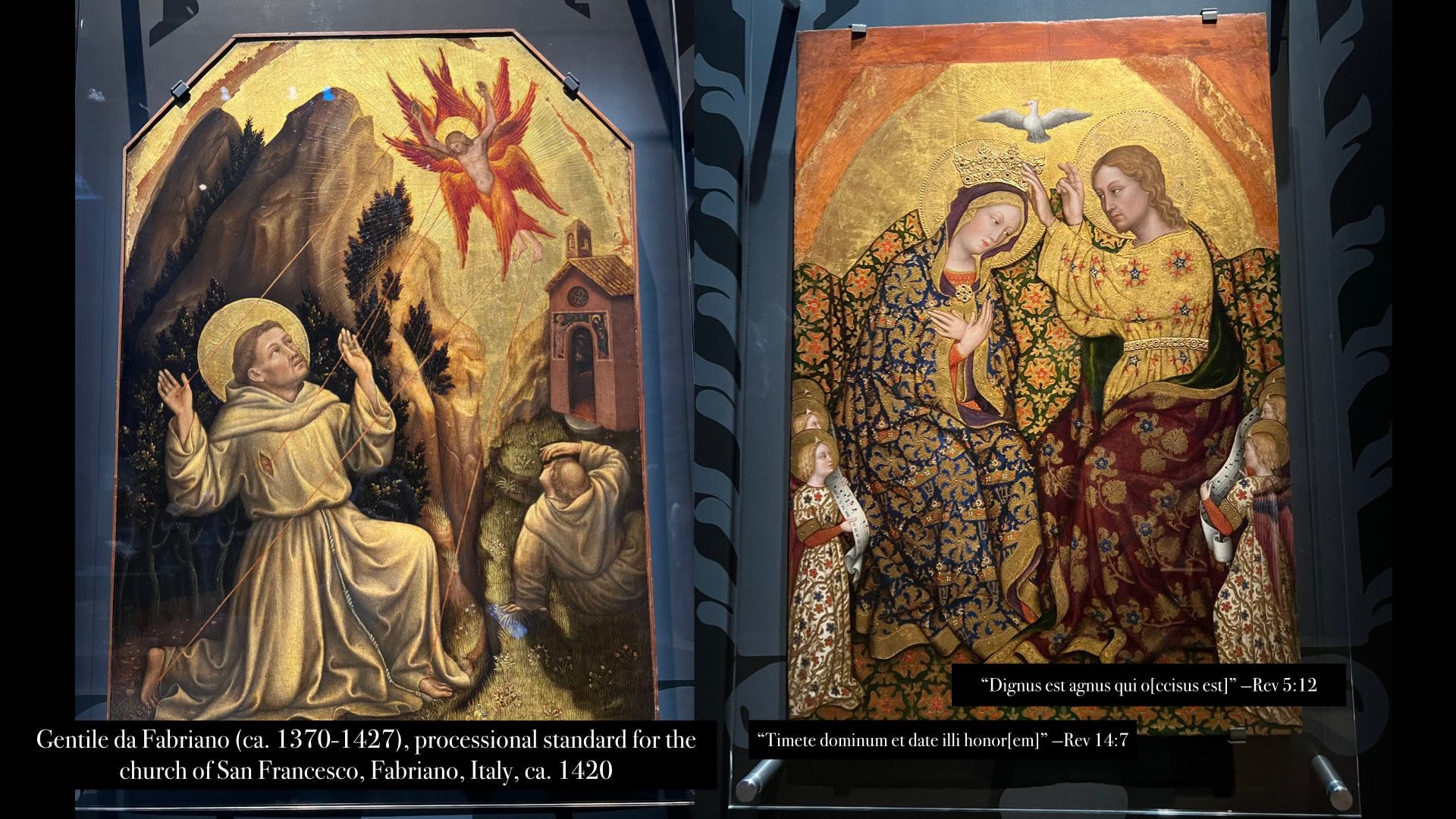
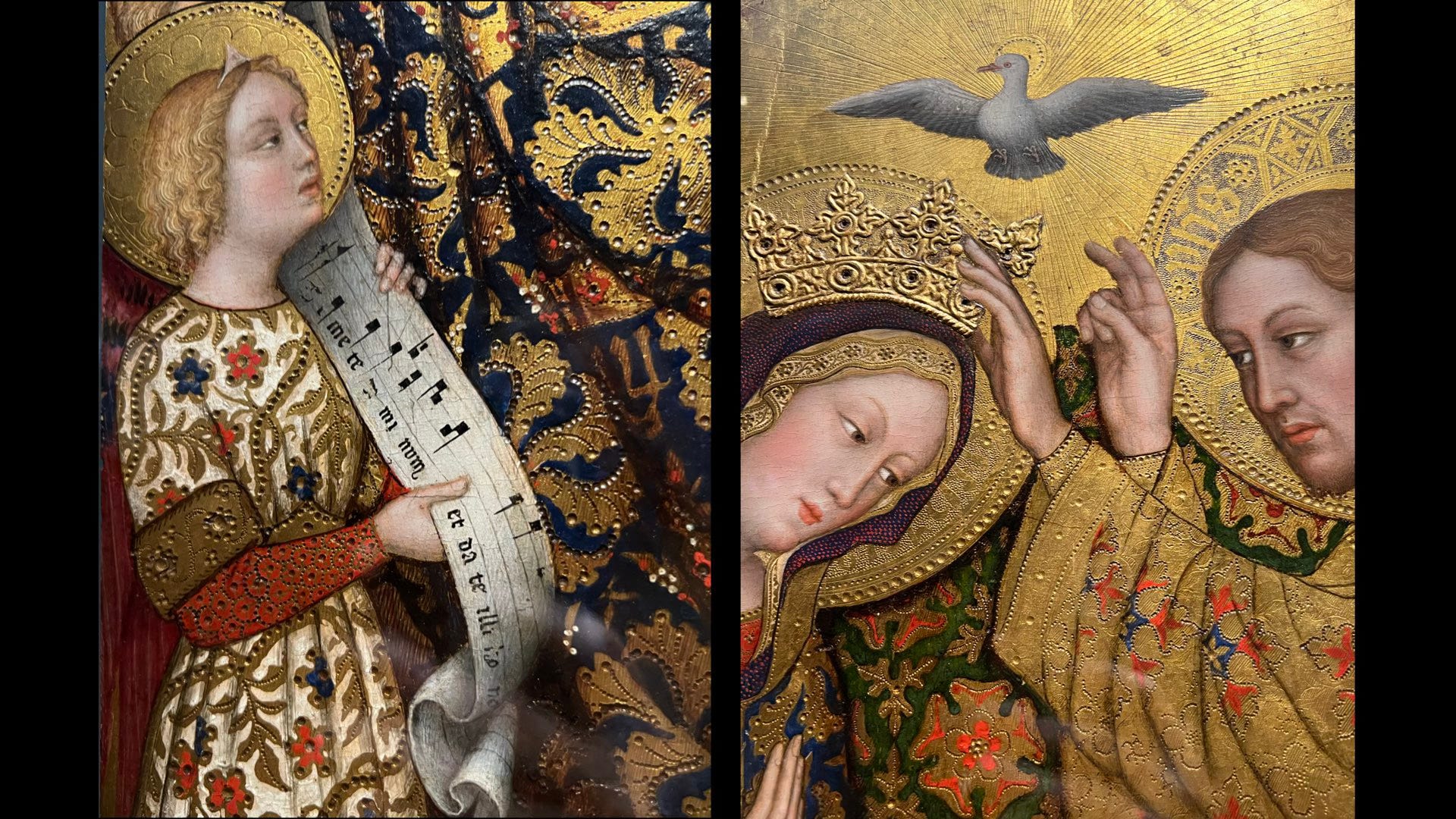
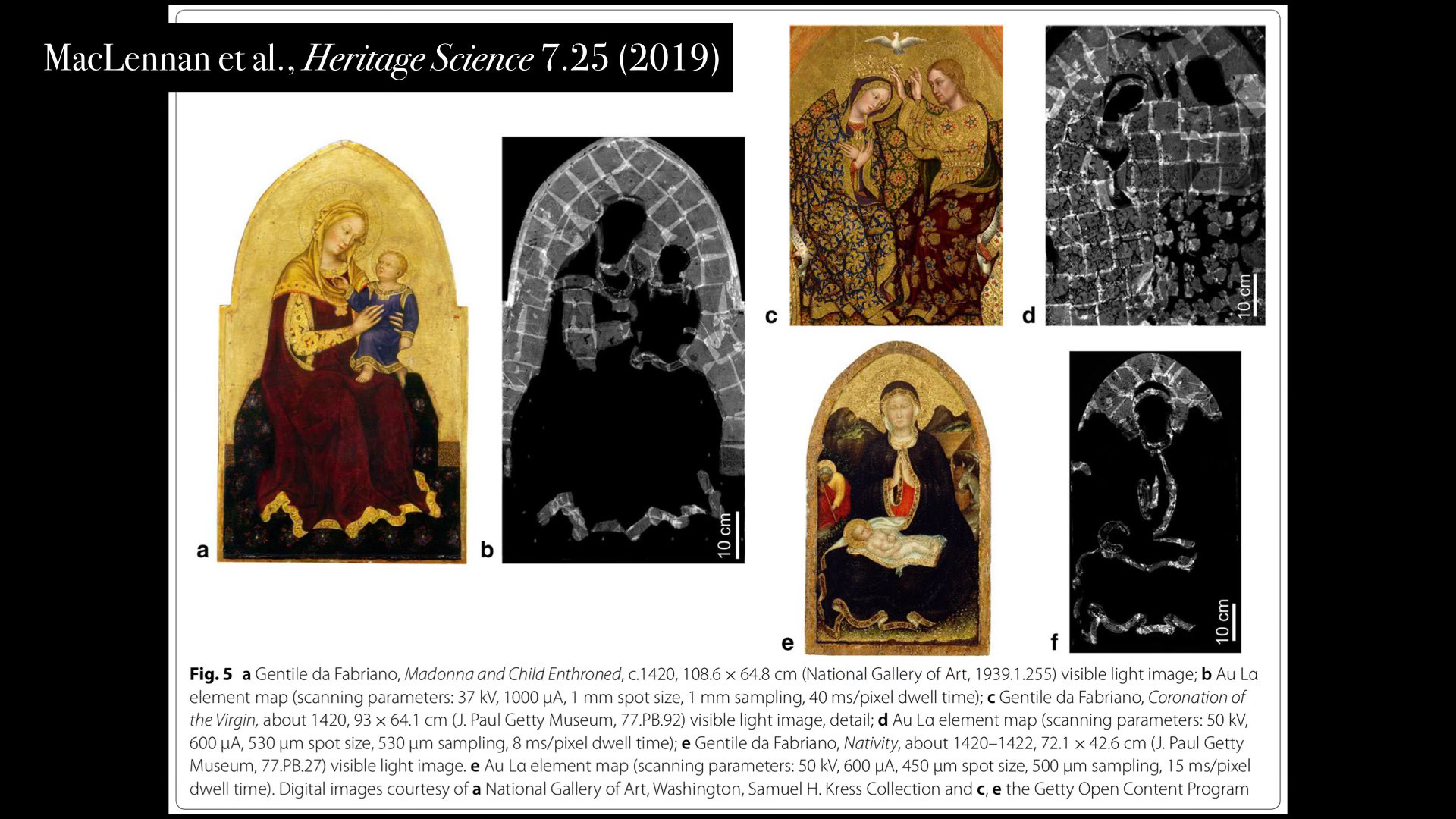
The Franciscans, to put it mildly, were obsessed with optics and light—Roger Bacon famously described the optics of the rainbow—but they were also great patrons of art. Scratch a Franciscan painting of, for example, St. Francis receiving the stigmata, and you are suddenly in a world of artisans caught up in the problem of how to represent the incarnation of heavenly light.
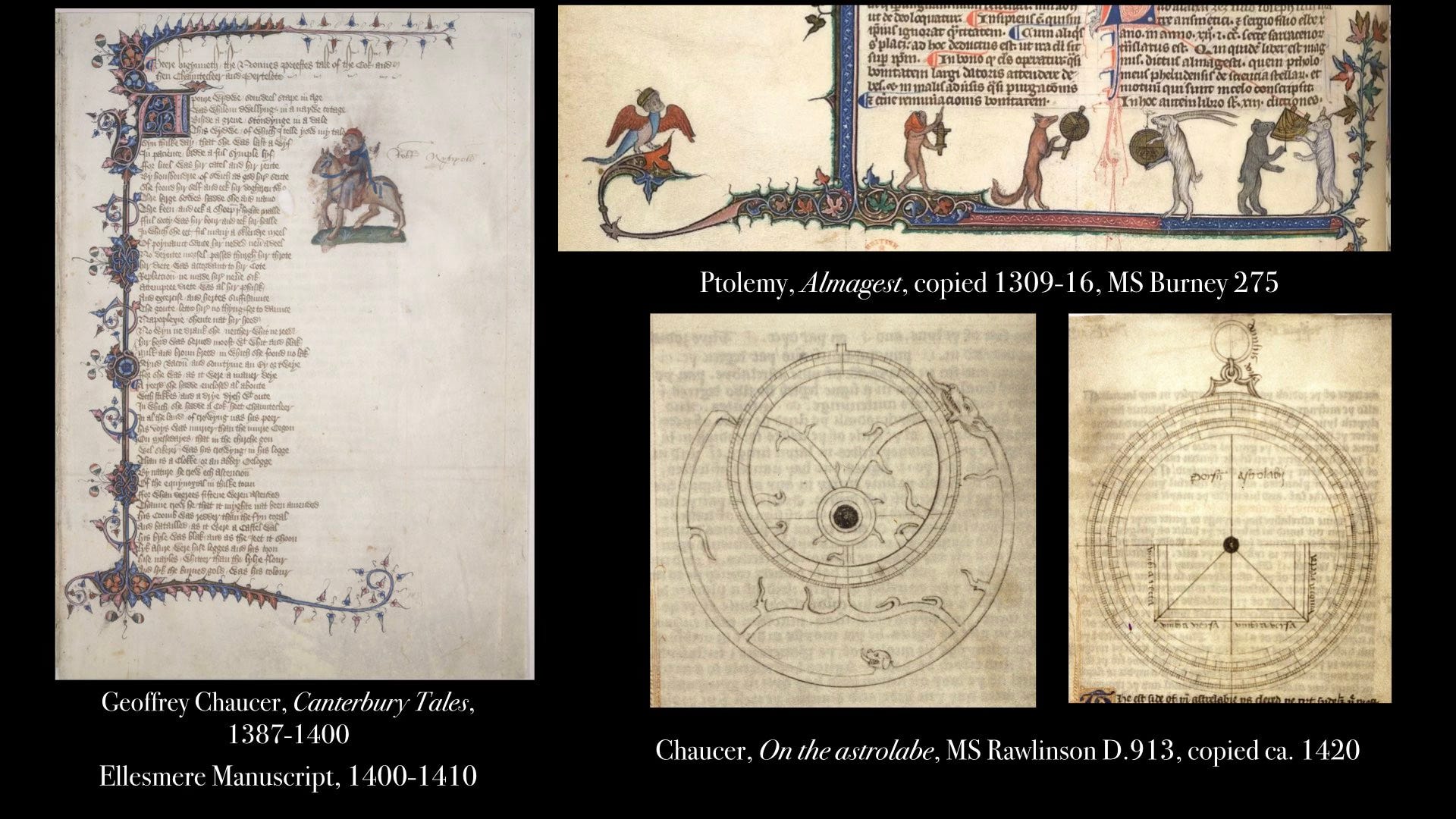
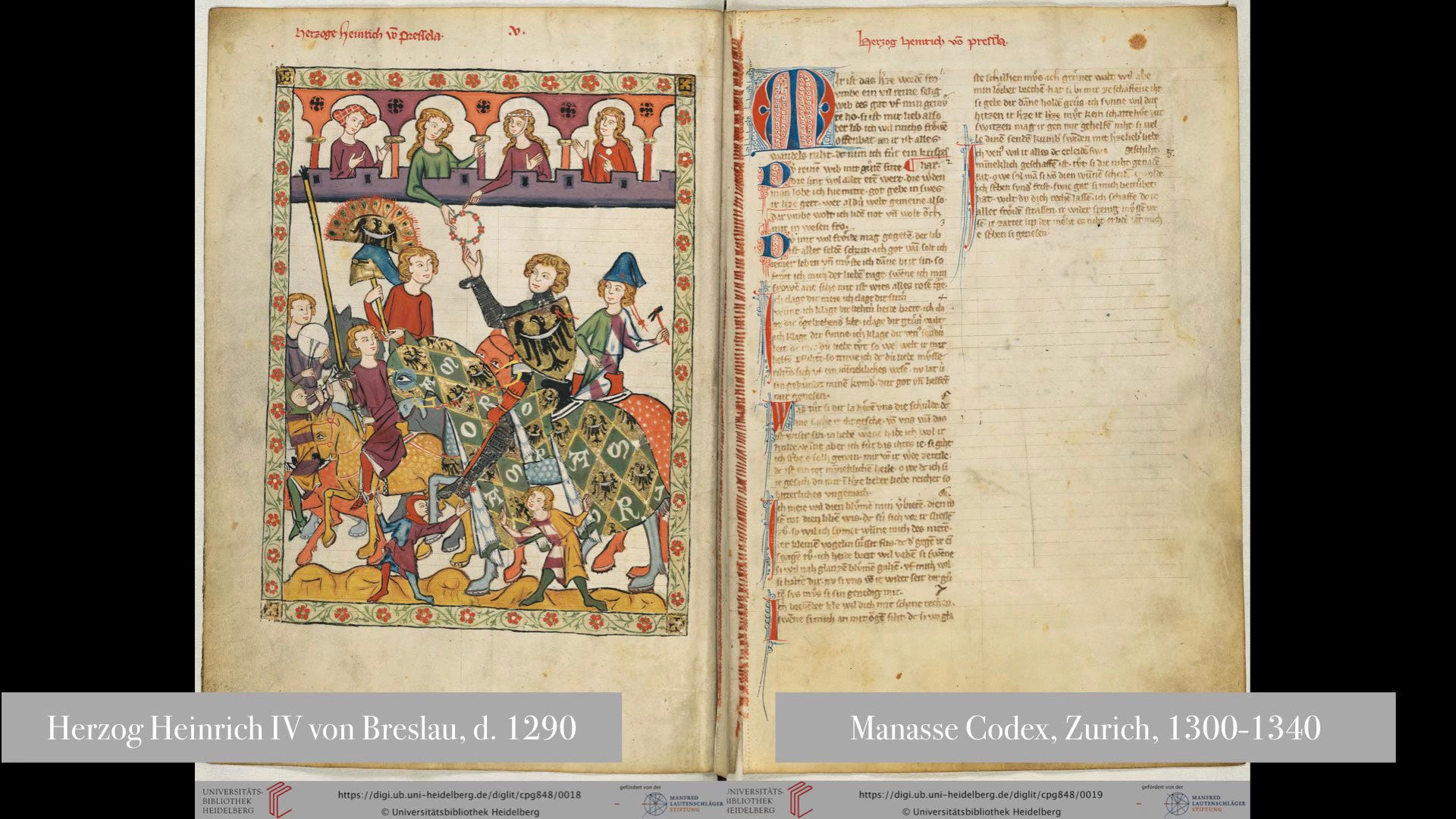
2) Chaucer: If you read Chaucer in high school, you probably remember the Wife of Bath’s tale (yes, women do want sovereignty, just like she says!). But did you get a chance to read the story of the rooster Chauntecleer and his hens? Maybe you remember the bard in the Disney movie of Robin Hood (the 1973 version); his name is Alan-a-Dale, but he is a rooster thanks to the stories of Reynard the Fox, on which Chaucer based the Nun’s Priest’s Tale.
There are many versions of the Reynard story, but Chaucer’s gives the rooster not only seven hen-wives, but also significant astronomical chops: Chauntecleer crows in the morning according to the proper elevation of the sun (fifteen degrees), and he keeps time throughout the day by observing its progress through the signs of the Zodiac.
Nor was it an accident, as historian of astronomy J.D. North has argued, that the rooster had seven wives: just as Chauntecleer takes the part of the sun, strutting across the barnyard as his solar counterpart struts across the sky (“Lyk the burned gold was his colour”), so Pertelote and her six sisters represent the seven stars of the Pleiades (known as hens or gallina throughout the Middle Ages), while the fox who has been lurking in the grove for the past three years waiting for his chance to seize the rooster, represents Saturn, which had been dwelling in the sign of Virgo since 1389 (about three years), only to rise “above the horizon” after the “undren of the day,” that is, 10am.
With further calculation, it is possible to time the attack on Chantecleer more precisely, to a minute after three in the afternoon. We can likewise tell what year it was when Saturn tried to run off with the sun: Friday, May 3, 1392, the only day in the years during which Chaucer conceivably was writing on which the sun had passed twenty-degrees and one of Taurus (ll. 3193-97), at which it was near the Pleiades. Also: it is significant that the fox seizes the rooster by the throat: in our Zodiacal diagrams, wounds to the throat are associated with Taurus (the bull).
Are we to believe that Chaucer’s readers would have appreciated this level of astronomical detail? Yes—given that Chaucer himself wrote an introductory treatise on how to use the astrolabe for Lewis, his ten-year-old son.
Obscure as the calculations may seem to us, this was elementary education in astronomy in the fourteenth century.
Can you hear him? Can you see him? Here’s our rooster crowing:
Text within this block will maintain its original spacing when published
Singing: “Lady, lady, will you come away with Me,
Lie among the bracken and break the barley bread?
We will see new suns arise in golden, far-off skies,
For the Son of God and Woman hath not where to lay His head.”
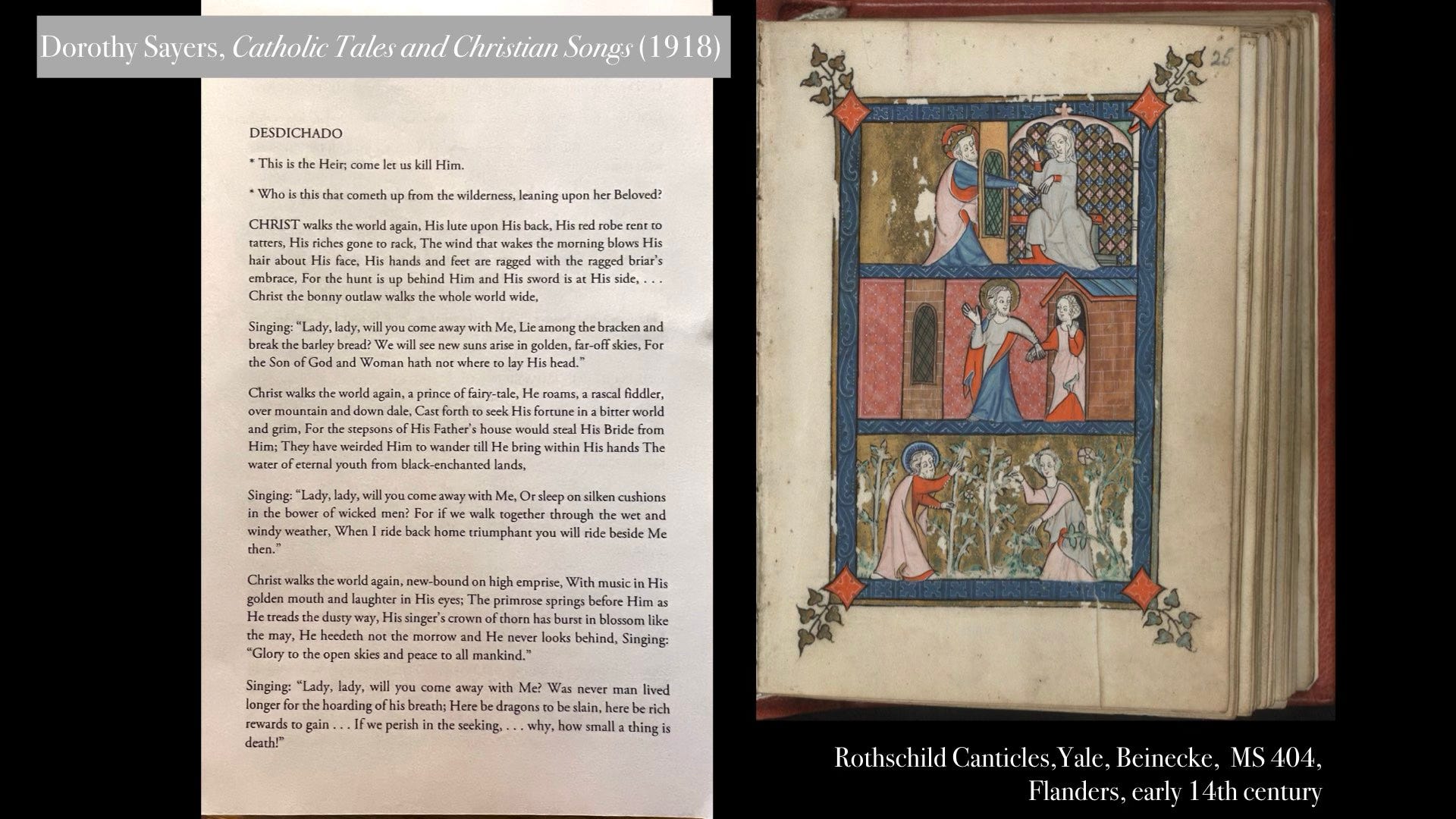
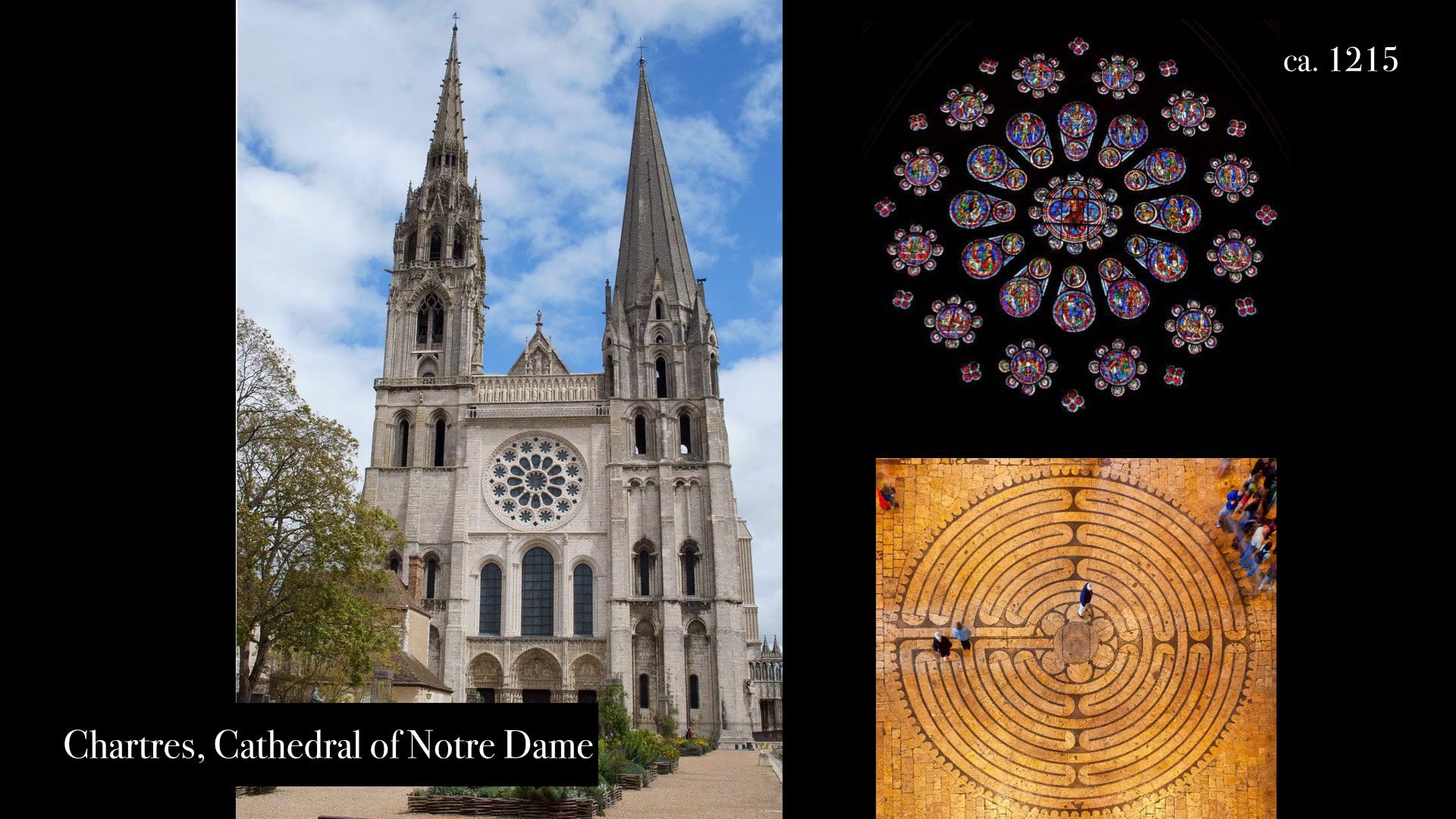
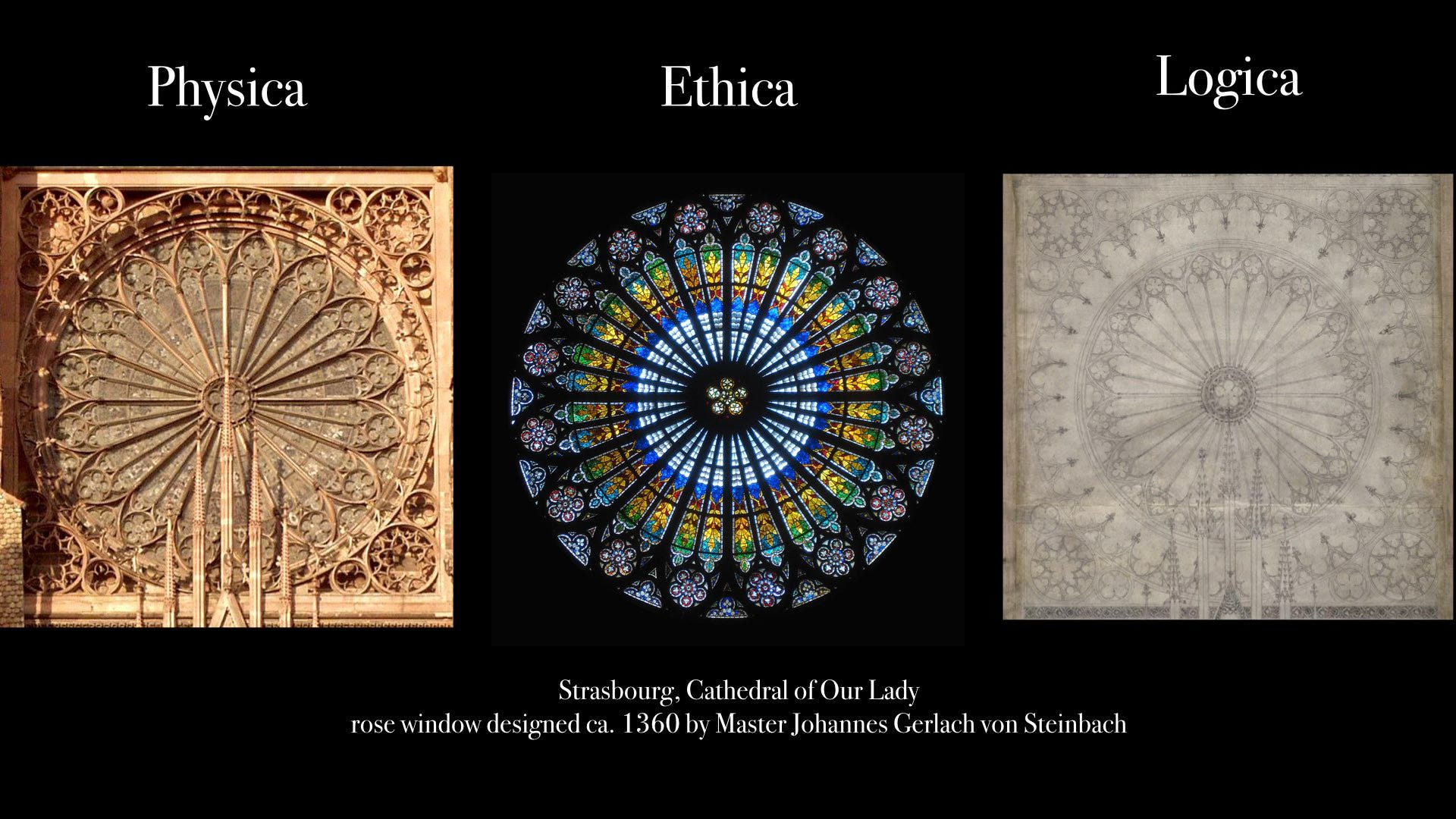
And here is the light that came into the world, incarnate as the Word:
Here is our big question: Not whether it is possible, but why have we have abandoned this integrated understanding of technology and contemplation? Art and science? Number and word?
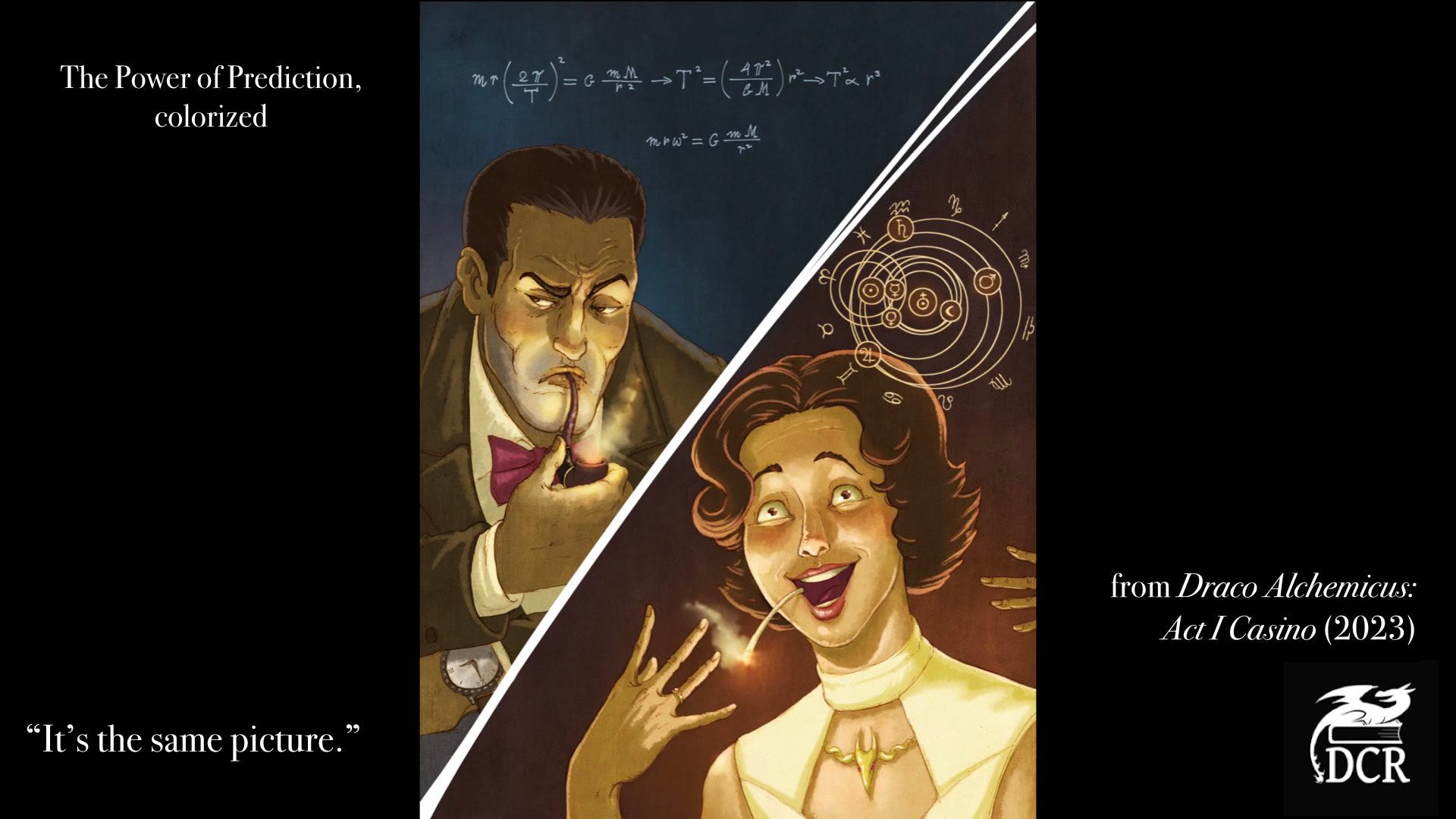
What if we were willing to see poetry as a science, wedding contemplation and craft?
That would be something to celebrate, don’t you think?!
With thanks to the community of Amarillo College for sponsoring this experience, and to my brother Robert for bringing us together for such a lively conversation!
To learn more about our poetry and buy our books, visit the Dragon Common Room.
Comments
Nothing yet. Say the first thing.
Sign in to join the conversation.