
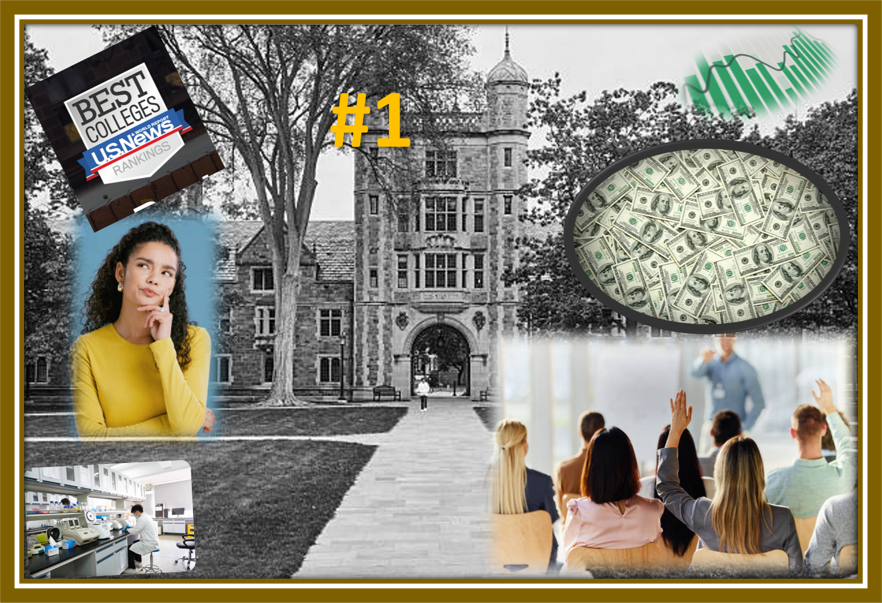
One college where I worked obsessed with rankings. They would throw a party every year if their ranking was high enough. The despair if they slipped one spot in the rankings permeated the corridors.
As federal funding for academic research became scarce, universities and colleges worked hard to maintain their image and ‘brand’ of productivity to not only attract top talent and students but gain funding.
Unsurprisingly, there was an increased focus on national and global university rankings. With the inauguration of U.S. News and World Report college and universities ranking 1983 including aspects such as institutional resources and admissions rates, rankings “quality” began to define the academic world. A decline in rankings could be correlated in a “decline” in applicant numbers and quality, or those that required more financial aid.
The research system became increasingly competitive, and even more autonomous within the university itself (Geiger, 2020). While the American public in theory seemed to ‘approve’ of this research for its ‘usefulness’ there were many detractors to such industry-academic connections. When these new “research parks” did not display short-term payoffs this resulted in criticism (Geiger, 2019b). To make matters worse, in 1991, Stanford was found to be abusing indirect-cost recovery on federal grant funds, which was quietly repaid (Folkenflik, 1994). The Stanford case and other investigations into university use of federal funds, resulted in a dip in public confidence in academic research and slower increases in federal funding (Geiger, 2019b).
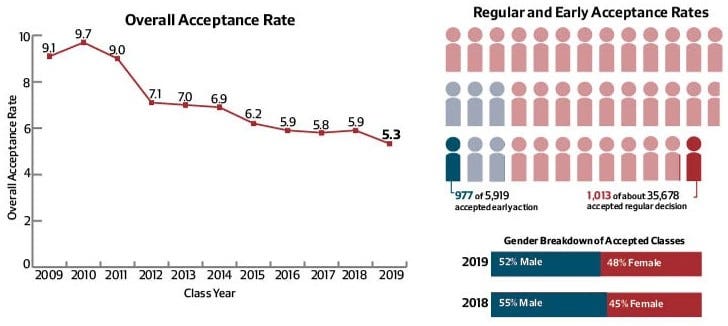
Harvard University’s acceptance rate continues to decline. The bar for research, admittance, and achievement is raised ever higher at the American Research University.
Yet, the research university continued its relentless push forward. Between 1982 and 1995, overall departmental quality and ratings rose at many universities, due to upgrading of faculty and research (Geiger, 2019b). Even the “leading” universities of the time, outpaced themselves in the quality, quantity, and impact of their research.
Those outside of the ranks, strived to get in. For example, in the mid-1990s, The Ohio State University began a deliberate push to become a top 10 public research university (Miller, 1994). Some students at OSU questioned these efforts, suggesting this drive would sacrifice teaching quality (Miller, 1994). However, by 2005, OSU had achieved its goal (OSU, 2005). The Purdue Agricultural and Biological Engineering department also underwent rigorous curriculum and research changes, with increased focus on entrepreneurial and corporate partnerships, to become the #1 top ranked department in their field by 2009 (Heidi A. Diefes-Dux and Kamyar Haghighi, 2001 ; ABE, 2005 ; Purdue, 2021).
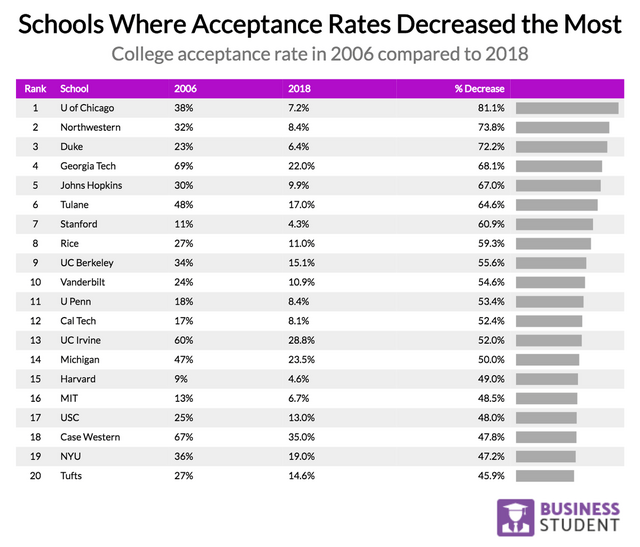
Universities with the steepest declines in acceptance rates.
Such changes, however, cut into the public mission of these institutions. There was increasing reliance on out-of-state or international students to subsize tuition (Daugherty and Dorsey, 2018; Purdue, 2022a). Money was often directed to the most “wealth producing” fields, like engineering and biotechnology (Rhoades and Slaughter, 1997, p 25). Programs and departments were continually evaluated for their “centrality” (Rhoades and Slaughter, 1997, p 19).
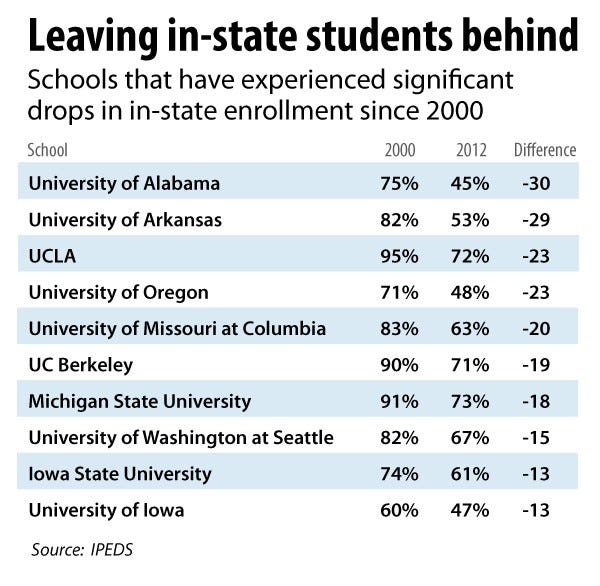
In the 2000s and 2010s, public colleges saw sharp declines in in-state student enrollment as universities expanded effort to recruit out of state students (who would pay full tuition not get a discount) to subsidize declining state fundings.
Interdisciplinary units that addressed complex or new subject matters (e.g., cancer research), scientific institutes with new technology and instruments, and consumer-oriented centers (e.g., business school) that closely collaborated with industry were favored (Geiger, 2019b) in this environment. Departments in different subject areas struggled, particularly at public universities. Notably, there were also significant cuts to humanities departments resulting in layoffs, consolidation, increased student to faculty ratios, and cut programs (Purdue, 2022b; Murley, 2021; Adamski, 2012; Yaw, 2020).
Furthermore, there was increasing effort to displace tenure-track faculty members by admitting more graduate students and developing low-paying, contingent faculty jobs (Rhoades and Slaughter, 1997) . While academia remains extremely labor-intensive, there is constant “restructuring” and “streamlining”, with tenure-stream faculty being laid-off, retrenched, or pushed into early retirement (Rhoades and Slaughter, 1997). The remaining faculty who were hired had to increasingly compete for travel grants or resources or to even raise their own salary through grants and contracts (Rhoades and Slaughter, 1997; Bousquet, 2008).
Faculty and students were “invested” in according to their “revenue” potential (Rhoades and Slaughter, 1997, p 33). By the year 2000, there were hardly any higher educational institutions in the United States, even at the most elite institutions, in which more than 30% of course sections were taught by tenure-stream faculty (Bousquet, 2008). Such changes were attributed to the “supply and demand” of the academic labor market.
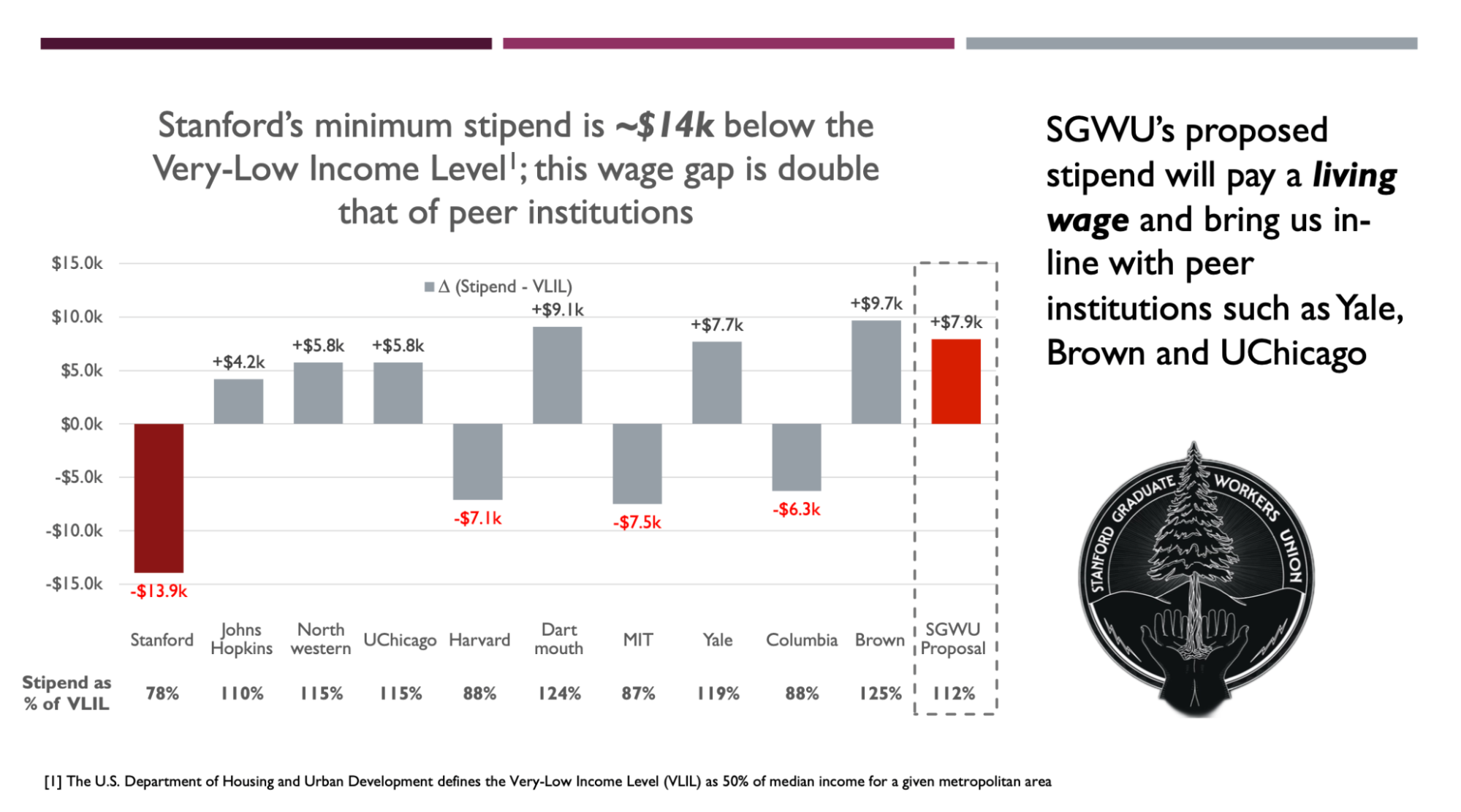
Stanford’s graduate worker stipends ($50,616) was lower than the local cost of living (2024).
Notably, graduate student stipends in humanities programs were lower compared to STEM programs. At Cornell University, the graduate stipend in the Biological and Environmental Engineering program in a 12-month 2019-2020 was $36, 291 (BEE, 2021) where the university minimum was $27, 218 (CU, 2019).
The University of Illinois Urbana-Champagne had a minimum graduate stipend of $18,500 (UIUC, 2021a) while the Agricultural and Biological Department had a $27,497 Ph.D. stipend (UIUC, 2021b). The OSU Engineering College has a minimum stipend of $28,368 (OSU, 2021) where the university minimum is $21,280 (OSU, 2020). The University of Florida in the Liberal Arts and Sciences had a base Ph.D. stipend of $17,000 (UF, 2019). The college of Arts and Sciences at Oklahoma State University has $15, 183.00 (OSU, 2022).
Typically, graduate students in the humanities are receiving aid through teaching assistantships, versus research assistantship for STEM students, with teaching assistantships providing a lower stipend. The message is that teachers are of less value than researchers.
In this obsession of rankings, even STEM fields are not safe, and if the field is not ‘wealth producing enough’ it can go on the chopping block. Fields like botany could be downsized over something like, AI research. Departments are on a continuous hamster wheel to prove relevance. This increase in pressure can create a toxic, competitive environment among staff and students. This hampers diversity.
Please follow me on my social media platforms:
ABE, 2005. ABE Expands Biological Engineering Program and Embarks on a Venture into Discovery Park. West Lafayette, IN.
Adamski, N., 2012. MFA Program cut due to budget. Dly. Coll.
BEE, 2021. Funding for M.S. and Ph.D. Graduate Students [WWW Document]. Cornell CALS.
Bousquet, M., 2008. How the University Works: Higher Education and the Low-Wage Nation. New York University Press, New York, London.
CU, 2019. 2019-20 Graduate Student Assistantship and Fellowship Stipend Rates [WWW Document]. URL
Daugherty, O., Dorsey, M., 2018. Where Buckeyes Come From: Ohio Residents Account for Smaller Portion of Freshmen Enrollment. Ohio State Lantern 1–23.
Folkenflik, D., 1994. What Happened to Stanford’s Expense Scandal? Balt. Sun.
Geiger, R.L., 2020. Building Knowledge:The Research Mission in American Universities, 1890–2018, in: Engwall, L. (Ed.), Missions of Universities Past, Present, Future. Springer International Publishing.
Geiger, R.L., 2019a. Surviving the Seventies, in: American Higher Education Since World War II. Princeton University Press, pp. 217–265.
Geiger, R.L., 2019b. Dawn of the Current Era, 1980-2000, in: American Higher Education Since World War II. Princeton University Press, Princeton & Oxford, pp. 269–311.
Heidi A. Diefes-Dux, Kamyar Haghighi, 2001. Closing the EC 2000 Loop and Implementing Change, in: 2001 ASAE Annual International Meeting. Sacramento, California. https://doi.org/10.13031/2013.3592
Miller, T.C., 1994. USG Eyes Push for Research. Ohio State Lantern 1.
Murley, S., 2021. Lack of funding to English department to shutter graduate programs. Purdue Expon.
NSF, 2022. About the IUCRC Program [WWW Document]. IURC. URL https://iucrc.nsf.gov/about/ (accessed 5.21.22).
OSU, 2022. Fellowships and Assistantships [WWW Document]. OSU Coll. Arts Sci. URL https://cas.okstate.edu/department_of_history/graduate_studies_pages/fellowships_assistantships.html (accessed 1.25.22).
OSU, 2021. Funding [WWW Document]. Ohio State Univ. Coll. Eng. URL https://engineering.osu.edu/graduate/graduate-students/funding (accessed 1.25.22).
OSU, 2020. Ohio State increases minimum graduate stipends by $4,000 over two years [WWW Document]. Ohio State NEws. URL https://news.osu.edu/ohio-state-increases-minimum-graduate-stipends-by-4000-over-two-years/ (accessed 1.25.22).
OSU, 2005. Ohio State Ranked One Of Nation’s Top 10 Public Research Universities [WWW Document]. OSU.
Pulido, L., 2014. Faculty Governance at the University of Southern California, in: Chatterjee, P., Maira, S. (Eds.), The Imperial University: Academic Repression and Scholarly Dissent. University of Minnesota Press, Minneapolis, Minnesota, pp. 145–168.
Purdue, 2022a. Student Enrollment [WWW Document]. Data Dig. URL https://www.purdue.edu/datadigest/?dashboard=EnrollmentBars_1 (accessed 1.24.22).
Purdue, 2022b. Student to Faculty Ratio [WWW Document]. Data Dig. URL https://www.purdue.edu/datadigest/?dashboard=Student_Faculty_Ratio_1
Purdue, 2021. Purdue Agricultural and Biological Engineering program ranked No. 1 [WWW Document]. Agric. News.
Rhoades, G., Slaughter, S., 1997. Academic Capitalism, Managed Professionals, and Supply-Side Higher Education. Soc. Text 51, 9–38.
Stanford, 2022. A History of OTL [WWW Document]. Off. Technol. Licens. URL https://otl.stanford.edu/history-otl (accessed 5.21.22).
UF, 2019. Financial Aid [WWW Document]. UF Lib. Arts Sci. URL https://english.ufl.edu/graduate/prospective-phd-students/financial-aid/ (accessed 1.25.22).
UIUC, 2021a. Graduate Funding [WWW Document]. Dep. Commun. URL https://communication.illinois.edu/academics/ma-and-phd/graduate-funding#:~:text=For the 2019-2020 academic,to about %24700 per term (accessed 1.25.22).
UIUC, 2021b. Graduate Financial Support [WWW Document]. Agric. Biol. Eng. URL https://abe.illinois.edu/future-students/financial-support/graduate-financial-support (accessed 1.25.22).
Yaw, C., 2020. In the face of enrollment crisis, humanities advisers to face layoffs. Dly.
No posts
Comments
Nothing yet. Say the first thing.
Sign in to join the conversation.