
I would hate to wade into the waters of “pop music discourse slop” on here, but the waters are digital, and therefore impossible to actually drown in. And so if at any point you do feel suffocated, feel free to wave your virtual arms, and I am sure a lifeguard will be sure to come and save you.
Recap & Summary (can skip if you’re gay)
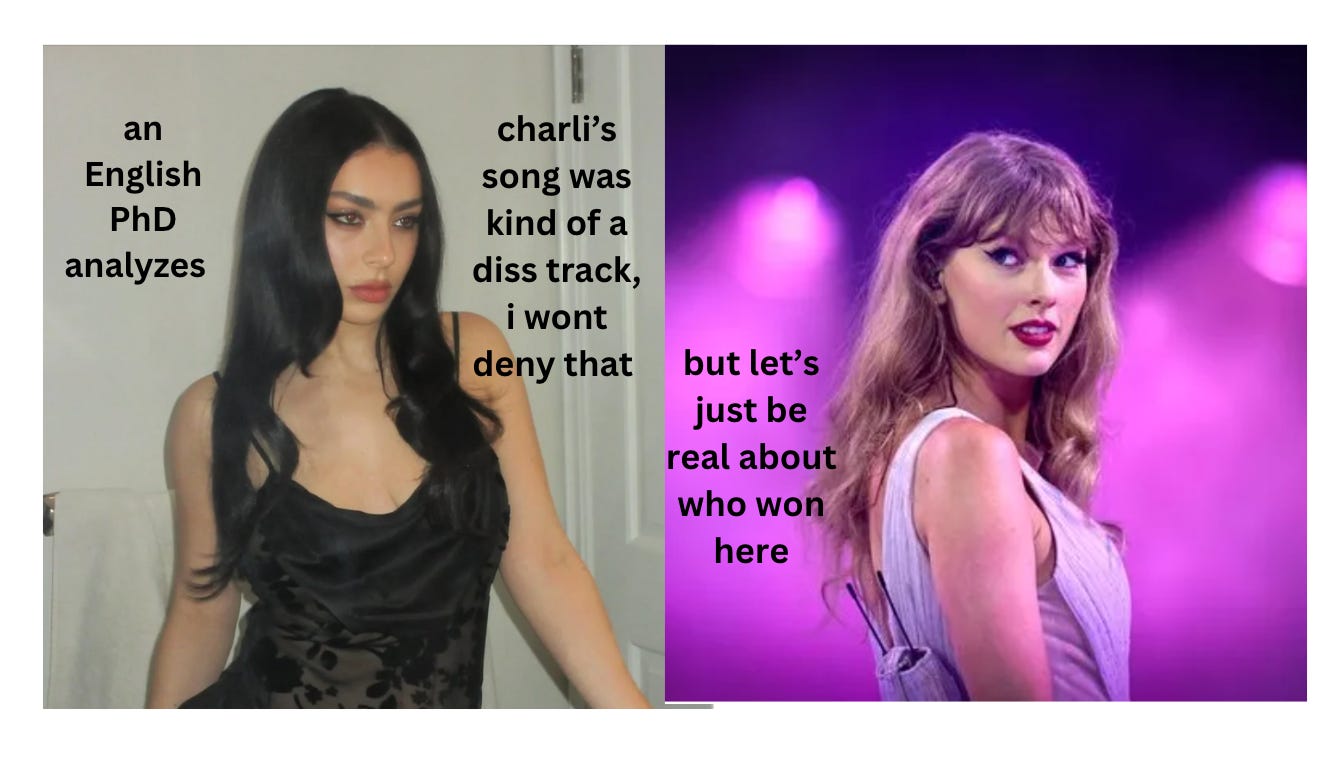
To recap – for the non-chronically online, the heterosexual, the employed (although aren’t these all kind of the same thing by now?) – Charli XCX wrote a song “Sympathy is a Knife” in her now-famous, now-summer-season-defining, vernacular-creating album BRAT.

The song is semi-clearly (semi is important here) about Taylor Swift. In it, Charli reflects on the experience of being an opener for Taylor Swift and always coming in second (or maybe third or fourth) – basically, not getting enough praise as Miss American Barbie, but getting a lot of sympathy for it. Charli hates the sympathy but needs it.
From there, she writes about the experience of her and Taylor both dating men in the same band, The 1975. Taylor Swift dated Matty Healy (guitar), and Charli XCX is now married to George Daniel (drums). Since they were both dating men in the same band, they would often be backstage together at their shows. Charli writes of this experience (or at least, many assume):
“I don’t wanna share the space
I don’t wanna force a smile
This one girl taps my insecurities
Don’t know if it’s real or if I’m spiraling
One voice tells me that they laugh
George says, ‘I’m just paranoid’
Says he just don’t see it, he’s so naive
I’m embarrassed to have it, but need the sympathy
…
Don’t wanna see her backstage at my boyfriend’s show
Fingers crossed behind my back, I hope they break up quick
‘Cause I couldn’t even be her if I tried
I’m opposite, I’m on the other side
I feel all these feelings I can’t control
Oh no, don’t know why
All this sympathy is just a knife
Why I can’t even grit my teeth and lie?
I feel all these feelings I can’t control (oh no)”
Taylor makes her feel paranoid and insecure. She’s risen to the top of Billboard charts numerous times, and has by all metrics achieved mainstream fame. Charli XCX, by contrast, has to ask in her biggest album “I used to never think about Billboard / But now I’ve started thinkin’ again / Wonderin’ ‘bout whether I think I deserve commercial success” (Rewind, 22-24). But Charli can’t be Taylor – not even if she tried.
Taylor is blonde, blue-eyed, American, a generic tabula rasa onto which millions of fans can project their fantasies, traumas, yearnings, affects. Charli has wild, dark, curly hair; her mother is of Gujarati-Indian descent and her father is British; she grew up in Essex, which “has long been denigrated, its people viewed with condescension”; in England, the “Essex girl” is a caricature-meme, who “came to represent sexually promiscuous and somewhat dim women from the south of the county” (Burrows).
The real knife came when Brat was supposed to debut at No. 1 on the Billboard UK charts on a Thursday. That very evening, Taylor Nation (Swift’s PR arm) released six new deluxe variants of The Tortured Poets Department out of the blue. And here’s the knife’s edge: these variants were exclusive to the UK and “available only in the UK until 11:59pm that evening – the end of the tracking week for the album charts” (D’Souza). This kicked Charli off the No. 1 spot, ensuring Taylor’s album held it for yet another week. Swift has often deployed reissues of her old work to maintain her top standing on charts.
Taylor is not the only artist who uses reissues to regain popularity or standing. But she has done it so much, it’s become egregious. That was in 2024.
Today, Taylor just came out with her Showgirl album, which includes the song “Actually Romantic,” which is a transparent diss track to Charli’s “Sympathy.”
This whole situation is catnip for a bitch like me, and apparently – like some of these music girls. Don’t worry, I’m not actually calling Taylor and Charli bitches, I’m using it in the way we like – to capture a certain cattiness and bite, not a degradation of women.
As an English PhD student in the very nostalgic period of her first week, I have a certain (pretentious?) urge to usher in some more interesting theory and analysis – certainly, at the very least, better written stuff than the AI-simulacrum-written lyrics of Swift.
I want to wander and write something a little fun, a little theoretical, a little clever, a little bitchy. Let’s have fun, shall we?
“Sympathy is a knife” is a perfect metaphor, as far as metaphors go. The oxymoron instantaneously captures an exacting feeling, one as sharp as the object in question. This feeling we commonly associate with warmth, compassion, and goodness has been turned paradoxically on its head; sympathy is rendered cruel, violent, weaponized.
There’s a lot of critical theory work that’s been done on the politics of sympathy. Sara Ahmed, in The Cultural Politics of Emotion, distinguishes sympathy from solidarity. Lauren Berlant, wrote about how “compassion” is a conservative emotional impulse. After 9/11, George W. Bush articulated the idea of “compassionate conservatism.” This idea advocated for helping those suffering through a combination of the free market, private charities, and faith-based organizations.
The policies of compassion “relocate the template of justice from the collective condition of specific populations to that of the individual” (Berlant 2). We feel compassion for the sick child, the impoverished mother, the war-torn land – and so instead of collectivizing, or perhaps simply not invading country after country, we are encouraged to volunteer at church, donate $10 per month, work hard so as to let our salaries trickle down to those at the bottom.
Berlant asks: “What if it turns out that compassion and coldness are not opposite at all but are two sides of a bargain that the subjects of modernity have struck with structural inequality?” (10). Previously, it was a public, collective, and governmental responsibility to protect those in precarious positions.
But this politics of compassion/sympathy, of “aaww, we feel bad for you, let’s have some compassion” transfers the responsibility of social welfare from the state to the individual. This is not to say that all compassion is bad, or that we as individuals cannot or should not do anything in our power to improve the world. It’s simply that Bush weaponized compassion in service of austerity, war, individualism, and the free market.
Ahmed writes that sympathy is a conditional feeling, and one quite removed: “To be moved by the suffering of some others (the ‘deserving’ poor, the innocent child, the injured hero), is also to be elevated into a place that remains untouched by other others (whose suffering cannot be converted into my sympathy or admiration)” (192).
Sympathy is framed as a gift, as “saving” or “helping” others, such that “the other remains indebted to us” and so “to transform bad feeling into good feeling (hatred into love, indifference into sympathy, shame into pride, despair into hope) is not necessarily to repair the costs of injustice” (192).
This is all to say that Charli’s analysis of sympathy, a commodity which the struggling person needs but also feels is a dagger, is apt.
pre-order my book (releasing dec 10): femcel erotica. a collection of erotic, humor, and literary essays, most of which are not available on substack. 20% of proceeds will go to immigrant justice organizations —
So far, a lot of the discourse has stipulated that Taylor had no business in the first place writing a diss track.

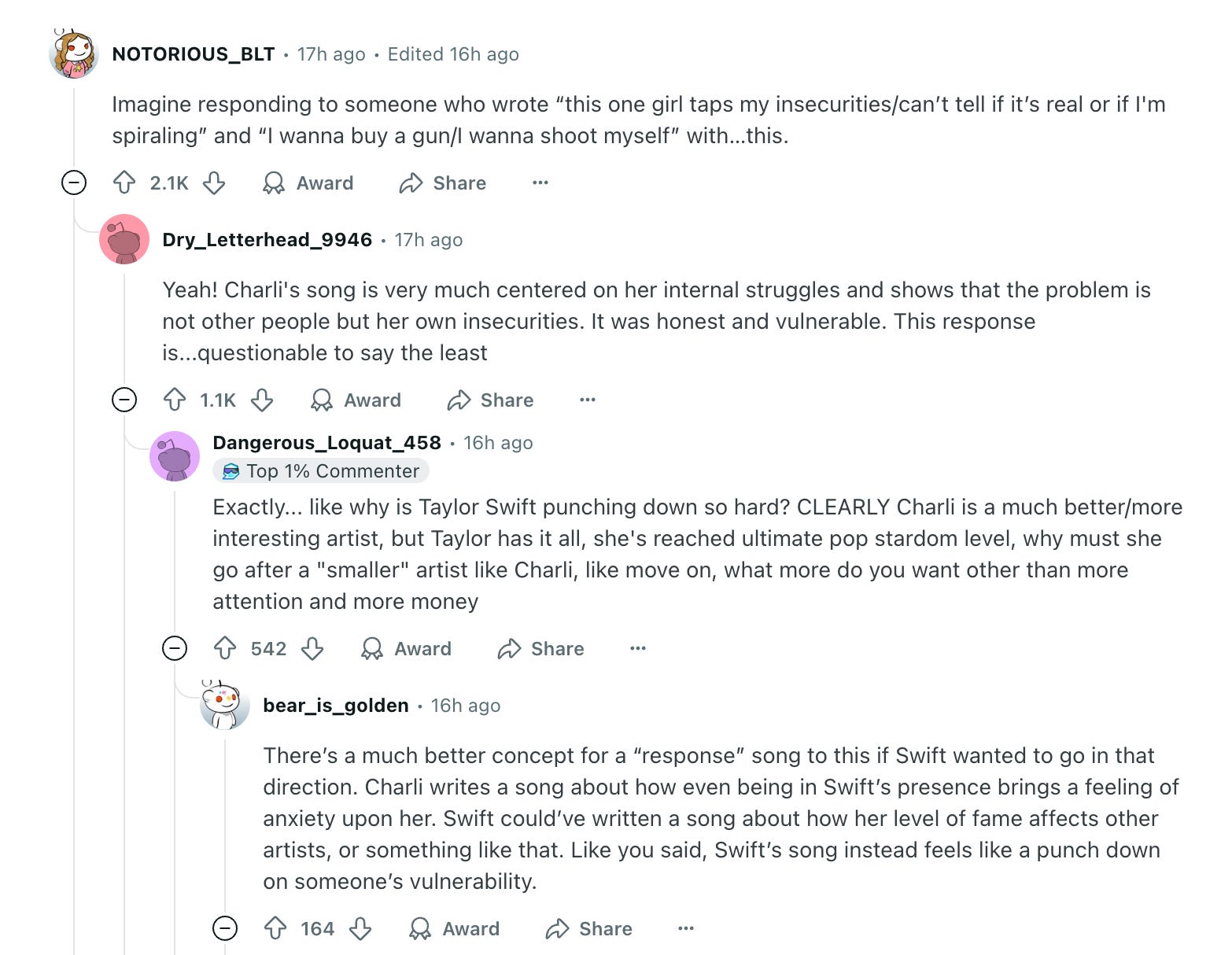
But let’s be so for real here: Sympathy is a Knife was – despite also being a universally poetic and introspective song – a diss track. It doesn’t take that much digging to realize that the girl she’s wishing a break up – is Taylor. While Taylor could have taken the high road to hearing that someone wished her boyfriend would dump her, she didn’t and that makes sense.
So the debate cannot be: “Taylor didn’t deserve to write this diss track because Charli never dissed her.” Just because her hope for the demise of Taylor’s relationship was mired in personal insecurity and envy does not change the undertones of the song.
The reality is that this was a battle of wits, and the debate actually comes down to: Who won?
I think we all know who the victor is here.
The power of Charli’s writing is evident in the mass outcry that she was “hardly” dissing Taylor. The best, most erudite criticism comes without you even realizing you’ve gotten it. The slap is delivered so intelligently and cleverly, your cheek is stung and you don’t even know why. Perhaps that’s why it took Taylor a year and a half to respond, and terribly so.
A lot like the line “fingers crossed behind my back I hope they break up” – this song was done behind the back. Of course not literally; Charli performed it on Saturday Night Live. What I mean is what the comments say – “Sympathy is a Knife” is simply less explicit than Actually Romantic. It’s done artfully.
As many have pointed out, it was more about Charli’s insecurity, envy, the devastating realization that you cannot be anything and everything you want, no matter how hard you try. And sure, this earns you sympathy, but who the fuck wants that? Charli’s diss to Taylor is subtle, if there is one at all. She hopes Healy dumps her, and later on, he does.
Here is where I think we can see some cultural difference at play. Charli is British and Taylor is American. Brits are a bit more subtle, and possess more of a Jane Austenian, quiet sort of bitchiness, something a little more clever.
Taylor is American, so she will just walk right up and say it to your face. And it’s crass, it’s bombastic, also a little dumbed down and boring.
Taylor Swift is a human AI bot. The conventional fear with AI is that there will be an AI which we cannot tell apart from a human being. But Taylor Swift is a human being we cannot tell apart from an AI. She represents the total breakdown of humanity, technology, artifice, reality, capitalism, speech, structure.
“Actually Romantic” is kitsch. It’s a poor attempt to participate in the sort of biting, bratty, cool mean girl ethos of Brat. But isn’t imitation the best form of flattery – especially when that imitation is executed so, so poorly?
The best line in the whole song, “Boring Barbie” (alliteration, cultural reference, dig at her basic blonde looks in contrast to the curly, brunette speaker) — was actually said by Charli. The insult “Like a toy chihuahua barking at me from a tiny purse” reads like something from a Disney writer’s room in 2008, as Gen Xers attempted to write parodic “mean girl” characters on the likes of That’s So Raven and Hannah Montana.
Taylor lauds some serious hurls Charli’s way, asking her “How many times has your boyfriend said / ‘Why are we always talking ‘bout her?’” and condescending to Charli “It’s actually sweet / All the time you’ve spent on me / It’s honestly wild / All the effort you’ve put in.”
With these serious insults, Taylor falls all over herself. Charli writes from a place of deep, self-effacing vulnerability about the way her boyfriend tells her that she’s just being paranoid. We’ve all been there, a sensitive woman with a man who doesn’t see or get it.
Instead of rising to that vulnerability, Taylor punches down. Honestly, the whole thing is kind of ridiculous. Taylor is a mega billionaire who was hardly dissed by Charli, and is now rubbing salt in a wound she herself picked. Yeah, maybe those around Charli feel she’s being paranoid and insecure — but Charli admits to that with sensitivity and authentic lyrics. Taylor uses this vulnerable divulging for…cannon fodder.
Compare this to Lorde. Charli wrote a song about their struggles as two women in the music industry. There were some lines it that could have been taken as a diss. But Lorde responded with some of the best writing on the remix album, about the experience of being insecure and avoiding another woman whose life feels too shiny and in the spotlight, and the avoidance inadvertently coming off as pretentious or cold. The women work it out on the remix.
Charli gently threw a bone to these women. They can take the bite, they can walk away, or they can do what Taylor did: bare her fangs.
Now let’s get into the weirdest part of the song. Taylor builds up all these insults about Charli’s obsession with her to saying that it’s “actually romantic” and “It’s kind of making me wet” and admitting (right after she just got engaged?!?!?!?): “No man has ever loved me like you do.”
If I were her fiancee I’d be like – guys, is this a diss track about me? Just kidding, we all know he can’t read. Ah, ignorance is truly bliss.
But anyway. There’s a few ways to view the psychosexual descent of the Taylor song.
The most obvious is to imagine Taylor sitting in the studio, assistant no. 12 bringing her a perfectly chilled La Croix, assistant no. 4 chanting that her Botox DOES NOT LOOK BOTCHED, assistant no. 9 making sure the Google news alert is turned on for any spike in success for Sabrina Carpenter, Olivia Rodrigo, or Charli XCX, while Taylor wonders aloud, “How can I edge up this song?...I know! I’ll say Charli turns me on and makes me wet. That’ll also bump Sabrina off #1 for horny pop music, right?”
Others have written about this better than I can, but Taylor isn’t a sex symbol. I don’t really wanna hear about my Millennial English teacher from Tennessee getting wet.
Most importantly, it’s just simply unbelievable. Unlike “Sympathy is a Knife,” which came from a place of true honesty, vulnerability, Taylor’s “Actually Romantic” comes from a place of gimmick, mimicry, kitsch. Charli’s song is the masterful sublimation of terrifying feelings of inadequacy, existential limitations, anguish, the desire for the unattainable into a universal poem that’s also a banger. I suppose I can’t say I know the inner workings of Taylor’s sexuality, but the idea that she’s found some enlightened eroticism in a woman wishing the demise of her relationship, and feeling painfully insecure in her presence, seems like a trumped up pretense.
Charli’s song is superior poetry for the way it universalizes a particular experience. As per this Reddit thread, “is sympathy is a knife about taylor swift?” – people cannot tell exactly if it’s really about Taylor, or if it is, exactly which parts.
Like the work of many great poets, Charli’s song is relatable to the most oblivious of heterosexuals, and to the priviest of gays.
The point is – a great poem is particular and universal. You can read a sonnet by Sir Wyatt Thomas, Petrarch, or a poem by Lord Byron, and still enjoy it even without being an English major who knows it’s about Anne Boleyn or Mary Chaworth.
That being said, there is something to being turned on by a diss or cruelty. I have a few lesbian friends who actively define their type as “the kind of girl who would have bullied me for being gay in high school.” Chappell Roan admits to having a crush on Regina George in “Naked in Manhattan.” Taylor had a chance to titillate us, and instead she wrote a tacky simulation to a 2010s-era strum.
I’m gonna stream Sympathy is a Knife a lot this weekend. Meet me in the bathroom if you’re bumping that.
Xoxo,
Femcel
No posts
Comments
Nothing yet. Say the first thing.
Sign in to join the conversation.