
A bitchy twink, my traditionally-minded female friend, and I were all hanging out. Our girlfriend was worried she’d never find a husband and have kids. The gay guy says he can’t imagine doing any of that right now.
“But I don’t have to worry about that because I don’t have a biological clock ticking. Tick tock! Tick tock!”
Like oh wow thank you! We weren’t aware of our dying ovaries and the fact that we could not, in fact, spend the next 20 years paying $120 to go to foam parties, then wake up with an existential hangover at 42 and have a baby.
This is the shit that pisses me off—gay guys thinking their homosexuality somehow precludes them from punching down at women, and entitles them to take every situation as an opportunity to do so.
What makes me sadder is the way some women (#NotAllWomen) lap this shit up like a dog who made its way down to West Hollywood after hiking Runyon Canyon without a water break.
“OMG, I totally look like shit Derrick, you’re so funny.”
Last year I walked into a party and a self-described “demon twink” didn’t introduce himself to me by name, but rather with an ABF (active bitch face) look up-and-down and saying, “so, I guess we didn’t feel like dressing up tonight?”
I’m sorry, do I fucking know you?
He was wearing a Cheesecake Factory-menu striped shirt and a forehead that became a scalp.
I had just about had it with this behavior, so I snapped back, “I guess your hairline didn’t feel like making an appearance tonight?”
Look. I am a Woman of The Culture™️so I understand as well as the next big city liberal that for historical, sociological, and cultural reasons, dissing fashion, looks, and sexual history is part of gay male culture. Far be it from me to tell gay guys to start speaking to me like “gentle-parenting” millennials.
In Kath Weston’s Families We Choose and Mother Camp by Esther Newton, the authors emphasize the fact that wit, insult, “reading,” and “throwing shade” are forms of social interaction, mechanisms of closeness, and acts which reinforce group boundaries. Particularly for Black and Latino ballroom culture, verbal sparring has been a sign of communal cohesion.
That is not what I take issue with. My problem is all the Curt-from-Glee wannabes who start singing off-key Ariana Grande and calling any woman with cleavage a “whore of Babylon” the second they down half a Tequila Sunrise. I love a good cat fight and deeply appreciate a read of me when it’s called for and clever, but oftentimes it’s cheap insults hurled at me specifically because I’m a woman.
And what’s more, I’m not expected to snap back, but offer adoration & adulation. I am done with giving flowers to white circuit gays who think asking me if I’m on my period is going to get them a “hahahah OMG you’re SO funny Jeremy.”
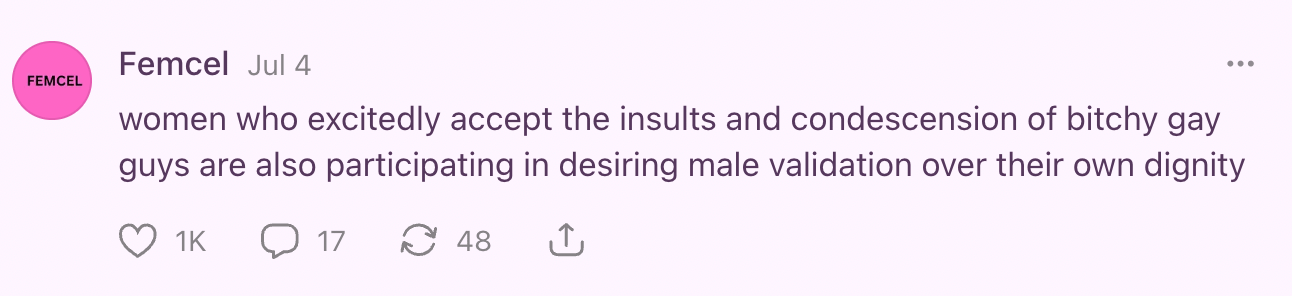
Some housekeeping is in order.
When the gay snark takes a misogynistic turn. Or when this bitchiness becomes heightened not just around women, but in the exclusive direction of them. In particular, when it seems like they’re okay with other gay guys snapping back, but women are supposed to dutifully laugh at, play along with, and enjoy their own belittling as ugly, poorly-dressed, under-fucked, boring, stupid, gross-vagina-having, menstruating hags.
This brings me to the movie Maddie’s Secret, which follows a publicly vegetarian, clandestinely bulimic food influencer. The movie’s already ruined by being bad, so I’ll “ruin” it for you: Maddie hides her bulimia from her husband by saying she is pregnant, only for the purging to worsen, landing her in an ED treatment facility. Here, it’s revealed that she’s vegetarian because her mother used to pressure her to purge the meat they ate in order to achieve a low-carb diet, and as she got older, her mother would bring her to bars to get attention from men, and then take sleep with those men in the bathroom, leaving an underage Maddie alone in a bar full of leering creeps.
This is a comedy. Or, it was supposed to be? Kate Berlant (who I worship) plays a lesbian best friend who obsessively dotes on Maddie, following her to the treatment facility and punching a hole in the wall when Maddie leaves her behind. Vanessa Bayer plays Maddie’s infantile roommate, her saccharine tone and dimple-y smile from various SNL characters kicking into high gear. Pat Regan plays an evidently gay nurse that Bayer’s character is obliviously in love with.
Berlant and Early have always been interested in the conventions of genre in comedy, and finding clever ways to mimic and mock them. In their Peacock special Would It Kill You To Laugh? they play “estranged, fallen-out celebrities who reunite during a TV event that’s interspersed with absurdist sketches,” as per Peacock’s summary.
I loved this special; it was a clever parody of the cheesy sitcoms of the 70s-90s. The duo have a unique ability to “mimic, mock, and recreate mannerisms, speech cadences, vibes and interactions that you didn’t even know could be emulated” (Phillips). The mainstay of the special is a reunion-interview between Berlant and Early’s characters, who play former co-stars on the mock sitcom He’s Gay, She’s Half-Jewish. Between clips of their return to the set, there are other sketches.
So much works about this older special. They don’t “over-dramatize what they satirize.” Instead, they are superbly “able to capture and reflect these little moments back to us with a straight face, funnier than any sort of overwrought interpretation. When Kate and John go to a dance class otherwise entirely populated by young children, they are made livid by their instructors’ kind suggestions and improvements. Determined to play victim, John screams accusations of gaslighting while clapping in time, a pitch perfect impersonation of a person desperate for the upper hand in a non-conflict situation…It’s an impersonation you didn’t even know could exist until he’s doing it” (Phillips).
Would It Kill You To Laugh felt truly novel in a world where every second-rate TikToker is getting a stand-up special to tell the same jokes about their terrible sex life and parents’ divorce.
Maddie’s Secret, Early’s new movie, is not clever. It takes what is so awesome about his usual work–mimicry, parody, social commentary, close observational humor, subtle self-deprecation–and puts it in a blender with a bizarre insensitivity, dullness rather than sharpness, easy punchlines, and little self-awareness.
The film seems intent on mocking/mimicking Hallmark-style after-school specials that tackle serious issues with little intelligence, poor taste, and minimal sensitivity. If that was Early’s goal, he succeeded almost too well with an unintellectual, poor quality, untasteful, insensitive movie. While his satire of genre, upper-middle-class social performance, celebrity cliché, and media simulacra usually lands, his treatment of women and issues like eating disorders and sexual abuse lacks the sensitivity, wit, and insight that typically define his work.
This movie lands the conventional notes of a bad movie but with no satirical flair. And then it punches down at women with no purpose, simple-mindedly parroting the ridicule and contempt society has for women and their problems.
Every review of this movie has nervously danced around whether or not Early “sensitively” handled his playing a woman as a gay man. Each brushes past it so quickly you barely miss the fact that they’re all too scared to really address it. That it must be brought up every time, only to never be wrestled with, shows that people are feeling some type of way but no one wants to admit it. Was it really his place as a man to mock the way women sound in bed, to not only play but also write a woman character struggling with issues faced by far more women than men?
I’m all for offensiveness and political incorrectness, so long as it’s funny. And this movie was not funny. There were moments where I laughed; but this is true of even very depressing dramas. Overall, the tone was confusing and the purpose/direction (or rather, misdirection) of the parody was not clear, if there even was one.
During the one sex scene between Maddie and her husband, he begins to go down on her. Playing Maddie, Early lets out an “ah!”--the kind of surprised, grateful, yet demure micro-moan of a woman unaccustomed to receiving pleasure. The Brooklyn audience I watched the movie with laughed. I laughed too, but why?
A moment later, I was hit with the kind of wave of realization one feels after laughing mindlessly at something because everyone else is.
Why was the sound of a woman’s moan, no matter how pedestrian, funny? And why are we all here again, laughing along with a man making fun of something uniquely woman? Sure, these cringey sex scenes are a classic beat of the kind of movies Early wanted to parody. But he didn’t do much besides copy the beat with gusto! Just because he’s a liberal gay guy doesn’t change the fact that the sound of female pleasure was played for humor.
Maddie’s Secret doesn’t deconstruct these tropes, like the stereotypical hetero sex scenes where the woman orgasms in 45 seconds with porn-like moans. It just copies and pastes and expects a laugh in return.
The most interesting and comical part of the movie was the homoerotic tension between Berlant and Early’s female friendship. I would have been much more interested in a movie which explored the ways in which close female friendships threaten the boundary between what’s sexual, romantic, and platonic–what’s heterosexual or homosexual and what’s something else entirely.
When Berlant’s character punches a wall in response to Maddie leaving, it’s a perfect parody of the trope of straight men punching a hole in the wall, this parody rendered more succinct and clever via the “jealous lesbian” surrogate parody.
The movie ultimately, unthoughtfully mocks two issues which disproportionately impact women.
Not to sound like Miss Woke, but as a woman who used to do stand-up comedy, I noticed that basically every new straight male comedian had some joke about childhood sexual abuse. This is an issue that disproportionately impacts girls (1 in 9 versus 1 in 20 for boys) and so I never understood why every guy who likely doesn’t know the trauma of that experience was rushing to make a joke about it. Additionally, eating disorders (particularly the kind of bingeing and purging portrayed in the movie) disproportionately impact women as well. So why did a man play this character?
One review wrote: “Tackling the sensitivity of bulimia, the film never trivializes the disorder itself. Rather, it dissects the tragicomedy surrounding our current moment, satirizing the cultural fixations, interests, and institutions we lean on in an era where the internet’s attempt to connect us fractures our communities instead.”
These two sentences are totally unrelated. Satirizing the world around our bulimic protagonist via queer jazzercise classes, online therapy fads, and cringe-y foodie culture does not mean it does the protagonist justice. While it mocks the world around her, it mocks her and the women in her position in real life too.
Bulimia is absolutely trivialized, as the disorder is played off as a silly, mawkish personal problem experienced by ridiculous, childlike women and girls. It is not taken seriously, and as the script delves into a dark backstory to explain Maddie’s ED, it furthers the idea that women’s dispossession of their bodies from a young age is a cheap, sappy, corny triviality.
As it is portrayed, it’s still something to laugh at rather than understand why these issues are so often mishandled in mainstream media.
I have never struggled with an eating disorder, but I know plenty of women who have. And all of the women I spoke to about this movie found it viscerally offensive. As the movie became darker and darker, I worried about the women in the audience. And once we reach the near-final scene, wherein Maddie reveals the sexual humiliation and exploitation of her adolescence, I had to ask myself: what the fuck am I watching?
The difference between mimicking and parody is critique. And Maddie’s Secret offered no critique or commentary whatsoever.
Am I supposed to feel genuinely moved by Maddie’s suffering? Am I supposed to laugh at her Midwestern sensibilities in the face of a profit-driven, fake LA environment? If the portrayal of a Lifetime-esque Breakfast Club of bulimics and anorexics intended to parody shows like The Secret Life of an American Teenager, what is it parodying exactly and why? And if I am supposed to feel something real, then what? At times, the movie veers into trying to strike out on its own as a comedy divorced from the satire of crummy teen media; then it swiftly jumps back into its attempt at satire.
I don’t need or like movies which hit me over the head with a message, moral, or black-and-white meaning. But I also don’t like movies which have zero artistic compass or direction other than the momentum of a rough first draft which somehow got a green light.
The problem is Maddie’s Secret doesn’t know what it’s mocking and it doesn’t know what it’s taking seriously. It’s a cheap work of mimicry of the art it seeks to ridicule; by mindlessly replicating the form, it participates in the same degradation of women, mockery of real problems, and unintelligent fumbling of serious issues.
The tone and purpose was all over the place. Sincerity and satire can co-exist and often have. But by the end of the movie, I felt like I watched a bunch of disparate skits–a satire of LA influencer culture, a parody of a cheesy Hallmark movie, a campy queer satire of lesbian hysterics–with no thread pulling them all together.
There are moments where vulnerability and parody co-exist well. When Bayer’s character dies due to heart failure from her eating disorder (haha?), Maddie and a clique of Gen-Z anorexics have a vigil for her. There, honest grieving happens alongside some punchlines about the deceased girl’s obsession with a clearly gay man.
Another failure of the movie is its criminal under use of its cast. I’ve seen Kate Berlant and Pat Regan perform live numerous times in Los Angeles–they are capable of much more than what they were assigned.
It’s hard to write that actors “understood the assignment” when the assignment was a bunch of boring crap to begin with. What’s there to understand, besides a watery-thin script and a gimmicky excuse for a feature film?
“A food influencer who’s secretly bulimic”--some punchy loglines are just that, and don’t need to become screen plays < 3.
Pat Regan, whose meanderings on the absurdist horrors of gay male dating in LA (and Chino), or Kate Berlant’s hyper-intellectual observations of the minutiae of the everyday life of Angelenos, only children, and half-Jews in big cities are lost in dialogues which could have been read by just about any gay guy and any brunette who could offer Botox-less facial expressions. These are smart, cutting edge, type-B comedians who were asked to play paper cut outs of tired tropes, much like the ones the movie merely replicated.
My most generous read of the movie is that Maddie’s Secret—along with its promotional rollout—is itself an elaborate satire of John Early’s Silver Lake-Brooklyn audience. Kate Berlant has played with this idea before. In CommuniKate, she performs as a psychic while mocking the audience’s desire to believe her. Perhaps Maddie’s Secret is attempting something similar on a larger scale.
The marketing certainly invites that reading. Early partnered with Kismet Rotisserie, as well as Marissa Zappas to release a $125 perfume called maddie’s secrets.
If the film is really about the commodification of trauma, the emptiness of cultural discourse, our now total critical blindness, desperation to yasss at everything that has the feeling of being relevant, and our willingness to mistake anything vaguely transgressive for meaningful art–then selling rotisserie chicken and luxury perfume off the back of a story about bulimia, sexual abuse, and women’s suffering would itself be a better commentary than the film alone.
If this is high camp performance art about the drivel that sells and how, then I have to give Early credit. That food and perfume brands would take a movie about bulimia as an opportunity to sell their consumer goods is a real-life satire of Los Angeles that shines a better light on the movie.
If the movie and its PR was ultimately about the same thing–the loss of critical audiences, the ubiquity of discourse, the reverence of gimmick, and the automatic five star reviews given to “art” made by any queers living east of the 405–then it succeeded, and profoundly so. I’m just not sure if that was the aim, if there was one at all.
That would be a generous read. It’s hard to tell, because the movie seems to take itself seriously as a genuinely sharp genre parody.
Like the movie itself, at every step of its rollout, the intention is confusing. And not confusing in a complex, interesting way. There’s simply no cohesion. In interviews, the acting for Maddie is discussed like Early is Natalie Portman in Black Swan and not what felt like an extended TikTok bit. At every stage, the project seems to ask to be taken at face value. But maybe these pretentious interviews, where interviewers earnestly take the movie seriously, are all part of the act.
People took this movie seriously as an interesting and commentative work of art when at best, it was some lightweight curiosity mistaken for something profound. Ultimately, it was the apex of women embracing and adoring all the ways in which gay guys punch down at them with no deeper meaning or critique of the sexism they’re parroting; let’s not mistake mimicry for critique simply because it’s wrapped in the aesthetics of irony.
No posts
Comments
Nothing yet. Say the first thing.
Sign in to join the conversation.