
We are richer than ever. Germany’s private wealth exceeds ten trillion euros. But instead of asking what we could solve with that money, we keep circling the same old questions: Who owns it? Who should inherit it? How should we tax it?
Those are fair questions. But they miss the point. The real issue isn’t the amount of wealth or even its distribution. The problem is how little of it is being used to solve the problems that actually matter.
“A better world is not only possible — we can buy it.” (p. 25)
This isn’t a moral judgment. It’s a missed opportunity. Climate collapse, war, inequality, democratic backsliding — these problems can’t be solved with good intentions alone. They need capital. And the capital exists. But it’s held back — not by greed, but by outdated structures and mindsets.
In most developed economies, including Germany, wealth is no longer primarily earned. It’s inherited. That comes with emotional, legal and institutional baggage. Many heirs I’ve met — and I’ve met many — don’t feel like they own their money. It’s “not really theirs.” It’s embedded in family expectations, managed by cautious financial advisors, and locked up in legal vehicles built for a world that no longer exists.
“Philanthropy is an industry in decline.” (p. 24)
At the same time, the social sector has moved on. A new generation of founders is building scalable social ventures. Philanthropy has become more direct, more global, more collaborative. The rise of impact investing adds another layer. In this world, the old logic of saving capital and distributing only the interest simply doesn’t fit anymore.
But most wealth stays in neutral. Especially foundation wealth. Designed for eternity, these vehicles avoid risk, avoid speed, and often avoid relevance. And while the money sits still, the cost of doing nothing rises.
Wealth holders know this. They are not stupid. Many feel the dissonance. They want to act, but the system they’ve inherited — legally, culturally, emotionally — tells them to preserve, not deploy. And so we waste time, waiting for others to start.
This paralysis often leads people to point to the state. Surely government should solve these problems. Tax the wealthy more. Redistribute through public spending. And yes — progressive taxation is important. But while the legal and political machinery grinds slowly forward, we miss what’s already in front of us: a vast pool of private capital that could get to work right now, if we gave it a better path.
“Public programs and private giving complement each other.” (p. 135)
We need both. Public systems for scale and stability. Private initiatives for speed, risk-taking, and innovation. It’s not either/or. But as long as the public debate paints the rich as villains and the state as the only solution, the result is the same: hesitation.
The good news is this: a revolution in giving is already underway. It’s younger. Often female. More agile, international, and bold. These philanthropists are not building empires. They’re spending down. Giving collaboratively. Sharing power. Choosing digital tools over dusty foundation boards. Some even give up control entirely.
“Giving up power also means spending down wealth.” (p. 165)
But the old structures resist. Foundations were built to last forever, not to adapt. Some have mission statements written in another century. Their managers are rewarded for preservation, not transformation. The result is a landscape full of “zombie foundations” — money that legally cannot die, but also cannot live.
This is not a compelling value proposition for new funds. And it’s not the future.
The future of philanthropy lies in accessibility. The same way neobrokers and digital banks made professional investing available to millions, we need platforms that let anyone start a foundation-like account, make strategic donations, track their impact, and co-fund with others. Giving should be as easy as banking. As visible as investing. As empowering as entrepreneurship.
“Investing has been democratized. Why is giving still so complicated?” (p. 206)
This is more than a product shift. It’s a cultural one. If we make giving simple, transparent, and powerful, more people will do it. If we make it normal, more people will talk about it. If we make it collective, more people will feel proud of it.
The bigger question is: can we re-establish giving as a social norm? Not just for the rich. Not just when there’s a crisis. But as a visible, regular, meaningful part of life — like voting, like investing, like learning.
This kind of giving fits the exponential speed of the problems we face. It fits the tools of our time. And it fits a generation that wants to act, not just manage.
We don’t need every wealthy person to become a full-time philanthropist. But we do need to unlock the capital that is currently frozen by caution, complexity, and outdated traditions. That starts with changing how we talk about money. And giving people the tools to act — with clarity, simplicity, and purpose.
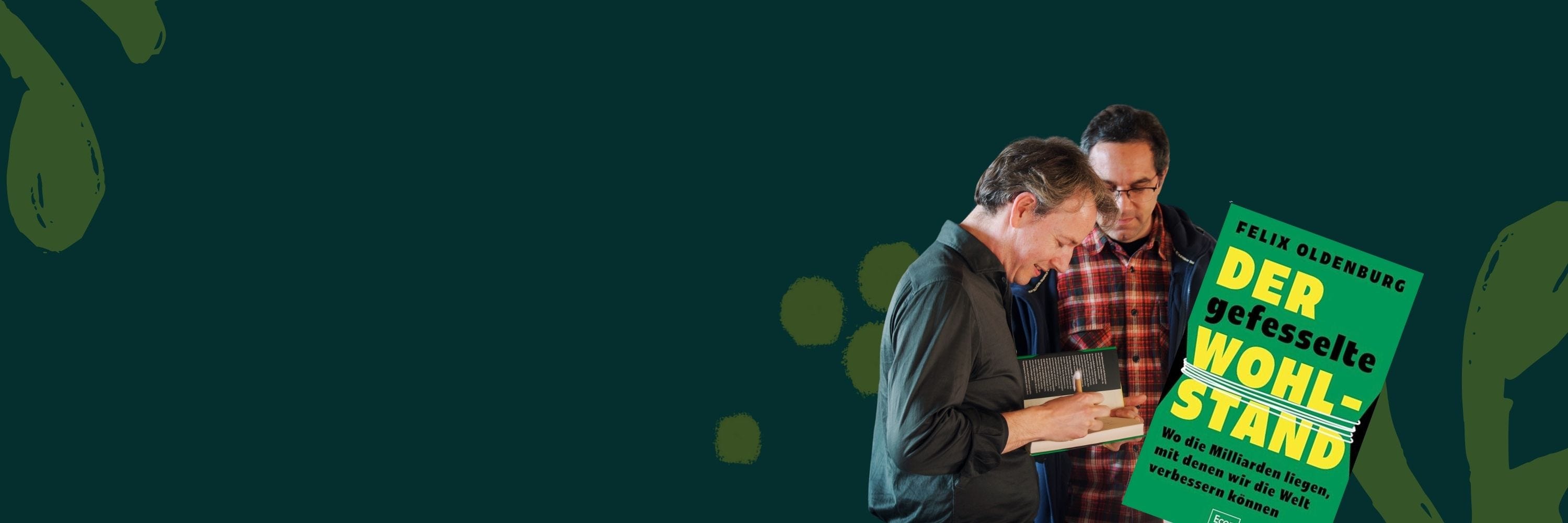
Note: No, I have no plans to get my book translated. Sorry. For the moment, only German readers can access the full version, with much more detail, personal stories, 20 portraits of wealth holders I have encountered along the path, and the audio book. If you, however, subscribe to my substack, you will get similar content, and always up to date.
No posts
Comments
Nothing yet. Say the first thing.
Sign in to join the conversation.