
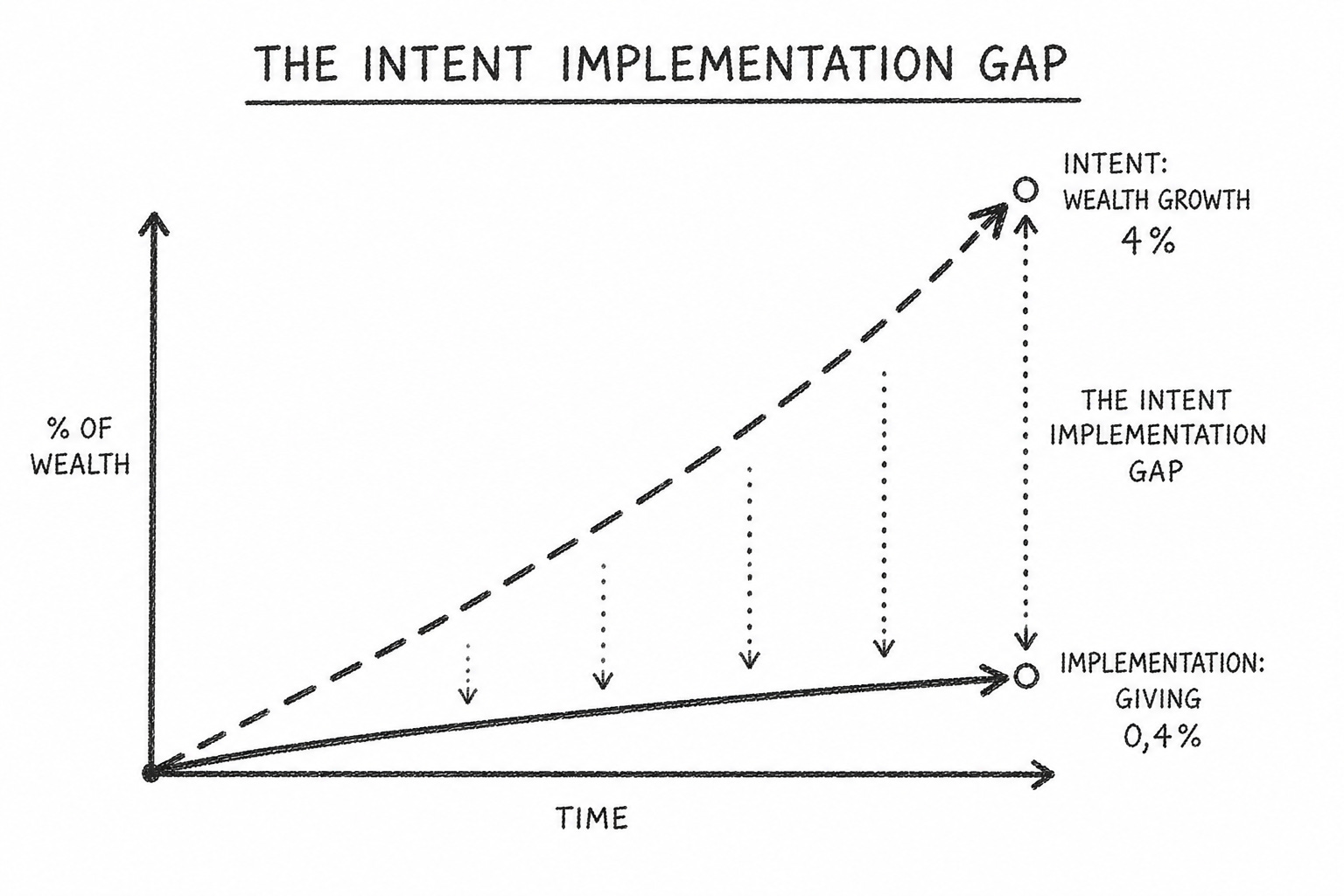
Across the globe, ultra-high net wealth individuals, those with at least 30 million US dollars, held an estimated 49.2 trillion dollars in total wealth in 2023 and gave around 190 billion to philanthropy that year. That is roughly 0.4 percent of their wealth. Their portfolios, meanwhile, returned over 4 percent on average, so their fortunes grew about ten times faster than they gave.
In Germany, among households that donate, giving ranges from 0.5 to 2 percent of disposable income. At first glance the comparison flatters the wealthy. If investment returns are their income, they hand over a tenth of it, far more than any income bracket below them. But the comparison assumes that income means the same thing on both sides, and it does not. A household living on wages gives money it needs. Every donated euro competes with rent, groceries, and savings. A household earning capital returns can give from the returns alone, keeping the principal untouched and growing over time. Measured against what each side actually has, income reliant households are far more generous than those with access to outsized resources.
Wealth grows about ten times faster than giving.
Why? The obvious answer could be that people with more money care less. But nothing in our experience supports this. Philanthropy consistently ranks near the top of stated interests among the ultra wealthy and between us we have sat with hundreds of wealth holders in Germany and beyond whose concern for the world is beyond doubt. The intention is there. Action is not.
There are multiple reasons for this intention-action gap:
First, most private wealth is dedicated to preservation and growth. Between strong personal and professional normative pressure and a genuine lack of language, concepts, and support around alternatives, most wealth holders are introduced to wealth as something they should guard and protect. This is particularly pronounced in multigenerational settings, where legal and felt ownership may diverge, family dynamics take hold, and access to wealth becomes entangled with identity. Many families are fighting ‘from shirtsleeves to shirtsleeves in three generations’ narratives, not wanting to be the generation that lost it. Beneath all of this sits a question that is rarely asked and hard to answer: how much is enough? And how much wealth is therefore disposable, including for philanthropy?
Many families are fighting ‘from shirtsleeves to shirtsleeves in three generations’ narratives, not wanting to be the generation that lost it.
Second, suppose a wealth holder has cleared this first hurdle. They have gained clarity on their relationship to their wealth and landed on a number that matches their ambition. Even then, making a meaningful difference is not trivial. There are a million ways to contribute and navigating them alone is accordingly hard. Nearly half of next-gen donors say they cannot tell whether their giving works, and four in ten struggle to identify good causes at all.
Third, even with a sound strategy, implementation remains a real challenge. Too much of our infrastructure and professional support is built around preservation and growth, meaning that the very rails that are meant to carry giving often make it harder. A recent US study shows 80 percent of wealthy clients believe their advisor should raise philanthropy. Only 45 percent of advisors do so with most clients. Almost 40 percent of clients report needing guidance that exceeds their advisors’ knowledge. And many of our giving institutions like Stiftungen are administrative behemoths that take months to set up, require meaningful minimum capital, and lock in a purpose clause that is nearly impossible to change later. So, even with all the clarity in the world, wealth holders still need to put in considerable effort to actually translate intention into action.
80 percent of wealthy clients believe their advisor should raise philanthropy.
So the gap is real. How do we bridge it? We need to build the counterpart, on the giving side, to what private banking has long done for wealth: real guidance, clean execution, honest reporting, held to the highest standard and executed in one integrated process that reduces friction as much as possible. This rests on three pillars.
Pillar one is professionals who have the experience and moral integrity to guide a process that serves the wealth holder, not the money. They should understand the intricacies of private wealth, how it operates and how it shapes identity, relationships, and decisions.
Pillar two is a supportive ecosystem of experts and analysts to inform impactful action. In Germany, Effektiv Spenden and PHINEO assess organisations for whether their interventions are actually realising the envisioned impact. When Susanne Klatten moved around 100 million euros through the SKala initiative, the 93 recipients were chosen on measured impact.
Pillar three is administrative infrastructure that democratises giving and makes it as easy as self-directed investing. A simple account where wealth holders give once into a charitable trust and receive their tax receipt immediately. The amount then sits in a personal giving account they run like online banking. Balances are invested while they wait, so the money can grow before it moves. In the United States, giving accounts of exactly this kind, donor-advised funds, already hold over 300 billion dollars and pay out around 65 billion a year. What is ordinary there is almost entirely absent in Germany and most of Europe.
$21 trillion will change hands in Europe, the Middle East and Africa in the coming decades. This capital is waiting for vehicles.
We are not approaching this as a theoretical consideration, but as a mission. We are building all of that by contributing the necessary expertise, offering guidance and direct support to those who seek it, and implementing the infrastructure that makes giving as easy and transparent as self-directed investment accounts.
Ultimately, we are convinced that we do not need to worry about people’s intentions. Most people already care. The conviction was never missing. What has been missing is a functional pathway from intention to giving, one that can now be built.
More information on the Club Neues Geben, Germany’s largest independent major donor network. More about the bcause platform for digital foundation accounts.
No posts
Comments
Nothing yet. Say the first thing.
Sign in to join the conversation.