
A promise is a promise.
A month ago, I told you I was going to publish a big article on the markers to test for anxiety and depression. I was writing from the French Alps and had a lot of time to reflect on the future of my content. I feel like what people want is concrete and actionable tips that they can use in their own lives. So that’s what I decided to do.
In this article, I’ll be drawing heavily on my personal experience. I went through a lot of trial and error before I truly came to understand the body’s biochemistry in depth. The information I’m sharing here is quite rare, because I’ve actually tested all of this on myself.
I’m very familiar with the side effects of all the supplements I’m discussing. When someone tells me, “I have brain fog,” I know exactly what they’re feeling—unlike many practitioners, for whom this might seem vague and foggy. No pun intended.
People don’t develop anxiety and depression out of nowhere. There are specific things happening in people’s bodies and brains. There are about 22 main deficiencies and markers that can cause this. In this article, I’ll go over them.
But first, I’ll describe the typical journey of a patient who goes to the doctor. I think many of you will recognize yourselves in what I’m about to write.
If you go see your primary care doctor and tell them you’re feeling bad, that you’re tired, and that you don’t feel anything anymore, they’ll tell you you’re “depressed”, a somewhat imprecise word.
fter that, they’ll write you a prescription. “You’re deficient in fluoxetine,” says the doctor. “So you need a medication to boost your serotonin levels.” And so the patient ends up at the pharmacy with three boxes of capsules.
“20 mg a day,” says the doctor. The patient follows the instructions. He sticks to his treatment as agreed. After three weeks, he feels somewhat better; his anxiety is gone, and he has a more positive outlook on life.
After a few months, he starts experiencing side effects: weight gain and a decrease in libido. After a year, he feels that his emotions are somewhat flat; he doesn’t feel much of anything anymore.
His doctor then advises increasing the dose to 40 mg of fluoxetine per day. The situation gets even worse: he experiences even more side effects, has gained 20 pounds, and has lost his self-confidence.
What I’ve just described is the basic trajectory of millions of people around the world. They’re prescribed a drug that makes them feel better at first, but then it starts to wear off. And then withdrawal sets in. They realize they can’t stop as easily as their doctor told them. They experience intense symptoms—sweating, tremors, and so on. These drugs are prescribed to millions of people, and thousands go through hell when they try to stop taking them. That’s an understatement. I lived it myself.
What’s terrible is that people don’t know there are dozens of ways to get better without necessarily resorting to these drugs. Sure, they can be effective in severe cases, but for most people, other solutions exist. The good news is that those solutions are often very effective.
In this article, I’ll present the 22 tests to take if you’re suffering from anxiety or depression. I’ll also outline reference values and concrete solutions to help you escape the classic hamster wheel that millions of people are stuck in.
I will be using publications from organizations specializing in applied biochemistry, such as the Institute for Functional Medicine, led by Mark Hyman.
For several years now, they have been publishing very interesting content that helps people understand their biomarkers, how to get tested, and so on.
For each biomarker, I will include:
- the names of the tests
- reference ranges
- How to supplement
First and foremost, I’d like to take a moment to thank you for reading my work and for your support. Enjoy the read. Please feel free to send me a message if you need any clarification or have questions about my work. Have a great weekend.
The first marker I’ll discuss is homocysteine, a natural metabolite of the methylation cycle that can become toxic if it builds up in the body.
Homocysteine is a metabolite and a normal byproduct of the methylation cycle. When the body’s methylation process is functioning properly, homocysteine levels remain low. The problem is that when this process breaks down, homocysteine builds up and can become toxic. As for the brain, it becomes neurotoxic. High homocysteine equals low methylation. If methylation is low, it cannot produce enough SAMe (S-Adenosyl-Methionine), the main compound that synthesize neurotransmitters. SAMe is a supplement that you can buy if you have depression or anxiety, but beware. It is very potent and acts quickly. It is, in my experience, the most powerful supplement available to reverse depression and apathy.
There is debate regarding the optimal homocysteine level. Personally, I would say it lies between 4 to 8 mcmol/L in the blood.
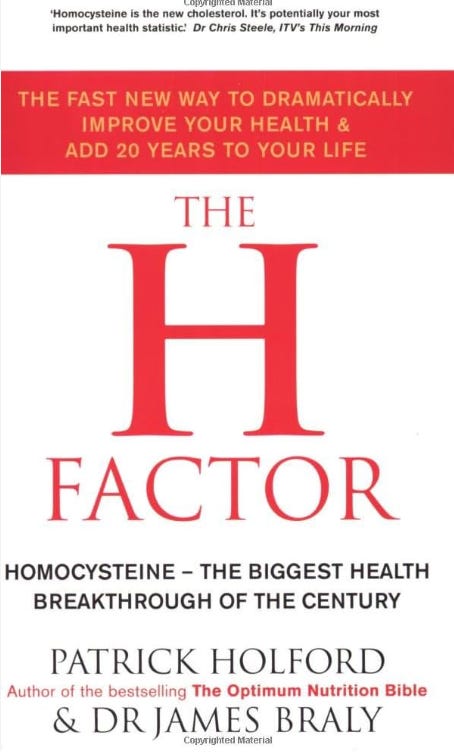
To lower homocysteine, you need to supplement with bioactive B vitamins, particularly B6 (active form, P5P), B9 (5-MTHF or methyfolate), and B12 (methylcobalamin). All of these vitamins are essential for lowering homocysteine. Adding TMG (Trimethylglycine) may be necessary if your homocysteine is really high. Feel free to send me a message if you want advices on the dosing. Patrick Holfrod wrote some interesting things about this. His book The H Factor is a very interesting read.
Since methylation is deeply involved in neurotransmitter production, detoxification, DNA repair, and nervous system regulation, chronically elevated homocysteine may contribute to fatigue, anxiety, depression, brain fog, and cognitive decline. If we consider that cancer risk is affected by the ability of the body to repair DNA, then lowering homocysteine is an indirect way to lower your cancer risk. Holford also talked about that and presented the studies. Remember that low methylation = low glutathione. Glutathione is the one of the most powerful antioxidant in the body. Therefore, high homocysteine also mean that your body is under a lot of oxidative stress, a situation you want to avoid at all costs.
Poor diet, chronic stress, alcohol consumption, smoking, low intake of B vitamins, digestive dysfunction, and genetic polymorphisms such as MTHFR may all contribute to elevated homocysteine levels. Supporting methylation through adequate folate, vitamin B12, vitamin B6, magnesium, and choline intake may help normalize levels over time.
Tests:
Plasma Homocysteine: 4–8 µmol/L
Total Homocysteine (tHcy): 4–8 µmol/L
Vitamin D deficiency is so widespread in our society that it is being studied as a potential factor in all major chronic diseases. A vitamin D deficiency means that the immune system isn’t getting enough support, and that inflammation is threatening your health. You are more vulnerable to infections, the flu, among many other things. Strangely enough, you are more prone to develop anxiety and depression also.
The brain is particularly vulnerable to inflammation. To maintain optimal levels, you should aim for between 40 and 80 ng/mL. There is still no official consensus about the optimal level of vitamin D. Please don’t believe the people telling you that going over 40 ng is toxic. It is simply not true.
Vitamin D is actually not a vitamin but a steroid hormone that the body makes in steps. When the sun hits the skin, it makes vitamin D2 (Ergocalciferol) and then D3 (ergocalciferol).
The problem is that it’s not easily found in food. It’s present in fatty fish, eggs, and certain mushrooms, but sunlight remains the best way to boost your levels. This is very important. For people who don’t want to go to the sun without sunscreen, supplements are the preferred way.
If you do, take them after a fatty meal, since cholecalciferol (vitamin D3) is a fat-soluble substance. It’s important to limit calcium intake when taking high doses of vitamin D, as it can lead to increased calcium absorption into the bloodstream. Be sure to take between 200 and 400 mg of magnesium to prevent this and to allow vitamin D3 to be properly metabolized in the body.
Very few overdoses of vitamin D have been reported. The only documented cases I have seen involve elderly people who took very high daily doses (50,000 to 200,000 IU) without taking magnesium supplements alongside them.
Since the two molecules are necessary to activate each other, taking too much vitamin D can lead to a rapid drop in magnesium levels, which can cause dizziness and falls. When you really dig into it, you realize that death is never actually directly linked to the vitamin itself.
Test:
25-Hydroxy Vitamin D (25-OH Vitamin D)
Among the B vitamins, B12 is often the one that receives the most attention from doctors, and for good reason.
For vegans, taking cobalamin is often recommended because it is found almost exclusively in meat and animal-based proteins. However, blood tests do not always provide an accurate picture of intracellular levels. In a 1988 study, Lindenbaum & Al. found that people with normal blood levels could be deficient in the brain. Some people also have genetic mutations making them prone to localized cerebral deficiency. Linus Pauling also demonstrated this in his landmark paper published in Science in 1968.
Vitamin B12 is essential for the body’s methylation processes and for producing serotonin and other neurotransmitters. It helps to lower homocysteine and to give energy to the body.
In patients with a true vitamin B12 deficiency, taking the active coenzyme form often has a revitalizing effect. I have seen many testimonials of people that recovered from anxiety and depression just by taking this. The sublingual form is always preferred because it helps to avoid the so called intrinsic factor, that prevents some people from absorbing it in the gut. Several genetic SNPs (mutations) impact your ability to either absorb B12 or either to metabolize it properly. The most famous one is the FUT2, that can influence the IFC (Intrinsic Factor Complex). If you have the intrinsic factor, it means you won’t be able to absorb it properly. This FUT2 mutation is often correlated with lower blood values. But this is not the only SNPs to look for. There is also the TCN2, for transcobalamin (see below).
There is also the MTR and MTRR genes, deeply involved into the methylation cycle. And of course the MTHFR gene. Even if this gene codes for folate (vitamin B9), it also influences the whole B-complex spectrum. If you do have a MTHFR mutation, your body will not be able to process B12 to its active form, methylcobalamin. I know that all those informations about the MTHFR gene can be quite confusing for beginners in biochemistry. This is a complex topic, so I will do more articles about this in the future. So much mysterious things to discover about the human body.
The same is true for vitamin B9, or folate, which is also involved in methylation and thus in the production of serotonin and dopamine in the body. Folate deficiency has strong neuropsychiatric symptoms.
Important tests
Transcobalamin II or TCN2: This test will assess the gene that helps to transport active B12 into the bloodstream. Many people have an intrinsic factor in the gut that prevents them from metabolizing the vitamin to its active form and transport it into the blood.
Serum Vitamin B12: optimal range: 500–900 pg/mL
Holotranscobalamin (Active B12): 70–150 pmol/L
Methylmalonic Acid (MMA): 0.07 – 0.27 µmol/L
Folate:
FBP (Folate Binding Protein)
Homocysteine (If high, then it means low folates): 4–8 µmol/L
Serum Folate: 10–17 ng/mL
Red Blood Cell Folate (RBC Folate): 500–1500 ng/mL
Note about MMA (Methylmalonic acid):
I believe that the MMA test is the only one that can accurately measure active vitamin B12 in the body. When the body does not have enough active vitamin B12, MMA begins to accumulate in the blood and urine. This often happens before serum B12 levels become abnormal, which is why MMA is considered a much more sensitive marker of intracellular B12 deficiency. Elevated MMA is frequently associated with fatigue, brain fog, neuropathy, poor concentration, anxiety, and depression. An increasing number of publications are addressing this topic, and biochemistry laboratories are increasingly viewing it as the most appropriate test. Please visit the Linus Pauling Institute website for more information.
Comments
Nothing yet. Say the first thing.
Sign in to join the conversation.