
When last week I finally pressed the submit button, I was relieved.
I had spent the last year on a new mathematical article and was truly delighted by its breakthroughs. Yet, I found myself unusually anxious to establish the intellectual paternity of my work by submitting it to a prestigious journal.
This anxiety had an equally unusual cause. The unstoppable AI train continues to gather speed, relentlessly. AI has reached average PhD level strength in scientific problem solving, which will not only strain the whole peer review system, but also raise difficult questions about the relative contribution of human authors. I was also worried that in some aspects of research, AI could soon dramatically surpass human capabilities, just as a speeding train makes neighboring cars appear motionless. What if my result suddenly fell within those boundaries?
The probability of this scenario, formerly quite scant, has been amplified by recent news, even more shocking than GPT’s solution of the Erdős Unit Distance Conjecture. In my opinion, this scenario is still unlikely, but defending my claim now requires the rest of this essay.
As I previously argued, the advancements in AI that we are observing suggest a distinction between mechanical and creative intelligence. Mechanical intelligence prospers with complex puzzles and concrete problems. Creative intelligence forges whole new conceptual frameworks. Mechanical intelligence is the ability to navigate an existing conceptual landscape, whereas creative intelligence is the ability to create a new one.
This distinction is reflected in scientific practice. Although open problems often guide scientific enquiry, few major breakthroughs in science arise as direct consequence of problem-solving. Problems do not fall from the sky either: the formulation of an important problem is often itself a creative breakthrough. Many times the decisive creative act is inventing the objects about which future theorems could be proved. Riemann hypothesis could not exist without Riemann’s conceptual insights, including his prior invention of the Riemann zeta function, which supplied the very object of the conjecture. At the frontier of science, finding questions is as important as finding answers.
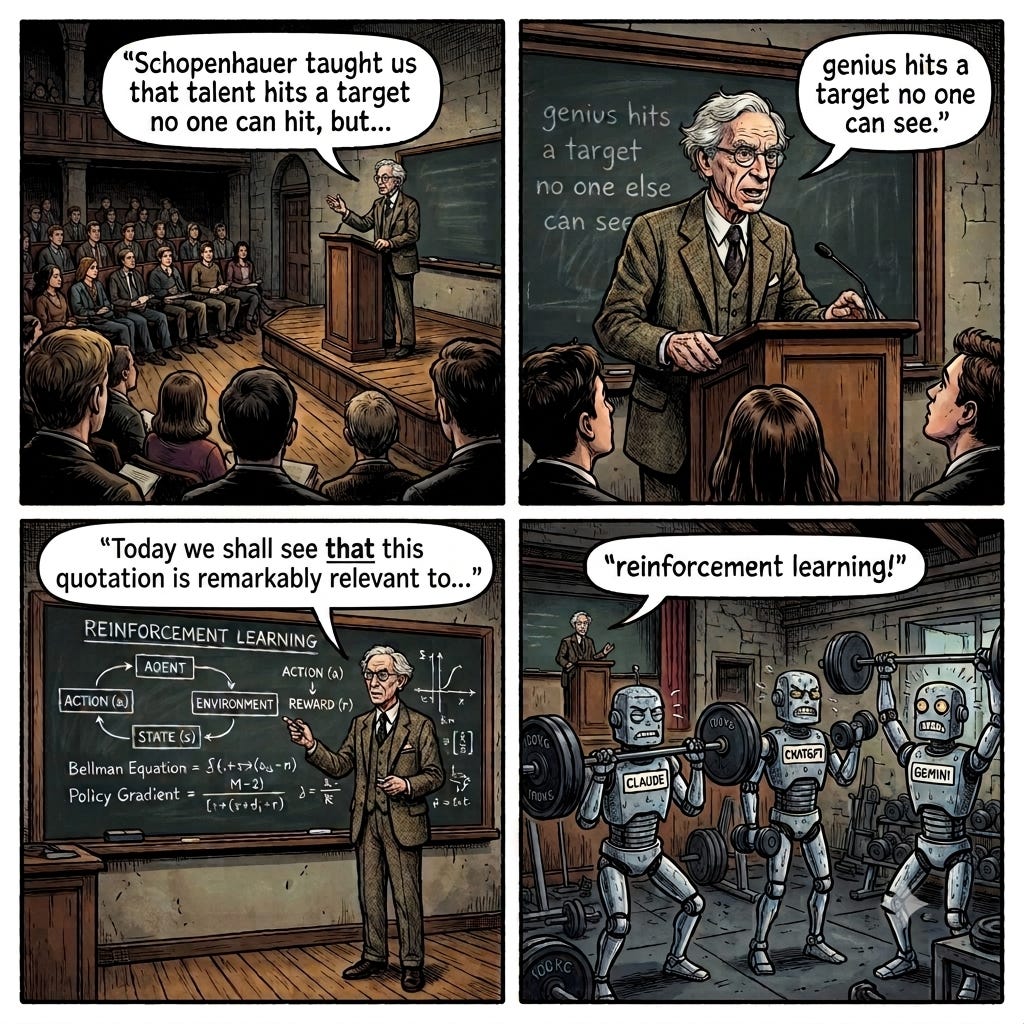
Scientists are often drawn less by the utilitarian task of solving problems than by the Greek ideal of contemplative intellectual life. The most striking scientific discoveries are often unexpected and originate from genuine spirit of observation and open-ended desire for understanding. Schopenhauer captured the distinction perfectly:
Talent hits a target no one else can hit. Genius hits a target no one else can see.
Talent here plays the role of mechanical intelligence, which is specialized in solving problems — hitting targets. Genius, the truly creative intelligence, discovers targets that no one knew existed. Famously, Einstein developed general relativity before anyone realized such a theory was needed.
Yet the tech bros, as they are increasingly called in Europe, rarely seem to appreciate such subtleties. Many place an almost religious faith in reinforcement learning, the technique behind AI’s dominance in board games such as chess and Go. Extrapolating from the current, undeniable progress, they believe mathematics and science are merely larger games that AI is bound to master.
Their narrative has been recently legitimized politically. The US government has started to monitor and even ban new AI models like Anthropic’s Fable 5 and GPT-5.6, out of concern they may already be dangerously capable.
But is there really new evidence for increased AI intelligence? What is reinforcement learning? Why do so many believe it will eventually succeed? The aim of this essay is answering these questions.
I have already discussed at length the resolution of the Unit Distance Conjecture by an unreleased OpenAI model. The achievement is certainly impressive, but as all single examples, it bears little statistical importance and does not allow to draw more general conclusions on AI’s actual mathematical ability. There is, however, new evidence.
First, it came the startling news that the Frontier Math benchmark has been saturated by Fable 5 and, likely, by GPT-5.6. I have been watching the constant progress of AI models on this test closely: for a long time, it was the only valuable one I consider trustworthy. The most difficult level of Frontier Math was the outcome of a singular gathering of international renowned mathematicians in May 2025. The aim of the meeting was to produce numerous research-level questions expected to resist AI assaults for years. To prevent contaminating future training data, the problems have been kept entirely private. At the beginning, even the most advanced reasoning models performed poorly. Yet, they have since become so capable that they began finding errors in the problems themselves. The test was therefore revised, after which Fable 5 solved 87.8% of the hardest problems. An astonishing gap now separates GPT and Fable 5 from Gemini 3.1 Pro, GLM 5.2 and DeepSeek V4, all of which remain below 34%. Even the conspiracy theorist would struggle to explain why only some models perform so well.
Second, the latest round of the First Proof experiment took place. Again, a group of international level mathematicians contributed a collection of ten difficult problems drawn from their own, soon to be published research. Seven out of ten problems have been solved by agentic versions of the commercially available GPT, Claude and Gemini models. None consumed more than $3000 in compute credits, showing an impressive efficiency, well below the cost of employing research mathematicians.
Third, Fable 5 solved 55% of the private problems in Riemann-Bench, a private benchmark of problems designed to assess the performance of AI systems on research-level mathematics. The problems were authored by international level mathematicians, and took their authors weeks to solve independently.
Fourth, theorem provers based on large language models are saturating the Putnam level competition problems.
Taken together, this evidence is impossible to dismiss. AI models are increasingly clever and are mastering mathematical problem solving. As I have been careful to anticipate, this does not imply that AI has reached human-level in mathematics. It has never solved truly important problems, nor has it displayed the kind of creative insight that we admire in great mathematicians.
Something is missing. To understand why current systems excel at one form of intelligence while struggling with another, we must examine the learning algorithm responsible for their recent success: reinforcement learning.
The first large language models, such as GPT-4, were stochastic parrots; perhaps, given their exceptional achievements, they were also on steroids. Their major flaw was that they were trained for next-word prediction only. As a consequence, they failed at reasoning for two, equally important reasons:
The logic issue. Next token prediction is a completely local objective. At every step, the model relies on the surrounding human text. If it predicts one word incorrectly, training immediately reveals the correct one before asking for the following word. After temporary derailing, the model is therefore constantly guided back onto the right path. Guessing correctly each next word of a reasoning may allow a model to imitate a proof without ever understanding its overall logical structure. As a consequence, LLMs lacked command of logic and were massively prone to hallucinations, especially when confronted with difficult problems.
The lack-of-computation issue. LLMs did not possess the computational mechanisms required to construct sophisticated reasoning. They had to guess the entire argument in one pass and hope it succeeds — even for professional mathematicians, it usually does not. Crafting a reasoning requires exploring possibilities, formulating hypotheses, revising assumptions and learning from failures.
The second wave of language models, the reasoning models, introduced a fundamentally different approach. They were additionally trained with reinforcement learning to generate long chains of thought; in effect, to think. Reinforcement learning radically differs from next-word prediction, because the reward is difficult to interpret. The process works as follows:
The LLM is given a problem and instructed to produce both a reasoning and a final answer.
The verifier extracts the final answer and checks it against the ground truth. If the code passes all unit tests or the math answer matches exactly, it gains a success reward. If it fails or formats incorrectly, it obtains a failure reward.
An RL algorithm (like PPO or GRPO) uses these rewards to update the model’s weights.
Whether the final answer is correct or wrong, a credit assignment problem arises: which parts of the reasoning deserve credit, and which did not?
In the simplest version of reinforcement learning, every word in a failed reasoning chaining is penalized equally: the system down-votes the probability of every word generated in that reasoning trajectory. Fifty flawless lines followed by a single arithmetic mistake are treated no differently from complete nonsense. The good steps are suppressed right along with the bad ones.
Conversely, if the final answer is correct, the reasoning sequence receives a positive evaluation. All intermediate words in that chain are rewarded and up-voted. If the model went down a bizarre, partially flawed logical sequence but somehow finally stumbled into the correct answer, those flawed habits are reinforced nonetheless.
As a consequence, the effectiveness of reinforcement learning was questioned by two major objections.
The first was the long-horizon objection: as problems become harder, the reasoning “horizon” increases: models must think for days to reach a single outcome, causing the learning signal to vanish. Days of computation may only yield a miserable number: 1 in case of correctness or -1 in case of failure, a number that must contain correctness information for all steps of a long chain of thought.
The second was that the cost objection: unlike next-word prediction, reinforcement learning costs significantly. It involves verification, evaluation and credit assignment across complex sequences of words. By contrast, in the next-word prediction problem the models produces only one word at a time and compares it to the correct one.
It was therefore far from obvious that reinforcement learning would scale at all.
In the rest of the essay, we will argue that:
despite the triumphant Silicon Valley narrative, whether AI progress in reasoning is approaching human level remains entirely controversial: assigning fancy Greek names to models like Gemini “Aletheia” or Claude “Mythos” does not automatically grant extraordinary powers;
nevertheless, recent refinements in reinforcement learning largely overcome the long-horizon objection;
a realistic assessment of progress requires three dimensions: thinking, logic and creativity, revealing that the cost objection fails for the thinking dimension, but largely holds for the logic and creativity dimensions; advancement is thus real, but not uniform;
progress enabled by current technology will continue, but at increasing cost, while doing comparatively little to enhance creativity.
The objection that models must think for days to reach a single outcome, causing the learning signal to vanish, was logically sound but shortsighted. Although we do not know how frontier models addressed this difficulty, open-source models such as QED Nano, illustrate several effective solutions:
rewards are calculated not just on the basis of the final reasoning outcome, but on the basis of the logical progress realized within the chain of thought. Even incomplete reasoning can therefore receive useful feedback long before it reaches its conclusion. QED Nano implements this idea by integrating outcome rewards with rubric-based grading: an LLM automatically grades intermediate progress by measuring how many major conceptual steps from a reference solution have been produced. This is an example of the increasingly common LLM-as-judge technique. Similarly, Process Reward Models evaluate intermediate steps directly, creating dense reward signals regardless of total horizon length;
reasoning caches control the growth of reasoning chains. In QED Nano, these never exceed 30K tokens: once they become too long, the model summarizes its progress and continues reasoning from that summary. Because rewards are attached to these shorter segments, reinforcement learning no longer depends on extraordinarily long reasoning trajectories;
a carefully curated curriculum is employed. Problems are classified by difficulty and only those at the appropriated level are selected, avoiding weak learning signals and an excess of failed reasoning trajectories. QED Nano uses a dataset in which nearly all problems yield both successful and unsuccessful chain-of-thought rollouts, ensuring dense, informative feedback rather than sparse success signals.
This objection argued that the exponential cost of reinforcement learning would render scaling to the next frontier fundamentally unsustainable. This argument did not anticipate that reinforcement learning training would make fundamental strides, becoming more effective and reshaping the cost curve. Yet this objection cannot be easily dismissed, as AI progress in reasoning is not as even as the narrative claims. The recent progress of AI is real, but intelligence is not advancing uniformly; some capacities are accelerating while others remain nearly stationary.
To gain a more accurate perspective, AI advancement must be broken down into three axes: thinking, logic and creativity, each telling a very different story.
In the thinking dimension, models are effectively learning to harness extended chains of thought, by observing, exploring, progressing through trial-and-error. This largely explains their remarkable progress in reasoning.
In the logic dimension, after roughly two years of reinforcement learning, LLMs still confidently produce logical absurdities, especially outside their training distribution. For instance, Aletheia achieves 91% on the IMO-ProofBench test, yet it hallucinates at scale: of all its proposed solutions to the Erdös database problems, 68% were incorrect, and only 6% actually solved the problems as stated.
In the creativity dimension, models show even less progress.
The cost of improving thinking through reinforcement learning has been vastly exaggerated.
Modern reinforcement learning pipelines are remarkably efficient. Training a model such as QED Nano requires only eight H100 GPUs running for four days. Despite these modest resources, the same training raises Qwen3-4B from 20% to 59% on IMO-ProofBench, matching Gemini 3 Pro. A similar demystification occurred previously: in early 2025, researchers at Stanford and the University of Washington developed a model performing comparably to o1— for less than $50 in cloud-computing credits.
Taking into account that frontier models can be 1000 times larger, the cost scales to the millions of dollars: a trivial sum for major AI companies. Even worse, such monstrous models may not even be necessary. The performance of QED Nano and GLM 5.2 suggests that far smaller systems can already capture much of the available gain.
The cost of reinforcement learning for improving performance in the logic dimension, on the other hand, has been vastly underestimated. Here, the picture is much less encouraging.
Reinforcement learning with verifiable rewards sidesteps logical verification by training only on problems with automatically verifiable answers: typically, mathematical problems with numerical solutions or coding problems with testable output. This approach fails because models may guess correct numerical solutions despite flawed accompanying arguments.
The LLM-as-judge approach attempts to address this issue by asking another base model to evaluate reasoning correctness. Unfortunately, if the verifier itself is imperfect, the generator learns to deceive it by producing highly plausible but factually hollow output. The reward signal thus becomes corrupted.
While thinking tolerates noisy rewards, logic does not. To learn logic reliably, reasoning must be translated into formal languages such as Lean, where entire proofs can be deterministically checked and flawed steps identified precisely. The result is an almost ideal reward signal: every correct inference can be reinforced, every flawed one corrected.
Even automatic formalization, however, is extremely expensive: it requires building vast corpora of Lean proofs almost from scratch. Indeed, an LLM may fail to formalize an otherwise correct proof simply because of missing lemmas in the Lean database, rather than because of defective reasoning.
These logical bottlenecks point toward a compute wall of the kind anticipated by skeptics. For the foreseeable future, reaching human-level logical reliability may remain feasible only for the wealthiest frontier laboratories — if it is feasible at all.
Despite the evidence that creativity display little improvement, many tech bros remain convinced that scaling will eventually succeed. They just need more problems, more training, more compute — more money. The cost in this dimension is thus predicted to reach the stars.
But why is this happening? Believers in reinforcement learning invariably point to the same meager set of examples of apparent AI originality. One is the stunning move 37 by AlphaGo against Lee Sedol match, a move that no one could have predicted and altered human understanding of Go. Another is DeepMind’s work on protein folding, whose models routinely predict structures that would otherwise require months of experimental work.
These examples, however impressive, fall short in proving the very point they attempt to make. AI can learn, with extensive training, to master most games. But such is the generality and expressivity of mathematics that winning at this game, whatever it might mean, requires an ability to win all possible games, even those that do not exist yet. Mathematics contains them all. Reinforcement learning, by contrast, trains AI to solve problems that we already know to solve, games that we already mastered. It therefore produces systems that generalize within existing mathematics, solving problems that can be addressed with known mathematical tools.
This is valuable and impressive, because we have created our mathematical theories exactly to be as general as possible and address as many future problems as possible. Understanding mathematics deeply allows us to create profound concepts and uniform ways to tackle seemingly different problems. Geometric problems once requiring complex and virtuosic calculations can now be tackled easily by any student familiar with undergraduate Calculus.
The natural question, then, is why AlphaGo appeared creative while today’s frontier models do not. The crucial point is that games reward pattern matching with the past. Games are limited environments and, however large, the number of possible patterns is finite. Every serious chess player knows this. Go is strategically richer, but still restricted. By self-playing, AI may encounter a new pattern for hundreds of times and, by sheer amount of repetition, absorb it.
This situation has no equivalent in mathematics. While games reward mastery of a fixed universe, mathematics continually enlarges the arena in which the game is played. Each important open problem introduces challenges unlike those encountered before and unlikely to emerge while solving other problems. Gödel’s and Turing’s theorems taught us that there can be no algorithm capable of solving every possible mathematical problem. Mathematics, in this sense, is inexhaustible and requires infinitely many modes of reasoning. Even the experience of the greatest mind at some point will fall short, and true creativity needs to emerge. Reinforcement learning can optimize within a conceptual framework. Creativity changes the framework itself.
Current artificial neural networks appear poorly suited to reproduce creativity. They create a topographical map of the current territory, but are ill-equipped to explore beyond. Exploration demands a highly developed ability to abstract and memorize. Explicit memory is a crucial mechanism of the human brain, responsible for both creativity and efficiency. It remains conspicuously underdeveloped in contemporary AI systems.
Thinking, logic, and creativity have followed remarkably different trajectories. Reinforcement learning has transformed the first, only partially improved the second, and scarcely touched the third. My view is that reinforcement learning succeeds in the human mind because it operates on a fundamentally different substrate. For that reason, I doubt reinforcement learning alone can unlock comparable creativity in today’s transformer architectures.
Yet, this limitation will not prevent AI from achieving superhuman performance across vast domains of problem-solving. Humans prefer conceptual solutions, but in all likelihood, there may exist a vast class of problems that also can be addressed in direct, albeit intricate ways. On such problems, AI may consistently reach brute-force computational solutions long before humans discover conceptual ones. Whether this capability will transform mathematical research remains an open question. By 2027, we will probably find out.
Federico Aschieri
No posts
Comments
Nothing yet. Say the first thing.
Sign in to join the conversation.