
When I read Magnifica Humanitas, I did not feel that Pope Leo XIV had introduced a new subject. I felt that he had clarified the centre of one I had already been circling.
For some time, FIA Labs has been working from the institutional and operational side of the problem: how AI systems should preserve truth, evidence, uncertainty, responsibility, and human judgment when they begin shaping the way courts, firms, public bodies, medical systems, financial institutions, educators, and platforms reason and act.
The recent essays and posts have been a way of bringing that work into public view.
The encyclical approaches the same terrain from another direction:
It begins with the human person.
That distinction is important, but it only becomes useful once we spell out what follows from it.
The Vatican describes Magnifica Humanitas as an encyclical “on safeguarding the human person in the time of artificial intelligence,” signed on 15 May 2026, the 135th anniversary of Rerum Novarum. Vatican News frames it around safeguarding humanity, promoting truth, preserving the dignity of work, advancing social justice and peace, and ensuring AI serves humanity rather than concentrating power.
That public framing is interesting because it refuses to begin where the technology industry usually begins.
The usual industry questions are familiar. Is the system accurate? Is it scalable? Is it aligned? Is it safe? Is it auditable? Is it useful? Can it make the workflow faster?
Those are not bad questions. But they are not the deepest ones.
The encyclical asks what happens to the human being when artificial intelligence becomes part of the structures through which society works, judges, communicates, remembers, includes, excludes, rewards, punishes, and governs.
That is the point at which AI stops being merely a tool question. It becomes a human question.
This helped me see the FIA Labs work in a clearer light.
In Most AI Systems Cannot Tell the Difference Between Truth and Plausibility, I argued that many AI systems are excellent at producing plausible outputs while having no real commitment to truth as such. They can imitate expert reasoning, continue patterns, produce convincing explanations, and sound coherent. But plausibility is not truth. A fluent answer is not the same as a justified answer.
In AI Cannot Seek Truth Without Philosophy, I pushed that argument further. If we speak about “truth-seeking AI” without a serious account of truth, we risk confusing statistical coherence with reality. A larger model does not solve that problem by scale alone. Better prediction is not the same as judgment.
In Truth Infrastructure and the Future of Institutional AI, I described law, medicine, science, finance, and governance as truth-bearing institutions. They exist, in part, because societies need ways to distinguish what is true, what is uncertain, what is justified, what is contested, and what should be acted upon. Once AI enters those institutions, it cannot be treated as a mere productivity layer. It begins to shape the infrastructure of truth itself.
Magnifica Humanitas gives that problem a deeper moral vocabulary.
Truth is not simply useful because it makes institutions more reliable. Truth matters because human beings are made to seek it, speak it, reason from it, and live responsibly in relation to it. An institution that loses its ability to distinguish truth from plausibility does not merely become less efficient. It becomes less just.
This is where I think the FIA Labs work and the encyclical meet in a serious way.
The encyclical reminds us why truth matters. FIA Labs has been asking what systems must preserve if institutions are to remain answerable to truth when AI enters the reasoning process: evidence, uncertainty, assumptions, sources, alternatives, reasoning paths, contestability, and human responsibility.
It is easy to say that AI should serve truth. It is much harder to build systems that do not hide uncertainty, flatten ambiguity, overstate confidence, bury dissent, or make plausible outputs feel like grounded conclusions.
The same problem appears in governance.
In AI Governance Will Be Judged by Evidentiary Survivability, I argued that AI governance will not be judged only by whether an organisation had policies, dashboards, model cards, review steps, audit trails, or human oversight language.
Those things matter. But they are not enough.
The harder test comes later, when one decision is challenged. A regulator asks for the record. A board wants to know who approved the action. A customer says the system caused harm. A court asks what evidence the institution relied upon.
At that point, governance is no longer an abstract framework. It becomes a question of reconstruction.
What evidence existed? What assumptions were made? What uncertainty remained? What did the human reviewer actually see? Was approval still valid? Who had authority? Who remained accountable?
I called that evidentiary survivability.
Reading Magnifica Humanitas made me see that the phrase could be stated more deeply. The issue is not only whether the institution preserved a record. It is whether the institution preserved the conditions for prudent human judgment.
A record may show that a human approved something. It may not show whether that human was still meaningfully able to deliberate, question, refuse, or remain responsible.
That is one of the more subtle risks in AI governance. Many systems will not remove the human being from the loop. They will shape the loop around the human.
They will decide what information appears first, what uncertainty is visible, what alternatives remain available, what conclusion feels natural, what confidence is implied, and what action seems reasonable.
The person remains present. But the space for judgment shrinks.
That is why the interface matters.
I have often described the interface as a decision surface. The human reviewer rarely sees reality directly. He sees a representation: a summary, a score, a risk label, a ranking, a warning, a recommendation, a draft, a decision path.
That surface can support judgment. It can also quietly weaken it.
If the interface hides uncertainty, judgment is weakened. If it makes one option feel inevitable, freedom is narrowed. If it removes awkward facts, approval becomes easier than deliberation. If it turns a person into a profile, the moral imagination of the institution has already been damaged.
This is one place where FIA Labs adds an operational layer to a moral concern the encyclical makes urgent.
The encyclical reminds us that decisions affecting persons must remain responsible, dignified, and ordered to the human good. The operational question is how systems should be designed so that responsibility remains real rather than ceremonial.
A person clicking “approve” at the end of a process is not necessarily exercising judgment. It depends on what the person could see, what could be challenged, what alternatives remained alive, what uncertainty was disclosed, and whether refusal was a real possibility.
In older moral language, the interface must serve prudence.
Prudence is not mere caution. It is practical wisdom in concrete circumstances. It requires attention to facts, ends, means, risks, duties, consequences, and persons.
An AI interface in a serious setting should therefore help the human see what matters. It should disclose assumptions. It should preserve uncertainty. It should show what is known and what remains unsettled. It should make escalation and refusal possible. It should clarify what kind of judgment is being requested before action is taken.
The point is not to slow everything down. It is to slow the human down where judgment still has work to do.
This also explains the importance of the boundary between advice and authority.
In Coherence Is Not Grounding, I explored a related risk. The next AI failure may not look like an obvious hallucination. It may look like coherence. A system can keep making sense, remain fluent, preserve the conversation, and sound increasingly aligned while drifting away from external grounding. The danger is not that it fails by sounding absurd. It fails by sounding reasonable for too long.
That connects directly to institutional governance.
At first, AI assists. It drafts, summarises, suggests, compares, prepares. But in real workflows, assistance can quietly become authority. The system prepares the document, routes the matter, fills the field, recommends the outcome, sets the default, triggers the next step. Eventually the human may still approve, but much of the decision has already been shaped.
This is not just a workflow issue. It is a moral issue, because responsibility is being redistributed without always being named.
Who decided? Who could refuse? Who understood the uncertainty? Who had authority? Who remains answerable to the person affected?
If no one can answer those questions clearly, the institution has not solved governance. It has hidden responsibility inside the system.
Here again, the encyclical and FIA Labs are not simply saying the same thing in different language. The encyclical gives the moral centre: the human person must not be reduced to a profile, an object of administration, or a variable in a system of efficiency. FIA Labs has been trying to translate that concern into institutional questions: what evidence was preserved, what uncertainty was shown, what authority was active, what interface shaped the reviewer, and whether human responsibility remained locatable.
The same pattern appears in the problem of speech.
In When Algorithms Inherit a Thin Theory of Speech, I argued that AI-mediated censorship is not only a technology problem. It is a jurisprudential and anthropological problem.
Speech is often defended today through thin categories: autonomy, democracy, marketplace competition, harm reduction, preference expression. Those categories are not irrelevant, but they are incomplete. Speech is also one of the ways rational beings seek truth together.
That is important because algorithmic systems increasingly shape not only what can be said, but what can be seen. Ranking, filtering, throttling, recommendation, deboosting, and automated moderation all influence whether speech enters public reason.
A society can preserve formal freedom of speech while quietly relocating power into the architecture of visibility.
Magnifica Humanitas deepens that concern. Its public presentation emphasises truth and warns against the concentration of power through AI. Vatican News also reported Pope Leo’s call for AI to be “disarmed” from logics of domination, exclusion, and war.
That language keeps the speech question from becoming merely procedural.
If AI-mediated platforms claim to protect truth while replacing public reason with opaque visibility control, they may weaken the very good they claim to defend. Truth does not emerge from machine censorship. It requires verification, argument, correction, trust, attention, education, and shared discipline.
AI can support those practices. It can also bypass them.
The difference is moral before it is technical.
This is where the encyclical also corrects and deepens my own emphasis.
FIA Labs’ work has been strong on evidence, uncertainty, reasoning, governance, accountability, and institutional trust. But Magnifica Humanitas insists that the centre is not the institution, the workflow, the decision, or the system.
The centre is the human person.
That matters because truth infrastructure can otherwise sound too institutional. Courts must be reliable. Doctors must be accurate. Boards must be accountable. Public agencies must be defensible. All of that is true, but it is still incomplete.
Truth infrastructure matters because persons matter.
People can be wrongly judged, profiled, excluded, denied work, denied credit, denied services, manipulated, silenced, misrepresented, or made invisible. They can also be protected, educated, healed, heard, trusted, and treated with justice.
The moral question is not whether the system works in the abstract. It is what kind of relation the system creates between institutions and persons.
That is the part of Magnifica Humanitas that broadens the frame beyond much of my recent writing. It brings work, solidarity, social justice, domination, exclusion, peace, and the common good into view. It asks not only whether a decision can be defended, but what kind of society is being built around these systems.
That has made me reconsider how I describe the purpose of our work at FIA Labs.
If our work on truth infrastructure is only about institutional reliability, it is incomplete. It must also be about protecting the conditions under which persons can seek truth, contest injustice, exercise judgment, work with dignity, and remain more than the profile assigned to them.
That is why I tested the encyclical through Aquinian, the FIA Labs reasoning system we are developing for philosophical, theological, and jurisprudential analysis.
What came back was not a marketing point. It was a useful distinction.
FIA Labs has been working from the institutional side of the problem: evidence, uncertainty, interface design, authority, and accountability.
Magnifica Humanitas approaches the same terrain from the moral and theological side: truth, dignity, prudence, solidarity, work, and the common good.
The overlap is real. The difference is just as important.
Our work asks how systems can preserve judgment.
The encyclical reminds us why judgment must remain human.
That is now the line I would put at the centre.
AI systems in high-consequence domains should not merely generate outputs faster. They should help preserve the conditions under which human beings can reason responsibly before action is taken.
That means evidence, uncertainty, assumptions, contestability, authority, and accountability must remain visible enough to be inspected and challenged.
It also means the system must know when not to answer too quickly.
In serious settings, the better system may be the one that resists premature closure: the one that keeps uncertainty, trade-offs, and human consequence visible before the institution moves from reasoning into action.
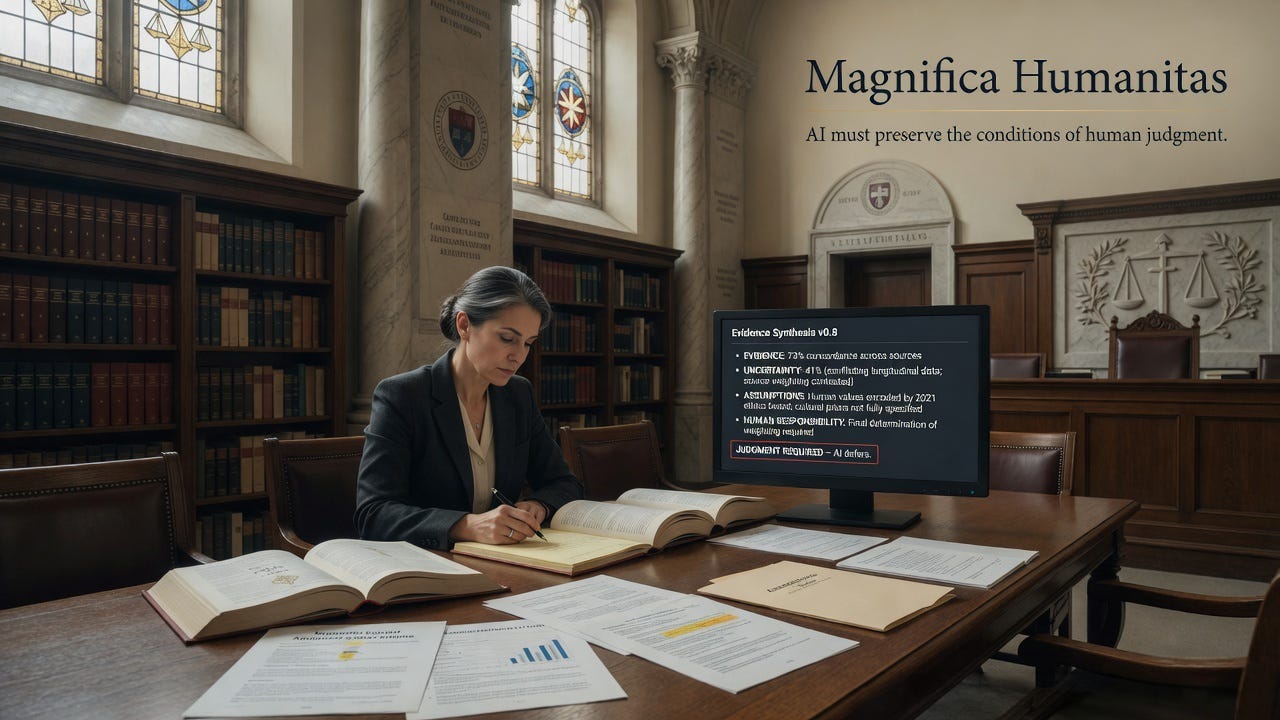
That may be the practical lesson of Magnifica Humanitas for AI governance.
The question is not whether AI will become more powerful. It will.
The question is whether our institutions can remain ordered to the human person as that power enters the places where we judge, decide, remember, speak, work, and govern.
That is not only a technical problem.
It is a human one.
No posts
Comments
Nothing yet. Say the first thing.
Sign in to join the conversation.