
Monday, August 3
GDPNow update
Tuesday, August 4
GDPNow update
JOLTS Report
Wednesday, August 5
Cook Speaks at the Anchorage Economic Development Corporation (AEDC) 2026 Economic Luncheon
Thursday, August 6
GDPNow update
Initial Jobless Claims
Friday, August 7
Jobs Report
Survey of Consumer Expectations
Saturday, August 8
Bowman Speaks at the 2026 CEO & Senior Management Summit and Annual Meeting Speakers
Slower growth… Real gross domestic product (GDP) grew at a continuously compounding annualized rate of 1.5 percent in 2026:Q2, according to the advance estimate from the Bureau of Economic Analysis released last week. It has grown 2.1 percent over the last year. For comparison, real GDP grew at a continuously compounding annualized rate of 2.5 percent over the five-year period just prior to the pandemic.
Nominal spending shows no such slowdown. Nominal GDP grew at a continuously compounding annualized rate of 7.6 percent in 2026:Q2 and has grown 6.3 percent over the last year. For comparison, it averaged just 4.1 percent annualized growth over the five years just prior to the pandemic. The level of spending tells the same story. Nominal spending totaled $32.48 trillion in 2026:Q2, compared with a neutral level of $32.01 trillion, which puts the nominal spending gap at 1.45 percent.
Prices… Inflation slowed in June, according to new data from the Bureau of Economic Analysis. The Personal Consumption Expenditures Price Index (PCEPI) fell at a continuously compounding annualized rate of 1.3 percent in June 2026, down from 5.5 percent growth in the prior month. It has averaged 4.3 percent annualized growth over the last six months and 3.6 percent over the last year.
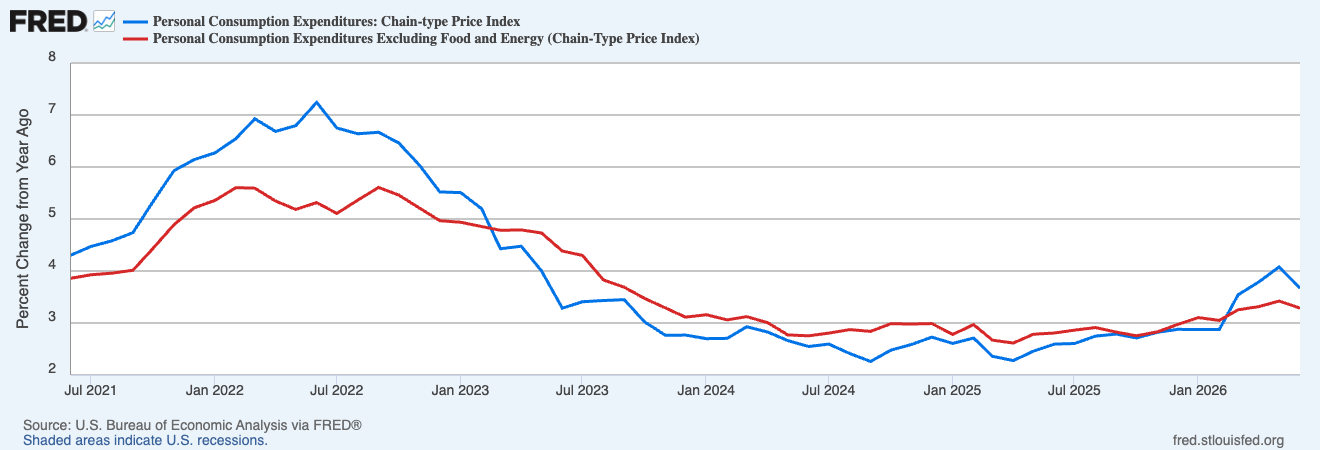
Core inflation, which excludes volatile food and energy prices, also slowed. Core PCEPI grew at a continuously compounding annualized rate of 1.6 percent in June 2026, down from 4.0 percent in the prior month. It has averaged 3.7 percent annualized growth over the last six months and 3.2 percent over the last year.
Three Dissents… The Committee left the target range for the federal funds rate unchanged at 3.5 to 3.75 percent on July 29, but the vote was not unanimous. Lorie Logan, Beth Hammack, and Neel Kashkari each dissented in favor of a quarter-point increase, and each published a statement two days later explaining the vote. The three make different arguments, but they arrive at the same judgment: inflation is not on track to return to 2 percent on its own, and the current setting of policy is not restraining demand.
Logan’s argument starts with the stance of policy itself:
Labor, consumption and financial market conditions indicate that monetary policy is not restraining the economy. Without any policy restraint, inflation will likely continue to trend above target until there’s an unanticipated shock.
She puts the likely trend of inflation in the mid-2s rather than at 2 percent, with the risks to the upside, and describes the job market as solid and perhaps strengthening. Her conclusion is about timing: modest action now reduces the odds of having to take sharper action later.
Hammack was more explicit about where the pressure is coming from:
Supply-side factors, including energy prices, have boosted inflation this year, but I see inflationary pressures coming from the demand side of the economy, as well.
Businesses across the Fourth District, she reports, describe pricing pressures as broadening rather than fading. With unemployment near her estimate of maximum employment, she treats inflation as the more pressing half of the mandate and says plainly that she did not see the current policy stance as appropriately restrictive.
Kashkari takes on the supply-shock defense directly. He accepts the standard advice that policymakers should look through an individual shock, but not a run of them:
I increasingly believe that monetary policy does have an important role to play in addressing a series of successive supply shocks that might lead to entrenched higher inflation.
He points to the 1970s, when policymakers also read inflation as the product of successive supply shocks and eventually concluded that tighter money was necessary anyway. His preferred remedy is incremental: small moves now, which can be slowed or paused if inflation fades, rather than a larger correction forced on the Committee later.
The Fed Is Expected to Hold Rates. The Rules Say It Shouldn’t - Matthew Schaffer
Standing Still as Inflation Runs Hot - Bryan Cutsinger
One Month of Falling Prices Won’t Restore Price Stability - Bryan Cutsinger
Comments
Nothing yet. Say the first thing.
Sign in to join the conversation.