
Tuesday, June 30
Job Openings and Labor Turnover Survey Release
Wednesday, July 1
GDPNow Update
Warsh Speaks at the European Central Bank (ECB) Forum on Central Banking 2026
Thursday, July 2
Employment Situation Release
Prices… Inflation increased in May, according to new data from the Bureau of Economic Analysis. The Personal Consumption Expenditures Price Index (PCEPI) grew at a continuously compounding annualized rate of 5.4 percent in May 2026, up from 4.9 percent in the prior month. It has averaged 5.2 percent annualized growth over the last six months and 4.0 percent over the last year.
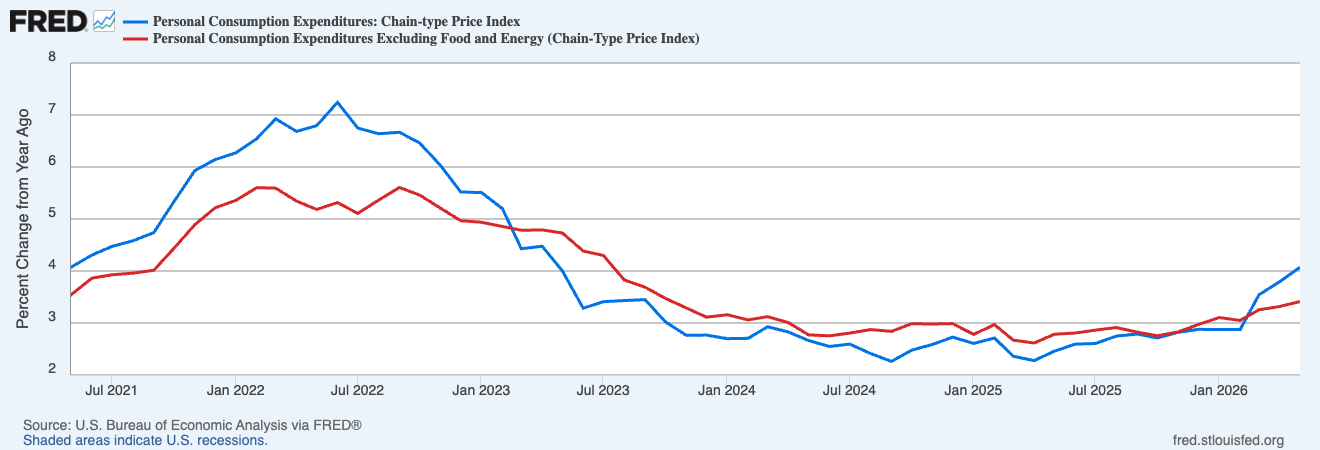
Core inflation, which excludes volatile food and energy prices, also rose. Core PCEPI grew at a continuously compounding annualized rate of 3.8 percent in May 2026, up from 3 percent in the prior month. It has averaged 4.1 percent annualized growth over the last six months and 3.4 percent over the last year.
Although much of the recent rise in inflation can be explained by the ongoing conflict in the Middle East, which has pushed up energy prices, excess demand continues to contribute to the longer run inflation problem. Nominal spending has grown at a continuously compounding annualized rate of 5.6 percent over the last year. For comparison, it averaged just 4.1 percent annualized growth over the five years just prior to the pandemic. Absent a change in total factor productivity growth, restoring nominal spending growth to its pre-pandemic rate would reduce the annual rate of inflation by 160 basis points.
Solid growth… Real gross domestic product (GDP) grew at a continuously compounding annualized rate of 2.1 percent in 2026:Q1, according to the third estimate from the Bureau of Economic Analysis released last week. It has grown 2.7 percent over the last year. For comparison, real GDP grew at a continuously compounding annualized rate of 2.5 percent over the five-year period just prior to the pandemic.
The Atlanta Fed currently estimates real GDP will grow at an annualized rate of 2.5 percent in 2026:Q2. Earlier this month, the median Federal Open Market Committee (FOMC) member projected 2.2 percent real GDP growth this year.
Dollar Dominance… Governor Christopher Waller opened the Fed’s Fifth Conference on the International Roles of the U.S. Dollar on June 22, with this year’s focus on how stablecoins are reshaping the dollar’s place in the world. His message was simple. The foundations of dollar dominance are intact, but the machinery around them is changing fast.
The reasons the world reaches for dollars haven’t gone anywhere. Deep, liquid markets and a long reputation for the rule of law still do most of the work. What’s new is the plumbing. Tokenized assets are building fresh channels for moving dollars around, alongside the banks and payment systems that have always handled the job.
Distributed ledger technologies and tokenized assets, such as stablecoins, are creating new channels for global dollar intermediation.
Waller didn’t treat any of this as a threat. He sees stablecoins as part complement, part competitor to the existing system, and as an economist he’s fine with that. More competition, in his view, tends to leave consumers better off.
The Fed sits at the center of both stories, the dollar’s global role and the rules taking shape around digital assets, so where a governor lands on stablecoins is worth tracking. Waller is looking at dollar-backed tokens, including the prospect that they channel foreign demand for safe assets straight into the Treasury market, and seeing opportunity rather than something to wall off.
Comments
Nothing yet. Say the first thing.
Sign in to join the conversation.