
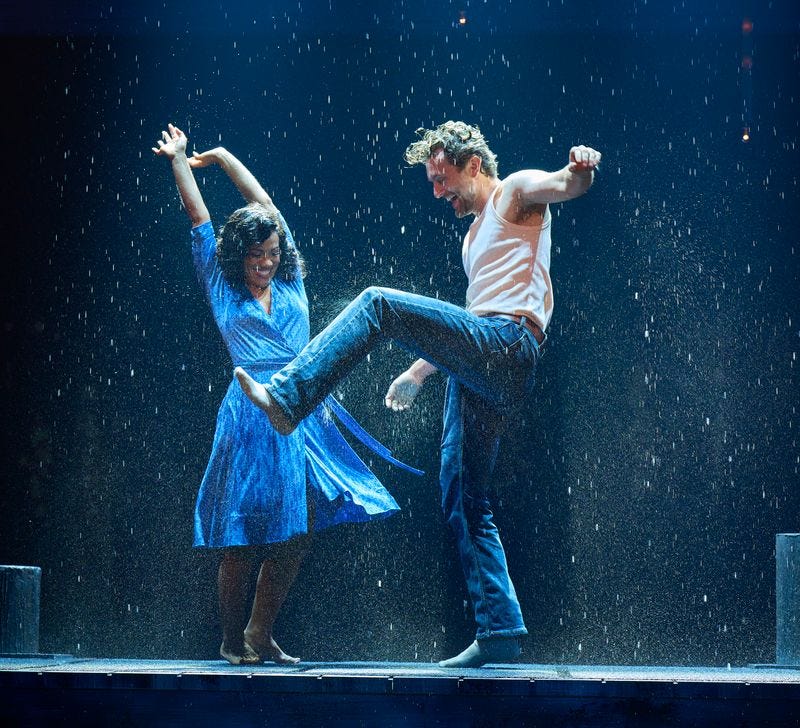
If you cried reading Nicholas Sparks’ 1996 bestseller The Notebook, or if you cried watching Nick Cassavetes’ 2004 film adaptation starring Ryan Gosling and Rachel McAdams, then you will cry watching the musical. Everyone was crying at the performance I saw at the National Theatre in D.C., where the North American Tour has stopped for a two-week stay. And that’s because the story of a star-crossed couple separated by outside forces, time, and eventually a tragic case of cognitive decline is both heartwarming and heartbreaking. The musical version of The Notebook, co-directed by Michael Greif (known for his tearjerkers, having directed Rent, Next to Normal, and Dear Evan Hansen) and Schele Williams (The Wiz), doesn’t try too hard because it knows you already like The Notebook and that you will probably cry at the end regardless of what they do and how they do it.
The stage adaptation splits the story of Allie, the pampered heiress, and Noah, the lumber mill worker, into three eras: their initial love affair, their inevitable reunion, and the framing device, where, a few decades later, Noah reads their love story to Allie, who now battles dementia, aloud from her notebook. As Older Allie (Yassmin Alers) and Older Noah (Beau Gravitte), the two have the difficult task of making you believe their long love for each other, deep down in their bones, despite the fact that one of them doesn’t even know who the other is or was.
Younger Allie (Makena Jackson) and Younger Noah (Kyle Mangold) get to play the fun, crazy, over-the-top emotions that come with falling head over heels for the love of your life. The infatuation, the sexual discovery (Mangold gets a pretty solid laugh when his tongue hangs out of his mouth as he watches his leading lady undress for the first time), and, of course, the pain of falling for someone you’ll never be able to be with. It’s Romeo and Juliet. (Similarly, costume designer Paloma Young takes a Montague and Capulet approach to their clothing, only putting Noah in brown flannel and Allie in beautiful blue. I found this curious, however, considering there are only really two characters, of different races and genders. I didn’t need any help remembering who they were at any given time.)
Middle Allie (Alysha Deslorieux) and Middle Noah (Ken Wulf Clark, both are quite good) get the bulk of the familiar material, including, naturally, that famous kissing scene in the pouring rain. Book writer Bekah Brunstetter restructures most of the piece (with three ages of the characters, and by pushing it 30 years into the future to update the present-day setting — Noah joins Vietnam instead of WWII, for example) and rewrites most of the dialogue. Unfortunately, if you’ve seen The Notebook movie before, then you’ve probably seen it a thousand times on basic cable, and both the lines and line readings have stuck in your brain. It might be unfair to compare the musical to the movie, but it is inviting some comparison just by the very nature of its existence. In almost every dramatic beat, the movie pulls it off better. The only time Brunstetter really copies and pastes is Noah’s “I wrote you 365 letters. I wrote you every day for a year,” and, as the rain washes all over them, Clark hits it with conviction. It’s iconic for a reason.
My pining for the movie’s screenplay over the musical’s book is minor in comparison to the challenge of the songs, which are some of the most banal tunes I’ve ever heard in a Broadway musical. The singer-songwriter Ingrid Michaelson, who is otherwise very talented and successful in her indie pop career (I like many of her songs), has given every song in this show a vague, shapeless feeling of sameness. In her debut as a musical theatre composer and lyricist, she has written nothing but the form’s classic “I Want” song over and over. I want this girl to fall in love with me. I want this girl to come back to me. I want my wife to remember me.
With titles like “Home” and “Carry You Home” or “Sadness and Joy” and “It’s Not Easy,” they’re impossible to differentiate. Lyrics like “One day, I’ll carry you to our home, yeah, one day, you’ll be my home” and “God, he looks good in that shirt, in those pants” don’t help matters. Neither does the co-directors’ go-to staging of having the Older version of a character look longingly at the Middle version, who in turn looks longingly at the Younger version, which is an extremely obvious decision in the show’s first minute and an increasingly lazy decision the more they do it. At least Brunstetter’s book, which works best when it’s playing the story’s humor, actually moves the show along.
But, in the end, the story still works. It worked on me. Is that because Sparks and Cassavetes and Gosling and McAdams have built up a ton of goodwill with their rewatchable classic? Maybe. But I think it’s because the story of Noah and Allie is built to be universal. The long-lost love, the true love, the love that is patient and kind. The tragedy of losing someone to a disease that not only takes them away from you, but takes them away from themselves. Just about every single person in that audience has experienced that tragedy with a loved one. You have that story.
I have that story. Just a few weeks ago, I said goodbye to my great-aunt, who is nearing 100 and can’t remember much anymore. When I first walked in, I could tell she didn’t know who I was. I had expected that and had prepared for it. What I didn’t expect, however, was for her to, about ten minutes later, point right at me and say my name. For just a second, she remembered me. That was enough for me. That’s all we can really ask for. That’s what Noah wants, and why he reads Allie her notebook. That’s The Notebook.
Visit Broadway at the National for tickets and more information.
Comments
Nothing yet. Say the first thing.
Sign in to join the conversation.