
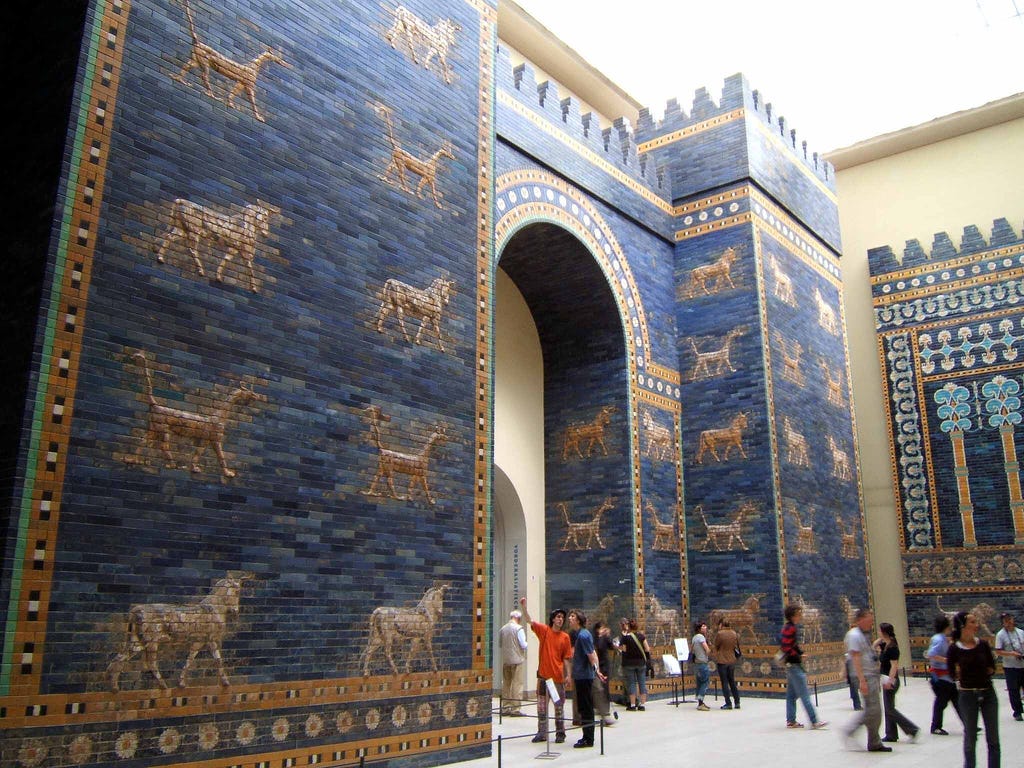
Above: The Ishtar Gate which once led to the inner, royal complex of king Nebuchadnezzar II. According to one legend, the “Hanging Gardens of Babylon” were constructed by Nebuchadnezzar within that complex as a gift for his wife Amytis. The reconstructed gates are now located in the Pergamon Museum of Berlin.
It was I by my great power and outstretched arm who made the earth, and the people and animals on the face of the earth, and I give it to whoever seems right to me. And now, I have given all these lands into the hand of Nebuchadnezzar, king of Babylon, my servant. And I have also given the animals of the field to serve him. All nations shall serve him, his son, and his grandson, until the time of his own land comes. Then many nations and great kings shall make him their slave.
Jeremiah 27:5-7
In today’s reading we continue to explore prophecies from toward the end of Jeremiah’s career. As we saw yesterday, Jeremiah lived through the Babylonian Exile of 586 BC and many of the prophecies in his book originated around that time. The passage quoted above, for example, was given at the beginning of the reign of Zedekiah (27:1) in 597 BC.
Jeremiah’s message to Zedekiah and to the people of Judah was clear. The punishment that Babylon had inflicted on Judah in 597 was ordained by God. When Babylon captured the king, slaughtered his sons, and took the elite of society off to captivity, that was to punish the Judeans for their generations of obstinate sins. But even then, when God’s vengeance was already being meted out, Jeremiah taught the people how to protect themselves. Jeremiah told king Zedekiah to submit to Babylon, to bear the yoke, and to wait for God’s salvation. One day God himself would destroy Babylon, liberating Judah in the process (27:7). But until then, the Judeans should submit themselves as willing vassals of Babylon, accepting subjugation as a punishment from God. The Judeans were given one final command: Do not, under any circumstances, rebel against Babylon. If they did, then God promised to hurt them again, and exponentially more severely (27:8-11).
As we have seen, they did in fact rebel. Though Jeremiah had warned the Judeans to remain faithful vassals and wait for God’s salvation, king Zedekiah tried to regain Judean independence by force of arms. The story of this utter failure is told in 2 Kings 25 and the king suffered a fate much worse than death for his rebellion (2 Kings 25:7). The king’s fate could have been avoided, along with most of the destruction involved in the Babylonian Exile, if he had not rebelled.
But as it says in Proverbs 21:1, “The king’s heart is a river in the hand of Yahweh; he turns it wherever he wills.” By this point in Israelite history, God’s patience with the Israelites had run out. He had already decided that punishment must be meted out against his ever-rebellious people. So in the language of the Bible, God “hardened” the king’s “heart” (cf. Ex. 4:21) to ensure that the punishment would come.
Thus God’s original plan for the Israelite nation ended in dismal failure. It had operated from 1250-586 BC, almost a thousand years at the beginning of recorded history. But in 586 God’s plan changed forever, and he abandoned the Israelite nation. From that point on, God’s relationship would not be with a nation but with a people—not defined by ethnicity, language, or culture, but drawn from all the peoples of the world. In other words, to fulfill his eternal plan, God abandoned the temple in Jerusalem and began to construct a spiritual temple, which would be completed after the death of Jesus and the birth of the Church.
No posts
Comments
Nothing yet. Say the first thing.
Sign in to join the conversation.