
Stacking Cups is one of my favorite lessons—I taught it years ago with real paper cups and wrote about it here.
Then I saw the digital version in Amplify Desmos Math, so I did the only reasonable thing: I put them side by side.
Which lesson launch wins, A or B?
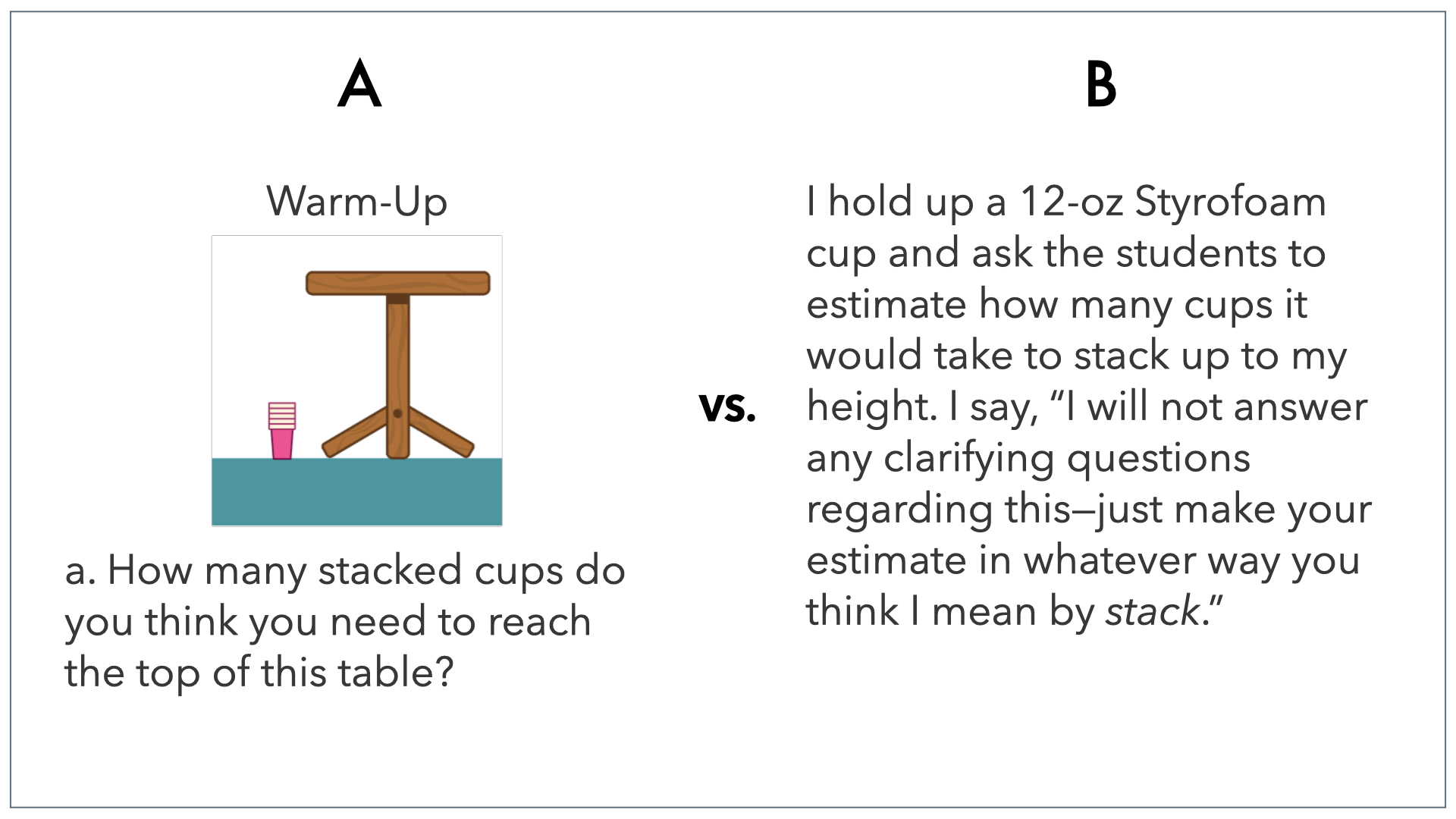
I’m going with B because Ms. Win isn’t even tall—I can eyeball this, no problem.
How about having kids gather and record data digitally? In A, they drag the movable point to however many cups they want, the ruler adjusts accordingly, and they record the heights in a table.
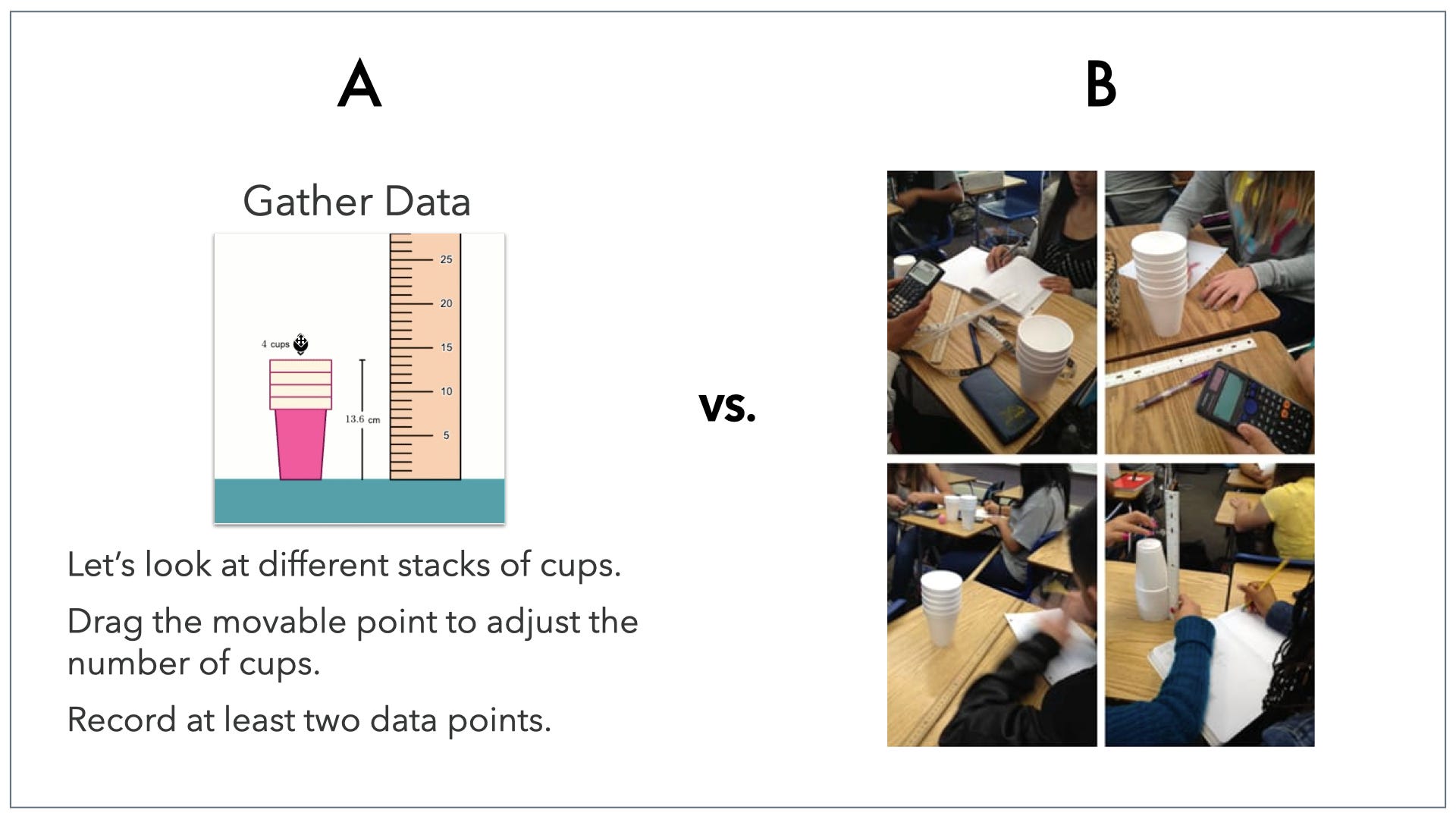
B wins here too because it’s tactile—and gathering data requires accuracy and patience and a deep restraint not to snap a ruler against a teammate’s arm, even if you have sorry-I-was-just-playing-around teed up for the split second you commit the abuse.
B’s up two to nothing. And yet—this is where I fell in love with the digital version. It’s well crafted—the questions ramp up smartly, and the digital screens matter in ways I can’t touch with real paper cups.

Once the table height is given, students are expected to calculate the exact number of cups. And they receive feedback on correctness before moving on.
I didn’t even know it’s called a minaret, but eyeballing is not gonna work here. Asking how many stacked cups it takes to reach a height of 42.5 meters is just the right question at the right time, before anyone gets too comfortable.
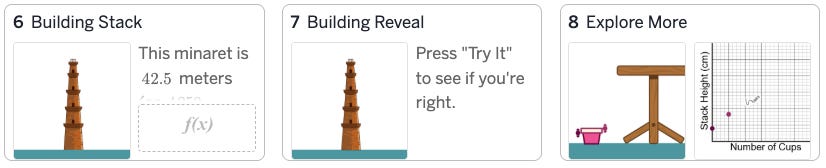
And screen 8 below is tech-enhanced pedagogy that makes me want to hug and high-five our curriculum writers.
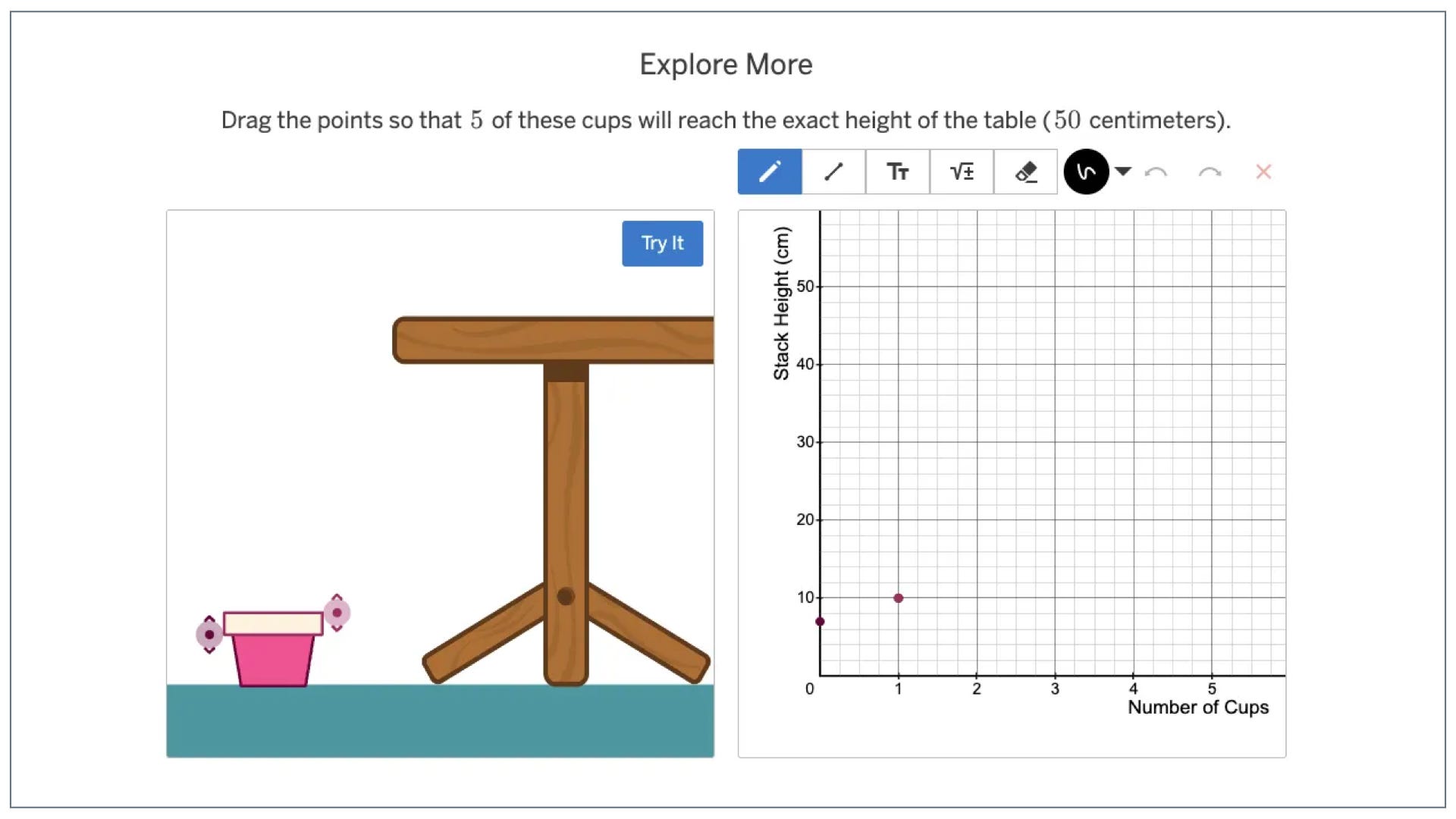
The table is 50 centimeters, and 5 cups have to reach it exactly. You drag two points—one sets the height of the cup body, the other sets the lip—until your stack of 5 lands right at the top. And as you drag, a graph plots it right there. Slope and y-intercept suddenly come out to play and taunt you into a math showdown.
What I love is that they’re working backwards. They’re not solving for a number—they’re building the cup itself to fit the answer, which is exactly the thing paper cups can’t do.
The lesson continues and seizes the chance to ask students about the usefulness of two different graphs—one with a line, one with points. See, I wasn’t smart enough to bring that up.
Sure, it was fun to ask kids to estimate how many cups to reach my height, and I’d absolutely launch this task the same way. That takes a total of one paper cup. Okay, two.
The tactile part of kids measuring real cups feels like the good, rich, hands-on thing, but it starts costing more than it teaches. The data comes in sloppy (sloppy is real and I honor it—but not here, not in this lesson), and now the linear relationship they’re supposed to discover is buried under measurement error you created. Digital doesn’t remove the thinking; it removes the friction that was never the point—so the slope and intercept show up clean.
But Jesus, the memory of driving around to find this many cups (in three different effing sizes!), hauling them out to my car, and hiding them in my classroom closet until lesson time is one I do not miss. Time and money not well spent for any poor teacher.
Digital lesson wins hands down here.
P.S. — Unrelated to cups: I finally revamped B2N and Chewable Math, both through GitHub. You'll find them in the top navigation—go poke around.
Comments
Nothing yet. Say the first thing.
Sign in to join the conversation.