
I've transferred another once standalone site chewablemath.com into this space to cut down costs. You can access the 40 entries at the top menu. I'm proud of this work because in addition to the [mostly] proportional reasoning math, it's full of fun facts and things you never knew you needed to know.

At speaking events recently, I shared this problem and folks were engaged with good discussions to be had, so I thought I’d share it here too:
Some friends painted 2 fences—1 large fence and 1 smaller fence that was half the size of the large fence. They spent half a day painting the large fence together. For the rest of the day, half of the friends painted the large fence, while the other half painted the smaller fence. At the end of the day, the big fence was done. 1 friend finished painting the small fence the next day. How many friends painted the fences?
Have a go at this. Can you solve it in more than one way? Did a sketch help you? How might a high school student solve this? How would a middle schooler approach it? What about a 5th grader?
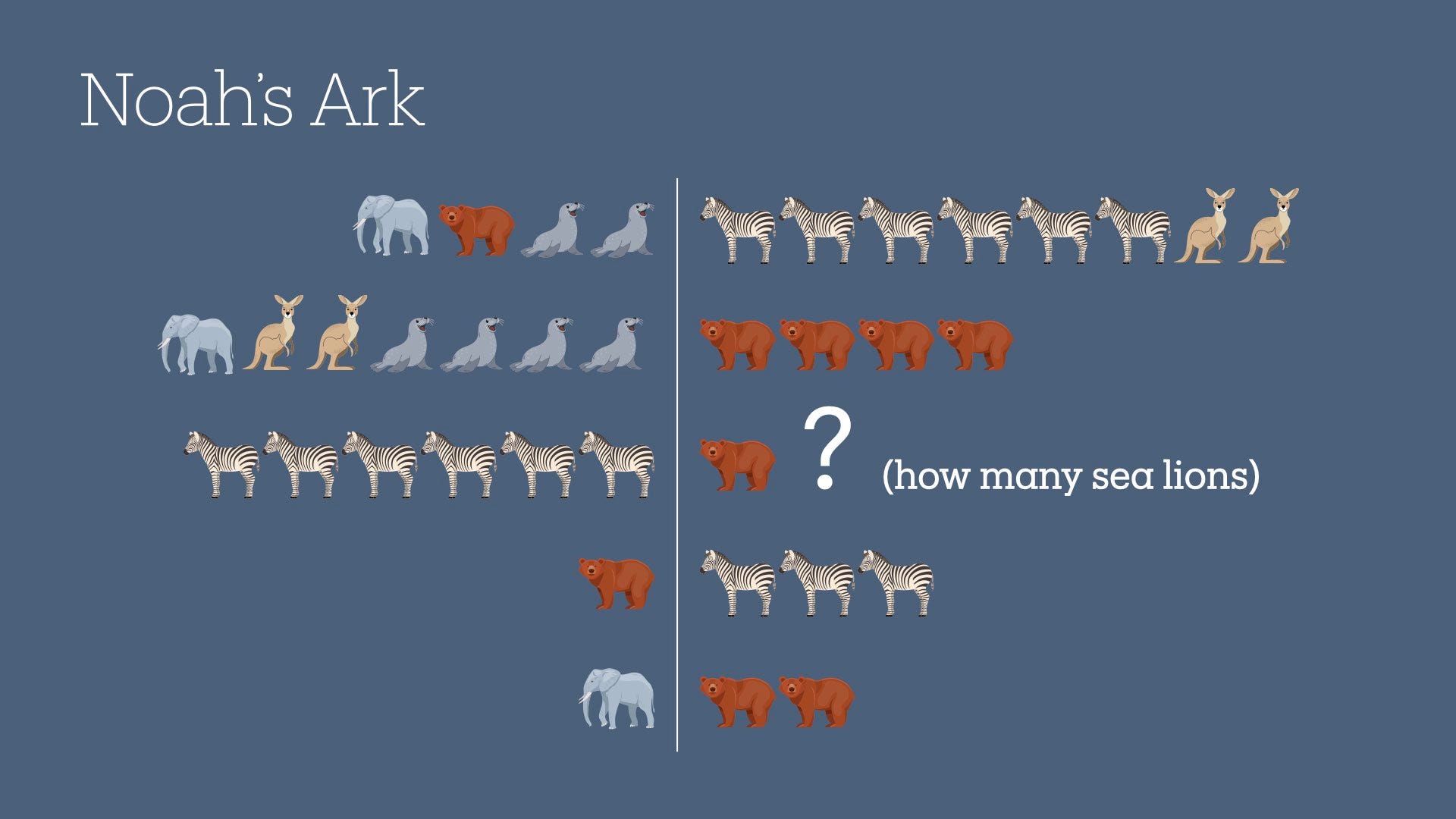
My favorite problems are the ones you can pose to students across grade levels. My perennial favorite, Noah's Ark, for example.
Back to the fences problem. It's from Amplify Desmos Math's Grade 5, Unit 3 Extensions. And any time I speak of extensions, I have begged teachers to assign them to all students. When we say access for all, then make it happen. I don't want only early finishers working on these problems—they tend to be richer and more application-based. I'd hate for a student to lean over her shoulder and see a classmate working on some "extension" and think, "Oh, I'll never get to do those because…" That bites.
You pose the extension to the whole class. Give them 5 to 10 minutes in small groups to get into the problem: notice and wonder. That's it. Move on to your regularly scheduled whatever and say, "When you're done with this work, go back to the extension." This works beautifully on an exam day or any day where some students will finish early. Don't grade it, obviously. Build a culture of tinkering, collaboration, and curiosity—one where students who struggle with arithmetic realize they can do hard things. And that culture starts with you.
Here’s another extension problem from ADM, and I won’t tell you from which grade because it doesn’t matter. There’s no prerequisite to tinkering and pattern-seeking.
Two lines can intersect at a maximum of 1 point.
a. What is the maximum number of intersections for 3 lines? 4 lines?
b. Draw 5 lines so that they intersect at the maximum number of points.
c. What is the maximum number of intersections for 6 lines? 7 lines?
d. What is the maximum number of intersection points for n lines?
I hope your school and community are paying extra tribute to you this week—it’s Teacher Appreciation Week! Our school used to do something special each day of the week for us. Kids participated too. It was all very kind and thoughtful, but I really just wanted cash. I did have one mom hand me a big bag and say, “Don’t open that until after school.” It was alcohol. Close second to cash.
Congrats if you’re done with state testing. I salute you. If not, I’m sorry—hang in there. Either way, this might be the perfect time to pull out all the extension and challenge problems from your curriculum and just have fun.
Comments
Nothing yet. Say the first thing.
Sign in to join the conversation.