
Dear Reader,
This is my third article in the US-Israel-Iran war series. Like the Ukraine war, this too is threatening to prolong beyond days to weeks to months now. The talks in Islamabad are not yielding any results. It’s not a surprising outcome. Everyone is at a loss for thought about what alternatives the world has. Unless there is a new strategy in place, reinforcing a failure is a bad strategy. This article explores a possibility and its implications. Hope you will find time to read it.
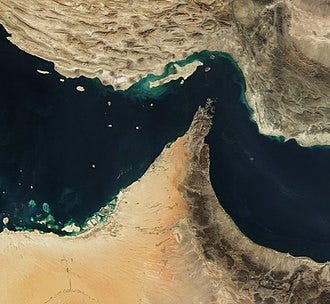
Is there an Alternative to the Straits of Hormuz
The Iran–US & Israel conflict is in a two-week ceasefire after 37 days of fighting. The ceasefire aims to bring both sides back to the negotiating table. Pakistan, favoured by the Trump administration, was tasked with organising talks between US Vice President JD Vance and the Iranian delegation. As of 12 Apr ’26, the talks have not yielded results. The US Vice President has returned home, leaving a team for further negotiations on the second day. The second day appears cosmetic, to show sincerity and commitment, but is unlikely to achieve a breakthrough. The demands of both sides are so far apart that finding common ground is a distant dream. President Trump faces heavy criticism at home and abroad. His gamble has failed. The geography around Iran has become its Waterloo. Many experts believe the President did not plan thoroughly and that there was no end-state execution plan. As President Clinton said in his radio and TV speech: ‘The US administration decided to enter a building which they did not map, and now they are searching for the exit.’
Two contentious issues are the ‘Achilles Heel’ of the negotiations. The US is adamant on the Iranians giving up their enriched uranium and giving a commitment to give up their nuclear weapons program, and second, to keep the Straits of Hormuz open for international shipping toll-free. Both these conditions are the leverage that Iran is using to tilt the balance of power. No Iranian delegation would voluntarily give away this advantage. They believe the US needs a deal more than Iran does and is therefore unlikely to succumb to US demands. Where does it lead then if the talks fail, which appears to be the case unless a miracle happens? And even if it happens, it would favour Iran more than the US and the larger international community. Iran has mined the Strait of Hormuz and controls the waterway. Only Iranian ships, or those with Iran’s consent, may transit. 230 million barrels of oil are stuck in the Persian Gulf on ships waiting to be shipped out to their destinations. They were waiting for the talks to bail them out, but it looks like their wait has got longer.
The Straits of Hormuz play a critical role in global energy transport, as 20% of the world’s oil passes through this narrow route, primarily bound for China, India, Japan, and other Asian countries, with some also reaching Europe. With ongoing conflict, the likelihood of the straits becoming closed or offering only selective passage threatens to severely disrupt energy supply lines and the global economy. Therefore, it is essential for military and national planners to develop alternative routes—a Plan B in case Plan A fails. While some alternatives for oil and gas transport exist if the Straits of Hormuz are closed, these options are currently neither viable nor sustainable. The following paragraphs will analyse these alternatives.
Source: East West Crude Oil Pipeline: Wikipedia
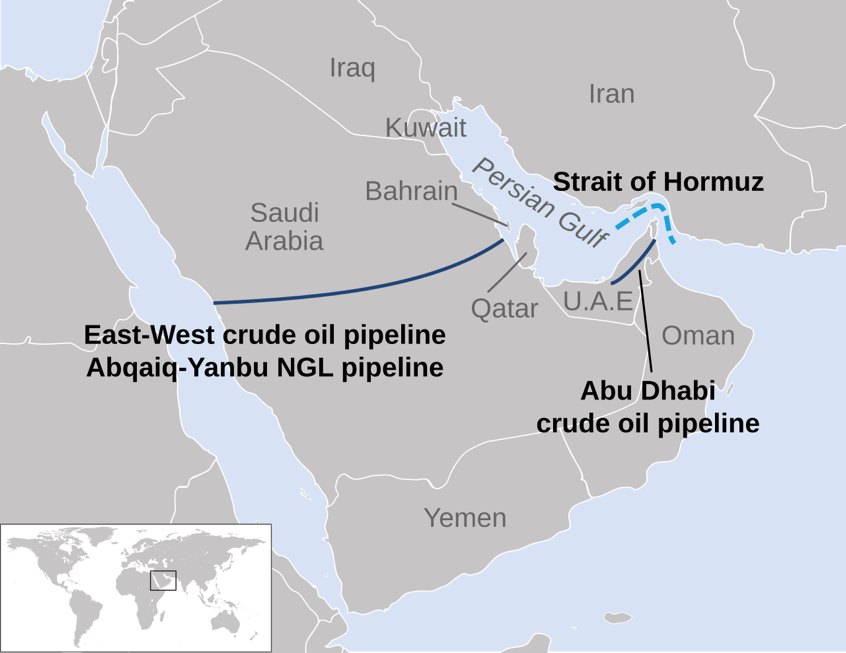
The East-West Pipe Line
The East-West Pipeline in Saudi Arabia is 750 miles long, running from the Abqaiq oil fields on the eastern coast to the Yanbu terminal on the Red Sea. This pipeline can transport about 7 mbd (Millions of Barrels per Day); of this, 4.5 million barrels are for exports at the Yanbu terminal, with the remainder for local consumption. Each day, 18 million barrels of crude oil and 4 million barrels of refined petroleum products flow through the Straits of Hormuz. To replace this flow, the East-West line would need to create an additional 15 mbd of excess capacity. The Habshan-Fujairah Pipeline (220 miles), which runs through Abu Dhabi and opens into the Strait of Hormuz, has a capacity of 1.5-1.8 mbd. This reduces the requirement for alternative capacity to the Straits of Hormuz to nearly 13.5 mbd. Such excess capacity must be created to mitigate Iran’s stranglehold over the Hormuz Strait. Both pipelines currently transport crude oil from oil fields to their terminal ports.
However, this is not the only problem. There are structural technological problems. Crude flows through larger, thicker pipelines to accommodate its far more viscous, impure nature. Refined petroleum products require thinner, smaller pipelines to transport them due to their water-like consistency. Europeans rely on oil refined in the Middle East, most of which comes from the Persian Gulf. The East-West pipeline caters 75% of its exports to Asian countries in the form of crude oil. Thus, the East-West pipeline and the Habshan-Fujairah pipeline can carry either crude oil or refined oil, but not both. Thus, a solution that relies on an alternative source outside Hormuz will not satisfy their European customers.
Notwithstanding the above, the East West Pipeline must transport crude to Asia via the Red Sea and the Bab-el-Mandeb, a strategic chokepoint for the Houthis. This move will restore the Houthis’ importance. Although they have largely stayed out of the conflict—except for firing a few missiles at Israel—they can still exert a stranglehold on the Bab-el-Mandeb, much as the Iranians have over the Straits of Hormuz. While the extent of this control is debatable, it is sufficient to deter insurance companies. The resulting fragile peace between the Saudis and the Houthis has allowed Saudi Arabia to use the Red Sea route. Whether the Saudis take this free passage for granted remains a question that will influence decisions about diverting excess capacity to the East-West Pipeline.
The decision to create an alternative passage for the oil will take time to bear fruit. Historical examples, such as Operation Pluto during the Second World War, show how the Allies laid a pipeline to supply oil to Europe via the English Channel. This was a wartime engineering marvel. Within a few months of the Normandy landings, the Allies in mainland Europe were receiving a million gallons of fuel per day. It’s essentially an engineering problem. The US, its Gulf allies, and Israel possess cutting-edge technology in this field. In the US, for example, construction of the Dakota Access Pipeline from North Dakota to Illinois—a distance of 1,172 miles, much longer than the East-West Pipeline—took 10 months. The US has already spent 33 billion US dollars on the war effort in Iran and is likely to spend more if the conflict is prolonged. Even if a fraction of this is directed toward constructing this pipeline, it would snatch the leverage that Iran flaunts to the world. This approach carries risks, such as vulnerability to Iranian drone attacks. However, anti-drone measures, such as those developed by Ukraine during its war against Russia, could help mitigate such dangers. Increased capacity would also require expanding refining, docking, and loading areas at ports on the Red Sea and the Gulf of Oman.
The Iranians possibly have played their hand too fast and exposed all their trump cards. Having targeted all the Gulf countries, they have lost all friends in the Gulf. The blackmail will not last beyond a reasonable period. Iran is believed to have the capacity to withstand this offensive for another three to six months. If the US starts a war on the ground, who knows, it could even be less. The blocking of the Straits of Hormuz comes at a suicidal cost to Iran, whose economy is already in shatters. They will restrict oil exports, but in the bargain, they will also suffer a near-total halt in imports. Iran’s trade and commerce would suffer a permanent impairment. This scenario is the worst-case scenario that planners must take into account.
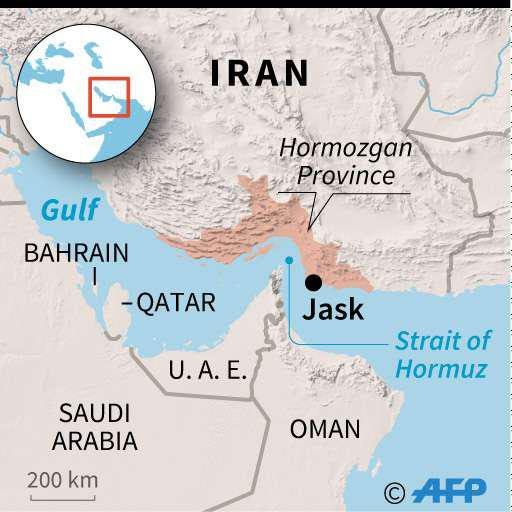
A question arises: Can the US Navy fully blockade all Iranian ports? Could it cut off Iran’s oil revenue entirely? Iran continues to operate its ghost fleet to South Asian transfer points, moving about 1.85 mbd of oil. Much of this supply goes to China, which pays a premium to keep its oil lines uninterrupted. Iran also imposes a two-million-dollar toll on each ship passing through the Hormuz Strait. In the future, could the US Navy block this revenue? The key to Iran’s oil supply to China and South Asia is the Jask Oil Terminal, located outside the Strait of Hormuz.
Source: The Arab Weekly, 12 Oct 2019, Sat
The terminal is active. Iran’s decision to export crude was anticipated by the current crisis. The terminal’s loading capacity is one mbd, and it can store 5 million barrels. The Ghost fleet may obtain its oil supply from this facility. The US Navy and Air Force face a tough decision about whether to destroy the terminal, since it supplies oil to China. The US fears this might prompt China to take sides. Blockading the terminal could be a separate action considered in the future.
Conclusion
The talks in Islamabad are unlikely to bring a viable deal between the US and Iran. It signals either widening of the conflict or a state of frozen flux in which both the bombing and intermittent talks would continue. Yet the important issue of the Straits of Hormuz will remain unresolved. The jostling for control will continue, causing damage to both sides. It is likely that the Gulf states like Saudi Arabia and the UAE will jump in with the US to effect regime change, as that remains the only hope, to terminate the conflict. But this crisis has forever changed the geostrategic perspective of the Persian Gulf. It will no longer be an area where countries will want their ships to berth to meet their energy requirements, even after the war has ended. They will be looking for safer berthing terminals where the potential for conflict and damage is not part of the commerce. The floating mines in the Persian Gulf will remain a permanent threat, as reports suggest that Iran does not know the locations of the mines it has laid. Such a scenario is asking Gulf countries to invest in a Plan B for transporting oil produced in their own countries. It’s a distinct possibility, and such leverage will allow us to lessen Iran’s geopolitical importance and its ability to blackmail innocent passage of ships, which are only interested in trade and not in politics. With technology, many more possibilities can emerge, but the Gulf states must reach a consensus to change how they do business in the future.
Comments
Nothing yet. Say the first thing.
Sign in to join the conversation.