
My Dear Friend,
Saturday was the Feast of the Assumption. By the time the comments settled, it had exposed an impressive number of assumptions.
Some concerned Mary herself. Others concerned what Catholics, Protestants, and Orthodox Christians supposedly believe about her. One reader raised the title “Co-Redemptrix.” Others described the ways Marian devotion had nourished them, confused them, or made them deeply uncomfortable. It became clear that this conversation deserved more than a few hurried replies beneath Saturday’s essay.
So, today’s piece grew directly from that comment thread.
Then, on Monday, the first episode of the Message From the Margins podcast went live. I hoped people would enjoy it. I was not prepared for the response.
Martyjo wrote:
“After four years of biblical study I thought I learned everything I needed to know. Not so! Your significant lessons revealed more layers than I thought existed.”
Another listener, a lifelong Catholic who attended Catholic school for thirteen years, wrote:
“I learned things I never knew.”
DSW Ministries said the episode made a complex history understandable while leaving room for personal research, and especially appreciated that the Q&A was handled compassionately.
Those responses tell me that people are hungry for a faith that does not ask them to stop thinking. They want the history, the theology, the difficult questions, and a pastor who will not become frightened when the conversation gets complicated.
Then Christy asked whether future episodes might explore the history behind the Assumption, the Immaculate Conception, Mary’s perpetual virginity, and other Catholic teachings. I could not have arranged a better bridge into today’s essay if I had tried.
If you have not heard the first podcast episode, I would love for you to join us.
Listen to the first episode of the podcast here.
Supporting members made that podcast possible. They provide the research time, equipment, and breathing room required to make work like this carefully and keep most of it available to everyone. If these conversations are feeding you and you have the financial room, please consider becoming a supporting member today.
Support Message from the Margins
If money is tight or you’re still getting to know me, please stay. Read, pray, comment, and share. Those are real contributions to this community, and you are welcome here.
Your Brother in Christ,

Now, let us speak of Mary.
Few topics get Father pelted with rotten fruits and vegetables quite as quickly as speaking about the Blessed Virgin Mary.
Some call her the Blessed Virgin Mary. Some call her Our Blessed Mother, as I usually do. Some call her Saint Mary. Some call her just Mary. Some seem to think her last name was Christ. Others would rather not talk about her at all.
Regardless of where you stand, or what you sincerely believe, one thing remains the same: there is an astonishing amount of misinformation floating around about Mary. Most of it circulates about what other Christians supposedly believe about her.
Marian devotion, or the lack thereof, is deeply personal. It varies by faith tradition, culture, family, and individual piety. Two people can sit beside one another in the same church, profess the same creed, and have very different relationships with Mary.
Mine has ebbed and flowed, and ebbed again, and flowed again.
I love to pray the Rosary. I wish I could tell you that I pray it every day. I admire people who do. I should probably get into the habit of playing it in the background while I write for you. Perhaps I will start today.
But I digress.
Salvation history had already been unfolding for generations before a young woman in Nazareth entered the story. God had called Abraham, wrestled with Jacob, heard Israel cry from slavery, spoken through prophets, and kept faith through exile and return. Then all of a sudden, the spotlight shines on one young Jewish woman, recently engaged and going about her life in a town from which nobody expected anything remarkable.
God asks for consent. Mary says yes.
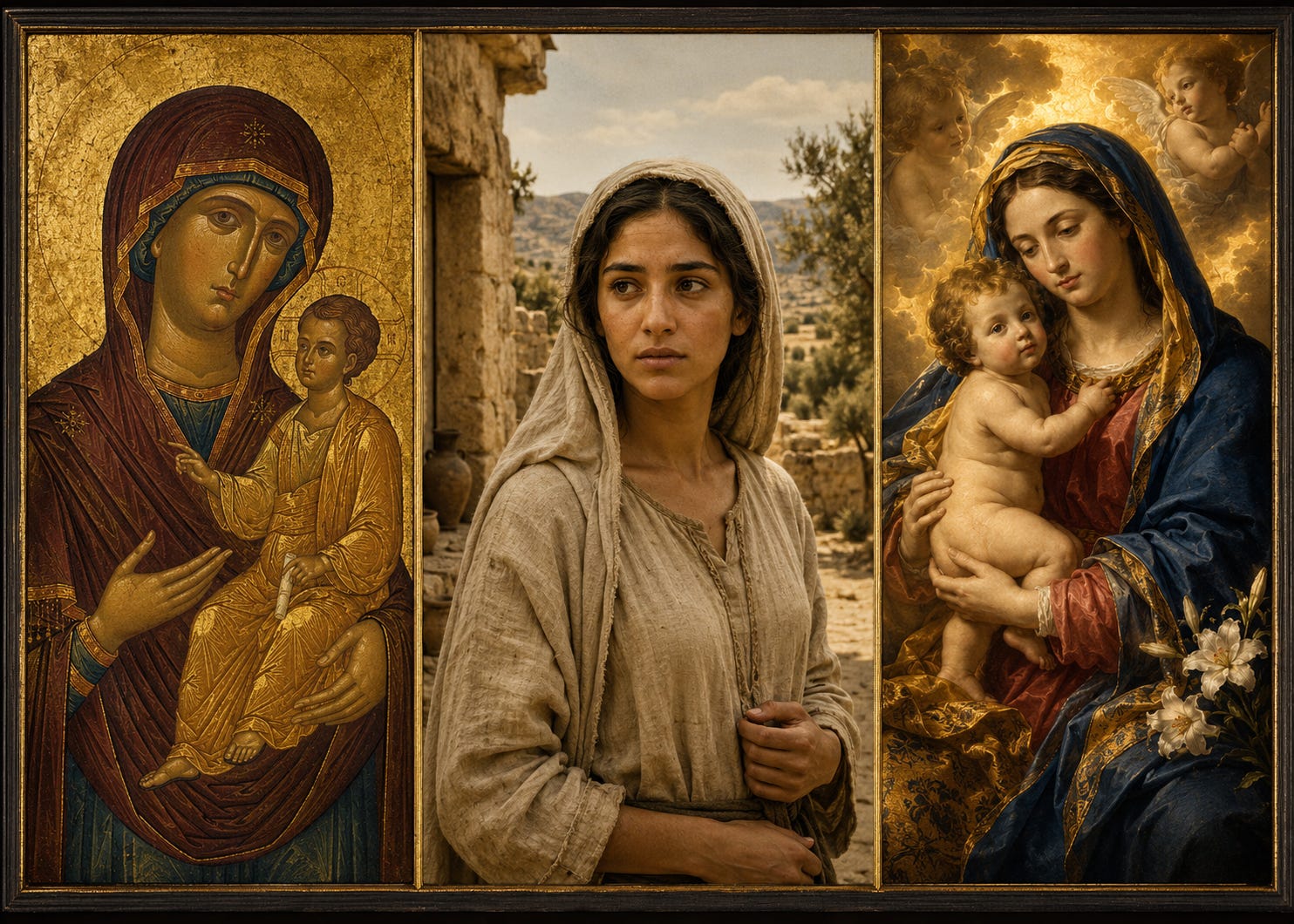
She says yes without a complete explanation, without a five-year plan, and without any guarantee that Joseph, her family, or her neighbors will believe a word of it. Her acceptance carries the possibility of public humiliation, abandonment, poverty, and danger. The sentimental pictures rarely show that part. Mary is usually serene, perfectly lit, and wearing blue fabric that no working-class woman in first-century Galilee could possibly have afforded.
The real Mary said yes when yes could cost her nearly everything.
So let us visit this woman in Nazareth and explore what she has come to mean to Christians today. We will listen to Protestant, Catholic, and Orthodox voices. We will notice what they share, where they genuinely disagree, and what each tradition is trying to protect.
This will not be a theological cage match. Nobody is leaving with a championship belt.
I should also tell you where I am sitting at the table. I am an Old Catholic priest. I call Mary Our Blessed Mother. I pray the Rosary, though less consistently than I would like. For one season of my life, I prayed before the Pietà nearly every day. Now, a large, beautifully painted image of Mary holding Jesus occupies a prominent place in my chapel office. My faith has been shaped by Marian feasts, Catholic liturgy, sacred art, and the communion of saints. However, I also possess a very functional skeptical eyebrow, particularly when a blurry photograph, unusual cloud, or piece of burnt toast is presented as the latest message from Heaven.
I need to say one more thing before we begin: this essay is utterly inadequate to its subject. I could write for the rest of my earthly life about Mary and still barely scratch the surface of the biblical, historical, theological, cultural, and devotional worlds gathered around her.
I am not a Marian scholar. I certainly do not speak for every Catholic, nor am I an expert in the sprawling worlds of Protestant or Orthodox Christianity. I am writing as a priest who has recently become the pastor of a beautifully ecumenical community. I am trying my best to serve the people entrusted to my care, and I will do my best to represent each tradition honestly, using Scripture, councils, confessions, liturgies, and the voices of Christians who actually belong to these communities.
If I have spoken about your tradition and missed the mark, please tell me. There is no ego here. I would much rather be corrected than confidently wrong. As always, I remain available for pelting with rocks and rotten vegetables at your convenience.
I want us to understand before we evaluate. We may still disagree when we finish. In fact, I can nearly guarantee it. At least we will be disagreeing about what people actually believe rather than arguing with a caricature we inherited.
So let’s start at the very beginning, which I hear is a very good place to start.
Before councils debated titles and churches divided over devotion, there was Mary.
Luke introduces her as a virgin pledged to be married to a man named Joseph. An angel appears and tells her that she will conceive and give birth to a son who will be called the Son of the Most High. Mary asks the obvious question. Gabriel gives her an answer that probably did not make the situation feel appreciably more normal.
Then she responds:
“Behold the handmaid of the Lord; be it done to me according to thy word.”
That is Luke 1:38 in the Douay-Rheims translation. In Catholic circles, her response is often called her fiat, from the Latin for “let it be done.” It is a small word carrying enormous weight.
Mary does not understand everything that will follow. She understands enough to consent.
Religious art has sometimes turned her into a beautiful container. Scripture gives us a person. She questions. She chooses. She travels. She sings. She worries. She remembers. She pushes Jesus toward His first public sign before He appears entirely interested in doing it. She watches her child die.
Soon after the Annunciation, Mary visits Elizabeth and sings the Magnificat. If your mental picture of Mary is fragile, pale, and permanently looking downward, her song may come as a surprise. She praises a God who scatters the proud, pulls rulers from their thrones, lifts the humble, fills the hungry, and sends the rich away empty.
This is not a lullaby designed to protect respectable society from discomfort. Mary is carrying a child whose coming will rearrange the world, and she knows it.
We find her again in Bethlehem, in the Temple, at Cana, near the cross, and among the disciples waiting in prayer after the Ascension. Scripture does not give us a modern biography. It gives us a series of scenes, and in each one Mary is bound to the mystery of Christ.
That is the common ground beneath this conversation. Catholics do not own her. The Orthodox do not own her. Protestants do not need anyone’s permission to recover her. Mary belongs to the Christian story because Jesus does.
The disagreements begin when Christians ask what follows from that story.
How does Scripture relate to Tradition? Can doctrine develop beyond what the Bible states explicitly? Are the saints conscious members of Christ’s body who pray with us, or does addressing them go beyond what Scripture permits? Can one form of mediation participate in Christ’s unique mediation, or does the language itself create too much danger of confusion?
Those are large questions. Mary walks into the room, and suddenly they are no longer abstract.
There is no such creature as the Generic Protestant. Christianity tried committees, denominational families, confessions, revivals, and church splits. Uniformity did not survive the experiment.
Lutherans, Anglicans, Methodists, Presbyterians, Baptists, Pentecostals, and nondenominational evangelicals can approach Mary very differently. Even within Anglicanism, one parish may hold a candlelit feast for the Blessed Virgin while another treats the word “rosary” as though someone has released a raccoon into the sanctuary.
The Protestant Reformation was also more complicated than the story many Christians inherited. Martin Luther did not wake up one morning, nail a document to a church door, and immediately remove Mary from Christianity. Lutheran confessional writings call her the Blessed Virgin and, in one place, the “pure, holy and always Virgin Mary.” They permit honoring the saints as examples of faith. The defense of the Augsburg Confession even grants that Mary and the saints pray for the Church.
Then comes the boundary. Those same confessions reject invoking the saints or asking for their aid because Scripture does not command or clearly model it. They insist that Christ alone is the mediator, high priest, advocate, and source of confidence before God.
That helps us hear the Protestant concern more fairly.
For many Protestants, objections to Marian devotion arise from a desire to protect the sufficiency of Christ and the authority of Scripture. They worry that ordinary believers may begin trusting Mary’s kindness more than Christ’s mercy, or treating her as the approachable parent who must calm down an angry Savior. In its worst form, the logic becomes almost comically familiar: if Jesus is not cooperating, ask His mother.
To be fair, Christians have sometimes spoken that way. The Lutheran reformers were reacting to devotional practices in which Jesus could sound like a terrifying judge and Mary like the sympathetic family member willing to put in a good word once He calms down. Any Christian tradition should be concerned when Jesus needs protection from His own reputation.
Reformed Christians often draw the line even more firmly. The Westminster Confession says that religious worship belongs to God alone and that prayer is offered through Christ alone. Many evangelical Christians add a straightforward biblical question: Where does Scripture tell me to pray to Mary?
That’s a good question.
Catholics and Orthodox Christians often answer, “We are not worshiping her. We are asking her to pray for us, much as we ask one another.”
The Protestant replies, “I can see and hear the person standing beside me at church. Scripture never clearly tells me to address a saint who has died.”
Now we have reached the real disagreement. It concerns the communion of saints, the condition of the faithful departed, the authority of Christian Tradition, and what Scripture must explicitly authorize. Shouting “idolatry” across the room will not resolve it. Neither will accusing Protestants of believing that Christians cease to exist when they die. Both responses avoid the stronger version of the other person’s argument.
There is another side to the Protestant story, and it deserves equal honesty. Some communities have worked so hard to avoid looking Catholic that Mary has nearly vanished.
She appears in the children’s Christmas pageant as an adorable little girl wearing a bathrobe and pillowcase head covering, anxiously awaiting the precise moment when she must announce to the assembled parents, “Behold, I shall name Him Jesus, and He will be the Savior of the world.”
The curtain closes. Everyone gets punch and pie. Mary’s name is not spoken again until next December.
I feel that is a loss.
One does not need to accept the Immaculate Conception, believe in the Assumption, or pray a single Hail Mary to take Mary seriously. Scripture presents her as a courageous disciple, a prophetic voice, a woman formed by Israel’s hope, and one of the few people who remains near Jesus at the cross. The Magnificat belongs in any Christian conversation about power, hunger, wealth, mercy, and the kingdom of God.
Any Christian man who tries to use theology to diminish women must first contend with Mary and the place God gave her in salvation history.
That having been said, not all Protestant traditions pushed Mary to the margins. Anglican and Lutheran traditions have retained more Marian language, feasts, and hymns than many people realize. Other Protestants are rediscovering Mary through biblical scholarship, feminist theology, and renewed attention to the Jewish world of Jesus. They may or may not invoke her intercession. They can still honor what God accomplished through her.
The Protestant instinct at its best asks a necessary question: Does this belief or practice reveal Christ more clearly?
The Protestant danger is allowing a necessary caution to become unnecessary neglect. It is possible to guard Jesus so aggressively from His mother that we stop listening to what Scripture says about her.
Catholics talk about Mary in several registers at once, then wonder why everyone else is confused.
There is formal doctrine. There is liturgy. There are theological opinions, religious orders, family traditions, shrines, statues, novenas, national customs, reported apparitions, old women with formidable collections of holy cards, and whatever someone’s grandmother kept clipped to the visor of her Buick LeSaber .
These things may be connected. They do not carry the same authority.
Let us begin with what Roman Catholicism formally teaches. Four doctrines usually organize the conversation: Mary is the Mother of God; she remained perpetually virgin; she was preserved from original sin from the first instant of her conception and never incurred personal sin; and at the completion of her earthly life she was taken body and soul into heavenly glory.
The first title, Mother of God or Theotokos, has been causing unnecessary panic for centuries. No Catholic or Orthodox Christian means that Mary existed before God, created the Trinity, or supplied Jesus with His divinity.
The Council of Ephesus defended the title in 431 because the child born from Mary is truly God incarnate. Jesus is not a human person standing beside the eternal Son like two people sharing a coat. He is one person, fully divine and fully human. The council used language about Mary to protect the Church’s teaching about Christ.
This is one of the great discoveries in Marian theology: Christians often think they are arguing about Mary when they are really arguing about Jesus.
The Immaculate Conception creates a different kind of confusion. If I had collected a dollar every time someone thought it referred to Jesus’ virgin birth, Message From the Margins would have a considerably larger production budget.
The doctrine concerns Mary’s conception. Roman Catholic teaching holds that, through the grace of Christ, Mary was preserved from original sin from the first instant of her life. She does not save herself. She is not placed outside the need for Christ. Catholic theology describes her redemption as preservative; the grace of Christ preserves her rather than restoring her after the fact.
The Assumption teaches that, when Mary’s earthly life was completed, she was taken body and soul into heavenly glory. The doctrine does not tell Catholics whether she died first. That question remains open, although the ancient tradition of the Dormition speaks of her falling asleep in death.
Then we arrive at intercession, where the conversation tends to become noisy.
Catholic theology states clearly that Jesus Christ is the one mediator between God and humanity. Vatican II says that Mary’s maternal role depends entirely upon Christ’s mediation and cannot add to or subtract from it. Catholics understand her intercession as participation in Christ, not competition with Him.
I noticed in the comments last week that someone raised the title “Co-Redemptrix” and expressed discomfort with it. I share that discomfort. As it turns out, the Vatican does too.
In November 2025, the Dicastery for the Doctrine of the Faith published Mater Populi Fidelis, a doctrinal note examining titles used to describe Mary’s cooperation in salvation. It acknowledges that “Co-Redemptrix” has a long history, that some popes have used it, and that people who cherish it may be trying to express something entirely orthodox: Mary truly cooperated with God through her yes, her motherhood, her discipleship, and her presence beside the cross.
The note also concludes that it is “always inappropriate” to use the title.
That is considerably stronger than saying “Co-Redemptrix” is simply unofficial. The Second Vatican Council deliberately avoided it. Cardinal Joseph Ratzinger argued that its meaning was unclear and that the faith behind it was being “expressed in the wrong way.” Pope Francis opposed it repeatedly because there is only one Redeemer and Christ’s work requires no addition.
Defenders of the title often explain that the prefix co- means “with,” not “equal to.” Etymologically, that is true… kinda. Pastorally, we cannot pretend most people hear “Co-Redemptrix” and immediately think, “a subordinate human participant entirely dependent upon the sole saving work of Jesus Christ.” They hear co-owner, co-author, or co-star. By the time a title requires three paragraphs, two Latin lessons, a lexicography class and a diagram to prevent heresy, the title is no longer helping.
The same note affirms Mary’s real cooperation. The Church teaches that her consent was free, active, and important within God’s saving plan. Its objection is to language that can leave Mary standing beside Christ as though redemption were a joint venture between two saviors. It is not.
The title Mediatrix receives a more careful answer. The Vatican treats it as acceptable only in a clearly subordinate sense, referring to Mary’s intercession, cooperation, and maternal help. Christ remains the one mediator of saving grace. In ordinary language we can mediate for one another, pray for one another, and cooperate with grace. Mary does this in a unique way, but everything she gives is received from Christ first.
The Vatican is trying to protect Marian devotion, not suppress it. Its pastoral message is essentially this: love her deeply, honor the ways she cooperated with grace, trust her maternal intercession if that belongs to your faith, and do not use language that makes Jesus sound as though He needed help accomplishing our redemption.
I find that clarification both faithful and overdue. A title that obscures Christ does no honor to the woman who told us, “Do whatever He tells you.”
This is also why Catholic theology distinguishes worship from veneration. Worship belongs to God alone. Saints are honored because God’s grace became visible in their lives, and Christians ask for their prayers as members of the one body of Christ. Mary receives a unique honor because she is the mother of Jesus and an extraordinary participant in salvation history. She is never divine.
The old theological vocabulary is latria for the worship of God, dulia for the honor given to saints, and hyperdulia for the particular honor given to Mary. You are under no obligation to memorize the Greek before you’ve finished your coffee, there will be no quiz at the end… or will there?
Anywho, The point is that Catholic theology knows there must be a boundary.
Of course, there is what the Church teaches, and then there is what Catholics occasionally do.
Popular devotion can make Mary sound like the compassionate one who sneaks mercy past a reluctant Jesus. Some Catholics can recite every alleged message from an apparition but become hazy around the Beatitudes. Marian language can merge with nationalism, politics, ethnicity, family identity, or commercial religion until nobody is quite sure where devotion ends and cultural loyalty begins.
Catholicism contains its own correction. Vatican II warns against exaggeration and directs every authentic Marian devotion toward Christ. The Rosary itself is a meditation on the life of Jesus. Mary’s greatness comes from what God has done in her and from the faith with which she responds.
We should also stop pretending there is one Catholic way to be devoted to Mary.
Our Lady of Guadalupe speaks through the history, wounds, symbols, and faith of the Americas, especially Mexico. Polish devotion to Our Lady of Częstochowa carries centuries of national memory and endurance. Filipino Marian processions are woven into communal identity. Lourdes and Fátima emphasize pilgrimage, prayer, penance, and healing in different ways. Carmelites, Dominicans, Franciscans, and other religious families bring their own spiritual accents.
One Catholic prays the Rosary every morning. Another reaches for the beads only in grief. A third hangs a rosary from the rearview mirror of their car.
One Catholic talks to Mary throughout the day. Another encounters her primarily through the liturgical year. A third loves her dearly while remaining skeptical of reported apparitions.
A Catholic with restrained Marian devotion is still Catholic. A Catholic whose home contains enough Marian statues to populate a small procession may also be entirely sincere and theologically grounded.
Doctrine gives Catholics a common grammar. Culture, family, and personal piety supply the accent.
Now we enter the world of Marian apparitions, where faith, longing, psychology, pastoral fruit, human fallibility, and the internet are sometimes left together without adult supervision.
I want to be careful here because apparition sites and devotions have carried people through grief, illness, addiction, war, displacement, and despair. People have returned to prayer, sought reconciliation, served the poor, and rebuilt their lives. I will not mock that. God has always been perfectly capable of meeting people in places that make theologians uncomfortable.
Still, sincerity does not settle the historical question. Human beings misinterpret experiences. Memory changes. Stories grow. Financial incentives appear. A spiritual experience can contain both grace and very human confusion.
Discernment is part of faith. Credulity is not a sacrament.
Roman Catholic teaching distinguishes public revelation from private revelation. God’s definitive revelation is Jesus Christ. An approved private revelation adds nothing to the Gospel, corrects nothing in the Gospel, and binds no Catholic as part of the faith.
The Vatican’s 2024 norms are even more cautious than many Catholics realize. Ordinarily, the Church no longer aims to declare that an alleged apparition is certainly supernatural. A nihil obstat means that serious obstacles have not been found and that the spiritual activity surrounding the event may be pastorally useful. It does not mean, “The Vatican has confirmed that Mary appeared.”
The Church may permit devotion without certifying the apparition. It may recognize prayer, conversion, charity, or healing taking place around an event without declaring every message or vision authentic. It may also restrict or reject a phenomenon when there is evidence of manipulation, doctrinal error, exploitation, or harm.
I appreciate that patience.
We are often desperate for a dramatic yes or no. Did Mary appear? Was the vision real? Is the message from Heaven? Sometimes the most faithful answer available is, “We do not know.”
Good fruit should be received with gratitude. It does not prove every supernatural claim. Skepticism should protect people from deception. It should not become a sneer directed at anyone who kneels at a shrine.
My eyebrow will remain raised when necessary. I promise to keep the rest of my face pastoral.
Actually, that is probably more than I can promise. My longtime parishioners can tell immediately when I’m not buying what someone is selling.
Still, I’ll try.
Anywho, let’s travel East…
To an outside observer, Catholic and Orthodox devotion to Mary can appear nearly identical. Both traditions call her Theotokos. Both venerate her, ask her intercession, celebrate major feasts, honor her perpetual virginity, sing elaborate hymns, and surround her with sacred images.
This similarity can tempt Western Christians to treat Orthodoxy as Catholicism with more incense and less pope. Our Orthodox brothers and sisters are understandably weary of that description.
Orthodoxy often sings what Western Christianity wants placed into a spreadsheet.
Mary is encountered in the Divine Liturgy, in icons, in the Akathist hymn, and in the feasts of her Nativity, Entrance, Annunciation, and Dormition. Theology is learned through worship as well as explanation. If you ask an Orthodox Christian for a systematic statement about Mary, you may receive a hymn. This can frustrate those of us who enjoy footnotes and labeled drawers. The hymn may still tell us more about Orthodox faith than the drawer ever could.
At the center is the title Theotokos, the one who gives birth to God. Once again, this title tells us who Jesus is. The Council of Ephesus refused to divide Mary’s son into a merely human Jesus connected to a divine Son. The baby in her arms is the eternal Word made flesh.
Orthodox icons make the same confession visually. Mary points toward Christ, holds Him before the world, or receives the prayers of the Church while remaining entirely defined by her relationship to Him. Even when she fills the icon, she does not stand alone.
Orthodoxy also calls Mary Panagia, the All-Holy, and sees her as the new Eve. The first Eve’s disobedience becomes a sign of humanity’s rupture; Mary’s consent becomes a sign of human freedom cooperating with grace. God acts. Mary truly responds. Her yes is neither divine coercion nor human self-salvation. We find this in the Catholic faith as well.
The Dormition shows how Catholic and Orthodox traditions can appear close while reasoning differently. Orthodox Christians celebrate Mary falling asleep in death and being received into life by her Son. Roman Catholics celebrate the Assumption. The images and prayers overlap considerably. Orthodoxy, however, does not receive the later Roman dogmatic definition through the same understanding of papal authority and doctrinal development.
Now, The Immaculate Conception reveals a much more substantial disagreement. Orthodox Christians honor Mary as all-holy but generally do not receive the Roman definition established in 1854. Part of the difficulty lies in different accounts of original or ancestral sin. Orthodox theology usually emphasizes that humanity inherits mortality and corruption from Adam, rather than personal guilt for Adam’s act. From that perspective, the Catholic definition can appear to solve a problem created by Western theology.
Catholics answer that the doctrine concerns the abundance of Christ’s grace. Mary remains human, free, and entirely dependent upon her Savior. She is preserved by Christ, not removed from the human family.
These traditions may use similar words while inhabiting different theological landscapes. Saying that Orthodox Christians simply reject Mary’s holiness is false. Saying that Catholics believe Mary had no freedom or no need for Christ is equally false.
Orthodoxy offers the rest of Christianity a valuable caution. Mary becomes distorted when she is removed from Christ, the Incarnation, the Church, and worship, then examined like a theological specimen under glass. She makes sense within the whole mystery.
We have heard three Christian families speak. None of them has spoken with only one voice, but certain instincts have emerged.
The Protestant looks at Mary and sees the faithful disciple who receives the Word Made Flesh. The Catholic sees the mother of Jesus whose yes continues to teach the Church how to receive Christ. The Orthodox Christian sees the Theotokos, the human person in whom the mystery of the Incarnation becomes visible.
Each tradition also arrives carrying a fear.
The Protestant fears that Mary may obscure the unique sufficiency of Christ or draw Christians beyond the warrant of Scripture. The Catholic fears that treating death as though it severs Mary and the faithful departed from the living Church leaves the Christian family thinner and the Incarnation strangely abstract. The Orthodox Christian fears that Western categories will reduce a mystery sung in worship to a bulleted list, then mistake the list for the mystery itself.
Those fears are not foolish. Each arises from something the tradition deeply cherishes.
Now comes the harder question: What does each tradition misunderstand about the others?
Many Protestants hear the words “pray to Mary” and assume worship. Catholics and Orthodox Christians insist that they are requesting intercession from a fellow member of Christ’s body. Many Catholics hear Protestant caution and assume hostility or a barren faith. Protestants may be protecting the direct mercy and accessibility of Jesus with great seriousness. Western Christians see icons and strong Orthodox hymns, then assume they are hearing Catholic doctrines in Byzantine clothing. Orthodoxy is speaking from its own theological and liturgical inheritance.
Understanding those distinctions does not make the disagreement disappear. It allows the disagreement to become honest.
Each tradition also has some housekeeping to do.
Catholics should face the places where devotion becomes superstition, where private revelation overshadows Scripture, or where Mary is made to sound kinder than her Son. Orthodox Christians can consider how their rich poetic language sounds to people who have never been taught its grammar, while guarding against allowing cultural custom to masquerade as universal Tradition. Protestants can ask whether avoiding Marian excess has sometimes meant avoiding Mary herself.
Then we may be ready to receive something from one another.
Protestants keep asking whether devotion reveals Christ clearly. Catholics should never stop asking that question. Catholics preserve a strong sense that Christians belong to one communion extending beyond death. Protestants may find there a richer account of the body of Christ than they expected. Orthodoxy refuses to separate Mary from the Incarnation and the worshiping Church. Both Western traditions could benefit from that refusal.
Nobody needs to surrender a conviction to learn from a beloved neighbor.
We will leave the table with real disagreements about Scripture, Tradition, authority, intercession, original sin, doctrine, and prayer. Ecumenism becomes dishonest when it pretends those differences are merely vocabulary.
But Christian charity also becomes dishonest when we prefer the easiest caricature because understanding the other person would require more work.
At Cana, the wedding runs out of wine. This is both a social embarrassment and, depending upon the wedding, a pastoral emergency.
Mary notices before the crisis becomes public. She brings the need to Jesus. He responds in a way that has launched two thousand years of biblical commentary and a fair number of uncomfortable mother-son conversations.
Then Mary turns to the servants and gives the final words attributed to her in John’s Gospel:
“Do whatever He tells you.”
Catholics hear those words from Our Blessed Mother. Orthodox Christians hear the Theotokos directing creation toward the incarnate Word. Protestants hear a faithful disciple pointing away from herself and toward Jesus.
The traditions do not hear Mary identically. Still, she gives each of them the same instruction.
She does not make the wine. She sees the need, trusts Jesus before anyone knows what He will do, and tells the servants to listen to Him.
I began by admitting that my own Marian devotion has ebbed and flowed. It probably will again. Faith has seasons, and prayer does too. Even our relationships with the people who accompany our faith can change over time.
Mary remains in Nazareth, at Bethlehem, in the Temple, at Cana, near the cross, and among the praying disciples. She remains the young Jewish woman who risked everything on a yes. She remains the mother who noticed that the wine had run out. She remains the disciple who directed attention toward her Son.
We do not need to agree about every doctrine or devotion before we can listen to her.
“Do whatever He tells you.”
Perhaps I will put on the Rosary while I write tomorrow after all.
God of mercy,
You chose Mary of Nazareth and entrusted her with a yes that would change the world. Give us courage to respond when faithfulness carries a cost and humility when we do not understand everything You are doing.
Purify our devotion wherever it becomes superstition. Correct our caution wherever it becomes neglect. Free us from caricatures of Christians whose traditions differ from our own, and teach us to listen carefully enough to disagree with honesty.
Keep our attention fixed on You in every doctrine, prayer, image, and devotion. Teach us to notice the needs around us as Mary noticed that the wine had run out. Form in us her readiness to trust Your grace and her determination to direct every person toward her Son.
When pride makes us defensive, make us teachable. When fear makes us suspicious, give us patience. When certainty becomes more important than charity, return us to the One who is Truth and Love.
May our words about Mary always lead us closer to Jesus, and may our lives become an answer to her enduring instruction: “Do whatever He tells you.”
Through Jesus Christ our Lord.
Amen.
How did your Christian tradition teach you to understand Mary? Has your relationship with her changed over time? What do you cherish, what concerns you, and what do you wish Christians from other traditions understood more accurately?
Please join the conversation with curiosity and respect. We are trying to understand one another, not award a denominational trophy.
If this essay helped you see Mary or another Christian tradition more clearly, please share it with someone willing to pull up a chair.
You made it to the end! This was a challenging one, you guys. You have no idea how many potential heresies were hiding in this essay. It is hard enough to represent one Christian tradition faithfully. Try doing it with three.
Essays like this require time, research, and the willingness to stay with questions that refuse to fit inside a slogan. Supporting members give me the room to do that work carefully, produce the podcast, and keep the larger ministry open to anyone who needs it.
If this kind of thoughtful, honest theology is valuable to you and you have room in your budget, please consider becoming a supporting member. I would be deeply grateful to welcome you. If paid support is not possible right now, please keep reading, commenting, and sharing. You belong at this table.
If that is not possible right now, please carry the work by reading, praying, commenting, or sharing this essay with someone who needs a more honest Christian conversation. I am grateful you are here.
Comments
Nothing yet. Say the first thing.
Sign in to join the conversation.