
Note: The live gathering with me for paid subscribers (called the Fellowship of the Weary Soul) is moved to next Monday May 25, 7pm and will be the last Monday of the month moving forward. I hope you all will join me for conversation, prayer, and community. Thank you all for your continued support of this ministry!
I went to the Rededicate 250 Jubilee Prayer thing last week. I keep calling it “the rededication thing” because honestly thing is the only word broad enough to accurately describe it. I had encounters with several people, most of them surprising for different reasons. I live nearby so I walked there in my collar, hoping to provide a religious counter-balance to Christian nationalism and expecting to get close to the stage and report back from some of the speakers. There was an hour-long line to get in, odd because there was plenty of room on the Mall, but there was enough going on outside the event to make my presence meaningful. It was wild and disheartening, but with some bright spots.
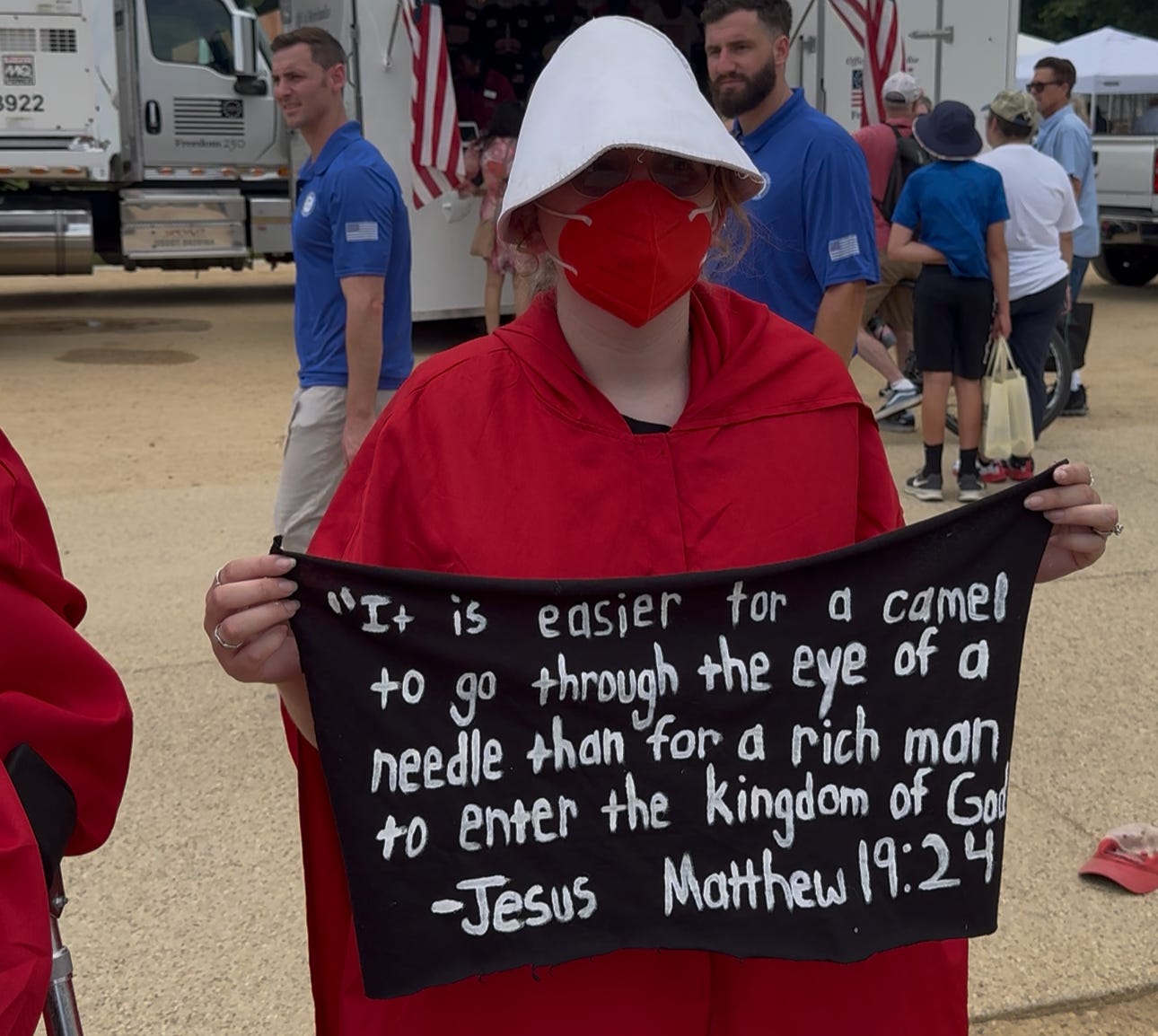
Some in line carried Jesus Saves signs, and wore patriotic or Christian shirts (or both). Others wore sundresses and khaki shorts. The counter-protestors were extremely creative, and had set up loud speakers blasting anti-Trump music (I didn’t know there was such a thing) and had signs about separation of church and state, anti-fascism, and anti-nationalism. My favorite were the two ladies dressed as Handmaids holding bible verses about the wealthy and abusing power. As I walked up to the counter-protestors some of them flinched, and I realized that they, understandably, associated any religious figure with Christian nationalism. “Progressive priest,” I said. “I love what you’re doing here.” Their shoulders relaxed and smiles came out. (I do not actually identify as a progressive priest, I identify as a priest. Full stop. But in the context, I had to communicate that I was safe.) I completely understand the reluctance to trust priests, but it angers me that my religion, its language and imagery, has been so taken over by hate that people are immediately suspicious. But I get it.
Case in point: I greeted a group of nuns huddled together. Ah, ok, some fellow people of the cloth have come out to protest this abomination of an event. “Hi sisters, how are you?” It was a strange collection: a tall, white nun, surrounded by smaller brown-skinned nuns who looked glassy-eyed and obsequious. I smiled. “How do you find yourself here today?” “We’re Trump voters,” the white nun said, touching my arm. “Thank God for Donald Trump.” I heard myself reflexively say “Oh wow, why is that?” Of course, it was about abortion. “We stand for life,” she said. “You don’t?” “What about the war in Iran?” I asked. She leaned back. “Well, I don’t really know about that,” she said. “That’s not really our business. Leaders make decisions.”
“That’s convenient,” I said. Then, when I told her I was pro-choice she jabbed a finger into my chest repeatedly and said “shame on you! You should be ashamed!” and pointed at my collar. “Shame? Are you serious?” Then I turned and walked away, bristling. I realize now that I shouldn’t have been surprised. I meet people all the time who have been scarred by Catholic churches or schools populated by nuns like this. But experiencing it first-hand gave me a visceral feeling of rage. Church folks, this is what so many people have experienced in their lives. We as ministers, pastors, and lay people would do well to recognize this and become agents of peace and healing for those who have been harmed by this kind of religious barbary.
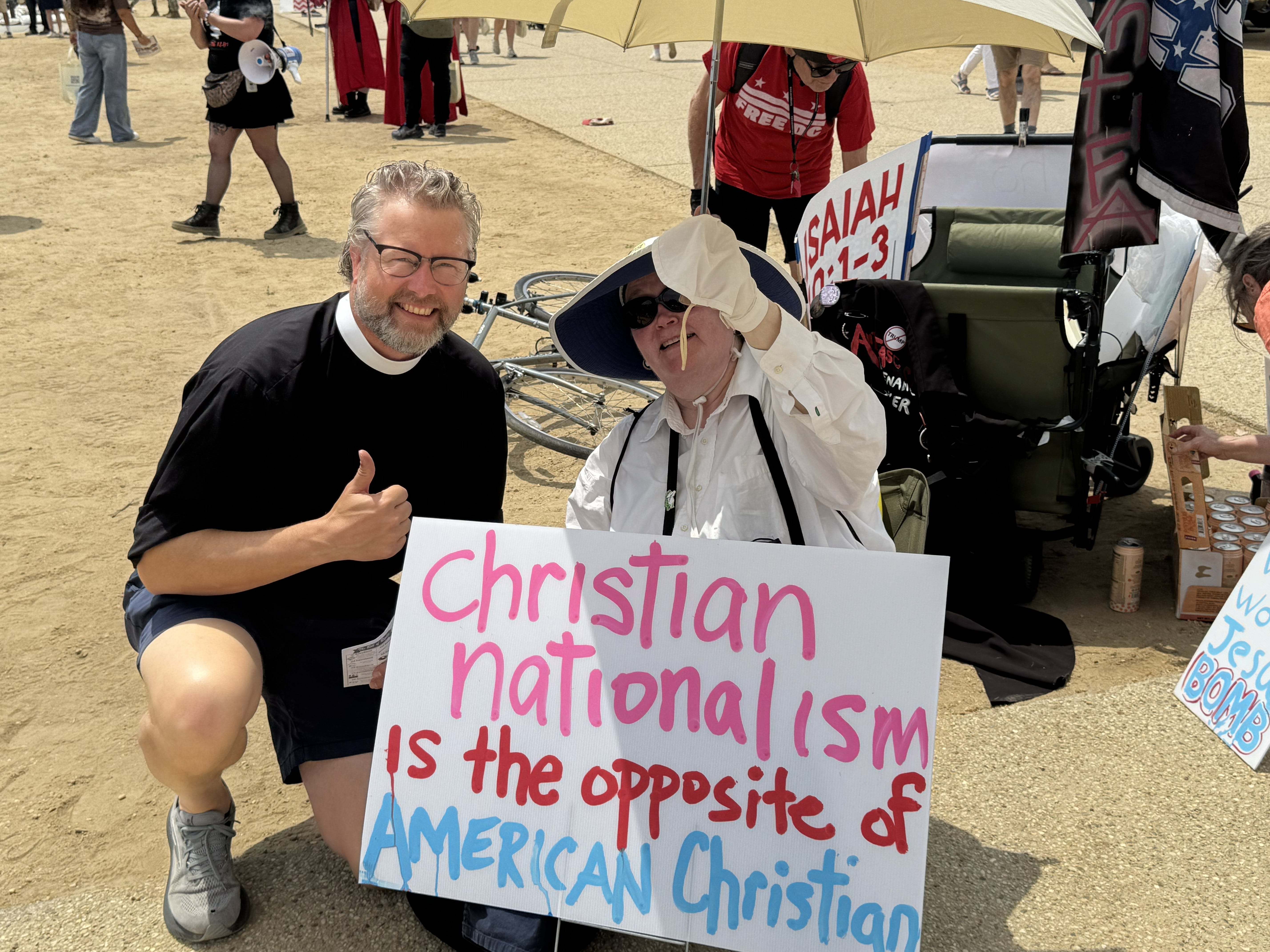
But there were two other encounters that were surprisingly beautiful. A burly man in his late-twenties approached me near the counter-protestors. “I heard you say you’re a progressive priest. What does that mean?” He was genuinely curious and thoughtful. I explained that it meant I believe God loves everyone, that all are created in God’s image, and that Jesus spent most of his time with people on the margins of society, thus we should do the same. “I’m kind of progressive too,” he said, “I think we should love gay people, but I don’t like that they have the rainbow flag. God gave all of us the rainbow, and I also don’t think they should put it inside the church.” I responded that I don’t think any flags should be inside the nave/sanctuary, including the American flag. He agreed. We continued talking about theology and church, including an exchange we both found comical when he said “America is a Christian nation,” to which I responded, “No it isn’t,” and he responded, “yes it is,” and I said “dude, no it isn’t.” We talked a bit more–while we didn’t agree on everything, we did find some common ground on a few things, and we both enjoyed talking about how theology intersects with politics, and social issues. I had to move on to talk to other people so we hugged and I left.
What was different about this conversation was that there was tangible mutual respect. And yes, it was likely a lot easier for him, a younger straight white man, to feel comfortable talking to someone who is like him. That’s part of why I was there in the first place. Straight, white, male clergy–and lay people–need to be on the front lines in conversation with people in our demographic, because for better or for worse, it is often safer for us, and we are often perceived as safer to talk to. It’s not perfect but it’s one next step in the right direction. And we can be a visible model of what it looks like to hold views contrary to conservative Christian expectations. This is part of our job. (I’ll have to write another post on re-imagining the role of parish priest and minister–for an organization existing for the benefit of its non-members, too much time is focused on the navel instead of the neighborhood.)
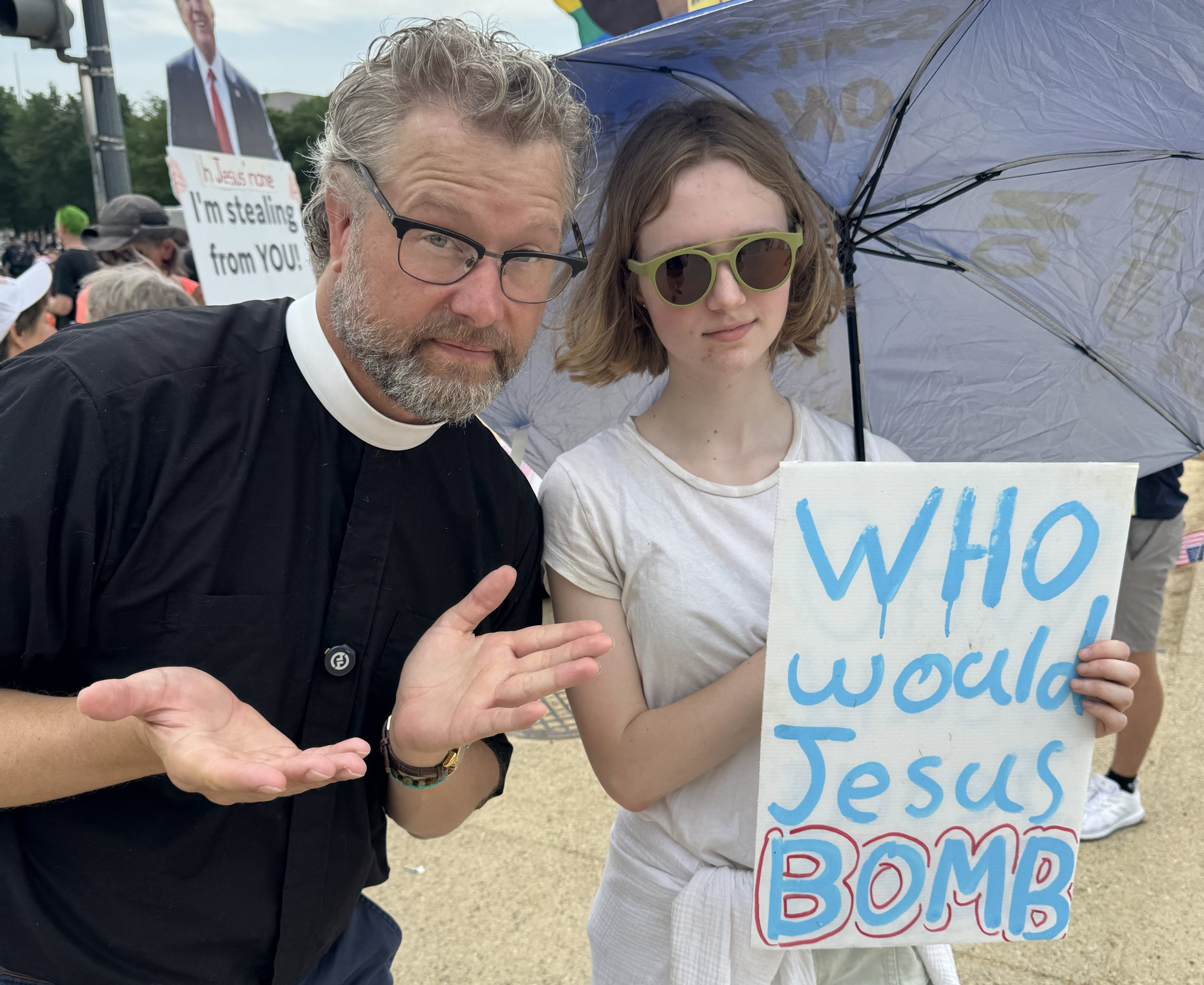
The second surprisingly beautiful interaction was with an older woman passing out books about America and “the Great Controversy.” “So what’s this book about?” “America is the horned beast in Revelation. You wouldn’t believe how much America is in the bible.” “America isn’t in the bible at all.” “Yes it is, it’s right there.” I smiled. “It’s literally not there.” She is Seventh-Day Adventist, and I told her while I don’t agree with much of their theology, I respect their dedication and commitment to their faith. She said “I’m actually pro-gay marriage, want to know why? Because the law says it’s legal, and even though my faith is against it, I don’t think my faith should be put upon others if they don’t believe.” Which is a nuanced view I wasn’t expecting—and it was notable that she really wanted me to know her view on gay marriage. We talked a bit more, and it was friendly and genuine. Before I left she asked, “Can I pray for you?” “Of course.” And she prayed for me to read the book of course, but also for my general well-being. We hugged and I headed home.
It was an emotionally fraught and wild day. It was hot, there was a lot of shouting, and ambient anxious energy. In both of these latter cases, I met people who I think were just looking for some acknowledgement. It didn’t matter to them that we disagreed, what mattered was being heard and seen. The Episcopal baptismal covenant asks Will you respect the dignity of every human being? As someone who occasionally talks to strangers about my new church plant, I can attest that it’s a little scary to put yourself out there to strangers, and it takes guts to start an honest theological conversation with someone wearing a collar, especially if you think differently. My conversation with the nun lacked any sense of respect. I was shouted at, literally poked in the chest, and shamed. Might have felt good to the nun, but it wasn’t an effective strategy because it was undignified and grotesque. Compare with the other two conversations that began with cautious curiosity and ended with mutual respect and hugs.
These are hard times. But while the leaders of the Christian nationalist movement (Hegseth, Trump, Doug Wilson, Mike Johnson, etc) are pure-blooded evil, a lot of people lined up on Saturday were just regular people following dangerous men. I recognize it’s easier–and safer–for me than for most people, and that it takes extraordinary spiritual and emotional effort to look past the damage their support of Trump has done to the vulnerable among us. I also know that God’s image doesn’t wear off at the ballot box and our baptismal vows don’t have circumstantial clauses or expiration dates. I don’t know what will happen with the people I spoke with, but I do know they came away a little more seen by someone on the other side, and maybe a little more loved. And love begets love, every time.
May 21, 7pm: Sunset Singalong, Titanic Memorial, DC
May 25, 7pm (zoom): Paid subscribers live community, Fellowship of the Weary Soul
May 26, 7pm: Sunset Eucharist, Titanic Memorial, DC
May 31, 11:15am: Catching Hope Book Talk, St. David’s, Brandywine Hundred, Wilmington, DE
May 31, 3:30pm: Pre-church kayaking, Fletcher’s Cove, DC, Reserve your kayak here
June 11, 7pm: Joint book launch party with Catching Hope and Maryann McKibben Dana and her fabulous book, Better Than Normal
June 14, 10am: Catching Hope book talk, St Columba’s, DC
July 18-19: Overnight Canoe trip on the Shenandoah River. Sign up here.
No posts
Comments
Nothing yet. Say the first thing.
Sign in to join the conversation.