
In advance of its release on May 12, I wanted to share with you an excerpt from my book Catching Hope: The Hidden Spiritual Wisdom of Fishing. I’m so excited, nervous, and overjoyed to share this with you. Pre-orders really help books get traction, so if you know anyone who likes fishing and nature-based spirituality, please consider ordering now and sharing widely! It’s available anywhere.
In the summer of 2018 I worked as a chaplain at Boy’s Home, a home for boys with fractured home lives and parents who couldn’t or wouldn’t take care of them. Boy’s Home is a place where troubled boys learn how to be young men. My father grew up there, and my life is layered with stories of his time there: what he learned, how the adults mentored him, and the deep impact of the combination of time, mentors, accountability, hard work, and faith. I owe my own life to that place and the kind of man it shaped my father into. I have always wanted to give back to Boy’s Home what it gave me—a spiritually grounded, healed, and loving father—so I was excited to spend the summer with “the boys.”
While there I started a candle-lit evening compline service which is quiet, peaceful, and a perfect end to the evening. The first service the boys came in rambunctious, but eventually they settled down and we began the service. As I was playing some quiet guitar music I noticed that some of the boys, not the ones I’d expected, were actually taking it seriously. Candles and quiet open a lot of doors. After the service I invited them to stay and enjoy the silence if they’d like. As they filed out, one kid stayed in his seat. Once it was just the two of us he put his head in his hands and his shoulders began to shake. I gently sat next to him. I knew at least one of his parents was incarcerated, and I imagined the entirety of his life was full of chaos and dysfunction–so many of the boys have had to grow up on their own, and too soon. “What’s up, Matthew?” I asked, putting my hand on his shoulder. He sobbed harder, the pain crashing out of him. When he could finally get words out he said, “I keep trying to be a good person, and I keep messing up. I feel like a failure. I just can’t get anything right.”
Oh buddy, how I know that feeling. How many nights have I spent alone on my couch with the same shaking shoulders and the same tear-streaked face and the same desperate feeling. “You’re doing better than you think,” I said. “We all struggle to do what we really want to do, and we all mess up a lot.” He looked at me with red eyes. “Even you?” “Especially me,” I said. “Life is really hard for everyone—did you know that even one of the apostles talked about this in the Bible?” He looked at me blankly. “Paul complains about this feeling. He says ‘Lord, why do I do the things I don’t want to do, and why do I not do the things I want to do?’ You’re not alone—everyone struggles with this. And I get it. I really do.” After a while he sat up, wiping tears. I secretly wiped my own. “You are a good kid, Matthew. You’re trying, and I can see that. That’s all that matters. And we always get another chance to do the right thing. That’s part of God’s love. God always forgives us. We keep getting chances to make things right.”

The gift of the church, particularly the mainline liturgical traditions, is that we have a rhythm of daily prayer, different services like morning prayer, compline, and Eucharist, and a year-long calendar marking different seasons of Jesus’s life, which, if we are paying attention, always intersect with our own. In the Episcopal tradition we use the Book of Common Prayer, the Presbyterians have the Book of Common Worship, Lutherans have the Evangelical Lutheran Worship, Methodists have the United Methodist Book of Worship. These are all foundational, grounding elements. They are weights to keep us grounded where we need to be.
A few years later I found myself in a deep, prolonged pit of despair. One evening I picked up the Book of Common Prayer, opened up to compline, and began praying. Outside of my weeping, which is in its own way the most authentic prayer, I hadn’t actually prayed in the communal tradition of my faith. As I began praying I remembered the sticky summer evenings at the start of Episcopal summer camp at Shrine Mont in the Shenandoah Valley of Virginia. Those evenings, some twenty-five years ago, were filled with meaning and anticipation as we counselors prepared for the kids to arrive. It reminded me of who I was then, and the clear, immense presence of God in our midst. It reminded me that I was not alone.
“The Lord Almighty grant us a peaceful night and a perfect end, Amen.” And then the next line: “My help is in the name of the Lord; the maker of heaven and earth.” I read that line again. And then again and again and again. My help is in the name of the Lord. My help is in the name of the Lord. I have help. And my help is God. And who is God? An adversary? A successful human? An imaginary being? An angel? No. The maker of heaven and earth. For the first time I thought I might make it out of this. I can’t do it. But God can. God made the heavens and the earth. And finally after drifting for weeks, my feet found a small patch of solid ground. My help is in the name of the Lord, the maker of heaven and earth.
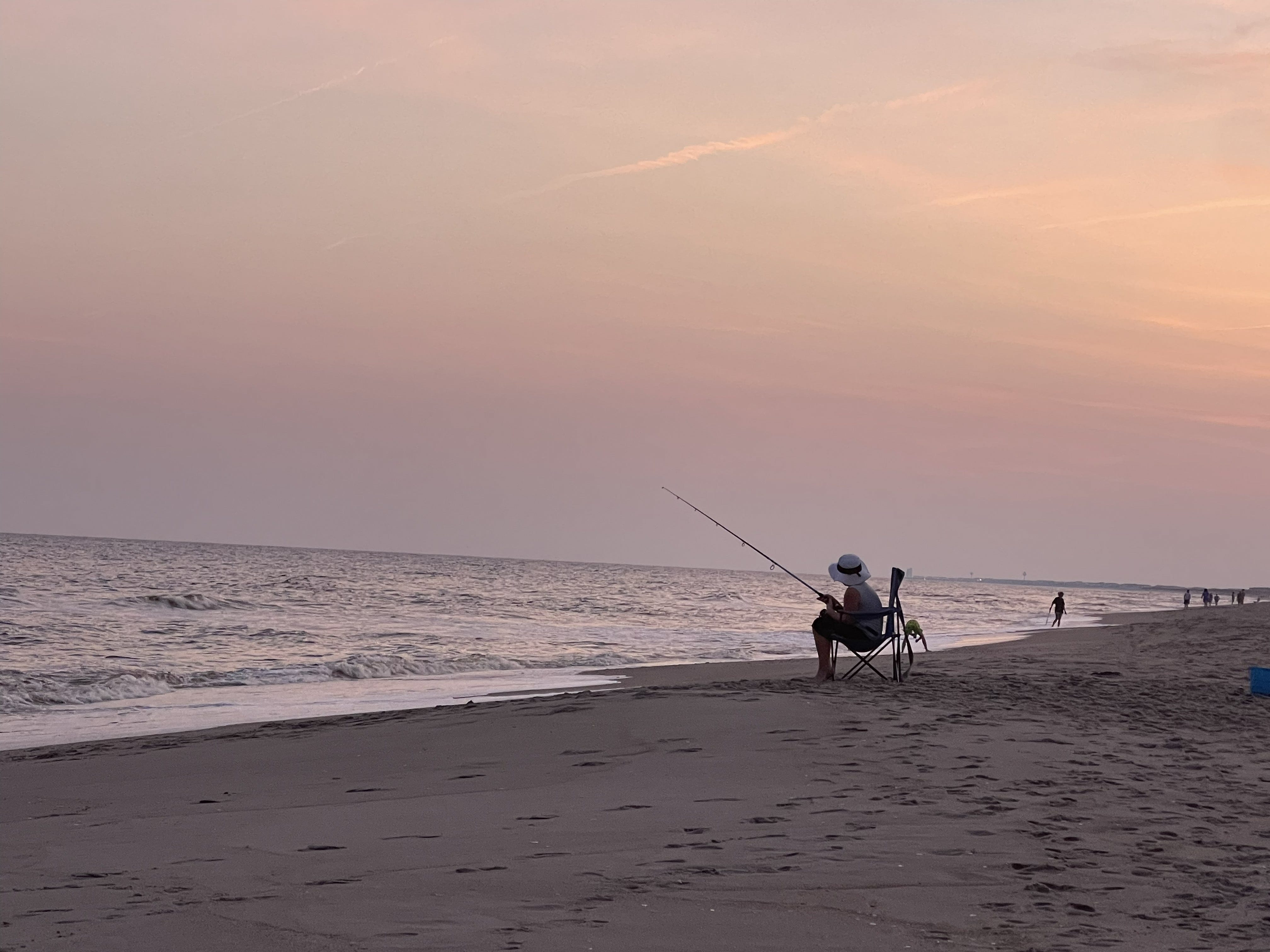
Unless you’re fishing with a topwater bait that doesn’t sink, or in a placid lake, you’ll need some kind of weight to get your bait to the right spot. I fish for catfish a lot, and they’re bottom-feeders so I need decent weight to get the bait down to the bottom of the water column. When I fish from the surf, with wild currents and waves, I need even more weight to hold the bait in place. In both cases without a heavy enough weight your bait will get dragged along by the current and you won’t be able to fish where you want to. The same thing is true of trolling and most kinds of fishing: You need weight to get your bait to the right spot and to hold it there against tides and current.
One of the first things I ask other surf fishermen, after the obligatory “Any luck?” is “What weight are you throwing?” It’s best to get the info ahead of time instead of wasting time wading out and throwing your line in and then watching the current push your bait slowly to the side and then back to shore. Surf and ocean fishing involve a constant battle against the forces of nature that are mightier than we will ever be. It’s just so readily apparent that we are powerless in the face of ultimate power. Weights are the one tool we have. If three ounces doesn’t “hold bottom,” you move up to four or five, and keep going until it holds. “Eight and bait” is a phrase often used to describe eight ounces plus the weight of your bait, and in really wild conditions I’ve used twelve ounces and still couldn’t hold bottom.
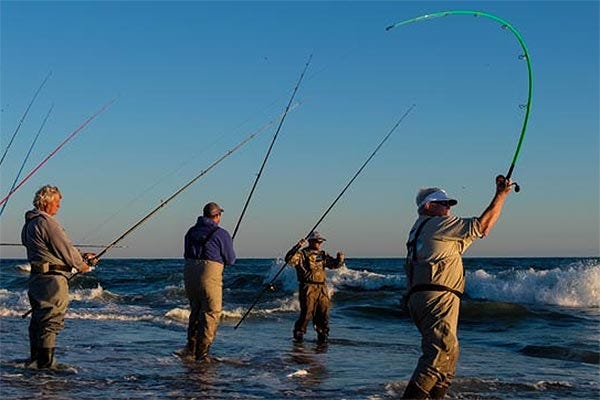
Sometimes you just can’t hold bottom, but you fish anyway. Down at Hatteras the experienced fishermen line up almost shoulder to shoulder right at the point in the spring and fall and heave out massive amounts of weight and bait. The current slowly drags the bait along, and the whole line of fishermen slowly follow their lines down the beach in piscine procession. Once they get to a certain point the person closest to the end reels up and walks back to the front of the line and casts out again and begins the slow walk with their bait. This dance is a continuous, circular promenade of fishing, requiring both skill and teamwork among anglers, many of whom are strangers to one another.
I think about weights a lot because it’s so easy in this life to get knocked off balance by the hardships of it, or to be distracted and wander off from where we need to be. Make no mistake: When Jesus talks about leaving the ninety-nine sheep to rescue the one lost sheep, we aren’t in the ninety-nine, we are that one lost sheep. For me both the unexpected tragedies and the bright shiny objects can take me away from what keeps me grounded and authentically me. One of the deeply frustrating circumstances of fishing is to be at the right place at the right time, with the right bait—everything you need, except weight. You can try as hard as you want, but you’re not going to be successful because you simply can’t get the bait down where it needs to be. You are powerless against the current without weight.
Part of the interior friction we feel sometimes is the tension between how life is going and what we want our lives to be like. As our adolescent dreams for our lives are slowly consumed by the realities of our current, actual life, the temptation is to look outward for blame and answers. If only the other people around me would change (still waiting for that). If only my boss was competent. If only I had more money. These are weightless fantasies. God has given all of us weights to ground us. For me the surest weight is not God, but the practices that draw me to God. If God is gravity, the weights are what work with gravity to draw me to the quiet part of my soul in which God dwells, commingling with my authentic self. For me that is making music with people, praying regularly in my tradition, serving others, building community, getting exercise, and exploring something new. You may have different practices, but you know you’ve found one when you feel surprisingly, completely you.
Y’all, I’m sop thankful for you. In this maddening world, it is a comfort and honor to share my writing with you and build this community. Here are other ways you can get involved in my ministry:
Join the Water and Wilderness Church Watershed Community via zoom bible studies, forums, retreats and more. You can sign up for our free newsletter here.
Become a paid subscriber to this Substack and join our Fellowship for the Weary Soul live monthly gathering.
Invite me to speak to your church or organization! I’d love to meet you and your people. More info at my spiffy new website.
No posts
Comments
Nothing yet. Say the first thing.
Sign in to join the conversation.