
Patrick Clancy buried all three of his children in 2023. He has sat through more than a month of testimony describing exactly how they died. And depending on what twelve jurors decide, he may never get a formal, statutory chance to tell a court what that cost him.
“The difference between a right and a request is exactly the gap this piece is about.”
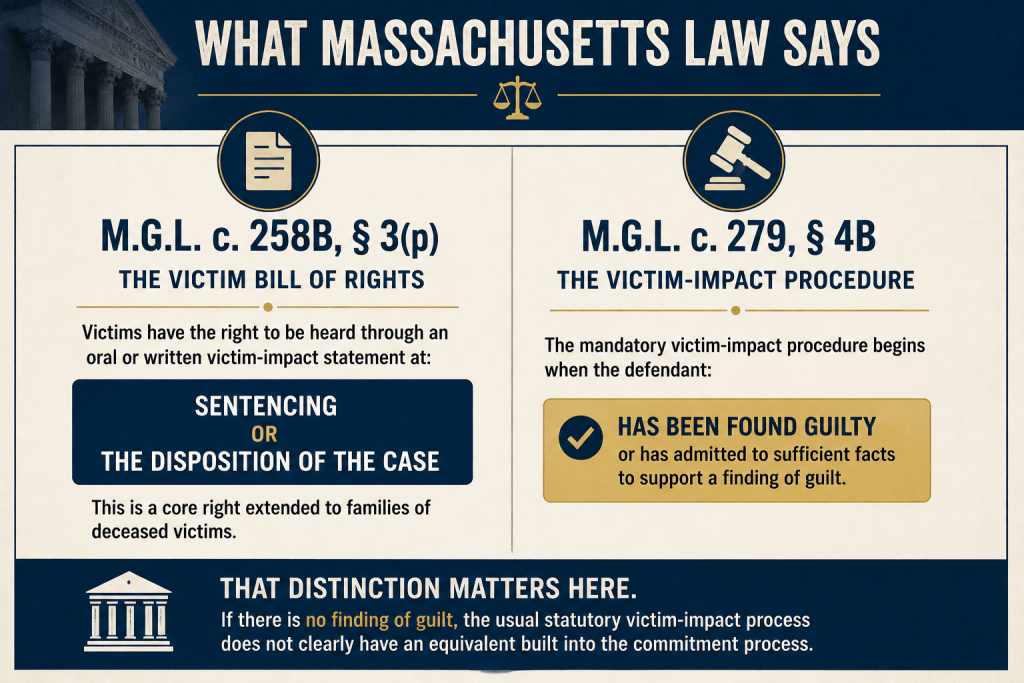
Massachusetts’ Victim Bill of Rights, M.G.L. c. 258B, extends to the family members of a deceased victim the same core rights afforded the victim directly — to be informed, to be present at proceedings, to confer with prosecutors, and, centrally, to submit a victim impact statement. As the father of Cora, Dawson, and Callan Clancy, Patrick Clancy qualifies for every one of those protections.
But read the actual mechanism closely, and the promise is narrower than it sounds. The victim impact statement — the part of the process built specifically to let a survivor speak directly to a judge about what a crime did to their family, and to weigh in on what should happen to the person who did it — is triggered by a specific procedural event: the defendant being found guilty, or admitting to sufficient facts to support a finding of guilt. It happens at sentencing. No conviction, no sentencing hearing, no statutory moment built for that statement.
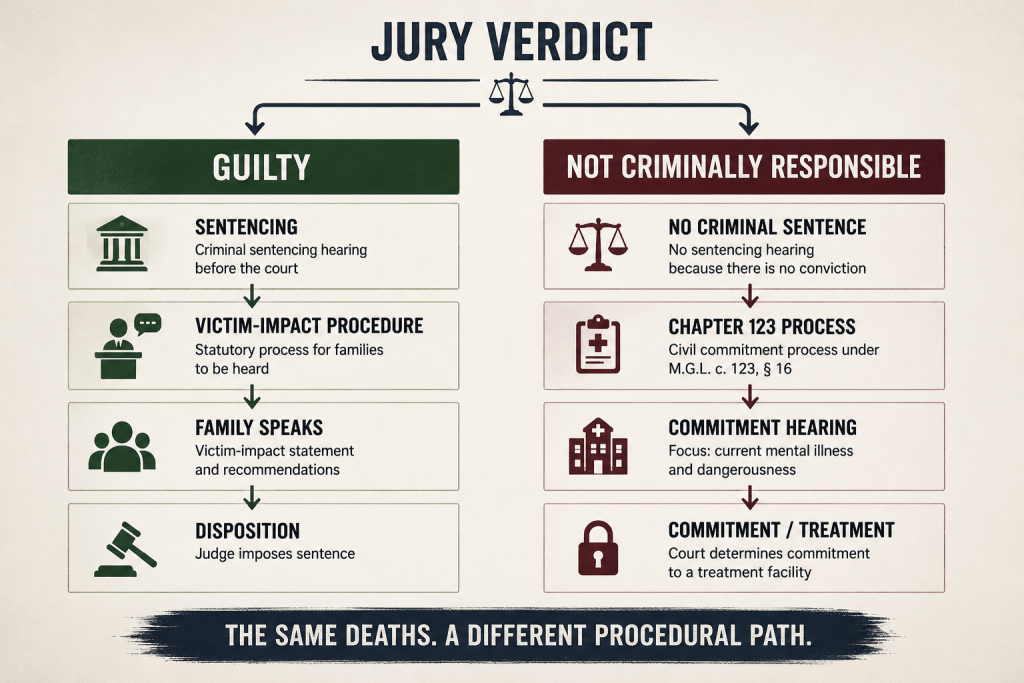
If Clancy’s jury returns a verdict of not guilty by reason of lack of criminal responsibility, there is no sentencing. What follows instead is a civil commitment process under a different statute entirely — M.G.L. c. 123, § 16 — where the district attorney, a facility superintendent, or the medical director of Bridgewater State Hospital petitions the court for the defendant’s commitment. The hearing turns on a clinical and legal question: is the person currently mentally ill and dangerous? It is not a forum built around what the crime cost the people left behind. It is not, procedurally, “his” moment in any sense comparable to a sentencing hearing.
That’s not a hypothetical gap. It’s the specific fork this case is sitting on right now. A father who has followed every rule the system asked of him — showed up, testified, sat through his children’s autopsy details read into the record — may find that the one formal mechanism built to let him speak on the record about what he lost simply never activates, because the legal question the jury answered wasn’t the one that mechanism was built around. The Victim Bill of Rights does include a catch-all: the right “to be heard at any other time deemed appropriate by the judge.” That’s real, but it’s discretionary — a judge may choose to allow it, not a guaranteed statutory moment the way sentencing is. The difference between a right and a request is exactly the gap this piece is about.
“No conviction, no sentencing hearing, no statutory moment built for that statement.”
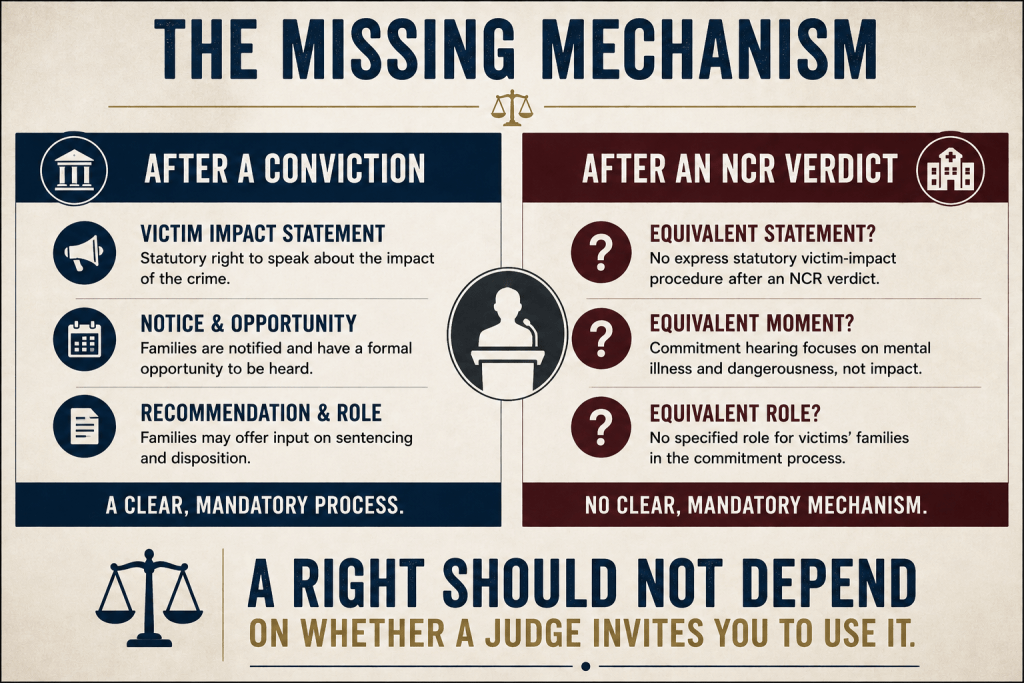
This isn’t a story about what Patrick Clancy has said publicly — he has spoken to reporters, and by all accounts does not blame his ex-wife for what happened. This is about what the system formally offers a father in his exact position, independent of what he personally wants to say or how he feels about the outcome. The victim-rights framework was built primarily around the ordinary case: an offender and a victim’s family on opposite sides of a sentencing hearing. It was not built for the case where the person legally responsible for a child’s death is also that child’s other parent, and where the outcome that best fits the facts might be the one outcome the statute didn’t design a formal voice around.
“The victim-rights framework was built primarily around the ordinary case: an offender and a victim’s family on opposite sides of a sentencing hearing.”
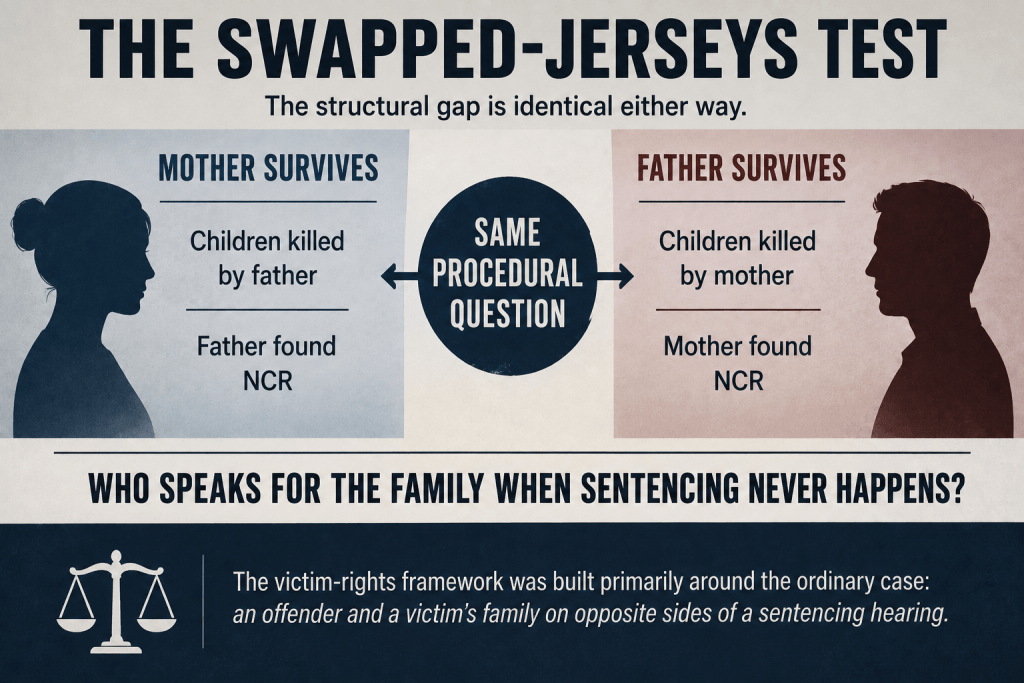
Run the swapped-jerseys test here too: strip out which parent killed the children and which parent survived, and the structural gap is identical either way. Any surviving parent — mother or father — whose children were killed by their co-parent, and whose co-parent is found not criminally responsible rather than guilty, hits the same procedural wall. The system has a well-built, statutorily explicit answer for “what does a victim’s family get to say when someone is sentenced?” It does not have an equivalent answer for “what does a victim’s family get to say when someone is committed instead.” That’s not a flaw invented by this case. It’s a gap in the architecture that this case happens to be standing directly on top of.
“It does not have an equivalent answer for ‘what does a victim’s family get to say when someone is committed instead.’”
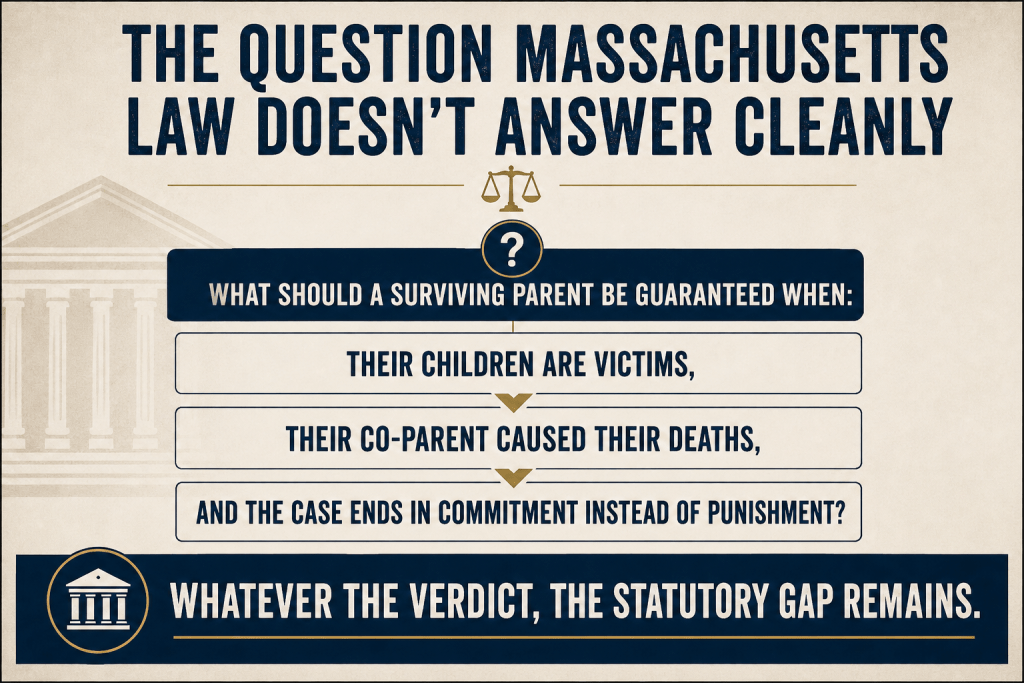
Whatever the jury decides, that gap doesn’t close on its own.
Sources: The Massachusetts Victim Bill of Rights, M.G.L. c. 258B, § 3(p), and related guidance from the Massachusetts Executive Office of Public Safety and multiple district attorneys’ offices; M.G.L. c. 123, § 16, obtained via the Massachusetts Legislature’s official site and Justia; reporting on Patrick Clancy’s public statements from The New Yorker (October 2024) as referenced in subsequent court reporting.

Father & Co. offers non-legal document review and organization for people representing themselves. This includes clarity, structure, neutral tone, and timeline organization — not legal advice or representation.
Submissions are reviewed with care and discretion. We respect privacy and handle sensitive information responsibly.
Help support my research and writing on the family court system and other related topics.
Check out Fatherand.co for other ways you can donate or support the cause. Every little bit helps.
Comments
Nothing yet. Say the first thing.
Sign in to join the conversation.