

In a windowless courtroom in Annandale, Virginia, a judge works through a docket of children who have no lawyer standing beside them. One is a small boy in a wrinkled white shirt, there because the government is trying to deport him. His mother isn’t in removal proceedings herself, so he has to navigate the system as his own party. The judge explains his rights as plainly as he can, hands him a list of legal aid groups, and delivers the line that is the actual subject of this piece: prepare yourself to speak on your behalf.
A federal legal-services contract for unaccompanied children lapsed at the end of July, disrupting representation for tens of thousands of kids and leaving the nonprofits still standing to absorb caseloads they can’t cover. That’s the proximate cause, and it’s being reported as a funding story. It is one. But the instruction the judge gives the boy — you will need to argue your own case — isn’t a funding artifact. It’s a fallback the system already had loaded, waiting for the moment representation failed. No adult legal system asks an unrepresented defendant to cross-examine a prosecutor. This one routinely asks it of a child.
Strip away the immigration-specific facts, and that fallback is not new. It is, in fact, the default architecture of a different courtroom entirely: family court.
“No adult legal system asks an unrepresented defendant to cross-examine a prosecutor. This one routinely asks it of a child.”
Immigration court’s failure this year is being told as a story of an assumption that collapsed — but the assumption was written as a hedge from the start. The Trafficking Victims Protection Reauthorization Act of 2008 requires the government to ensure unaccompanied children have counsel “to the greatest extent practicable,” a standard codified at 8 U.S.C. § 1232(c)(5). Not a right. A practicability standard, contingent on funding and staffing the government itself controls. Even before this year’s contract lapse, data from the Executive Office for Immigration Review, analyzed by the Vera Institute of Justice, showed more than 425,000 children with pending cases — 57 percent — had no legal representation, a decline from 64 percent represented as recently as 2017. The gap isn’t abstract: this year, represented children were roughly three times as likely as unrepresented ones to obtain some form of legal relief, and unrepresented children were far more likely to be ordered deported. “To the greatest extent practicable” has never meant “always,” and the gap has been widening for years. The system was built with an escape hatch, and this year the government walked through it further: a legal-services contract lapsed at the end of July, disrupting representation for tens of thousands more kids and leaving the nonprofits still standing to absorb caseloads they can’t cover.
Family court’s failure is different in mechanism but built from the identical hedge — and in Virginia, the statute doesn’t just leave a gap; it closes one on purpose. Courts are required to appoint a guardian ad litem or counsel for a child in cases involving abuse, neglect, entrustment agreements, or termination of parental rights. But Virginia Code § 16.1-266(F) goes a step further for ordinary custody disputes: where custody is contested, and each parent already has a lawyer, the court “shall not appoint” counsel or a guardian ad litem for the child unless it specifically finds that the child’s interests aren’t otherwise adequately represented. The default assumption, written into the statute, is that two competing parents’ attorneys already cover the child’s interests by proxy. The child doesn’t get his own advocate because the law presumes he doesn’t need one — not until a judge affirmatively decides otherwise.
“The hedge isn’t a loophole found later. It’s load-bearing.”
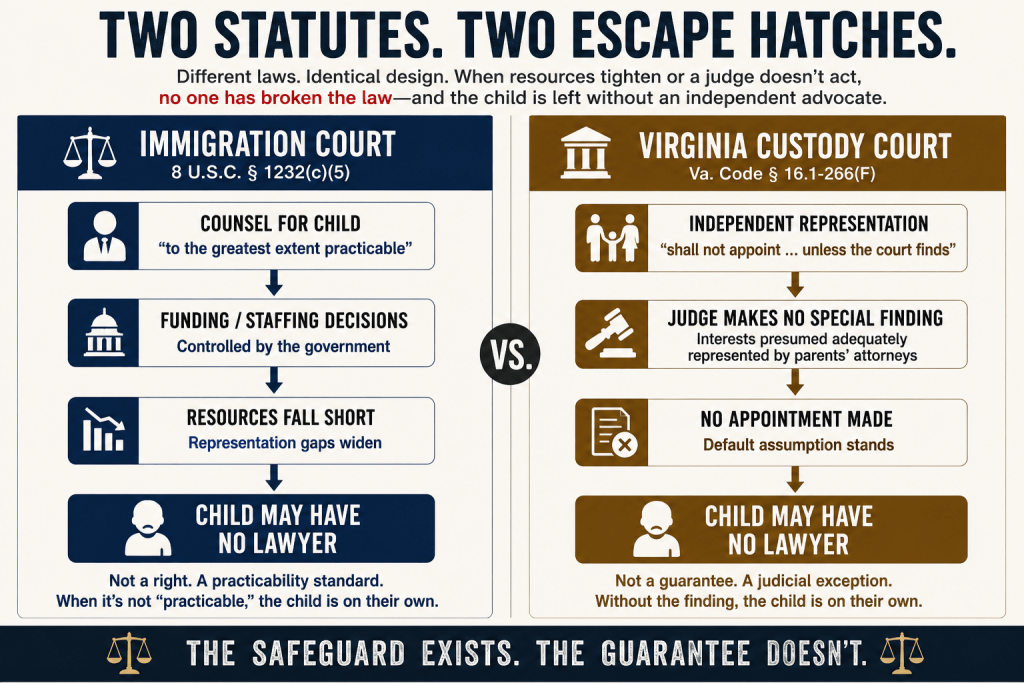
Two different statutes, one identical design choice: write a provision that gestures at protecting the child, then qualify it — “to the greatest extent practicable” on one side, “shall not appoint... unless the court finds” on the other — so that when resources tighten, or a judge doesn’t make that finding, no one has actually broken the law. The hedge isn’t a loophole found later. It’s load-bearing.
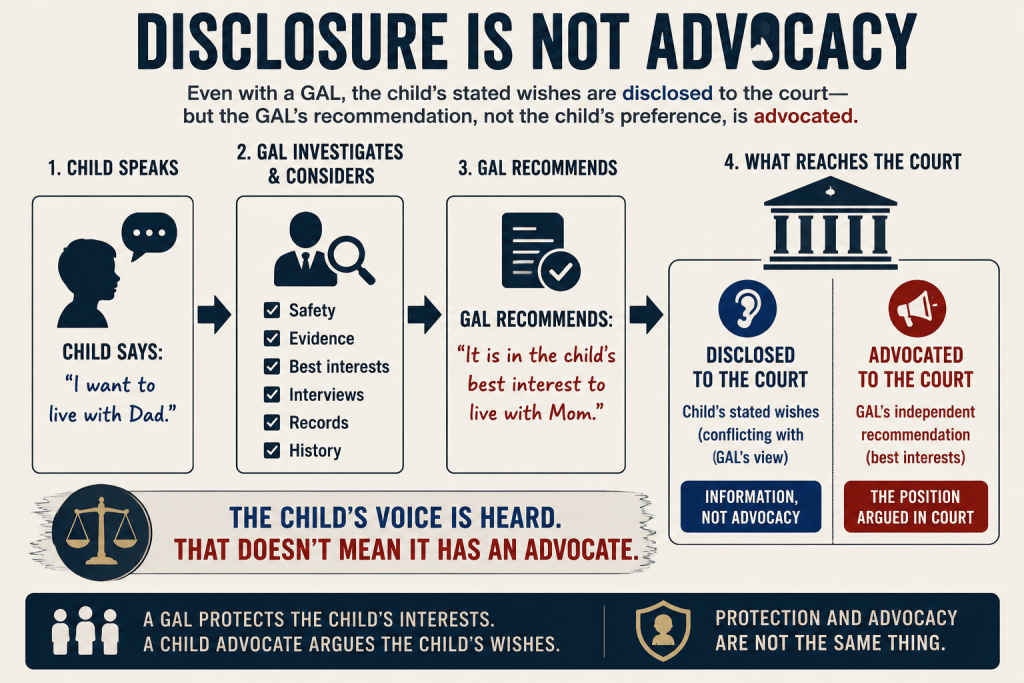
Where a guardian ad litem is appointed, Virginia Supreme Court Rule 8:6 charges that attorney to “vigorously represent the child, fully protecting the child’s interest and welfare” — real language, and a real protection when it’s triggered. But it’s worth being precise about what that protection actually guarantees, because it isn’t a direct line to the child’s own voice. The same rule requires the GAL to advise the court of the child’s wishes whenever those wishes conflict with the GAL’s own recommendation — so a child’s stated preference isn’t erased, exactly. It’s disclosed. But disclosed isn’t advocated for: the GAL’s own position in the room is still his independent judgment of the child’s best interest, not the child’s stated wish, and if a child says he wants to live with one parent and the GAL’s investigation points the other way, the GAL is expected to recommend against what the child said he wanted, footnoting the disagreement rather than arguing it. That’s defensible as child protection; a child’s stated wish isn’t always safe to follow. But it means that even in the scenario the statute treats as the safeguard, the child doesn’t get an advocate whose job is to argue what he said — he gets an adult’s judgment about what he should have said, with his own words reduced to a caveat in someone else’s recommendation. And that safeguard is still the exception, not the rule: the parents argue, the judge decides, and the child, whose entire living situation is being rearranged, has no one in the room whose job is solely to represent him unless a judge has already decided he needs one.
“Disclosed isn’t advocated for.”
Family court has its own version of “prepare yourself to speak on your behalf,” and it’s built into the process even when no crisis has hit: the in-camera interview. Virginia law authorizes it directly. Under Code § 20-124.2:1, a judge may interview a child about custody or visitation without either parent or their attorneys present; a record must be prepared unless the parties agree otherwise, but whether the child’s own attorneys are allowed in the room is left to the judge’s discretion. If a guardian ad litem happens to have been appointed, that GAL can attend. If one wasn’t — which, as above, is the default outcome in most ordinary custody disputes — no one attends but the judge and the child. The child’s “reasonable preference” is then weighed as one of ten statutory best-interest factors under § 20-124.3, alongside things like each parent’s health and history of abuse — a single data point extracted from a child, unaccompanied, in a room built specifically to hear him.
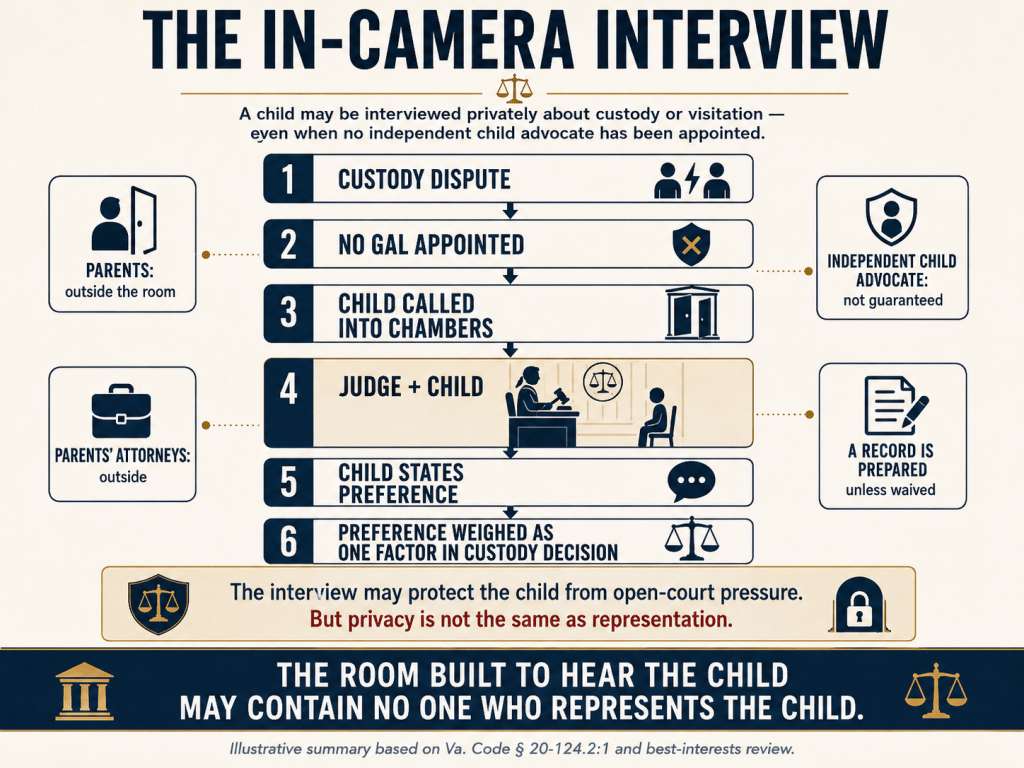
“A grown litigant gets a lawyer to interpret the proceeding for him. A child, in the room Virginia built specifically to hear his voice, gets one only if the court happened to appoint one beforehand.”
The stated rationale is protective: sparing the child from having to say it to his parents’ faces, in open court, with both of them watching. That’s a real and defensible reason. But the practical effect is that the person with the least legal sophistication in the building — a child, sometimes young enough that “reasonable intelligence, understanding, age, and experience” is itself the threshold the judge has to assess — is placed alone with a judge and asked to articulate his own preference, with no one whose job is to make sure he understood the question, knew what was at stake, or said what he actually meant. A grown litigant gets a lawyer to interpret the proceeding for him. A child, in the room Virginia built specifically to hear his voice, gets one only if the court happened to appoint one beforehand.
Put the two courtrooms side by side and the common failure isn’t political, and it isn’t really about funding at all. It’s the hedge, doing exactly what a hedge is built to do: absorb the collapse without anyone technically breaking a rule. “To the greatest extent practicable” absorbs a lapsed contract. “Shall not appoint... unless the court finds” absorbs a judge’s decision not to look closer. Both statutes were drafted by people who understood a child needs an independent voice in these rooms — that’s why the provisions exist at all — and both were drafted with a release valve wide enough that the guarantee could evaporate under ordinary pressure, without triggering a violation, a lawsuit, or even much notice.
Neither system was built to fail children on paper. Both were built so that when the system did fail them — a contract lapses, a judge declines to appoint, a caseload outpaces the nonprofits willing to take it — the failure would look like discretion, not breach. In both rooms, the child ends up the same way: present, affected, and unrepresented, while adults with lawyers negotiate what happens to him next.
“In both rooms, the child ends up the same way: present, affected, and unrepresented.”
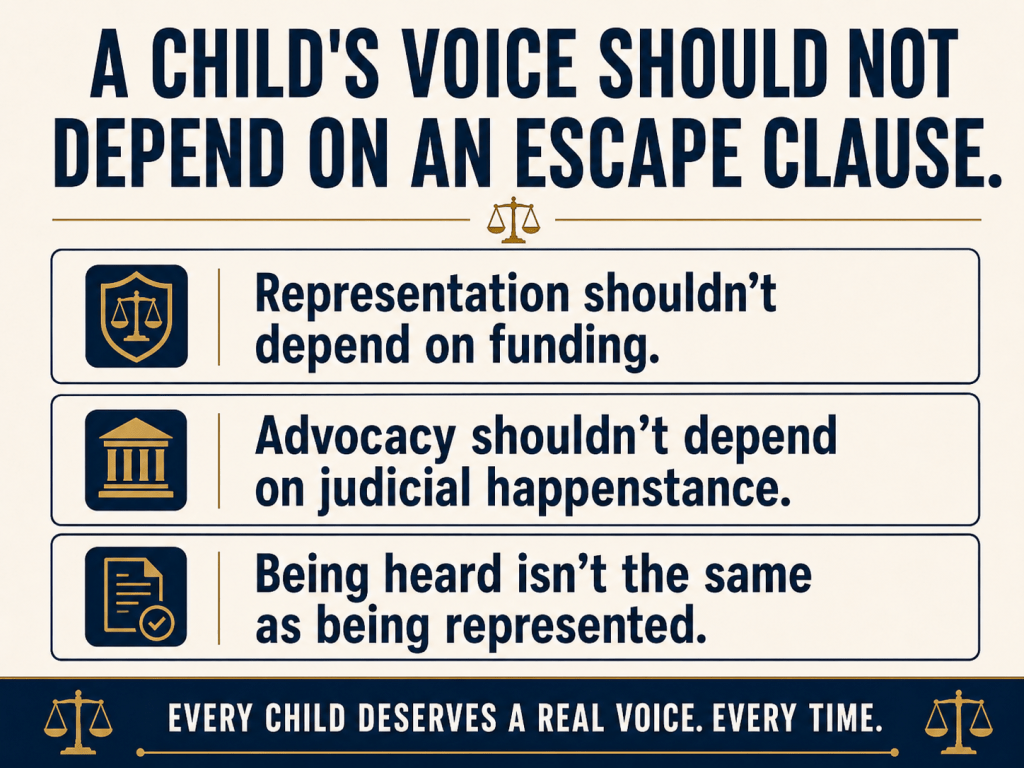
None of this argues that immigration courts and family courts should be treated as interchangeable, or that the fixes are the same. A funding restoration solves one problem; a statutory floor for child representation solves a different one. But the pattern is worth naming precisely because it’s not an immigration story or a custody story — it’s a design story about how legal systems handle children whose futures are being decided by adults who are not required to ask them what they need.
The boy in Annandale was told to prepare himself to speak on his own behalf, because the adult who was supposed to do it for him never showed up. In family courts across the country, on an ordinary Tuesday, children just as young are called into a judge’s chambers and asked the same thing — not because a contract lapsed, but because the system was built to ask it of them from the start.
Sources: reporting on the Annandale immigration court docket and the Acacia Center for Justice contract lapse; Trafficking Victims Protection Reauthorization Act of 2008, 8 U.S.C. § 1232(c)(5) (”to the greatest extent practicable” counsel standard); Executive Office for Immigration Review data analyzed by the Vera Institute of Justice, reported June 2026 (representation rates and outcome disparities for unaccompanied children); Va. Code § 16.1-266(A), (F) (appointment of counsel and guardian ad litem; presumption against appointment where custody is contested and both parents are represented); Va. Sup. Ct. Rule 8:6 (guardian ad litem duty to the child); Va. Code § 20-124.2:1 (in camera interviews of child; record); Va. Code § 20-124.3(8) (reasonable preference of the child as a best-interest factor).

Father & Co. offers non-legal document review and organization for people representing themselves. This includes clarity, structure, neutral tone, and timeline organization — not legal advice or representation.
Submissions are reviewed with care and discretion. We respect privacy and handle sensitive information responsibly.
Comments
Nothing yet. Say the first thing.
Sign in to join the conversation.