
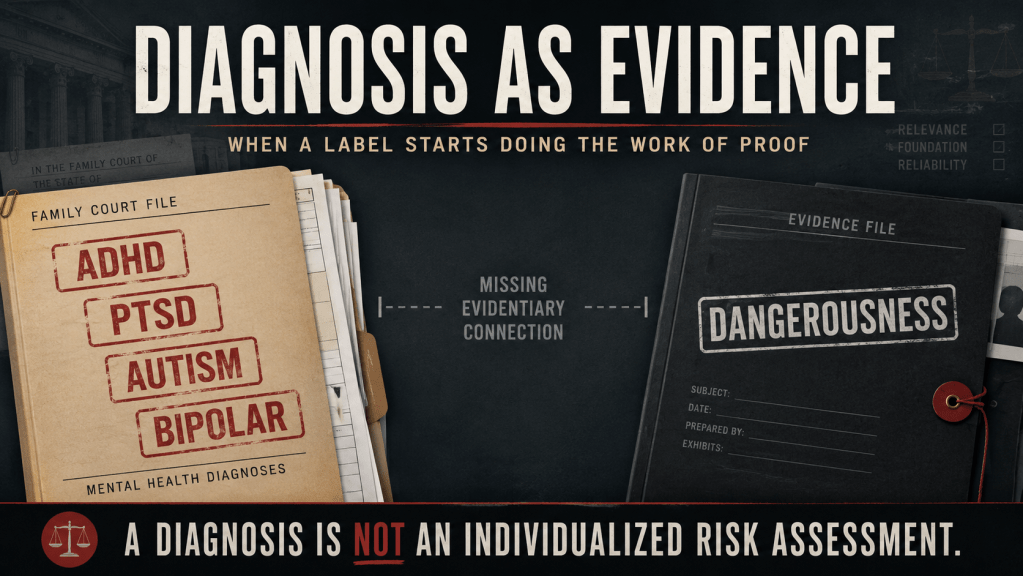
Somewhere in California family court this week, a judge will read a sworn statement claiming a parent is dangerous. The statement will mention a diagnosis — ADHD, bipolar disorder, autism, PTSD, doesn’t matter which. It will not mention a single incident that a police report, a witness, or a clinician can confirm. And under California law, that statement alone may be enough.
This isn’t a hypothetical. It’s the plain text of the statute.
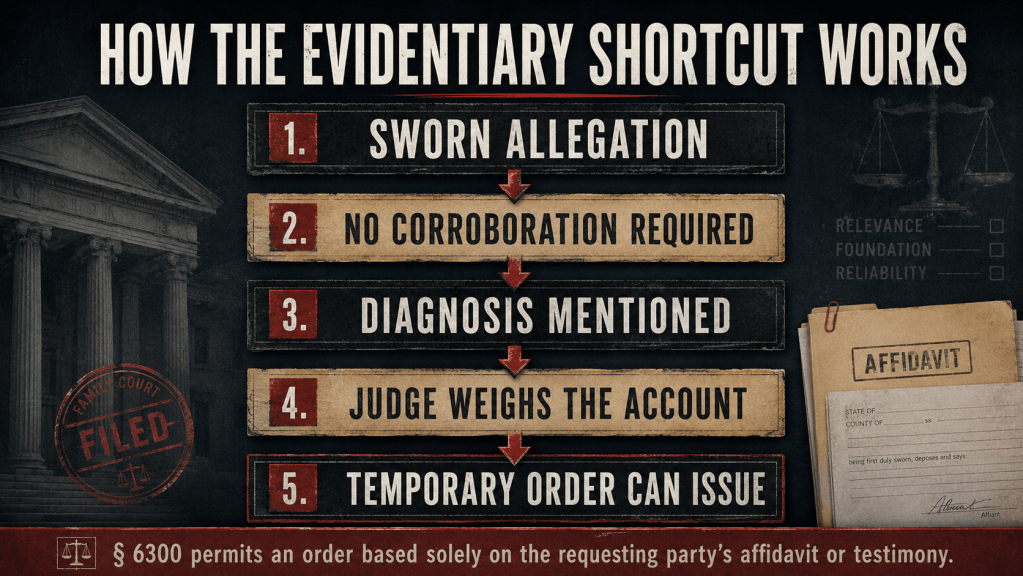
California Family Code § 6300 sets the standard for a domestic violence restraining order: preponderance of the evidence — more likely than not. That’s the lowest standard in civil law, well below the “clear and convincing” threshold used for civil harassment orders under Code of Civil Procedure § 527.6.
The statute goes further. It doesn’t just lower the bar — it removes the requirement that anyone else corroborate the claim at all. Section 6300(a) is explicit: a court “may issue an order under this part based solely on the affidavit or testimony of the person requesting the restraining order.”
No witness. No police report. No clinician. One person’s sworn account, evaluated by a judge who is, in the ex parte context, hearing only one side.
For decades, restraining orders were understood to address physical acts — hitting, stalking, threatening. That began to change with Rodriguez v. Menjivar (2015) 243 Cal.App.4th 816. At trial, the judge refused to consider evidence of isolation and controlling behavior, telling the petitioner that “being unpleasant... probably not, under all facts and circumstances, generally is not domestic violence.” The Court of Appeal reversed — the first California appellate decision to hold that acts of isolation and control, standing alone, could satisfy “disturbing the peace” under the DVPA. In 2020, the legislature codified and expanded that holding through SB 1141, adding subsection (c) to § 6320:
“Disturbing the peace of the other party” refers to conduct that, based on the totality of the circumstances, destroys the mental or emotional calm of the other party.
The amendment named “coercive control” as a qualifying category — a pattern of behavior that “unreasonably interferes with a person’s free will and personal liberty.” No touching required. No threat required. The standard is now a subjective one: did the other party’s mental or emotional calm get disrupted, viewed after the fact, through one party’s own account of events.
Family law attorneys will point out, correctly, that this expansion exists because psychological and coercive abuse are real, underrecognized, and historically dismissed by a system that only took physical violence seriously. That’s true, and it’s not in dispute here. The question this piece asks is different: what happens when a framework built to lower the evidentiary bar for genuine coercive control is applied to a claim built on nothing but a diagnosis?
It would be easy, and wrong, to write this piece as “there is no link between psychiatric diagnoses and violence, so any claim citing one is fabricated.” That’s not accurate, and Father & Co. doesn’t run on claims that fall apart under a second look.
A structured review by Whiting, Lichtenstein, and Fazel, published in The Lancet Psychiatry (online 2020, in print 2021), found a meta-analysis of five studies reporting increased odds of violence-related arrest — roughly 3.6 times — among people diagnosed with ADHD before age 18, relative to undiagnosed controls. A 2023 systematic review and meta-analysis in Psychological Medicine found ADHD was associated with elevated risk of involvement in intimate partner violence. These are real, peer-reviewed findings, and pretending otherwise would fail the same test this outlet applies to everyone else’s sourcing.
“Population-level statistical association is not individualized proof.”
But the authors of that second study added something the courtroom version of this claim always leaves out: “Our results are of high clinical and social relevance but could be misinterpreted... our results should not be used to stigmatize individuals with ADHD, as most individuals with the disorder will not be involved in a case of IPV.”
“A diagnosis can be introduced by a lay petitioner, unaccompanied by any clinician.”
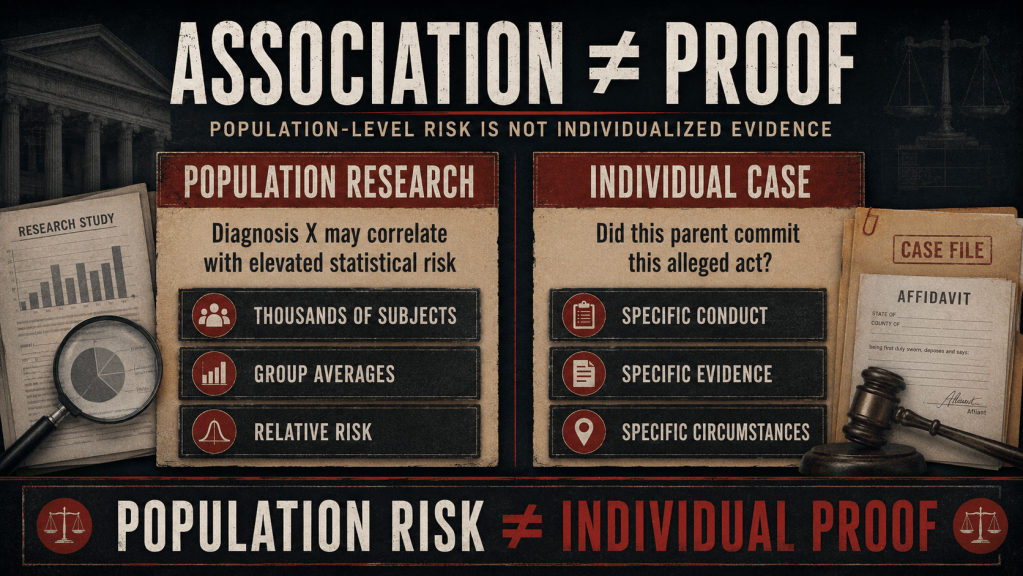
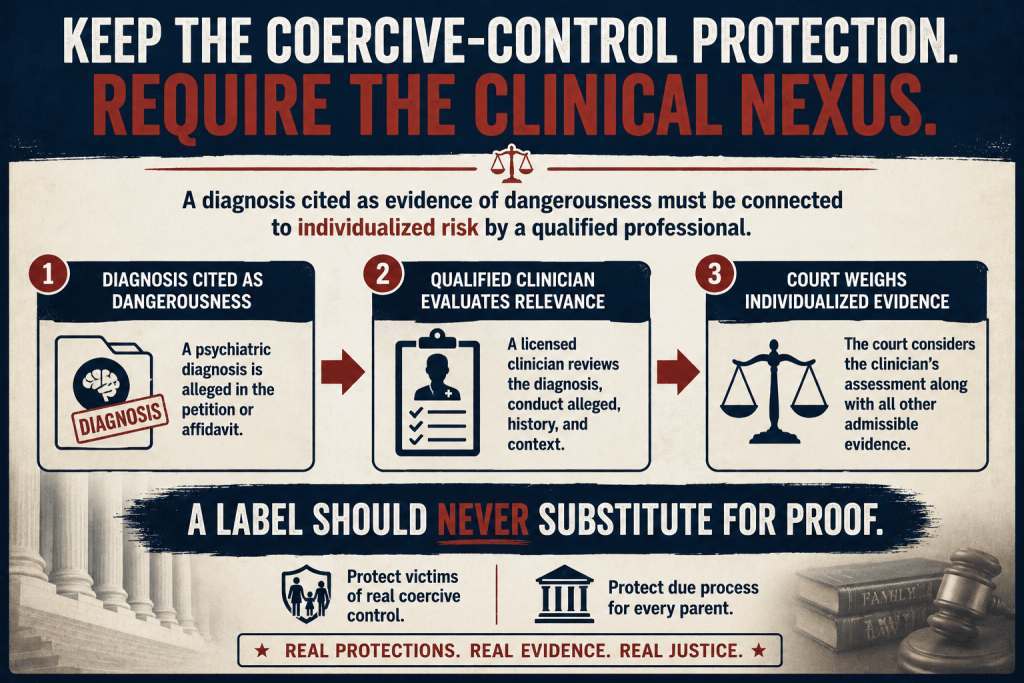
That’s the entire structural problem in one sentence. Population-level statistical association is not individualized proof. A relative-risk ratio derived from cohort studies says nothing about whether this specific person, on this specific date, did the thing they’re accused of. Courts elsewhere require expert testimony to bridge that gap — to connect a diagnosis to an individualized risk assessment before it can be treated as evidence of anything. California’s DVRO statute contains no such requirement. A diagnosis can be introduced by a lay petitioner, unaccompanied by any clinician, and weighed by a judge with no obligation to ask whether the diagnosis has any demonstrated connection to the conduct alleged.
Separately, the stigma research is its own body of evidence worth naming: a 2019 analysis of three National Stigma Studies found the public perception linking mental illness to dangerousness has increased over the past two decades, even as clinical understanding of most diagnoses has become more precise. The “myth of dangerousness,” as lead author Bernice Pescosolido termed it, doesn’t need to be scientifically accurate to be legally effective — it only needs to be persuasive to one judge, once, on one afternoon, with no one in the room to push back.
“The myth of dangerousness doesn’t need to be scientifically accurate to be legally effective.”
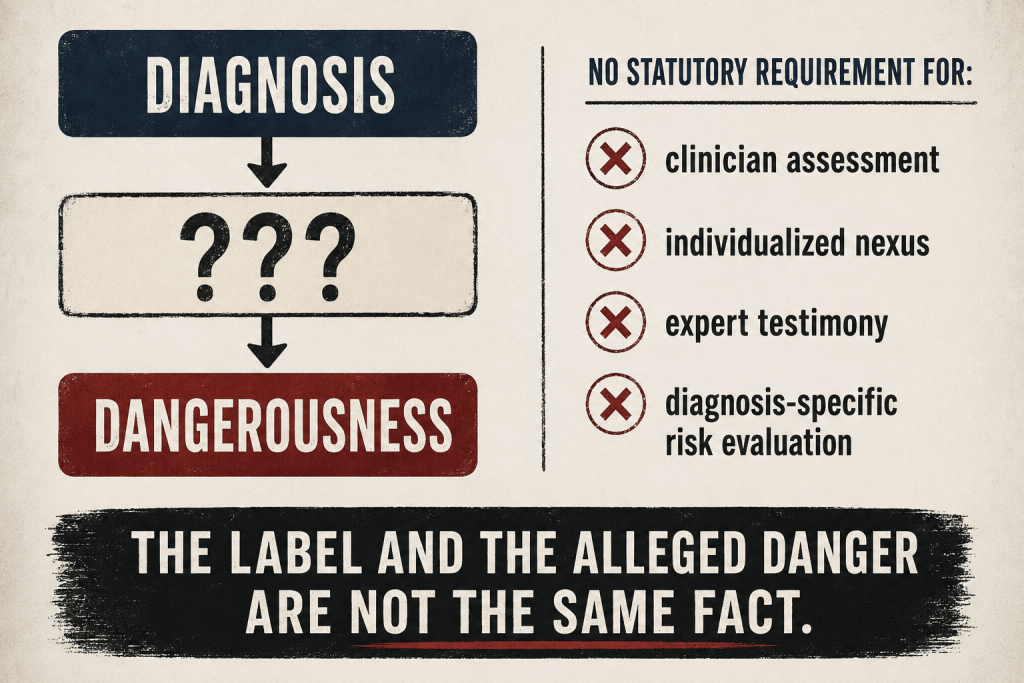
Put the pieces together, and the structural failure comes into focus. It is not that psychiatric diagnoses are irrelevant to family court. It is that:
A DVRO can issue on one party’s uncorroborated account (§ 6300(a));
That account can rest entirely on subjective, after-the-fact characterization of “disturbed” mental or emotional calm (§ 6320(c));
A diagnosis can be cited within that account as connotative proof of dangerousness; and
Nothing in the statute requires anyone — the petitioner, the court, or an independent evaluator — to establish that the diagnosis has any individualized bearing on the specific conduct alleged, before the order issues.
The ex parte hearing where this first happens is, by design, one-sided. The respondent doesn’t get to cross-examine, doesn’t get to introduce a countervailing clinical opinion, doesn’t get notice in time to prepare a defense. By statute, the noticed hearing on a long-term order must be held within 21 days — or 25 with good cause — of the temporary order (§ 242). But that’s still weeks during which the temporary order has already reshaped custody arrangements, employment, housing, and reputation. The “swapped jerseys” test applies cleanly here: swap which parent holds the diagnosis, which parent files the petition, and the mechanics of the gap don’t change. That’s what makes it structural rather than anecdotal.
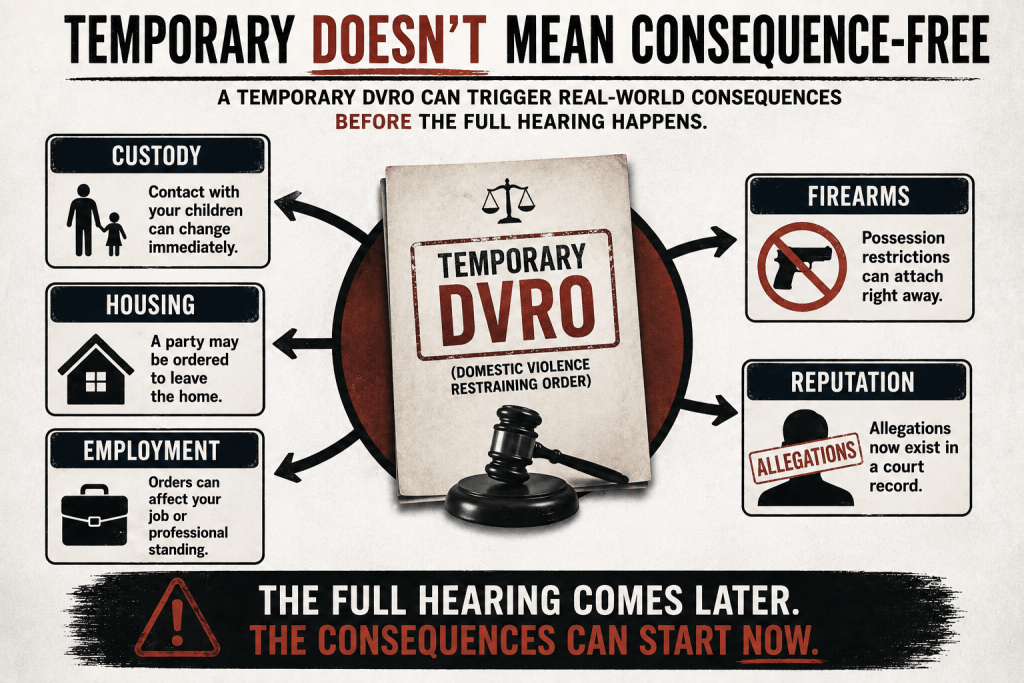
“Swap which parent holds the diagnosis, which parent files the petition, and the mechanics of the gap don’t change.”
Other areas of family law require exactly the kind of individualized nexus this statute skips. Custody evaluations under Family Code § 3111 must be conducted by an evaluator meeting the licensing and training standards set out in § 3110.5 — not a lay petitioner’s say-so. Dependency proceedings, which can also separate a parent from a child, generally require specific, documented jurisdictional findings rather than an uncorroborated characterization. There’s no obvious reason a DVRO — an order that can immediately restrict custody, contact, and firearm ownership — should require less.
“The diagnosis in the file and the danger in the petition remain two different things that the statute never requires anyone to connect.”
A narrow fix wouldn’t touch the coercive-control protections that make § 6320 valuable for the abuse survivors it was written to protect. It would simply require that when a diagnosis is introduced as evidence of dangerousness — as opposed to describing the petitioner’s own experience of distress — a treating or evaluating clinician’s assessment accompanies it before the court weighs it. That’s a lower bar than requiring corroboration for the underlying abuse claim generally. It targets the one specific failure mode: treating a label as a fact-in-itself.
Until that changes, the diagnosis in the file and the danger in the petition remain two different things that the statute never requires anyone to connect.
Next in this series: what the state’s own family court training tells evaluators about neurodivergent and disabled parents — and where that guidance protects, and where it doesn’t.
Sources: This piece draws on the text of California Family Code §§ 6300, 6320, and 242, along with § 3111 and § 3110.5 governing custody evaluator qualifications, all accessed via the official California Legislative Information site and cross-checked against Justia and FindLaw’s annotated codes. The account of Rodriguez v. Menjivar (2015) 243 Cal.App.4th 816 is drawn from the published appellate opinion, as compiled by Leagle, and from case summaries published by the Family Violence Appellate Project (now Survivor Justice Center), which litigated the appeal. Background on SB 1141’s 2020 amendment to § 6320 comes from the California Law Review and from contemporaneous legal analysis published by Kleeman Kremen Family Lawyers and the Thurman Arnold Law Firm. The research on ADHD and violence-related outcomes cites Whiting, Lichtenstein, and Fazel, “Violence and mental disorders: a structured review of associations by individual diagnoses, risk factors, and risk assessment,” published in The Lancet Psychiatry (2021; published online 2020), and Buitelaar et al.’s 2023 systematic review and meta-analysis in Psychological Medicine on ADHD as a risk factor for intimate partner and sexual violence. The stigma research cites Pescosolido et al.’s analysis of the National Stigma Studies, published in Psychiatric News in 2019. The dependency-court comparison draws on Welfare and Institutions Code § 300 and on In re Alexis E. (2009) 171 Cal.App.4th 438, which held that jurisdictional findings under § 300 must rest on substantial evidence tied to specific statutory subdivisions.
Comments
Nothing yet. Say the first thing.
Sign in to join the conversation.