
Yes, I’m a lucky Sandisk owner, sitting on a 90% return on a < 2-month holding. Sell, hold, or buy more? But first, how did I end up with this position? Or, as one analyst said to me, “Sandisk, is Micron on steroids.” By the way, the next podcast will be on AI memory, so if you aren’t subscribed, hit the button below.
Personally, I fall into the dying category of active stock pickers. There is nothing I love more than listening to investment pitches at the idea exchanges I organize. (FYI, the next one is in Rio - check it out here). Sometimes, though, I hold more cash than I should. And time in the market is important. I could allocate to a money market fund, a bond, or buy an ETF, but I wanted to try something different. One idea was a ‘permanent portfolio’ type approach (example) with investments in other asset classes (bonds, alternatives, commodities, etc). But I decided instead to allocate to a completely different strategy from my active stock picking.
Long story short, I decided to add a momentum strategy to the mix. I’m still a value investor and stock picker, but perhaps I can add some profits by adding something almost completely different. (Note the almost). The academic work confirms momentum as a valid factor, and it almost breaks my heart to say that my own research into the topic over the last 5 months agrees. As investors, we need to keep an open mind.
So, I decided to give it a shot with my own variation. I don’t randomly buy everything that moves up, but I also run two DCF models on each candidate. One model with analyst expectations, and a reverse DCF to see what growth is built into the stock price. If the growth is ridiculous (eg. need 20%+ growth for the next 10+ years) then the stock is taken out. I started implementing the strategy on my eToro account on March 9. I opened an account there in 2024, both because the company has been supporting my events and because they have a lot of nice freebies (e.g., WSJ, FT). Who doesn’t like free stuff? My account is public, and anyone can view, follow, or copy it (click here). So either I’ll look like a genius or an idiot and learn a lesson.
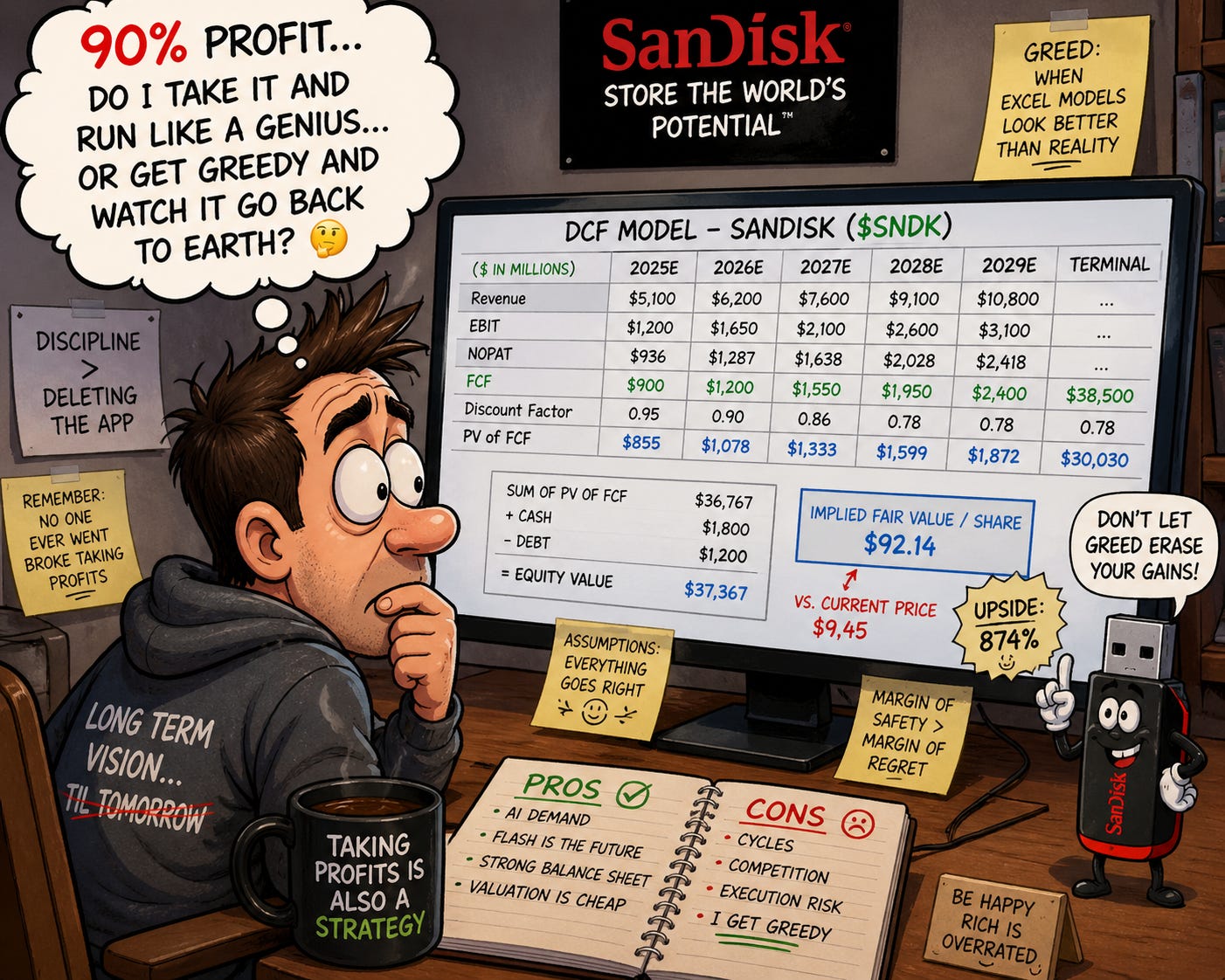
SanDisk is one of the world’s largest suppliers of NAND flash memory. If you’ve used an SD card in a camera, a USB stick, the SSD inside a laptop, or the storage in your iPhone, you’ve used NAND. It’s the technology that replaced the spinning hard disk in most modern devices.
There are two main kinds of memory chips: 1) DRAM, which is fast, expensive, and temporary (it forgets when power is off), and 2) NAND, which is slower, cheaper per gigabyte, and permanent (it remembers). SanDisk only does NAND. It has zero DRAM exposure (Micron, Hynix, Samsung).
The company was bought by Western Digital (WDC) for $19B in 2016, and was spun back out on February 24, 2025.
Market Info
Ticker: SNDK
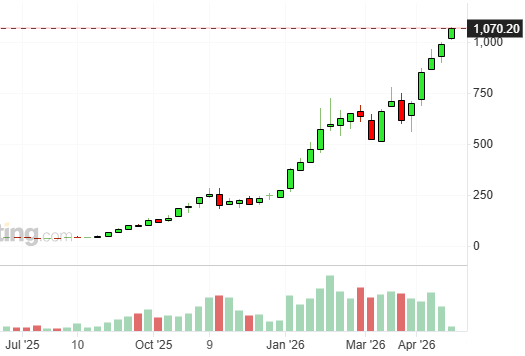
Stock Price (Local): 1,070.20
52-W High (April-27-2026): 1,070.66
52-W Low (April-30-2025): 31.01
5 Year Beta: N/A
Avg Volume (3-month, millions): 19.4
Avg Volume (USD, millions): 20,763
Shares outstanding (basic, millions): 147.6
Country of Incorporation: United States
Trading & Filing Currency: USD
Enterprise Value
Market Cap (USD, millions): 157,962.6
Plus: Total Debt 813.0 of which Leases 219.0
Less: Cash and ST Investments -1,539.0
EV (USD, millions): 157,236.6
Key Valuation Metrics
P/E forward: 24x
EV/EBITDA forward: 19x
Dividend Yield: N/A
Key Persons
Chairman & CEO: Goeckeler, David V.
Executive VP & CFO: Visoso, Luis
Executive VP & CTO: Ilkbahar, Alper
Top Holders
Vanguard Group 12%
FMR LLC 9%
BlackRock 7%
State Street Global Advisors 4%
Geode Capital Management 2%
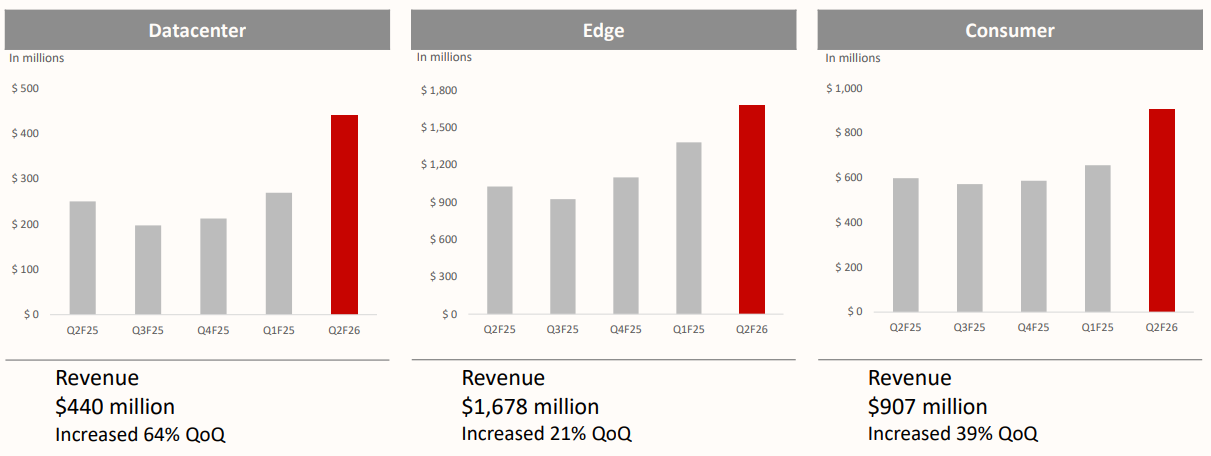
There are 3 segments: 1) Edge (previously ‘Client’) with $1.7b in revenue (55% of total) that is the SSDs in laptops, phones, cars, etc, 2) Consumer with $0.9b in revenue (30% of total) that is the retail business such as USB sticks, portable SSDs, etc, 3) Datacenter (previously ‘Cloud’) with $0.4b in revenue that is the SSDs sold to hyperscalers such as AWS, Microsoft, etc. While they are all growing in the double digits, the datacenter business grew 64% sequentially in the last quarter!
And investors have gotten really excited about the stock. It’s 4x up since December!
Now, you might think that the rally is already done. But it depends on your outlook and your required rate of return.
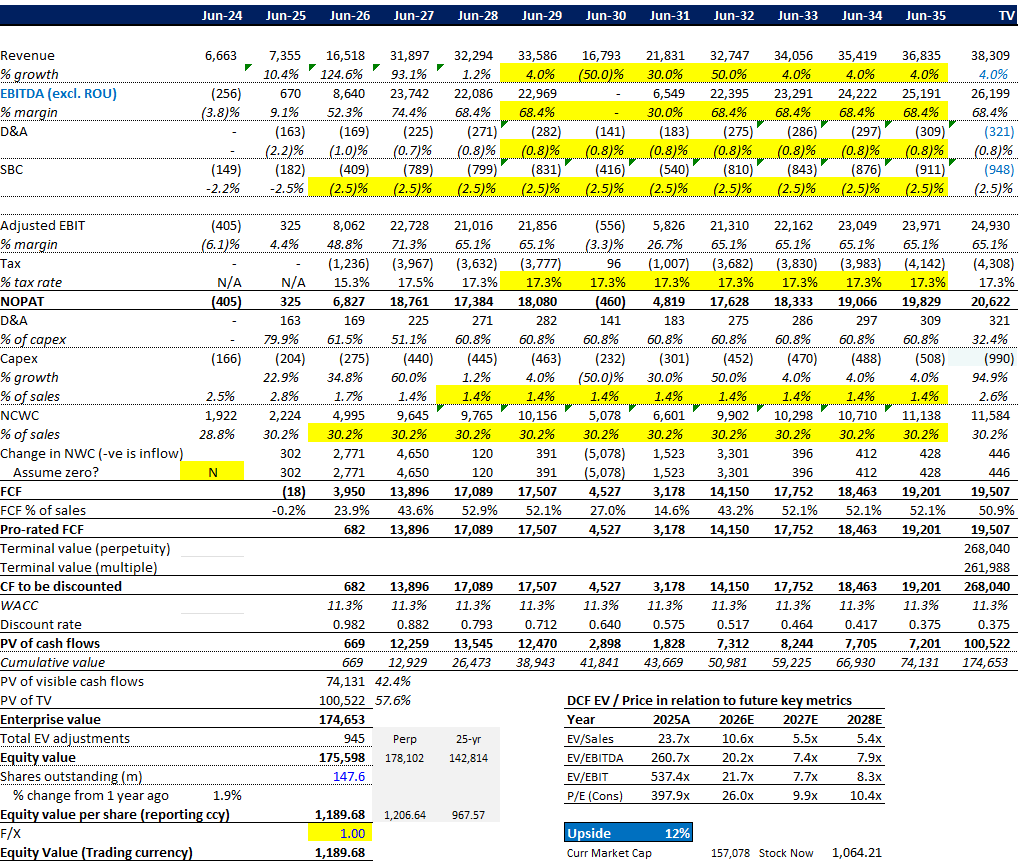
Perpetuity: Analysts see FCF at $12b for FY27 that ends in June. Assuming a simple perpetuity of 4% growth as a 12.3% WACC, the stock’s intrinsic value is c. $1060. The high WACC is due to the stock’s high beta (2.41) and the company's lack of debt, as it is in a net cash position. Bringing WACC down to 9% increases the fair value to c.$1750. So, a less volatile stock and some debt would add significant value. Let’s assume that the long-term beta declines 1.7 (mid of Western Digital and competitor Micron), then the discount factor drops to 11.3%, which implies a c.$1,200 intrinsic value.
25-year run: Another way to look at this is a 25-year life. Why? S&P 500 membership 25 years ago was a lot different from today (per memory, it was around 300-350 that survived, so 150-200 are no longer members). So assuming a limited life, we estimate the future cash flows by using today’s analyst estimates of growth, margin, D&A, CAPEX, a 4% top-line growth for 2029-2050, zero terminal value, and an 11.3% WACC. We get to c.$1,200
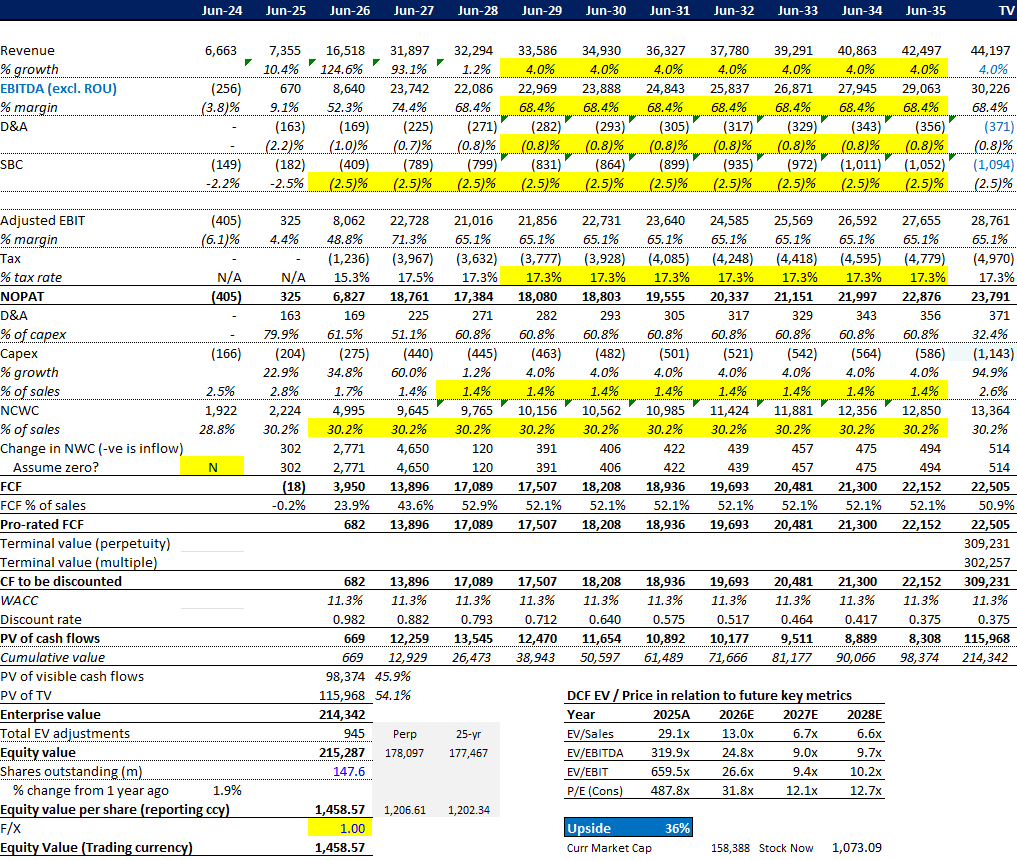
DCF: A traditional 10-year DCF (see below) gets to c.$1,460 value.
Peers
Per Sandisk’s 10-K, its publicly listed competitors are Kioxia, Micron Technology, Samsung Electronics, and SK Hynix.
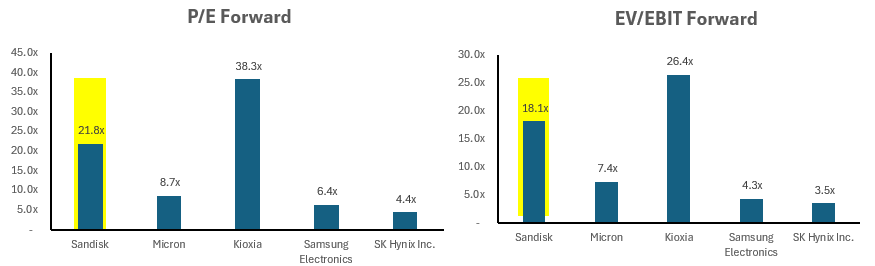
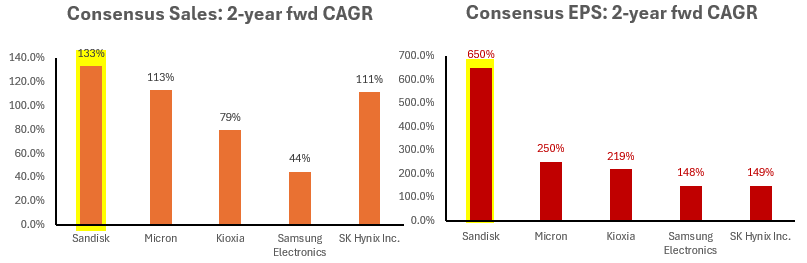
The stock is trading at a premium to comps except for Kioxia, though it has the highest 2-year forward EPS growth. EBITDA margin is expected to expand from c.9% in FY25 to 74% in FY27!
Risks
It’s a commodity that’s typically cyclical. “This time is different” usually doesn’t work. It’s a play on datacenters and AI, and a pause in spending could be brutal. Also, note that Drunkenmiller sold all his shares.
So let’s assume that in 2030, there is a 50% hit to revenues, the margin goes to zero, and it takes about 2 years to recover. (FYI, -50% was Micron’s hit in 2023). In that case, the intrinsic value drops to $1,090.
Conclusion/Final thoughts
So this isn’t my typical bottom-up, high conviction stock pick like Ryanair, which I pounded the table on at one of my events and doubled my money. For that sort of pick, join us in Rio:
- FatAlpha Value (LATAM) @ Hilton Copacabana, Rio de Janeiro
- Keynote: Dave Iben, founder/CIO of Kopernik ($11B+ AUM)
- Investors sharing ideas via 15 min pitches. Everyone presents
- June 2-3, 2026. Early bird: EUR 250
- More info: https://FatAlphaValue.com/latam
- Video highlights of past events: https://fatalphavalue.com/media
For context, this strategy (c. 25% of my equity portfolio) prioritizes momentum, which is then filtered based on valuation. It’s starting with the assumption that the market is right. The strategy accepts the market’s vote, and from there, we are looking at stock prices that don’t look ridiculous . An example of ridiculous would be Bloom Energy, which has gone parabolic but needs 20-40% growth for the next decade at least to justify its price. This is very different from value investing, where we typically assume the market is wrong. That’s my world. But if Buffett is willing to try something different (tech), then so should I.
SanDisk is one of the top-performing stocks, and its valuation is still ok. If it gets ridiculous, then I’ll be out. Let me know what you think? Am I nuts?
Disclaimer: Not investment advice. Do your own work! This substack is not operated by a broker, a dealer, a registered investment adviser, or a regulated entity. Under no circumstances does any information posted represent a recommendation to buy or sell a security. In no event shall the author be liable to anyone reading this post for any damages of any kind arising out of the use of any content available in this post. Past performance is a poor indicator of future performance. All the information on this substack and any related materials is not intended to be, nor does it constitute investment advice or a recommendation. All materials and information you obtain here are exclusively for informational purposes and do not constitute an offer or solicitation to provide any investment services to investors based in the U.S. or elsewhere.
No posts
Comments
Nothing yet. Say the first thing.
Sign in to join the conversation.