

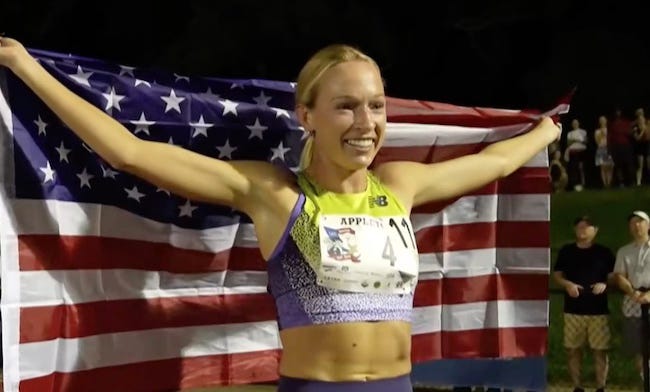
I thoroughly enjoyed the women’s pro mile at Friday’s Sir Walter Miler, because at various points in the race, it looked like about six different women had a shot at the win. Sinclaire Johnson and Heather MacLean went with rabbit Hannah Ballowe early, and it looked like it could become a two-woman race. But on the third lap, their pace lagged, and at the bell, almost the entire field was back in it.Lindsey Butler and Carmen Alder battled up front on the final lap, but Margot Appleton, who was in fifth with 300m to go, measured her kick well, took the lead midway up the homestretch, and won in 4:23.45. Kayley DeLay, who also moved up nicely, took second in 4:23.77, followed by Butler (third, 4:24.18), Annika Reiss (fourth, 4:24.21), Angelina Ellis (fifth, 4:24.46), MacLean (sixth, 4:24.59), Johnson (seventh, 4:25.15), and Alder (eighth in an Ecuadorian record of 4:26.13). Appleton earned $2,100 total—$1,600 for the win, plus a $500 time bonus. DeLay didn’t stick around for long after her runner-up finish. She was off to Cleveland to race the Guardian Mile, a point-to-point road race, which kicked off less than 23 hours later. The back-to-back races suited her well, and she dominated in Ohio, winning in an event record of 4:16.88 (which gets rounded to 4:17 because it’s a road race). Between that and her 4:17.4 runner-up finish at the Fifth Avenue Mile last year, DeLay has really proven herself on the roads. And she earned a total of $7,200 between her two races—$1,200 for finishing second at Sir Walter plus a $500 time bonus, and $5,000 for winning the Guardian mile, plus $500 for leading at halfway. On the
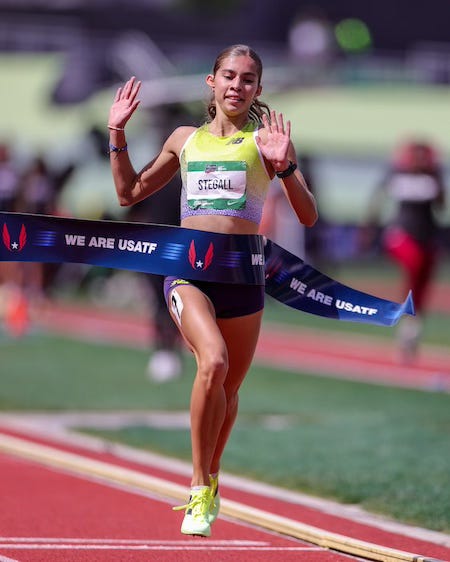
After University of Florida rising sophomore Claire Stegall finished fifth in a slow-starting race at the USATF Outdoor Championships two weeks ago, it was clear she was ready to run well at the World U20 Championships in Eugene, Oregon. And USAs proved to be a good rehearsal for Sunday’s 1500m final, which started even slower. The leaders hit 400m in 78 seconds, and 800m in 2:29, but that set up a very fast finish, with winner Earlier in the meet, Uganda’s
Most of the headlines I saw from the meet were about the awful air quality in Eugene due to wildfires. The AQI rose as high as 237 on Wednesday afternoon—which is considered very unhealthy—but the competition went on as scheduled. I was surprised to read that World Athletics didn’t have more of a backup plan. They just said that they were “monitoring recommendations by local health authorities to ensure the competition is safe to continue.” Due to climate change, things like this are going to become more and more of an issue in the sport. And more often than not, if a high-stakes event is continuing on, the athletes will line up, regardless of the risks. (Results)
D+M Engineering PLLC is a woman-owned, Austin-based engineering firm owned and operated by Muna and David Mitchell, dedicated runners and supporters of Fast Women and fans of women’s running. We are proud to sponsor the Fast Women newsletter for the month of August. Stay tuned each week for more about us and why we are in your inbox on Mondays this month.
Muna started her engineering journey with strong feelings about being simply an engineer and not a woman engineer. Instead of joining the Society of Women Engineers, she joined the American Society of Civil Engineers. That Muna would not have considered certifying her business as woman-owned and might not even have recognized the value of a newsletter dedicated to women’s running.
Thirty years of engineering and life experience later, she recognizes the value and necessity of elevating and recognizing the achievements of all women. Just as Fast Women celebrates women’s running, D+M is excited to elevate Fast Women. Together and with our many allies, we can normalize women’s achievements to move us steadily forward to greater opportunities for women in all endeavors.
To learn more about our engineering services and community endeavors, please visit www.dplusmengineering.com or contact Muna Mitchell at muna@dplusmengineering.com.
Ideally, I’d be churning out athlete features and stories about the phenomena in the sport that interest me each week. There are a lot of stories that I wish I had the time to research and write. But I’ve had some unexpected, unpleasant stuff come up lately that has required me to do a lot of mindless labor. The upside is that it has allowed me to fly through many audiobooks while I work.
Last week, I listened to Nicholas Carr’s Superbloom: How Technologies of Connection Tear Us Apart, about how modern communication tools have highlighted our differences and decreased people’s empathy. It got me thinking about running, social media, and the power of in-person connection. I’ve listened to a number of similar books in recent years and I appreciate the topic in general because, as time has gone on, I’ve only grown more confused about the role of social media in my work and life and how, if, and where I want to show up online. I’m not going to attempt a detailed analysis of the book, but I want to zero in on a couple of topics Carr covered. I thought it got interesting around chapter five, which focused on the idea that people expect that the more they learn about others, the more they will like them, but research has shown that more often, the opposite happens. And people sharing more about themselves online has led to greater division. We’ve all seen such things play out. There are some people who don’t know me at all, but they hate me because of the views I’ve shared online. There are a number of athletes whom I’ve followed online for years, and moments in their careers that felt like major triumphs for the entire sport, or they were people whose content I really liked. And then the 2024 presidential election happened. For a few days after the election, it seemed like some people in the running community thought Trump’s election meant they could show support for him without consequence. But then, for some, I think there were consequences—losing followers, disappointed messages from fans—so many of those people went back to being quieter Trump supporters. But after that, I couldn’t unsee the fact that quite a few prominent figures in the running community were subtly sharing their political beliefs in other ways: liking posts about Trump winning the election or sending ICE into cities, liking posts about banning trans women from sporting opportunities that they already did not have, and posts from MAGA influencers. I think that, on the whole, the women’s professional running community leans left, but I saw enough that I felt disillusioned about the work I do.
I see my job as highlighting others’ successes, among other things, and for a while, I really lost my enthusiasm for doing that, because it felt like too many of the women I was writing about didn’t have the backs of other women, immigrants, trans people, or other members of marginalized groups. I’d like to say that I reconciled all of that at some point. But there was no grand conclusion; I just decided that if I wanted to do this job, it was going to require highlighting the accomplishments of some people with wildly different views than my own. But I also have choice in what I cover, so in some cases, I’ve tried to profile those who have gone out of their way to stand up for marginalized groups.
Some of the stories I’ve written in recent years have led me to talk to people I probably wouldn’t have a lot in common with. It’s really easy to make assumptions about people based on very little information. I’ve certainly done it myself. But I find so much more value in phone conversations and in-person interactions, because there is so much more room for nuance and back-and-forth conversation, and I almost always like actual people more than what they post (or signal) online. That’s not to say that we can overcome all of our differences, but the way we show up online is almost always an oversimplification of who we are. And it’s easy to draw incomplete conclusions about someone’s life based on what they post. If I haven’t seen a friend in a long time, and all they’ve posted is happy photos of their family on vacation, I might assume their life is going great. But when I get together with them—especially if we have the opportunity to run together—that’s when I find out how they’re really doing. I used to say that if you think someone is normal or has no big challenges or family drama, you probably just haven’t run enough miles with them yet. Because sharing more online leads to greater divisiveness, I think we’ve increasingly seen high-profile runners and track & field athletes lean toward sticking to vanilla topics that have a chance of being relatable and appealing to all. I imagine many sponsors prefer that. Don’t rock the boat. But for me, that’s a turnoff. My favorite people to follow online are those I can learn from and are consistently vocal about what they believe in. Carr also writes about how young people today are much more likely to socialize online than in person, they’re going out less in general, and that they are lonelier and struggle with their mental health more compared to previous generations. And the phenomenon disproportionately affects women and girls. I also thought he made a good point about how the widespread use of smart phones and social media has reshaped society. Even if an individual makes the decision to step away from social media, they are still affected by the fact that other people are now less likely to get together in person. Being off social media can lead to further isolation, because you can miss what little interaction there is. (Or, with the demise of local newspapers, sometimes it’s the best way to get information about what’s happening in one’s community.) Not everything is about running, the sport isn’t for everyone, and it can’t fix all of the world’s ills. But at any age, running can be an excellent way to socialize, and I think it’s one of the easiest ways to get to know new people and see an honest version of who they are. I haven’t been able to run consistently in a long time, which is really frustrating, but I am still a running evangelist because I’ve seen the many ways in which the sport has connected people and changed their lives for the better. Sure, I’ve occasionally run with people who, as I’ve gotten to know them better, I’ve started to like less. But for the most part, the sport has helped me to have much deeper conversations with people than I otherwise would, and most of the time, it makes me feel greater empathy for them and like them more. If you’re someone who has the privilege of being able to run with other people, it’s an excellent antidote to our increasingly online lives.
Karissa Schweizer shared that she recently underwent surgery after feeling a pop in her knee during practice a few weeks ago. She did not disclose a specific diagnosis. It’s been a rough road for Schweizer. She dealt with femoral stress fractures in both 2024 and 2025, and she had Haglund’s surgeries on both sides before that. The good news is that she’s well versed in rebounding after setbacks.
Schweizer’s setback means that she is unable to represent the U.S. at the World Athletics Road Running Championships next month, but that has opened up an opportunity for Allie Ostrander, who was the 5K alternate. She is thrilled, and I imagine we’ll get to see some good content on her YouTube channel as a result.
Great Britain’s Ava Lloyd, 20, another M11 Track Club product, had a breakthrough race to defeat a strong 1500m field at Sunday’s British Milers Club Grand Prix, running 4:01.78 for 1500m. She took 4.67 seconds off of her previous personal best. She turns 21 this week. In the 800m, Ireland’s Sophie O’Sullivan broke 2:00 for the first time, running 1:59.65 for the win. (Results)
Leading into this week’s European Championships, Rick Broadbent wrote a nice piece for The Times about Georgia Hunter Bell and Keely Hodgkinson’s friendship. I liked the detail about Hodgkinson teaching Hunter Bell to ride her bike with no hands, despite Hunter Bell being the one with the far more extensive cycling background.
Romania’s Madalina Florea won Sierre-Zinal, a 31K race with 7,200 feet of climbing, in 2:55:46. Trail and mountain races continue to produce content that makes every finish line look like a party, albeit one where some of the guests arrive rather spent. (Results and recap from iRunFar)
Former University of North Dakota standout Jadyn Keeler of Canada announced that she has signed a pro deal with Adidas and she is joining the Flagstaff-based Golden Peaks Track Club. She didn’t go into the NCAA as a big superstar, but she’s made dramatic progress over the past four years.
Olympic 100mH medalist Jasmine Camacho-Quinn announced the arrival of her baby.
It’s good to see that Sage Hurta-Klecker is back to working out on the track, and her former college teammate Dani Jones is also making progress and plans to race in Falmouth this weekend.
I also listened to Lindsay Crouse’s new book, The Case for Quitting: The Surprising Benefits of Opting Out last week. Given where I currently am in life, I can’t say this is a book I would have been likely to pick on my own. But I had the chance to listen to the book in advance of its release, and I appreciate everything Crouse has contributed to the running world over the years. And unlike Superbloom, this book actually included some runners’ stories. If you are considering making a change, feeling stuck, or need a nudge to take a leap, this book could be exactly what you need. It left me thinking about the role privilege plays in the decision to quit or opt out, and I would have liked to hear more about that. But I think that regardless of where you are in life, there are enough nuggets of wisdom in there that something will resonate. Especially for distance runners, who are often used to persevering, no matter what. The book comes out September 8 and is available for preorder now.
January’s World Athletics Cross Country Championships in Tallahassee, Florida, were such a success that Leon County officials are already working to convince World Athletics that they should host the event again in 2029. Two officials spent time in Eugene, Oregon, this past week, during the World Athletics U20 Championships, so they could make their case. Given how difficult it is to get people to show up to a track meet in the U.S., it’s impressive that they were able to draw more than 15,000 attendees this year. But part of the appeal of attending was that the event hadn’t been held in the U.S. since 1992. If it becomes a more frequent occurrence, it’ll be interesting to see if as many people go out of their way to attend.
I enjoyed hearing Kara Goucher recap her recent half marathon on the Ali on the Run Show. If you’re fortunate enough to be a runner over many decades, what that looks like will change dramatically over time. But Goucher’s love for the sport is still as strong as ever.
I appreciated getting a Madie Boreman update on I’ll Have Another after her third place finish in the steeplechase at USAs. She’s at the top of the list of people I’d be featuring right now if I had more time.
I was interested to hear Emily Mackay say on C Tolle Run that she is no longer using bicarb. She’s said she’s not convinced that it works for her and she set all of her PRs without it.
I no longer have a reason to be a NYRR member, and I have no plans to ever run the NYC Marathon, but I still listened to NYRR’s Set the Pace episode about the changes they are making to the 9+1 program, which is many local runners’ path into the marathon. And as an outsider, I might be missing something, but all of their logic made sense to me. (If you’d prefer to read about the changes, Sarah Lorge Butler wrote about them for Runner’s World.) Times have changed dramatically, I remember the days of not having to plan ahead for most races, but running being too popular is a good problem to have. (And I have always been a fan of running the cheapest races with the easiest logistics. Many of those are really great in different ways.) I was also pleased to hear them mention the Race Free program, which allows 1,000 people per year to run NYRR races they otherwise could not afford.
I appreciated the latest episode of Burn It All Down, which included a nuanced discussion on sports gambling, including how it’s affecting women’s sports. Though it’s more prevalent in other sports, there are an increasing number of opportunities to bet on track & field. You might remember that last year, a man in the crowd at Grand Slam Track’s Philly slam heckled Gabby Thomas at the start of the 100m and then bragged online, “I made Gabby lose by heckling her. And it made my parlay win.” Thomas spoke out about her experience and FanDuel banned him.
Additional Episodes: Christina Aragon on Fueling Forward | Amanda Vestri on Hurdle | Australia’s Jessica Stenson, 36 weeks into her pregnancy with her third child, on Run With It
I hope you all have a good week. Alison
Comments
Nothing yet. Say the first thing.
Sign in to join the conversation.