
Hello — I’m glad to be back! More on my trip below.
It’s Thursday, July 16. One of my musical idols, Linda Ronstadt, turned 80 yesterday, and oh how I wish it was 1976 and she was turning 30 and still singing.
The sun rose in Boston at 5:21 a.m. and set at 8:18 p.m. for 14 hours and 57 minutes of sunlight. The waxing moon is 7% full.
The Old Farmer’s Almanac is already out with its fall foliage planner so that you can pick exactly which day you’ll get stuck in traffic on the Kancamagus Highway.
🌫 What’s it like outside? Smoke from a spate of wildfires in northern Minnesota and Ontario continue to sweep eastward across New England, yellowing our skies and blocking the sun. The smokiness should dissipate by mid-day Friday. The weekend looks pretty good, with some scattered showers and mugginess.
⚾️ Hey, sport: The Red Sox brought a 9-game winning streak into Tuesday’s All-Star game in Philly, which the American League won, 4-0. The Sox still are not a .500 team, but they certainly are making things interesting. This weekend brings a crucial four-game series at Fenway vs. Tampa Bay, who lead the Sox in the AL East by 10 games.
The two World Cup teams left standing, Spain and Argentina, will face off in the final in Atlanta at 3 p.m. Sunday in New Jersey (Fox, Peacock, Telemundo). The bronze medal game between France and England is 5 p.m. Saturday in Miami.
During my time off, I spent 10 full days in Greece (plus another couple of days traveling) with my nephew and his family. He’s quite well-versed in the history of ancient Greece (and mythology), and has visited there several times, so he was a terrific guide, from Knossos on the island of Crete to the Acropolis and Parthenon to the Peloponnese, Delphi, and a thousand places in between.
The weather was perfect, the landscapes and beaches breathtaking, and the outdoor cafe culture intoxicating. (Not literally.) It was about as close to a perfect vacation as you could want.
But there was one discovery that left me sad and angry.
The dominant building atop the Acropolis is, of course, the massive Parthenon, the ancient temple dedicated to the goddess Athena. But off to the side is another significant building: The Erechtheion, built primarily to worship Athena Polias.
(The goddess has many epithets, or cult titles: A few include Athena Nike for victory, Athena Soteira for savior, Athena Erganes to honor work. Athena Polias is Athena of the city, and the Parthenon is so named because it is dedicated to Athena Parthenos — Athena the Maiden. Sort of like Donald Trump aka John Barron aka John Baron aka John Miller aka Carolin Gallego aka David Dennison. The only difference is he’s godless.)
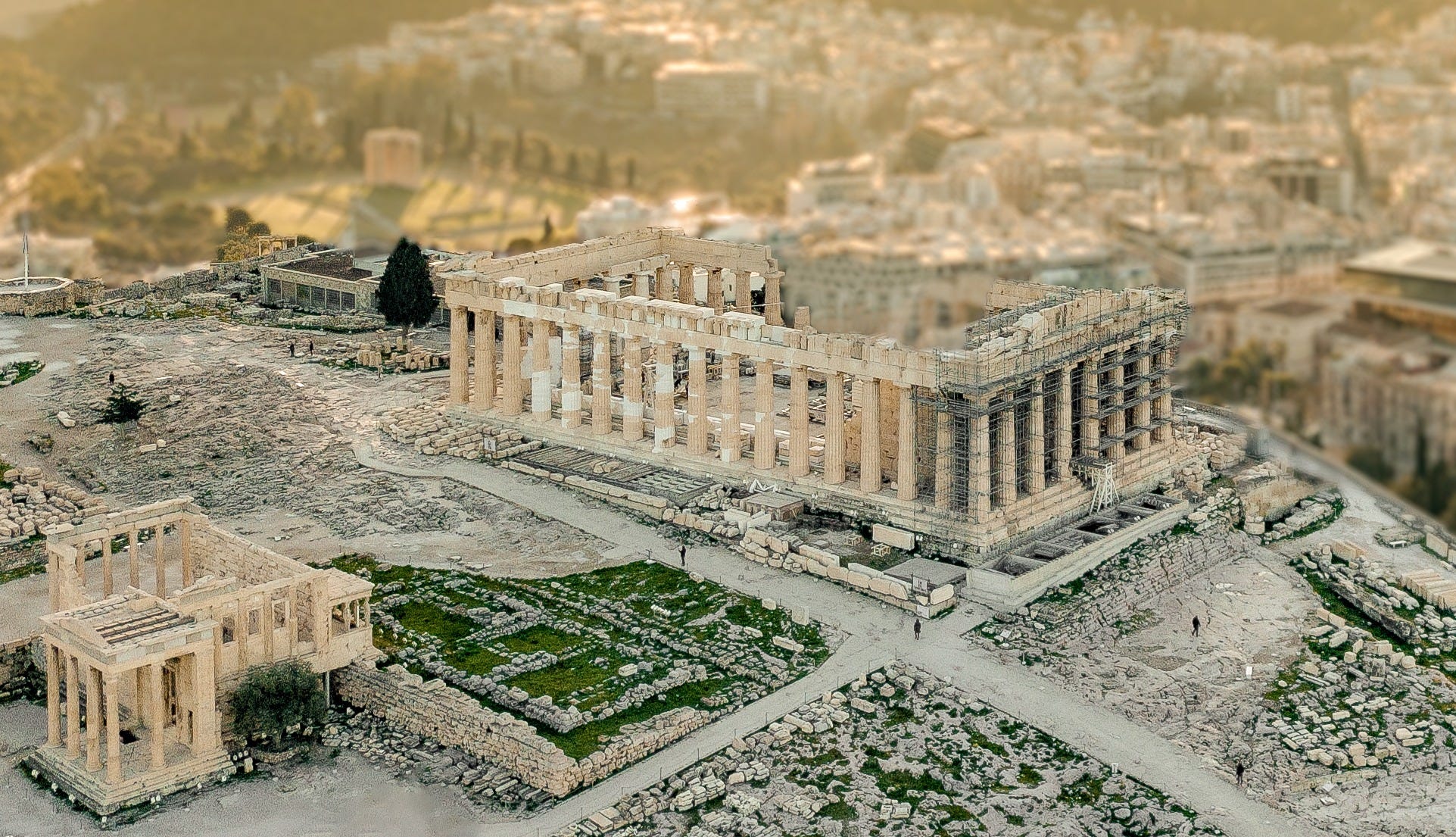
An aerial model of the Parthenon, with the Erechtheion in the lower left corner. You can see a couple of the Caryatids on the porch facing the Parthenon. (Source: ArchitecturePorn on reddit)
The most prominent architectural feature of the Erechtheion is the Porch of the Caryatids: Six statues of women that act as columns holding up the entablature above. There were caryatids elsewhere in Greece, most notably at the Treasury buildings at Delphi and Olympia. The name means “maidens of Karyai,” an ancient town in the Peloponnese. According to Wikipedia, some believe they represent the enslaved women of Karyai, who were punished for allying with the Persians against the Greeks and forced to carry the weight of heavy buildings. However, many historians believe the statues actually depict young dancers from a local festival dedicated to the goddess Artemis.
Whatever the origin, the most famous caryatids in the world are those six at the Erechtheion on the Acropolis in Athens, shown here (one is partially hidden behind the second from the left figure):
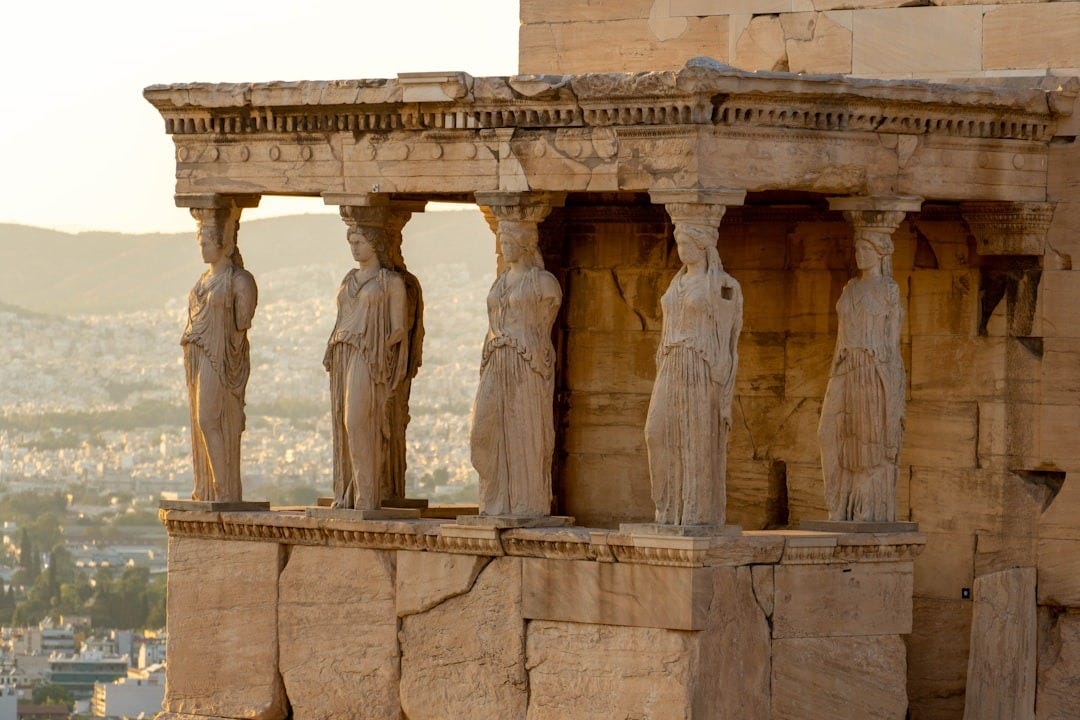
Get these women some Excedrin! (Photo by Andrey Nuraliev on Unsplash)
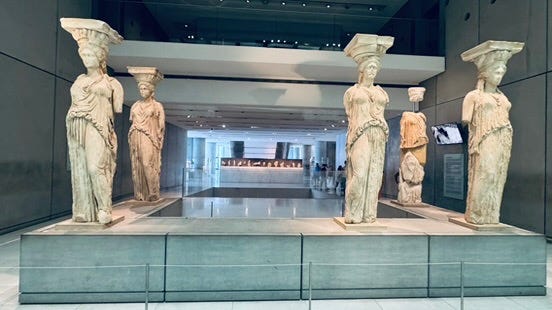
These are replicas, of course; the originals are protected in the Acropolis Museum, where they were carefully cleaned and are lovingly cared for. They are prominently displayed on a first-floor balcony. Here are some photos I took:
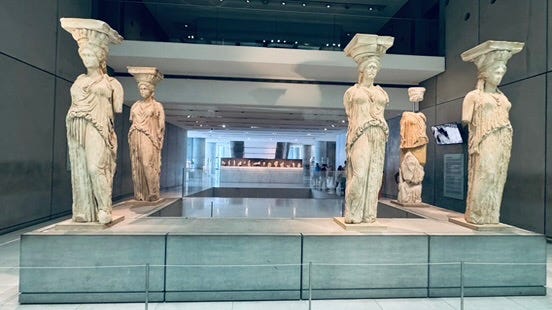
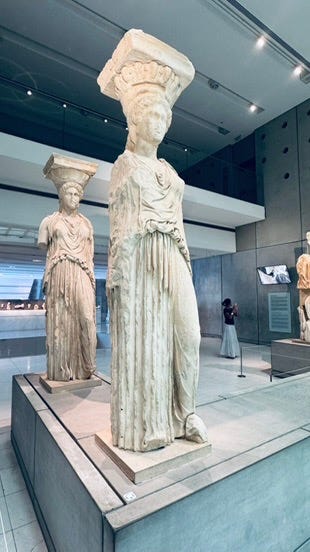
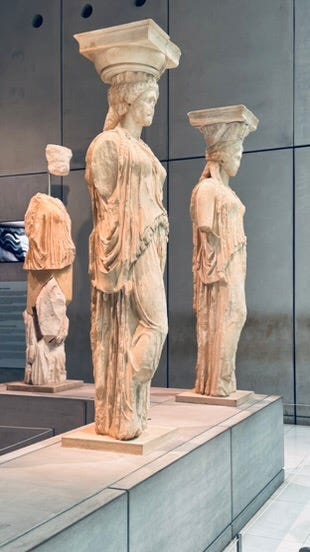
The statue in the back was badly damaged in 1827 by a Turkish bomb during the Greek struggle for liberation. Recovered pieces were assembled as much as possible.
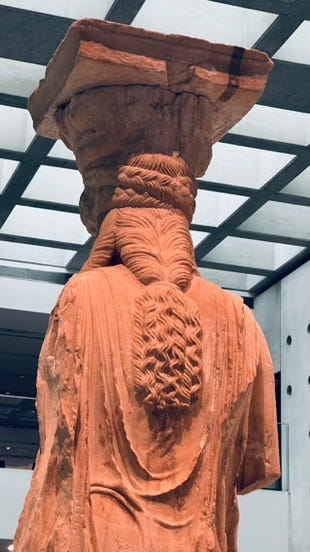
They are detailed and ornate, constructed of marble and standing 7.5 feet tall (12 feet when you include the pedestals and the entablature on top). Built between 421 and 405 B.C., they’re in pretty good shape for their age: More than 2,400 years old. All are slightly different from each other, with varied faces and differently plaited hair. But they also are similar: All wear the peplos, which the Metropolitan Museum of Art describes as a fitted inner tunic made of heavy wool, folded and pinned at the shoulders, and a himation, a large, unsewn rectangular cloak worn over the peplos by both men and women for warmth or modesty. All have one knee bent forward, likely to provide visual interest. All of their arms are missing, but were probably carrying libations or offerings.
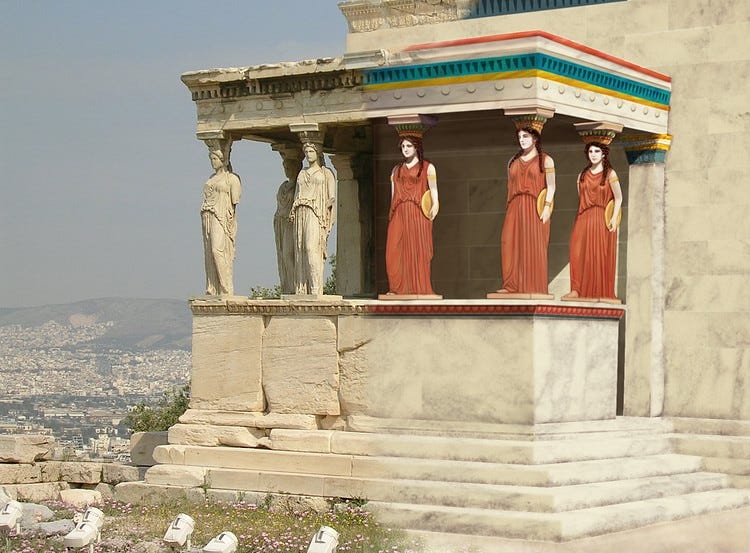
By the way, when they were first built, like many of the ruins you see in Greece, they were colorfully painted. Here’s one view of what they could have looked like:
I keep saying “all,” but if you look back at my first photo from the museum, you’ll notice something: One of the statues is missing. Where is it? You shouldn’t have to ask: It’s in the place that houses the largest collection of contested, looted, and colonial artifacts in the world: The British Museum.
The missing sister is just one part of the massive haul taken from the Acropolis by Thomas Bruce, 7th Earl of Elgin (known as Lord Elgin), a Scottish nobleman, diplomat, and collector. In 1800, as ambassador to the Ottoman Empire, which occupied Greece at the time, Elgin hired Italian artists to make drawings and take plaster casts of the sculptures and friezes and details of the Parthenon and other buildings on the Acropolis.
By the summer of 1801, Elgin had other ideas: Rather than copying the works, why not just chop them off the buildings and transport the real stuff back to Britain? In later years, when challenged on his actions, Elgin claimed to have the permission of the Ottomans. He produced a letter that not only was not an official permission document; the Turkish government had no record of it. But honestly, did the Ottomans really care if he took Greek heritage items?
His looting was devastating, not just to the physical structures he stripped, but also to Greece’s cultural heritage.
Between 1801 and 1812, Elgin and his agents removed roughly half of the surviving sculptural decoration of the Parthenon and dozens of other artifacts from the Acropolis. Specifically, they took about half of the Parthenon frieze, which was the continuous (not any more) sculpted band of figures that wrapped around the temple; 15 of the 92 high-relief marble panels that topped the temple's outer columns, and 17 life-sized figures and statues from the east and west gables, including the figures of Iris, Cecrops, and Dionysus. (Harvard University)
He also grabbed one of the Caryatids and a column from the Erechtheion, four sculptured slabs from the frieze on the temple of Athena Nike, and several architectural fragments, columns, and a large number of inscriptions from the Propylaea, the massive ceremonial gateway to the Acropolis. If you have climbed to the top, you walked through it. (Encyclopedia Brittanica)
That wasn’t all. He also grabbed various antiquities from Mycenae and other spots in Attica and districts of Hellas.
His haul is collectively known as the Elgin Marbles, after the material they were made of.
Elgin apologists claim he was just trying to preserve the artifacts by removing them from the devastating effects of the weather as well as attacks by various enemies of Greece and pillaging. Baloney. He wanted the antiquities for two reasons: The greater glory of Britain, and money.
Oh, he talked a good game. At the time, he wrote that if he hadn’t removed the items, they would have been lost entirely; that both Christians and Turks had been actively removing architectural fragments and using them to build modern walls or fortifications; and that he was simply saving the masterworks from active defacement, casual burning, and the decay of time.
Look, could Greece have done a better job decades ago to preserve the Parthenon and other structures on the Acropolis? Yes. Botched renovations and acid rain cause by Athens’ rapid industrialization and smog wreaked havoc. The old Acropolis Museum on the hill, built in 1874 to house artifacts, eventually became inadequate. It wasn’t until the new state-of-the-art Acropolis Museum opened in 2009 that antiquities could be preserved correctly. That’s when five of the six Caryatid maidens were moved inside.
The museum has a replica of sorts of the Parthenon inside, with the same dimensions and showing the original friezes on both the outside band and the inside band. But it’s pretty disconcerting to see the large amount of white plaster reproductions interspersed with the original art, most of which represent the missing originals now in the hands of the British.
Elgin’s preservation excuses rang hollow. In the same memo, he declared that securing these “original Athenian sculpture[s]” for Great Britain would elevate British artistic taste and help establish the UK as a center for classical study. And he aggressively tried to sell them. The British government bought his collection and installed it in the British Museum.
Despite the existence of the excellent Acropolis Museum, specifically designed to preserve these antiquities, Britain refuses to return the artifacts. It claims that Elgin obtained them legally — from an occupying force, mind you — and that losing them would undermine its worldwide collection of ancient artifacts. Far more people visit the British Museum than the Acropolis, they argue, so more people can see these valuable treasures.
But there’s something else at work here: An enduring imperial mindset that holds that Britain is the steward of a sort of “supranational classical heritage” that transcends national borders and individual cultures. A colonial attitude that the Brits know what’s best for these inferior countries. A breathtaking sense of entitlement.
Having lost its stranglehold on the 65 countries and territories that made up the British Empire — control that enabled it to extract resources to benefit the mother country — Britain now instead has a stranglehold on others’ treasures. In fact, the British Museum holds more than 2.2 million items cataloged from at least 212 different countries and territories. A massive portion of this collection was acquired when many of these countries were colonies of Great Britain.
I don’t buy the museum’s and government’s arguments that these artifacts form a rich, worldwide diorama of global events that is impossible to achieve if all of the treasures were returned to their home countries. Construct your spectacle with recreations, copies. Let the home countries keep what is rightfully theirs. Arrange special exhibits. Establish virtual, holographic displays. Be creative. Above all, be generous.
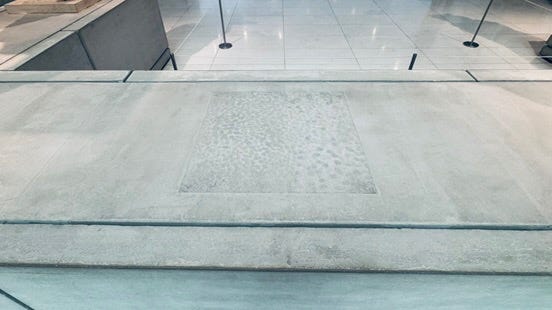
Meanwhile, the five Caryatid maidens in the Acropolis Museum wait for their missing sister, a simple square holding space for her return home.
Comments
Nothing yet. Say the first thing.
Sign in to join the conversation.