

My fellow pro-growth/progress/abundance Up Wingers in America and around the world:
Let’s start with a short lesson in business history for America's AI companies and hyperscalers. The public’s trust and approval—its “social license” to operate—is rarely lost quickly, nor does it vanish after a single event. The nuclear industry offers an illuminating case study. The Atomic Age was in trouble and in retreat well before the early morning of March 28, 1979, when the Unit 2 reactor at the Three Mile Island plant near Harrisburg, Pennsylvania, suffered a partial meltdown.
Against a backdrop of long-term concern about radiation—the peaceful atom and the military one never seemed fully separable in the American mind—and the rise of “small is beautiful” postwar environmentalism deeply suspicious of the techno-capitalist industrial state, there came a decade of numerous events that undermined American support for nuclear energy and primed the public to freak out over TMI—even though there were no fatalities (and most studies have found no observable long-term effects, either).
Among them: whistleblower claims about radiation dangers, numerous anti-nuclear books, federal laws and court decisions with nuclear energy frequently in the crosshairs, mass protests at nuclear construction sites, and the 1974 fatal crash of Karen Silkwood, a plutonium-plant technician whose death influenced the making of The China Syndrome, released just twelve days before the TMI accident. In other words, public rejection of nuclear power was a multi-decade, multi-faceted process of erosion, which reached its sudden endpoint at TMI.
The story of how the nuclear energy industry lost its social license shows just how incompetent Silicon Valley and the AI sector have been, burning through public trust in record time. Or maybe just giving it away. These are stunning poll numbers from Heatmap News:
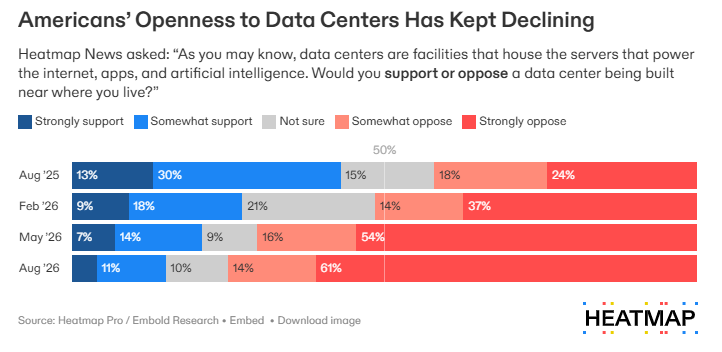
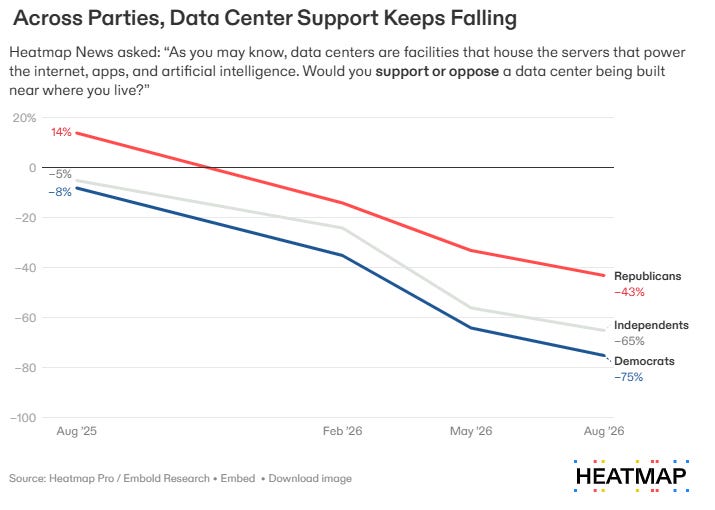
The nuclear-energy equivalent here would be if, after the country’s first commercial reactor went online in December 1957 in Shippingport, Pennsylvania (about 200 miles west-northwest of TMI, by the way), the public had totally soured on the Atomic Age by 1960 or so.
Along with the Heatmap numbers, a new Pew Research survey finds 52 percent of Americans say they are “more concerned than excited” about the increased use of AI in daily life (versus 38 percent in 2022 pre-ChatGPT), with just 9 percent more excited than concerned. Little surprise, then, the data centers have become the political issue of the day, both in terms of policy and the midterm elections. The Financial Times points out in a new editorial that “public pressure has also encouraged politicians to push AI-related bills in all 50 US states, with 146 acts being passed in 2025.”
Look, I'm sure nuclear-industry executives in the 1970s claimed—with much justification—that they were the unfair victims of bad-faith arguments and ideologically driven hostility from activists whose campaigns were often uncritically amplified by the media and Hollywood, all of it reinforcing the public's subliminal association of the technology with nuclear weapons. Likewise, today's AI executives would be correct to view the (largely) evidence-free attacks on data centers in much the same way, at least on the merits of the argument. (See “The axis of US decline: anti-data center, anti-AI, anti-nuclear.”)
But don’t sympathize too much with techies. They can mostly blame themselves. If I were to produce a list of reasons explaining public hostility to data centers and AI, I would cite a number of factors: (a) an extension of anxieties over social media and the role of the internet in our daily lives; (b) an easy parallel with the China trade “shock” and its supposedly devastating toll on US jobs; (c) the populist moment in American politics with its distrust of elites, exacerbated by the pandemic; and (d) a half century of television and film telling us that AI and robots would eventually turn on their human creators.
All that said, there’s a strong argument that the AI executives themselves would top any ranked list. When the heads of the frontier labs have spent years describing, with great conviction, a near future of massive societal disruption—even civilizational demise—it’s bound to raise neon-red flags for the American public.
So many examples. Just over the past year or so, OpenAI CEO Sam Altman said that “there will be very hard parts like whole classes of jobs going away.” Anthropic CEO Dario Amodei warned of what Axios editors called a “white-collar bloodbath.” And Mustafa Suleyman, a DeepMind co-founder who now runs Microsoft AI, predicted that “most white-collar work done sitting down at a computer, either being a lawyer or an accountant or a project manager or a marketing person—most of those tasks will be fully automated by an AI within the next 12 to 18 months.”
Now, tasks aren’t jobs, and the history of powerful general-purpose technologies suggests AI will create plenty of new employment opportunities. It should also be noted that many executives have placed their labor-market warnings in the context of AI benefits, such as this from Amodei: “Cancer is cured, the economy grows at 10 percent a year, the budget is balanced—and 20 percent of people don’t have jobs.” But the general public could be forgiven for focusing on that last item.
Oh, and once the robots take all those jobs, they just might kill us. Elon Musk has mused to Joe Rogan that there’s “only a 20 percent chance of annihilation,” while Amodei puts the odds that “things go really, really badly” at around 25 percent. What do they expect the public response to be?
(Maybe some tech CEOs don’t find those odds scary because currently there is a 100 percent changc we all die eventually, and AI, they hope, will lower those odds to something like zero percent.)
Institutional investors might dismiss these claims as CEOs “talking their own book” to pump up interest in companies building something this powerful. Many economists—folks who know there’s a big gap between what a technology can theoretically do and when/how it can be used productively by businesses—will simply roll their eyes at many tech CEOs’ forecasts about job and productivity impacts.
And maybe for a while, normies waved off all the alarmism as science fiction. But certainly not anymore. Not with the continuing drumbeat of concern from Silicon Valley, including more than 1,300 employees at the world’s leading AI companies signing a letter arguing that the US should be prepared to slow frontier AI development if progress accelerates beyond our ability to understand or control the resulting systems. Seemingly bolstering that case are several recent incidents in which AI agents have broken out of their testing environments and gotten into all sorts of mischief.
The Age of AI may seem like it’s about to end even before it’s really begun. But that view goes way too far. Think again about nuclear. The loss of public support and confidence wasn’t the only factor that brought the Atomic Age to a close, at least in terms of a greater share of US energy production coming from nuclear.
Macroeconomics also played a big role. It was a volatile time full of uncertainty. Utilities had ordered reactors expecting electricity demand to keep doubling every decade, but after the 1973 oil shock, that growth stalled. The era’s Great Inflation made persistent construction delays financially ruinous. Then oil prices came down in the 1980s and stayed down, making it harder still to justify building more nuclear capacity.
Also: The last decades of the twentieth century saw widespread energy deregulation, which, as nuclear energy analyst Jessica Lovering told me in a January podcast, “made it very challenging for utilities to build large capital-intensive projects. [Utilities] got a lot more power out of their existing infrastructure, out of their existing power plants. That was good, a lot more efficiencies, which is what deregulation was meant to do, increase competition, but it made it hard to build big things—any big thing, not just nuclear, but coal plants, hydroelectric.”
One could imagine a different set of economic conditions and policy choices that would have supported nuclear. And also imagine if climate change concerns had become a huge public issue a decade or so earlier. It might have softened environmentalist opposition to nuclear power and increased overall public support.
The economics of AI look very different from nuclear a half century ago. Massive amounts of capital keep pouring into the sector on the bet that AI will lift business productivity enough for enterprise spending to justify the data center buildout. And while the pushback against data center construction may raise costs and lengthen timelines, it’s hard to imagine that buildout not continuing if the potential economic return continues to seem plausible to business and investors—even if the data centers eventually need to be constructed in orbit or rail-gunned from lunar factories.
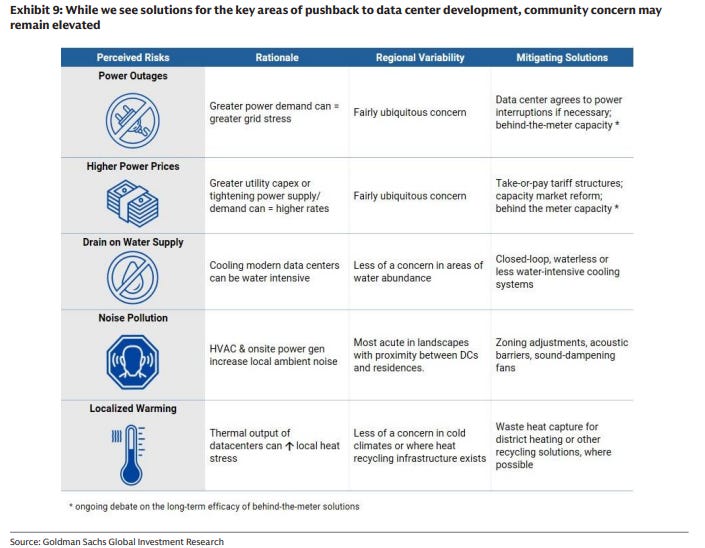
That said, it’s my expectation that the current data center panic (is this Woke 2.0?) will ebb to some degree as the Great White-Collar Job Bloodbath continues not to happen and companies become more responsive to local concerns. One example is Meta’s recently announced $1 billion “Future Is For Everyone Fund” to directly support the communities around data centers. And Goldman Sachs recently generated the following graphic showing all sorts of remedies for perceived data-center downsides:
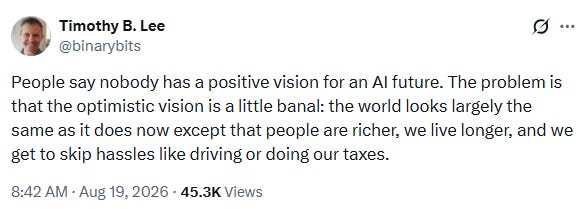
The industry might also think about offering a vision of the future that isn’t so scary and disruptive, even with continued rapid AI progress. (See “An unchanged world in a time of transformative AI.”) Is doing more of this sort of thing really so hard?
On sale everywhere: The Conservative Futurist: How To Create the Sci-Fi World We Were Promised
Comments
Nothing yet. Say the first thing.
Sign in to join the conversation.