
In an era where every euro counts, it's tempting for fashion businesses to cut their sustainability budgets. But here's the hard truth: scaling down on sustainability now may cost you far more in the long run: in compliance penalties, operational disruptions, lost brand value, and missed opportunities for innovation.

In 2025, the fashion industry is increasing sustainability investments, driven by regulatory pressure, consumer demand, and the push for circular business models. Major players like Inditex have launched venture capital funds to support sustainable fashion startups, particularly those innovating in textile recycling and alternative materials. Even, fast fashion giant Shein has committed €250 million to sustainability initiatives across the EU and UK, including a circularity fund focused on textile recycling and fiber innovation. Meanwhile, brands like Hugo Boss are investing in sustainability-focused VC funds and developing strategies to repurpose textile surplus, while luxury houses such as Chanel are setting ambitious targets to reduce their carbon footprint and enhance supply chain transparency.
These moves signal a growing industry-wide shift to embed sustainability at the core of business strategy.
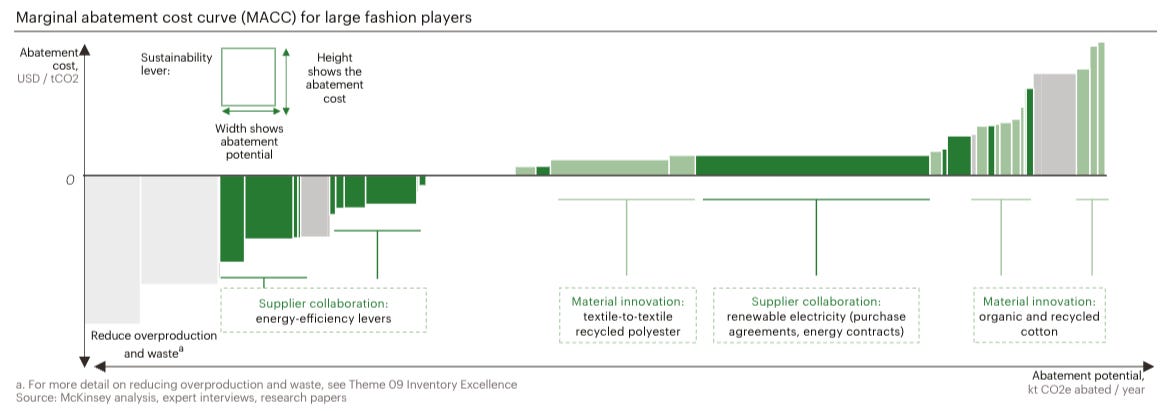
Contrary to popular belief, adopting sustainability measures can actually improve cost efficiency. In fact, up to 50% of emissions reductions at the tier-two supplier level can be achieved without adding extra costs.
Fashion companies have the opportunity to save both money and emissions at the same time. For instance, working with suppliers to implement low-cost energy efficiency improvements can help offset the expense of more costly efforts like developing sustainable materials. Moreover, better inventory management can help cut down on waste and overproduction, leading to further savings.
If you’re navigating budget constraints, you’re not alone. But instead of sidelining sustainability, proactive fashion professionals are reframing it as a business-critical investment. Here’s how you can do the same, and why it’s more urgent than ever:
To drive internal alignment and secure executive support, sustainability leaders must go beyond ethical arguments. They need to translate environmental initiatives into financial terms that resonate with CFOs and decision-makers. This means clearly linking sustainability efforts to:
Cost savings: through lower energy bills, reduced material usage, streamlined logistics, and minimized waste.
Risk mitigation: by proactively addressing emerging regulations, avoiding supply chain disruptions, and reducing exposure to reputational damage.
Competitive advantage: by responding to the growing demand from consumers and investors for transparent, ethical, and future-focused brands.
By using financial metrics, such as ROI, payback period, and risk-adjusted value, sustainability can be framed not as a cost center, but as a strategic lever for operational efficiency, resilience, and long-term profitability.
You don’t need to overhaul your entire business model overnight. Many sustainability gains can come from agile, targeted projects that deliver tangible results quickly. Focus on initiatives that:
Generate immediate efficiency or cost gains: such as digitizing supply chain traceability, switching to renewable energy sources, or conducting rapid environmental impact assessments.
Build foundational infrastructure for longer-term transformation: such as supplier training programs or material innovation pilots.
Showcase early wins: helping build internal confidence and momentum for broader adoption.
Think of these as your "minimum viable impact" projects, designed to be efficient, cost-effective, and scalable. They not only demonstrate the value of sustainability to stakeholders but also lay the groundwork for deeper, systemic change.
Inaction has a price, and in today’s climate, it’s rising fast. Delaying sustainability investments can expose your business to a host of risks, including:
Fines and penalties as regulatory pressure mounts worldwide.
Disruptions and losses from climate-related supply chain vulnerabilities or ethical violations.
Brand erosion as values-driven consumers, especially Gen Z and Millennials, walk away from companies seen as falling behind or greenwashing.
Declining investor trust, as environmental, social, and governance performance becomes a mainstream metric in capital allocation.
The longer sustainability is put on hold, the higher the eventual cost. What may appear as a short-term saving can quickly turn into a long-term liability.
In an era of transparency and digital scrutiny, brand perception is shaped in real time. Sustainability is a core marker of brand integrity and leadership. Companies perceived as passive or regressive in their environmental commitments risk:
Losing relevance among conscious consumers and collaborators.
Negative press coverage and viral backlash.
Loss of trust that takes years, and major investments, to rebuild.
Decisive and authentic sustainability action signals foresight, responsibility, and leadership. It shows stakeholders that your company is serious about the future.
Data-driven storytelling can often be more persuasive than abstract ideals. Use scenario modeling to compare potential outcomes between two futures: one where sustainability is prioritized, and one where it’s paused or deprioritized. Evaluate the impact across:
Operational costs.
Supply chain stability.
Market competitiveness.
Regulatory and reputational risk.
Stakeholder trust and investor sentiment.
These comparisons make the business case specific and difficult to ignore. When decision-makers see the long-term consequences in financial terms, sustainability shifts from a “should” to a “must”.
Now is not the time to pull back. It's the time to double down strategically. At BCome we’re working with fashion companies to not only defend their sustainability strategies but to evolve them into growth drivers, despite economic pressure. There are smart, cost-effective ways to stay aligned. Want to explore how? Let’s talk!
See you in future Substacks!
Gema from BCome
Comments
Nothing yet. Say the first thing.
Sign in to join the conversation.