
I’ve been slowly making my way through Robin Wall Kimmerer’s Braiding Sweetgrass last couple of months. It’s the kind of book you’re only allowed to read ten pages of before you have to put it down and stare at a wall for a while. There’s a whole chapter on what she calls the grammar of animacy: how English forces us to call a living forest an “it,” the same word we’d use for a chair, while Potawatomi and other Indigenous languages have grammar built for a world where everything is alive - where a bay, a mountain, a stand of trees, gets to be a “who,” not a “what.” Kimmerer’s argument, more or less, is that the language we use shapes whether we think to ask a forest anything at all, or whether we just talk at it and assume we already know the answer.
That idea has been sitting with us for a reason: this year, for the first time, we actually asked our agroforests something instead of just assuming we knew the answer - and it talked back.

Team updates and fire season are still in here too, further down. But we wanted to lead with the results of a pilot biodiversity study we just got back, including a bird we don’t have enough data on, and a clear-cut answer to a question we’d been too scared to ask: is our agroforestry model actually better for biodiversity than the conventional farming it replaces, or have we just been assuming that because it sounds right?
About six months ago, we started working with researchers Pooja Choksi, of Ficus Research Consulting, and Sarika Khanwilkar to help us answer a question we’d been thinking about for a while - is our agroforestry actually doing anything for biodiversity, or are we just planting trees and hoping very hard?
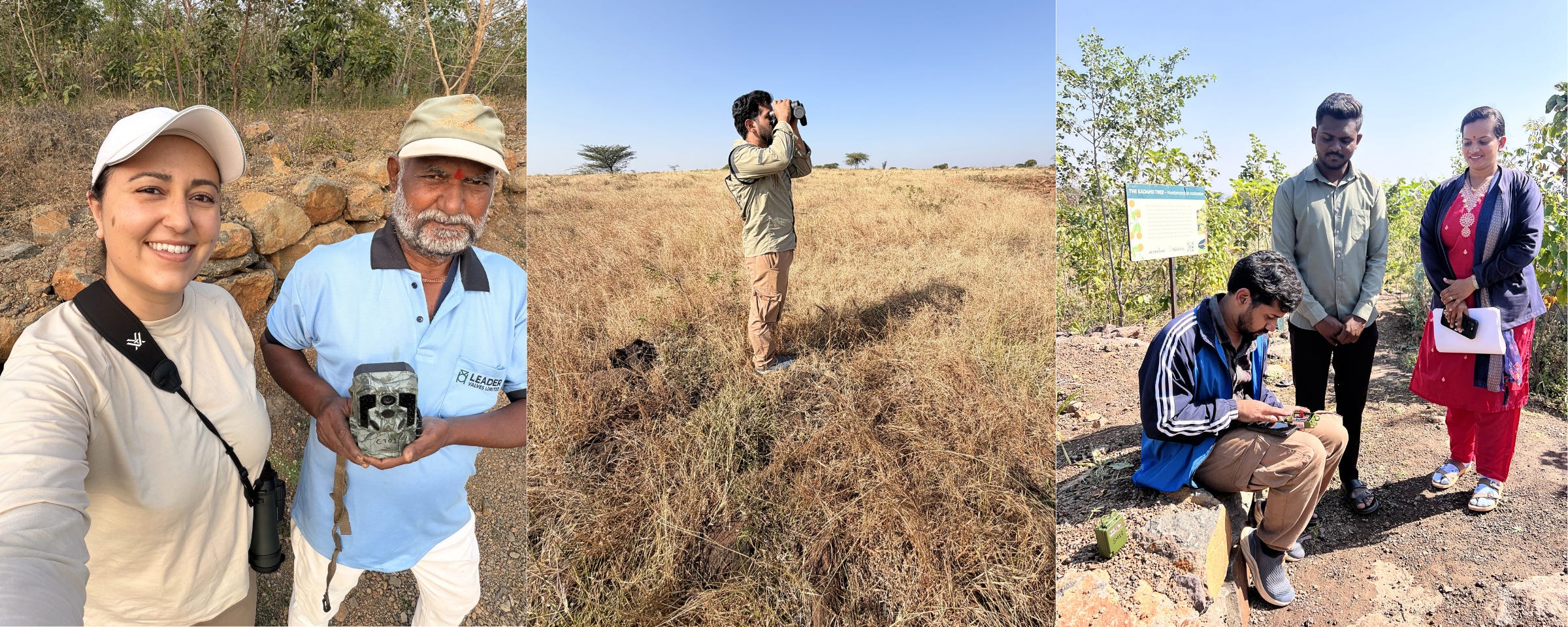
The ecologists spent January crawling around our plots with sound recorders and camera traps so that we could stop assuming and start measuring.
We now have an answer. It’s better than we hoped, wrapped in exactly as many caveats as good science requires.
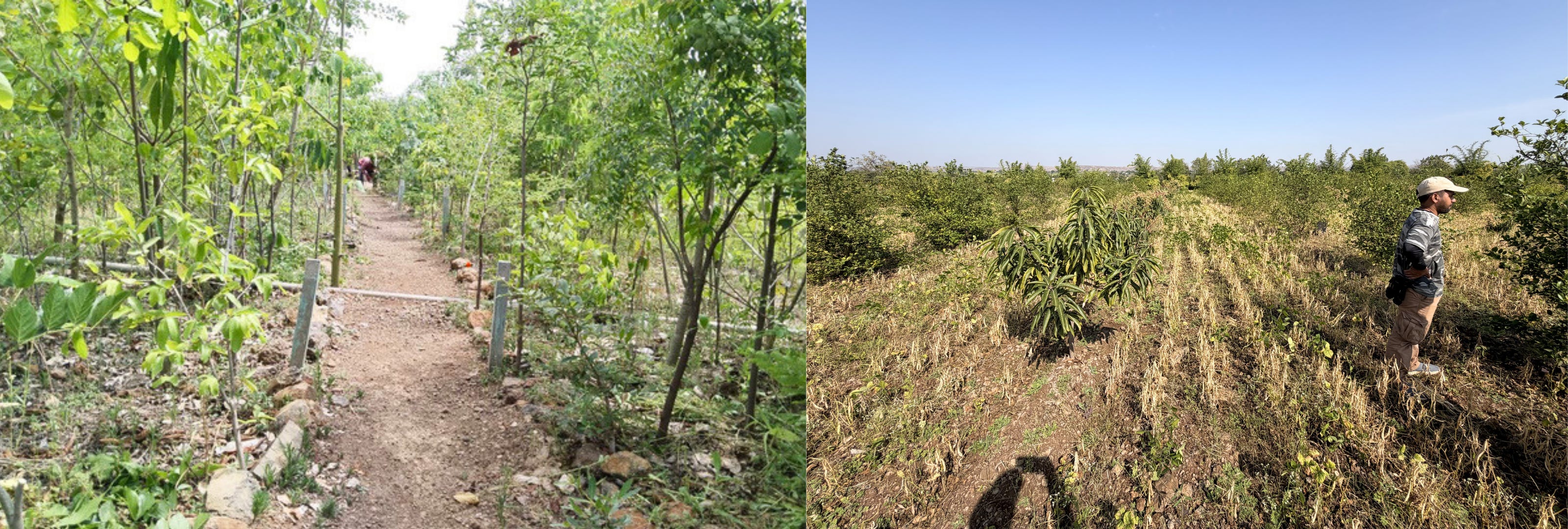
Eight agroforestry sites (treatment), four monoculture cropland sites (control), and four naturally occurring open natural ecosystem sites (benchmark), all wired with acoustic recorders and camera traps across two districts in Maharashtra.
Two of our urban/peri-urban biodiversity hubs came along for the ride as supplementary sites too. Where our regular agroforestry plots are planted with an eye toward what farmers can actually harvest and sell - fruit trees, timber, livelihood species - biodiversity hubs are planted densely and deliberately for habitat alone, no economic use case required.
On the final results call, the team played us two audio clips - one from a treatment site, one from a control site - and asked us to guess which was which. We confidently, collectively, guessed wrong.
First spectrogram below is from the control site. Second one is from the treatment.
Turns out telling a thriving agroforestry plot from a quiet monoculture field by ear is genuinely hard for an untrained human, most likely because these agroforests are young and of small sizes. Which is, conveniently, the entire reason you hire ecoacousticians instead of just guessing.
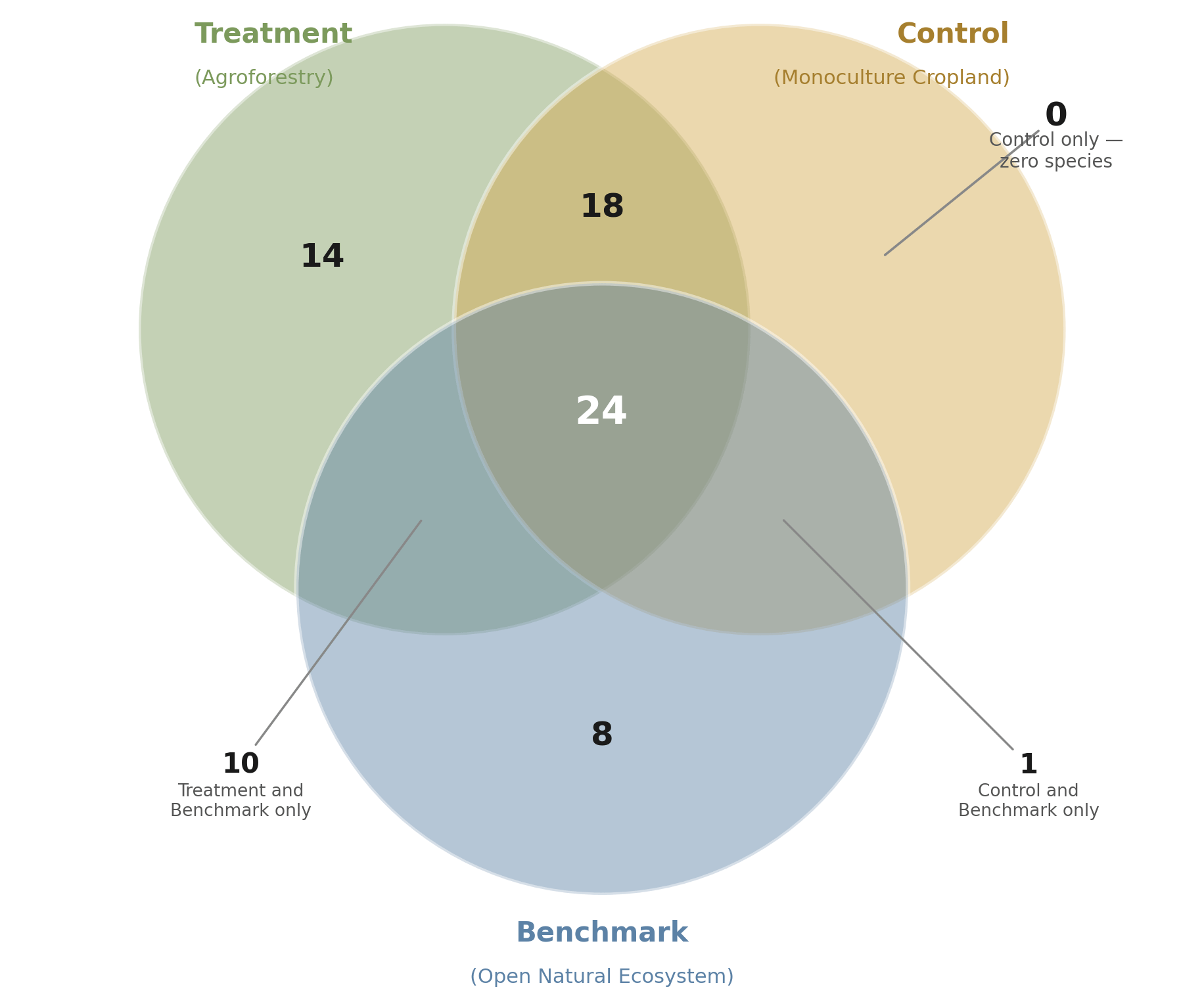
Monoculture cropland contributed zero unique bird species. Every single species detected in our control sites was also found in either the treatment or benchmark sites - meaning the cropland wasn’t adding anything to the local bird community that wasn’t already there, somewhere else, better. Our agroforestry and natural sites, meanwhile, each had their own species that showed up nowhere else.
Acoustics out-birded the humans. We detected 75 avian species acoustically versus 65 through old-fashioned point counts - a person, standing still, listening, the way birding has worked for a couple hundred years. Acoustic monitoring was especially good at catching migratory species: 27 detected acoustically versus 21 by point count, and this was the result when we used only a portion of the data for species detection. And control sites didn’t harbour any migratory species that the treatment and benchmark sites did not already host. Even though acoustics detected more species, point counts and observations are invaluable to our understanding of the relationship between sites and birds, moving beyond simply the presence or absence of a species. Worth flagging too: a lot of the migratory species we found are water birds, so it’s likely a mosaic of different land uses and land covers across the landscape, not agroforestry alone, that’s driving this result.
We found a bird that we don’t have enough data on. The Rock Bush-Quail - a species that the State of India’s Birds defines as “data deficient” because we currently lack sufficient data to track long-term and annual trends in its population - was detected in our treatment sites, and only acoustically. No one at Farmers for Forests has ever seen it on these plots (though villagers here probably have - it’s distributed across parts of Maharashtra). Sharing the soundscape below.
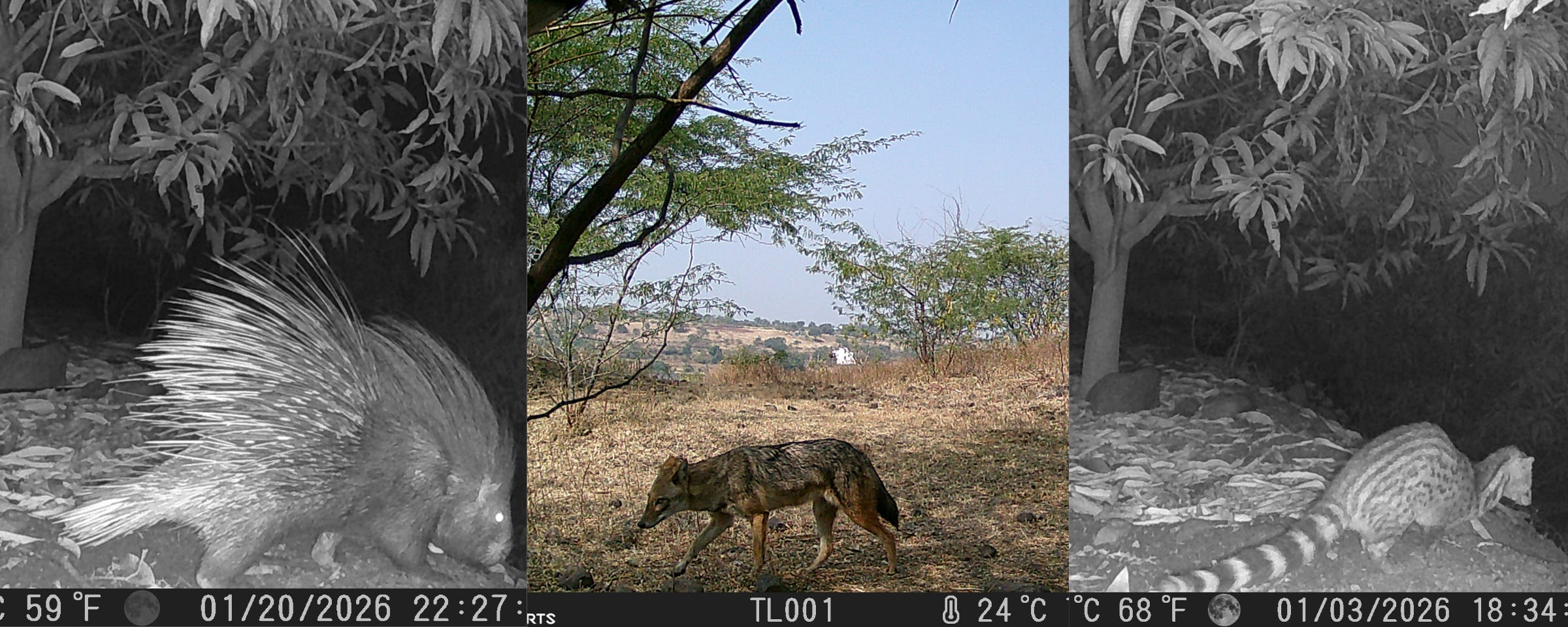
Camera traps turned up their own surprises, too. Across the sites where they were deployed, every single one picked up at least one Schedule I mammal - the highest legal protection category India gives a species. One of the more delightful finds was the Indian crested porcupine, showing up at one of our agroforestry sites.
This is a small pilot. Sites weren’t formally statistically matched, and treatment sites got double the sampling effort of control and benchmark. So we’re not declaring “agroforestry saves biodiversity, science says so” and calling it a day.
What we can say is this: these are encouraging signs that show the promise of agroforestry, which - coupled with the open natural ecosystems that have historically dominated this landscape - could provide real conservation value here. Worth building on with more seasons, tighter site-matching, and, per the research team’s recommendation, a locally-trained AI classifier so we’re not simply relying on global classifiers that can often miss or misclassify birds found in this landscape.
More seasons of this are already being planned. We’ll keep you posted, presumably with even better footage next time.
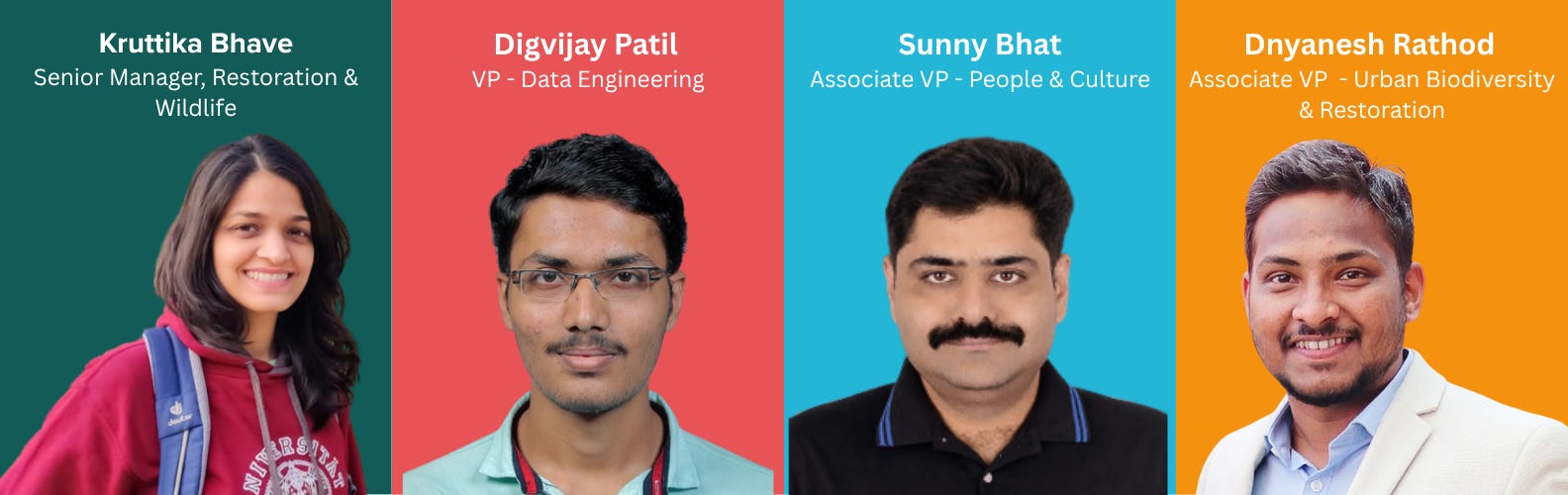
If you read Hornbill Dispatch #11, you’ll remember we said the next chapter was about scaling without losing the plot. Turns out scaling mostly means “hiring people so that no single person has to simultaneously run carbon accounting, forest fire response, and a biodiversity pilot.” Groundbreaking management insight, we know.
Introducing them properly would take another 1,000 words. So please just enjoy this yearbook of people you'll be hearing about for years to come (next Dispatch, we will introduce you to many more new team members).

While the recorders were quietly picking up birdsong, our field teams were busy with something considerably less relaxing: fire season.
This was also the first year we got to run forest protection and forest fire prevention at real scale, thanks to a grant from Salesforce that we’re genuinely thrilled about. What made it more interesting than a typical grant is that Salesforce wanted this treated less like straightforward implementation and more like a live research question - testing whether structured fire prevention actually moves the needle, evaluated against a control, the same instinct that got our research pilot with Project Dhvani off the ground in the first place. So alongside the actual on-the-ground patrolling, we’re tracking reductions in burnt area against historical baselines, which is what let us put real numbers on this season instead of just a lot of tired anecdotes from our field team.
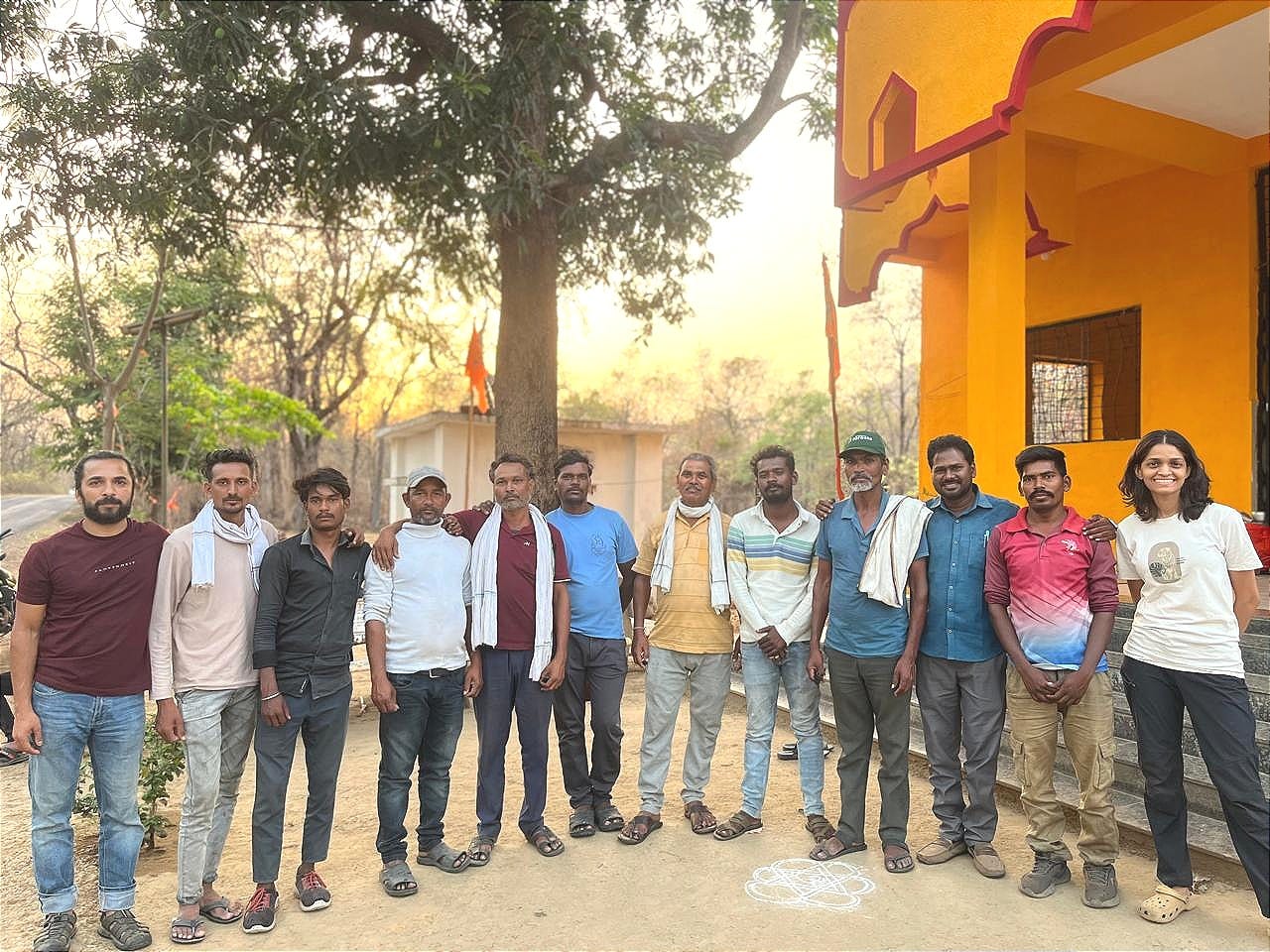
Some context first: Gadchiroli’s forests go through a fire season every year, roughly February through May, before the monsoon arrives and puts a natural stop to it. Nationally, well over 90% of India’s forest fires are set by people, and Gadchiroli consistently ranks among the worst-hit districts in the country. Most of these fires start small and deliberate - forest floor set alight to make it easier to collect mahua flowers off the ground and the new flush of tendu leaves, or to clear visibility and encourage fresh grass growth. Left alone, and without anyone around to catch them early, these same small ground fires are exactly the kind that spread into the larger, uncontrolled fires that take out saplings, undergrowth, and years of regeneration in a single dry season.
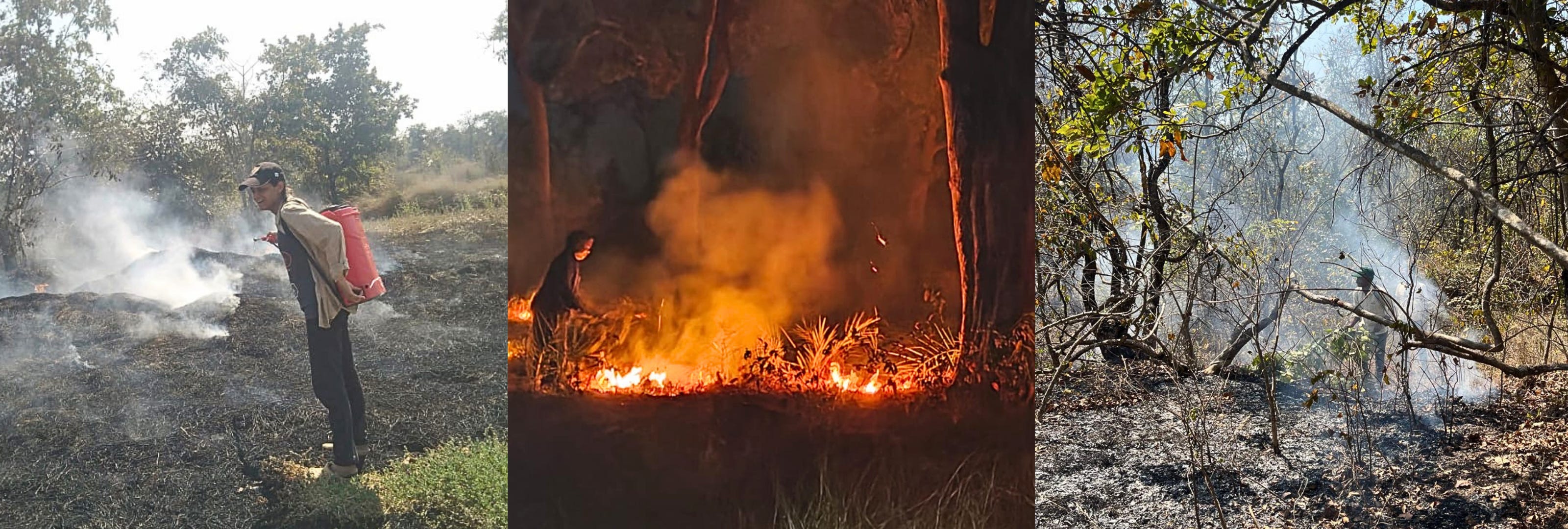
Across our forest fire prevention sites in Gadchiroli, our patrol and field teams logged and responded to 300 individual fire incidents (as of June 17th) this season. Median time from detection to the fire being controlled: about 53 minutes. Most of these were small ground fires in mixed forest - the kind that, left alone, don’t stay small for long.
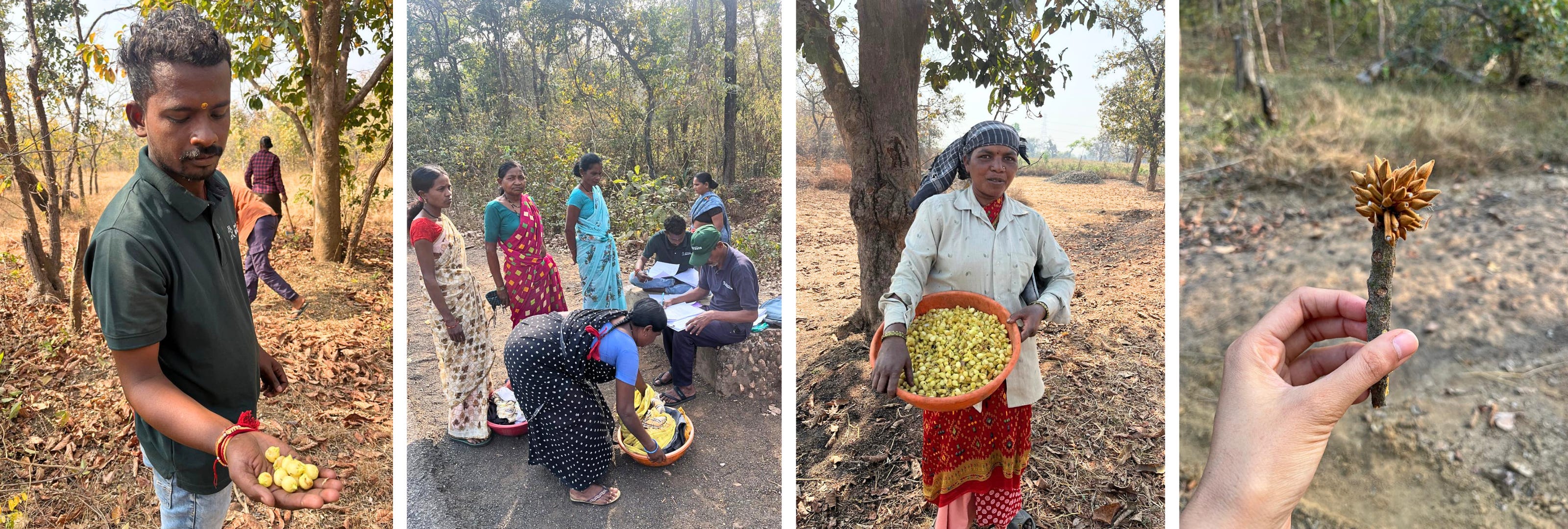
The overwhelming majority were intentional fires - most tied to how mahua flowers and tendu leaves get harvested here, where a quick burn makes picking easier and faster in a short seasonal window. This isn’t carelessness. For many families in these forests, tendu and mahua collection is one of the only sources of cash income all year, and burning is simply the fastest way to make a physically hard, poorly-paid harvest a little less hard.
So alongside patrolling, we tried something more direct this year: paying people to collect without burning. Through door-to-door surveys across 300 households, we found nearly everyone was willing to gather mahua the fire-free way if it didn't cost them time or money to do it. So we hired local daily wagers to manually clear the leaf litter under mahua trees by hand, and to trim tendu plants the old-fashioned way instead of torching them for a flush of new leaves. Across the season, that added up to roughly 1,800 person-days of paid work at ₹312 a day - real income, not just a fire-prevention line item. And it turns out manual clearing isn't just fire-free, it's better: no ash residue, better flower quality, and it let our teams pull out invasive species while they were at it. Our approach isn't about stopping the harvest; it's about making it fire-free.
We don't have a tidy fix for the deeper tension between that immediate income need and a forest's longer-term health, and we're not going to pretend patrolling and buy-back programs alone resolve it. But we can tell you what the sustained patrolling, awareness work, fire-free harvesting, and community agreements added up to this season:
Shankarpur: a 22% reduction in area burnt compared to the 2020–2025 average, which works out to roughly 182 hectares saved from burning (this number is still being finalized as data collection wraps up)
Gewardha: a 43% reduction, roughly 424 hectares saved from burning
Put together, that’s over 600 hectares still standing because someone was patrolling at the right time, with the right water, tree branches, or blower in hand. Some of this work is winding down for the season; some of it - awareness sessions, gram sabha agreements, monitoring protocols - continues year-round, because fire season doesn’t actually end so much as go quiet for a few months.
This is the view our drones caught during fire season:
We’d be lying if we said we weren’t watching El Niño forecasts with a low hum of dread. A stronger El Niño season generally means a drier, hotter window for us - which is bad news twice over. It stresses the young trees we’ve spent years getting into the ground, and it makes the fire seasons we just described considerably worse.
We don’t have a tidy resolution to offer here. We’re adjusting irrigation schedules, thinking harder about drought-tolerant species mixes, and bracing our fire teams for what could be a longer, meaner season next time around. We’re also quietly bracing our budget: we already cover the cost of replanting whatever doesn’t survive its first year, and we’re expecting mortality to run higher than usual this cycle, which means replantation costs that don’t look like a normal year’s either. If you’ve read this far and are the praying type, or the “please let it rain on schedule” type, we’ll take it.
Here’s the practical version of that same worry: most of our funding comes tied to specific projects - a grant for this many hectares, a partnership for that particular intervention - which is great, until reality doesn’t stick to the plan. Unexpected mortality from a rough El Niño year is exactly the kind of thing project budgets aren’t built to absorb. It’s the unrestricted, no-strings donations that actually let us respond to a year like this one instead of watching saplings die because the money for them was earmarked for something else. This is one of those years where that kind of giving will matter more than usual.
Kimmerer writes about a pond near her house, and how she came to understand that everybody lives downstream of everybody else - that what she does at her end of the water eventually reaches a lake she’ll never see. We think about our work the same way lately. None of this - the birds, the fires, the saplings - happens in isolation. It’s all one system, and right now that system could use some help.
If this letter was worth your time, here’s one way to do something with that. If you’re in the US, donations are tax-exempt through our 501(c)(3); if you’re in India, there’s a tax-exempt route too. Details for both are on our support us page.
-Arti Dhar, Co-Founder
No posts
Comments
Nothing yet. Say the first thing.
Sign in to join the conversation.