
Disclaimer: The views expressed in this article are those of the author and do not reflect the official policy or position of the Department of Defense or the U.S. Government.
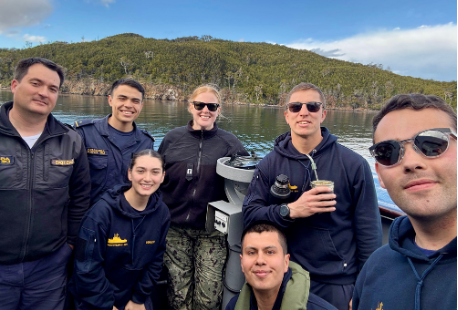
Foreign Area Officers serve across a range of military-diplomatic, security cooperation, and staff assignments, where they apply regional expertise to advise senior leaders, support planning and operations, engage foreign partners, and advance U.S. defense objectives. Yet those categories often obscure the breadth of experiences and responsibilities they encompass. Recently, in my capacity as a staff officer, I embarked on a Chilean Navy vessel, the PSG Sibbald, operating in the Third Naval Zone—a region where geography and strategy converge. Chile’s southern waterways connect the Pacific and Atlantic Oceans through a complex network of straits, channels, and islands, making maritime access and presence essential to the country’s security and sovereignty. The region’s remoteness and challenging operating environment also require the Chilean Navy to maintain capabilities that support both national defense and a sustained government presence in some of the country’s most isolated territory.
Chile’s Third Naval Zone, or Tercera Zona Naval, is headquartered in Punta Arenas. In this region, the Chilean Navy—the Armada de Chile—is responsible for the Magallanes and Chilean Antarctic Region, a vast area that includes the Strait of Magellan, the Beagle Channel, Cape Horn, and Chilean Antarctic Territory. It is one of the most austere maritime operating environments in the Western Hemisphere.
I joined the ship in Punta Arenas, Chile, often referred to as the Gateway to Patagonia and the Gateway to Antarctica. Situated along the Strait of Magellan, Punta Arenas occupies one of the most consequential maritime corridors in the Western Hemisphere. Before the opening of the Panama Canal in 1914, the Strait served as the principal maritime passage connecting the Atlantic and Pacific Oceans. More than a historical footnote, it remains a strategic redundancy in global trade and serves as an alternative route should vessel size, congestion, environmental disruption, or geopolitical constraint prevent or delay transiting Panama.
Unlike the open waters of Cape Horn, the Strait’s defined and navigable channels lie entirely under Chilean sovereignty, allowing for monitoring, regulation, and naval control. Its location also makes it a critical staging ground for Antarctic access, scientific operations, and broader Southern Ocean presence. Operating alongside the Chilean Navy in this environment offered a firsthand view of how geography continues to shape maritime power, regional partnerships, and strategic influence in the Southern Cone.
The mission set of the Chilean Navy in this region ranges from maritime safety and traffic control to sovereignty enforcement and patrol, search and rescue, hydrographic and navigational safety operations, Antarctic logistics support, environmental protection, and fisheries enforcement. While at sea aboard PSG Sibbald, a Chilean naval officer explained that the ship’s mission also includes servicing remote lighthouses and supporting the families who live there. The Chilean Navy may pay sailors four to five times their base pay to accept one-year orders with their families at these extremely isolated southern outposts. The Navy also conducts the logistical runs that resupply these families and rotate them out of isolation. For a U.S. FAO or policymaker, these missions illustrate how Chile uses its Navy beyond traditional defense roles to maintain government presence, support remote communities, and sustain access across its strategically important southern maritime territory.
Perhaps the most defining factor in this part of the world is the weather. Conditions are often harsh, even in the summer. On any given day, winds can exceed 50 knots, weather shifts rapidly, and narrow channels create complex currents influenced by tidal flows and glacial runoff. The farther south one travels, the more likely ice hazards become. Compounding these environmental challenges is the steady flow of cruise ships, ferries, liquified natural gas (LNG) tankers, and bulk carriers transiting the region.
Navigating in this environment requires highly skilled mariners and precise ship handling. I was most impressed by the prudent seamanship and professionalism demonstrated by the Chilean junior officers and the overall bridge team. As someone who previously taught ship handling at the Littoral Combat Ship (LCS) Training Facility, I appreciated the proficiency of Chilean officers operating in such dynamic conditions. They remained calm and confident, executing landings flawlessly even after long days at sea.
In the U.S. Navy, we often rely on simulators to practice launching and landing without tug assistance. In southern Chile, however, ships frequently operate in remote areas where tugs simply are not available. Watching the Chilean crew maneuver with that level of precision and self-reliance was truly impressive.
The Chilean Navy’s contributions to maritime safety, search and rescue, and stability in this region directly align with U.S. interests. The Southern Cone represents a defined maritime chokepoint that can be monitored and regulated, and it is strategically connected to global trade flows. Increasing congestion and geopolitical uncertainty heighten both the need for and the value of alternative sea lanes. This area is one of the few Atlantic–Pacific connectors and lies under the sovereignty of a democratic partner. A capable Chilean maritime presence reduces risk in a region critical to global shipping and Antarctic access.
Exchanges like this sharpen a junior Foreign Area Officer’s regional expertise while building the credibility necessary for strong bilateral military and security relationships. A ship ride serves as a valuable soft-power tool by fostering trust through shared operational experience. Shiprider programs allow partner-nation law enforcement or military personnel to embark on U.S. Navy or Coast Guard vessels and support cooperative maritime security operations. For FAOs, firsthand exposure to a partner’s operating environment and logistical constraints strengthens our ability to inform policy and coordinate planning. This experience deepened my respect for the Chilean Navy’s professionalism and reinforced the strength of our democratic maritime partnership in the Western Hemisphere.

Lieutenant Lydia Griffin is a U.S. Navy Foreign Area Officer specializing in Latin America. A former Surface Warfare Officer, she has served in a variety of operational, training, and international assignments throughout her naval career. Her professional interests include security cooperation, international partnerships, and U.S.–Latin American relations. She holds a B.S. in Mathematics from Georgia State University, has completed Joint Professional Military Education Phase I, and is pursuing graduate studies in international affairs.
No posts
Comments
Nothing yet. Say the first thing.
Sign in to join the conversation.