
Each year in fantasy football, the difference between a competitive season and an overall winning roster is finding the core breakout players at some positions, along with having their best players shine from Weeks 15 to 17.
Last year, I had Puka Nacua rated first at wide receiver all summer, and he rewarded my projections with an elite season (129/1,715/10 with 10 carries for 105 yards and one score). He also posted three winning weeks in the fantasy postseason (9/189, 12/225/2, and 5/47/1). His ADP was at the back end of 12-team leagues in the high-stakes market, but his results in PPR fantasy points (377.00) still gave him a breakout ceiling.
Breakout players can come at different levels, and I think of 60-point gaps as leveling up in fantasy football. A player stepping up by two levels in his position output should fall into the breakout category. Here’s a look at the top players in fantasy scoring (PPR and 4-point passing touchdowns) in 2025:
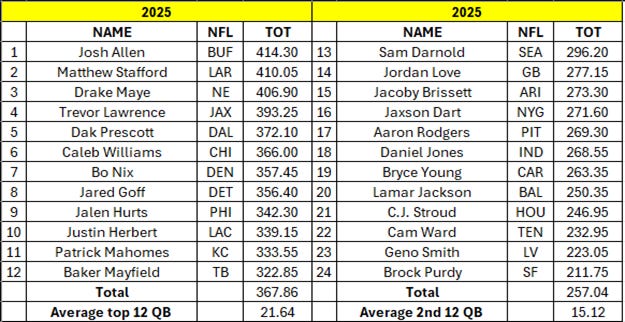
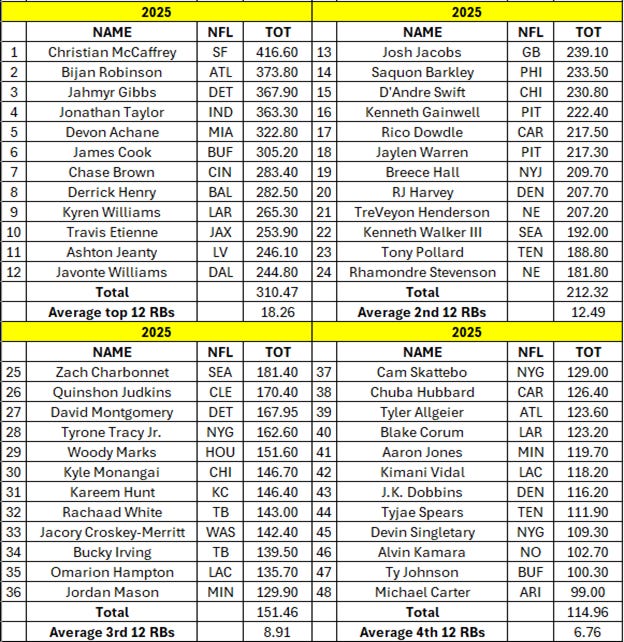
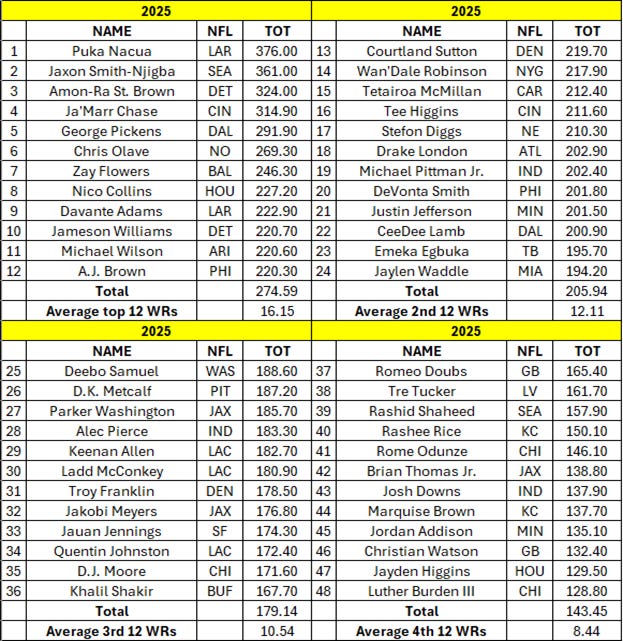
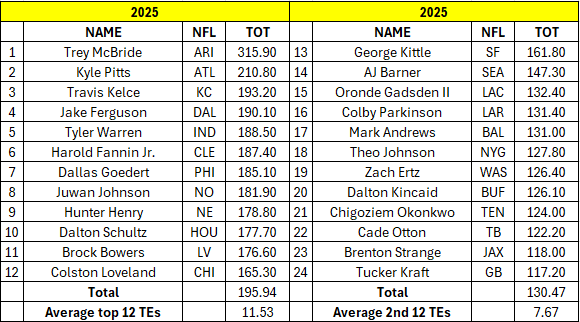
By reviewing these breakpoints and scoring for each position, it’s easy to see the gaps between a top player at each position and the 12th-ranked option.
Here’s the breakdown, comparing 2024 vs 2025 total fantasy points for players who appear in both years’ rankings at each position:
1. Drake Maye: 215.9 → 406.9 (+191.0)
2. Matthew Stafford: 263.3 → 410.05 (+146.75)
3. Caleb Williams: 300.95 → 366.0 (+65.05)
1. Lamar Jackson: 481.1 → 250.35 (-230.75)
2. Brock Purdy: 320.5 → 211.75 (-108.75)
3. Baker Mayfield: 428.8 → 322.85 (-105.95)
1. Travis Etienne: 131.4 → 253.9 (+122.5)
2. Jonathan Taylor: 245.7 → 363.3 (+117.6)
3. Jaylen Warren: 125.5 → 217.3 (+91.8)
1. Alvin Kamara: 265.3 → 102.7 (-162.6)
2. Aaron Jones: 244.6 → 119.7 (-124.9)
3. Saquon Barkley: 356.3 → 233.5 (-122.8)
1. Puka Nacua: 206.6 → 376.0 (+169.4)
2. George Pickens: 166.4 → 291.9 (+125.5)
3. Jaxon Smith-Njigba: 253.35 → 361.0 (+107.65)
1. Terry McLaurin: 268.8 → 114.2 (-154.6)
2. Brian Thomas Jr.: 284.0 → 138.8 (-145.2)
3. Jerry Jeudy: 240.9 → 121.7 (-119.2)
1. Kyle Pitts: 131.2 → 210.8 (+79.6)
2. Trey McBride: 249.8 → 315.9 (+66.1)
3. Dalton Schultz: 118.2 → 177.7 (+59.5)
1. Brock Bowers: 263.1 → 176.6 (-86.5)
2. George Kittle: 236.6 → 161.8 (-74.8)
3. Mark Andrews: 188.8 → 131.0 (-57.8)
A breakout quarterback for me this year is a big more challenging, as I already classed Bo Nix and Kyler Murray as great value buys with top-10 QB rankings in my projections.
Burrow comes off an injury season where he scored 157.55 fantasy points in four-point passing touchdown formats. I did an RTSports draft on Sunday night (8/23), and he came off the board as the third quarterback at pick 61. His ADP (73) in the National Fantasy Football Championship prices him as the second quarterback off the board over the past week, which doesn’t paint him as a breakout player in the minds of fantasy drafters due to his high ranking at his position.
The Bengals’ elite signal caller has the talent and weapons to pass for over 5,000 yards with a run at 45+ passing touchdowns. His first obstacle is staying on the field for 17 games, something he hasn’t done twice over the past three seasons. His 2024 stats (5,119 combined yards with 45 touchdowns) should shine brightly for the drafters who see his light.
If Cincinnati’s offense clicks this year and his key receiving corps stays healthy, Burrow would be on a path to post a top-five passing season in yards and touchdowns. The Bengals play @CAR, @IND, and BAL from Weeks 15 to 17.
In the end, his ceiling looks special, and his price point in drafts is more than fair in 2026. The bottom line is that he brings an expected edge at the quarterback position while offering a high floor and explosive ceiling.
I’m listing Maye only because I have him ranked as the number one quarterback in some scoring systems. He broke out last year, so he really shouldn’t fit into this category again, but his ADP (79 in the NFFC) is almost 40 draft slots behind Josh Allen. I have those two players as almost a dead heat in projection this year.
New England upgraded their receiving options over the winter, and they have tried to add more talent to their offensive line in recent drafts. Last night (8/23), I was able to secure Maye as pick 87 in my RTSports draft, which should give me an edge at quarterback while not giving up any foundation draft picks to running backs and wide receivers.
The Patriots play @KC, @NYJ, and DEN in this fantasy postseason, which doesn’t scream massive edge.
In July, some drafters in the high-stakes market were fighting for Hampton in the first round, which almost required him to score 300.00 PPR fantasy points to pay his fantasy bills. Over the past week, he has settled into an early second-round draft pick (ADP – 14) in the National Fantasy Football Championship due to many of their drafter preferring to add a wideout late in the first round.
The Chargers coaching staff has floated the idea that they would rotate in two other backs in August, which slowed down Hampton’s first-round throttle, especially when other drafters have followed suit. Los Angeles hasn’t featured the running back position in the passing game (2024 – 43/270/2 and 2025 – 63/386/3) since the arrival of Jim Harbaugh, but the Chargers’ new offensive coordinator (Mike McDaniel) leaned on De’Von Achane in the passing game over the past two seasons (78/592/6 and 67/488/4).
In the end, Hampton brings a three-down foundation with size to be an edge in scoring at the goal line. The Chargers want to play well defensively, and they will run the ball when having the lead in the second half. The key to his ceiling is a healthier offensive line. In addition, Los Angeles could be a much better offense as well in the passing game, creating more overall and scoring chances for their key offensive players.
When doing my team research for the 2026 fantasy football season, I had a neutral feel for Love due to other backs potentially getting in his way for touches. In his first preseason game, his movement brought back memories of Adrian Peterson for those playing this game long enough to see him in his prime. His motion and movement with the ball in his limited touches painted a winning go-sign on his back.
On the downside, Love came out of that game with an ankle issue, but plenty of time to recover for Week 1. Any red flag next to a player’s name tends to slow down their rise up draft boards. I have him ranked at RB12, while his recent ADP (49) in the NFFC prices Love as an RB16. For comparison, in my RTSports draft, he came off the board at pick 3.6 as the RB15. The only difference in scoring between the two formats is that one has two flex options with two WR slots, and the other has one flex and three WRs in its starting lineup.
Love must score about 240.00 PPR fantasy points to reach par for his current fantasy value. To jump to elite status at running back, his next break point is over 300.00 fantasy points, requiring 1,800 combined yards with 12 touchdowns and 60 catches. Arizona has talent at wide receiver and tight end, allowing them to move the ball multiple ways, and defenses shouldn’t be able to stack the box against the run.
It seems like a lot to ask for Love to climb more than one level in his rookie season, but he could be at his best late in the year, when fantasy championships are won. His ankle issue is most follow, but I sense he should be ready for Week 1.
In his second year in the NFL, Judkins probably has three potential knocks to his fantasy profile. First, can Cleveland get competitive NFL play from the quarterback position? Second, will the Browns climb out of the cellar-dweller range in scoring? Lastly, how involved will Judkins be in the passing game? The latter question would create more consistency in his fantasy profile, along with increasing his chance at more dynamic games.
His price point (RB24) screams steady piece to a fantasy puzzle, with underlying upside. I have Judkins priced as a mid-tier RB2, with his value in the passing game determining his potential ceiling.
Price is one of the more intriguing running backs in the 2026 fantasy class due to his potential to get a high-volume opportunity over the first half of the year. His ADP (65 in the NFFC) ranked him as the 25th running back drafted over the past week, which aligns with his price point in many formats in July.
Seattle has strung the fantasy market along with the status of Zack Charbonnet, rather than telling the truth that he will open the year on injured reserve. Once that information lands in the fantasy news section, more drafters will be willing to fight for Price.
As for Price, he missed practice in early August with a lower-body issue, which was just enough to give the injury-adverse drafters a reason to wait for better news before committing to him. Playing behind Jeremiyah Love at Notre Dame gives Price a lower college resume across three seasons (280/1,692/21 with 15 catches for 162 yards and three scores), but also gives him less mileage on his body.
He is the clear-cut best back in the Seahawks’ backfield to open 2026, and talent creates more opportunities. I expect another running back to get touches, but no one else on their roster is volume-worthy. Once Price has strutted his stuff on the field in game action, he’ll command more touches, even when Charbonnet comes back from his injury. I view Price as a running back target who may get tricky to roster as more drafters move him up the draft board over the next couple of weeks.
Last year in the high-stakes market, McMillan came off the board as WR2 in many leagues. He finished the year 15th in PPR scoring (213.6), but his wide receiver ranking (19th) in 2026 is much more favorable. McMillan comes with a back-end third-round ADP (33) in the National Fantasy Football Championship.
In his rookie season, he lacked fantasy explosiveness (5.9%), due to posting only one game (8/130/2) with more than 20.00 PPR fantasy points. McMillan scored under 15.00 fantasy points in 12 of his 17 starts. His season ended with 70 catches for 1,014 yards and seven touchdowns, which should be his starting point in 2026. He brings size, big-play, and scoring upside, which screams breakout player.
Bryce Young passed for under 200 yards in 12 games last year, which capped the pass-catching opportunity for their top wideout. In eight of those starts, he threw the ball 25 times or fewer. The ceiling of McMillan starts with a more active passing game by Carolina.
A couple of weeks ago, I did a Footballguys online championship where a top NFFC drafter fought for Tate (WR25). Over the past week, he ranked 31st at wide receiver in the National Fantasy Football Championship with an early fifth-round ADP (53), which is within a seven-pick range of his ADP since mid-July.
Tennessee selected him fourth overall in the 2026 NFL Draft after posting only a steady wide receiver outcome (51/875/9 on 65 targets) in his final season at Ohio State. Tate gained an impressive 17.2 yards per catch with a 68.0% catch rate. He missed three games with a calf/lower body issue last season.
His route running is a plus, and Tate has the size to create mismatches at the goal line. He must prove his worth vs. physical press corners, but most of his game lines up to hit the NFL in stride.
The Titans have given Cam Ward enough receiving talent to push up the passing rankings, which should be a win for Tate in his rookie campaign. All signs point to him leading Tennessee in catches, receiving yards, and receiving touchdowns this year.
The fantasy market has priced Loveland as a foundation piece to a fantasy roster this summer based on his ADP (42). He has an excellent chance at leading the Bears in all receiving categories in 2026, highlighted by four impact games (6/118/2, 6/94/1, 10/91/1, and 8/137) over his final 12 starts last year. Chicago gave him 10, 13, 15, and 10 targets to end 2025, which puts his opportunity in the volume range if repeated this season.
I have him projected to score 213.62 PPR fantasy points, giving Loveland a more stable outlook than some running backs and wide receivers selected in the range of his ADP (42) in the National Fantasy Football Championship.
Based on his price point in drafts in mid-August, Fannin is the best value at tight end in 2026. He brings a breakout ceiling, and I fully expect him to lead the Browns in catches, receiving yards, and touchdowns, even with subpar quarterback play. His ADP (98) in the National Fantasy Football Championship is in the free zone, and I have him projected just ahead of Colston Loveland in the last version of my projections.
In his rookie season, Fannin had a floor rating (scored over 10.00 PPR fantasy points) of 56.3% despite splitting time in many matchups with David Njoku. I respected Fannin’s ceiling, which could lead to me drafting him as my second tight end option in some leagues and play him at the flex position.
Comments
Nothing yet. Say the first thing.
Sign in to join the conversation.