
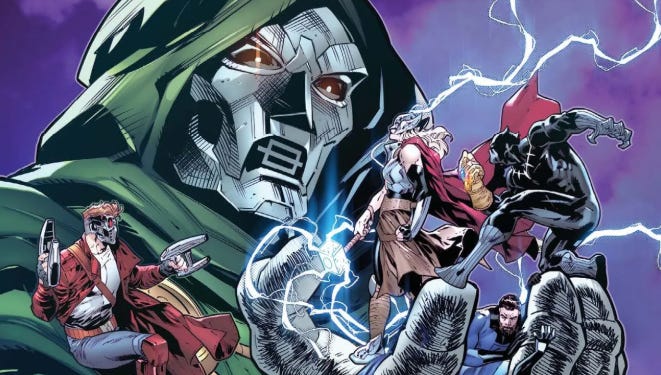
The Secret Wars Expansion has been hotly anticipated by fans of MMRPG for a while now, and I certainly count myself among that cavalcade. I’ve spent the past day and a half or so reading the whole thing, and I can say that it certainly pleases me. I’m going to caveat though by letting it be known that I am incredibly biased, as the book’s subject matter: the cosmic side of the Marvel Multiverse, is probably my favourite aspect of the whole damn shooting match.
Having said that, I can say that this latest MMRPG expansion is mind-boggling in the best possible way. It probably won’t be for everyone because cosmic shenanigans can be difficult to to wrap your head around at the best of times, but so much cosmology and history is packed into these pages in a manner that is coherent, if a little more brisk than I would have hoped.
The reason for that briskness though is that this book, more than most of the other expansions, goes a hell of a lot further towards providing Narrators and players with new mechanics and storytelling tools than previous instalments.
If you’re a lore fiend, have a hankering for concrete or even experimental mechanics, or just want some actionable advice for Narrating your own games, then the Secret Wars Expansion is an invaluable resource for your Marvel Multiverse campaigns.
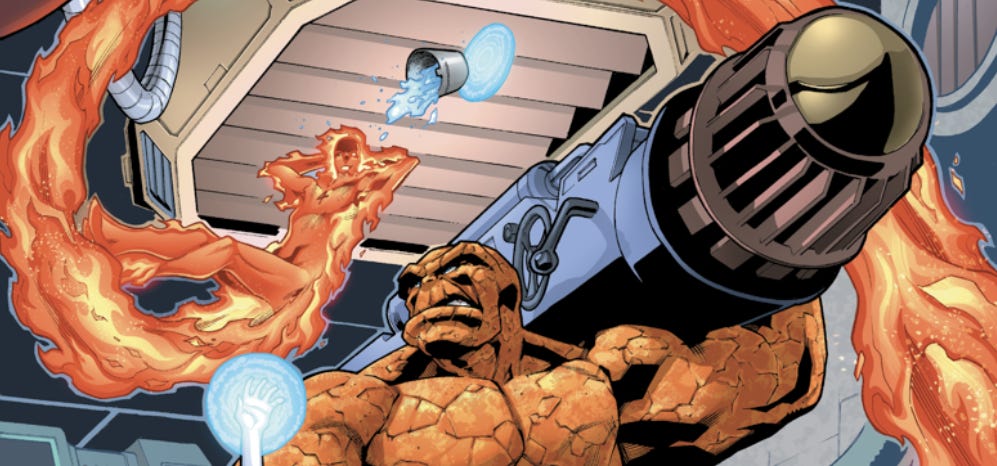
The lore chapters cover the histories of the Fantastic Four, the Guardians of the Galaxy, the Negative Zone, Doctor Doom, the Secret Wars, and Battleworld, in that order. There are such strong affiliations between the topics of each of these chapters that reading them sequentially almost plays out like a novel, and what’s more, there are distinct authorial voices to the chapters too. You can tell when you’re reading an Alex Irvine chapter versus a Marty or Matt Forbeck chapter. When reading most TTRPG rulebooks, I often find the language can be quite dry and clinical, and seldom if ever funny. But there are moments of levity sprinkled throughout these chapters to pump the brakes on the heaviness and complexity on some of the matters being written about. A favourite for me is where Irvine sums up the entire situation with Stakar and Aleta Ogord with the all-too-perfect refrain of: “It’s complicated.”
I’ve read those old Guardians stories and trust me when I say that “complicated” is the understatement of the century. Unless you’re really into somewhat incestuous ancient alien bird god stuff, then you’ll probably have a riproar of a time.
These chapters also feature some maps by returning cartographer Brian Patterson, who is really making a name for himself in the superhero TTRPG space with work not only on MMRPG but on the recent Invincible RPG from Free League (which I’ve also had a read of). I’m going to take this opportunity to highlight a discrepancy: The Baxter Building rooftop and basement maps from Cataclysm of Kang aren’t in the Cataclysm of Kang map pack PDF. I noticed when I went looking for them after seeing Brian’s maps for the top two floors of the FF’s HQ in this latest book. However, if you own that adventure then you’ve got a really great four-pack of maps at your disposal, for reference during play, when coupled with the Secret Wars Expansion.
While the book has some great maps, I think all of the multiversal jargon would have been a much easier pill to swallow along with an illustration of the cosmological geography being described. No such official illustrations of Marvel’s multiverse exist, at least not in the detail seen in Grant Morrison’s Multiversity from around the same time as the 2015 Secret Wars, but there have been efforts made by fans over the years that could have provided the basis for such a drawing. Below is one such fan effort that has been circulated for years, which should serve anyone who came away from the reading experience with a few questions.

I also want to call special attention to the Adventure Hooks at the end of the FF chapter. A lot of the hooks in these lore sections are great, but these are the best of the bunch, and there are well over a hundred hooks in the book when you take all the Battleworld domains into account. More than any of those other hooks though, the ones that cap off the FF chapter absolutely nail the vibe and tone of typical FF adventures while also cluing you into the fact that you would get as much inspirational value out of a subscription to Scientific American as you would out of these five closing paragraphs.
There are also references to characters like Bug, the Space Knights and Crystar, which raised an interesting thought. With D&D, ultimately owned by Hasbro, now launching their Universes Beyond initiative, and with the Transformers RPG being converted to 5.5E, and with ROM the Space Knight now being canon to the current Energon Universe comics, all licensed by Hasbro, and MMRPG having just done a collab with the Cyberpunk RPG to create a Johnny Silverhand character profile…
ROM is on the table, folks. I didn’t buy that omnibus for nothing.
While there are scant few profiles for multiversal variants of characters in this book, and the smallest number of profiles of any expansion so far (yay), I think the multiversal scope of the rest of the material more than makes up for it. Especially seeing as we’re getting outright references to the Dire Wraiths and the Space Knights, and advice on running various factions. Also, the character profiles have changed. The section that used to be titled “Personality” is now titled “Playing as…” and adopts a much more instructional and definitive tone than the older profiles. It leans much more into the fact that this game is designed with these characters envisioned as those being controlled by the players, or even just as a more succinct approach for Narrators controlling NPCs.
As for all of that lore that spans eons of time and the infinitude of space: Alex Irvine’s prose in the Guardians of the Galaxy chapter turns some of the most outlandish Marvel lore you’ve ever encountered into an experience akin to poring through the morning newspaper over some toast and a cup of tea. Maybe I’m just familiar enough with the material to feel that way, but honestly, it’s smooth as butter. I’ve also been listening to the audiobook of his novelisation of the original Secret Wars, and what a blast that is. There’s some advice if you wanna find voices for your villains and allies: listen to audio dramatisations of comics. You’ll probably pick up a few sound effects while you’re at it.
The lore is also VERY up-to-date, probably even more so than in previous books. The last major cosmic upheaval was only a few months ago, and there are references to all of it in the pages of the Secret Wars Expansion, up to and including some of the aftermath. There’s even a vehicle profile for Nova’s newest ship, the Principle of Reasonable Return, and the events of Jed McKay’s Centurion miniseries. That run finished 5 months ago. I know because I cried.
There’s a clear appreciation for the source material throughout the entire book. While certain things might be overlooked or avoided to save on space and time, nothing’s ever derided or outright dismissed. And it would be easy to do that, especially with the book’s looser prose, but the reverence for the ridiculous is there all the while from all three of the chapter authors.
We now get to my favourite chapter of the entire book though: Battleworld!
Now, I recently picked up Pirate Borg at Dublin Comic Con and that rulebook came with a sandbox setting that featured NPCs, a big fortress, and a whole village to explore. I was able to read that the night after buying the book and I ran an adventure there the following evening.
The Secret Wars Expansion has 45 of those.
They’re nowhere near as in-depth as that Pirate Borg material, but you essentially have 45 separate domains described in enough detail and with enough narrative accompaniment to be able to pluck one of them out of the book every week for almost a whole year and have time for overflow, either as a series of standalone stories or an entire campaign. While there are a few Editor’s Notes from Brian Overton about series to read for more information on particular topics, I think there could have been a lot of utility in including a list of relevant issues or stories with every domain’s profile. Even just a sentence like “as seen in Secret Wars: Battlezones #3” or some such for the sake of pointing Narrators toward some supplementary material. Would’ve made the suggestion to sign up to Marvel Unlimited or hit the local comic store a lot more actionable.
Regardless; to anybody who wants more adventures for this game: You should probably get this book.
You don’t need hours of prep. You don’t need reams of paper and piles of dice. And you sure as hell don’t need hundreds of pages of read-aloud text and d100 tables in a hardcover. Just pick a domain, read it, and run it. Flex your’s and your players’ storytelling muscles and have some unstructured fun. And if that sounds a little too daunting, then buy Pirate Borg, because all the prep’s done for you and it’ll give you the confidence to push yourself some more. There’s even material in some of the domain sections that goes beyond whatever saw print in the various miniseries in 2015. Matt Forbeck did mention to me when I chatted with him that he got to look at scripts for the relevant comics as well as the books themselves, and that really shows with the handful of occasions where the book presents wholly new information.
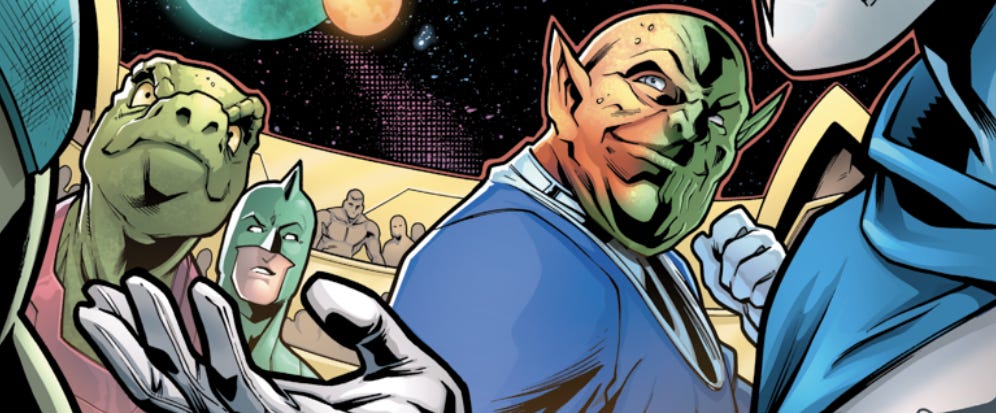
I’ve gushed over my cosmic lore enough, I think. There are those of you out there who are here for the cold, hard, gear-shifting mechanics of this book. I think the newest rules for Rank X characters are great, thematically consistent additions to the game. The fact that Rank X characters in their weakened form must make a Resilience check if they take 308 damage (half of 616) in a single turn is a fun and easy-to-remember thing. And this is something worth highlighting, because while the game’s insistence on using Marvel terminology and distinctly Marvel branding for just about everything can be a turn-off, for those who can look past the corporatism of it all, it’s oftentimes like a memory trick. As soon as I copped that 308 was half of 616, I knew I was never gonna forget that rule. If the game weren’t so reliant on being a MARVEL game then that rule wouldn’t really make sense, or it simply wouldn’t exist at all. And the game would be all the lesser for it.
One thing I will say though, while we’re on the matter of mechanics: I find that the suggested TNs for a lot of things are often quite low in official materials. I tend to adjust them in my games anyway, as I’m sure everybody does, but I feel there being such a prevalence for TNs of 10 and 12 in a setting with the threat of death around every corner to be a bit lacking. Especially if you’re playing with characters who have been min-maxxed to the nth degree. These are ultimately the kinds of things that are always in the hands of the Narrators, but setting them higher in-print might help to avoid some rookie mistakes that result in a cake walk following the promise of certain doom.
In the lead-up to this expansion’s release, Tony’s Workshop was updated with Verbal Combat rules that I would say have been resoundingly rejected by the community, and in this expansion there is what appears to be a much more interesting mechanic in its stead.
The Event Plot Points, with only minor adjustment for other scenarios beyond a confrontation with God Emperor Doom, can be a perfect way to handle those situations where characters need to talk their enemy down rather than going at them all guns blazing. As much as some groups of players may prefer the latter. As is, the idea of calling upon established alliances or just plot-relevant material to instigate an action check that can lead to winning over your enemy makes a lot more sense than just having dialogue deal Focus damage.
Similarly, the new Self-Sacrifice rule is an intriguing approach to the idea of players taking their character’s fate into their own hands. Letting a character unleash their full, unrestrained might, with the only potential outcomes being unconsciousness or death, is certainly a mechanic that was designed with very specific moments in mind. I’m curious to see how it’ll play at the table, but I very much like the concept behind it. Given that my own players are up at Rank 6 now, these kinds of innovations within the rule set should help to keep things fresh as we play on.
Ultimately, this is a book that provides the means and the materials for Narrators and players alike to make the most out of their collaborative narratives, especially if they really want to experience all that the Marvel Multiverse really has to offer. From the streets of New York to the collapse of the cosmos, the Secret Wars Expansion exists as a testament to the breadth of storytelling possibility within the bounds of the Marvel Multiverse, and lays everything on the table for you and your players to explore it with the abandon it truly deserves.
I’ll leave you with my favourite lines of the entire book. In the section discussing “The Outside”, a place beyond Exo-Space, it is written:
“A related realm is the House of Ideas, which often appears as an old Victorian mansion floating in mist-shrouded space. The One Above All—the originator of all creation—lives here.”
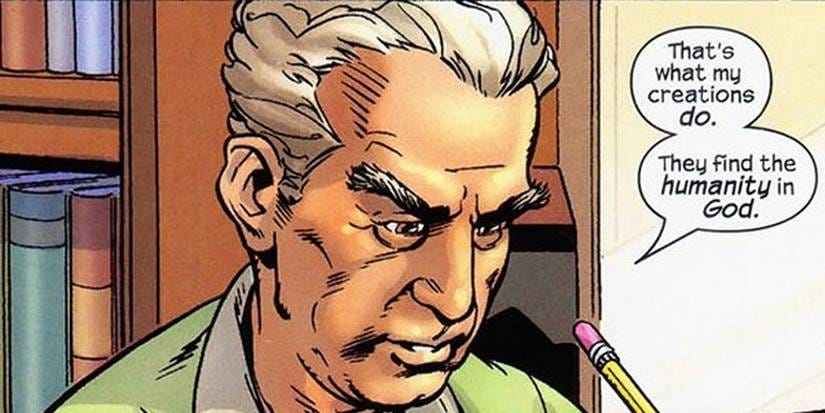
In the end though, when I finished reading this expansion, it made me want to run more games. And not just MMRPG games, but games in general. It’s the kind of resource that puts ideas into your head, both narrative and mechanical. If the book had a mission statement it would probably be something like this:
“Here’s the Marvel Multiverse. Have fun.”
I’ve had a crazy few weeks.
Dublin Comic Con (DCC) was a great time. Some interesting conversations were had and boy was there a lot of cool art to look at! Always nice to catch up with Ruairí Coleman at these things, too. You’ll have probably noticed his art’s littered throughout this article. If you’re not already subbed to him, head on over and tell him who sent ya.
Also at DCC, I met ol’ horn-head himself, Charlie Cox, who’s an absolute gent. I got my X-Men Narrator’s screen signed by Lenore Zann, Alison Sealy-Smith and Catherine Disher of X-Men ‘97 fame too, all of whom were very intrigued by the existence of a Marvel roleplaying game, and I was more than happy to fill them in on what the hell one of those is. And Doug Jones and I went cheek-to-cheek for a photo. Face cheeks, of course, get your mind out of the gutter.
Then just yesterday I met Jim Zub, prolific writer of the current Conan comics and the Murderworld That Time Forgot adventure for MMRPG, at Dublin City Comics for a signing. We geeked out over Arcade for about five minutes.
In the midst of all that though, I’ve been focusing on other work, and very much giving the blog a cooldown. Even though this book gave me a lot of great ideas for new stuff to post about, I’m not gonna be working on or sharing any of it till I’m much further along with my other pursuits. All that’s in my drafts folder right now is preparatory reviews for the upcoming MMRPG releases. So, there’ll probably be one post a month for the foreseeable.
If you do end up buying the PDF of the Secret Wars Expansion, you can use my affiliate link just above the FF image to get you there and I’ll get a small commission. It’s store credit, so you’ll be helping me save some money on RPG materials down the line.
In any case, I certainly do hope you have fun out there, and I’ll seeya next time.
Comments
Nothing yet. Say the first thing.
Sign in to join the conversation.