
A few weeks back I wrote about the distribution of Karma in MMRPG using elements of the video game Marvel Cosmic Invasion, and this week I’m doing something similar but with relation to plotting out your superheroic campaigns. Honestly, this advice is system agnostic; you can do this with pretty much any story you want in whatever genre you’re playing.
Cosmic Invasion doesn’t play out in a one hundred per cent linear fashion from beginning to end. Instead, there are a handful of levels between each boss fight on two separate tracks, and you can pick which track to follow, or even just play all the levels before moving onto the boss fight. Each level has its own unique setting, missions, and suggested characters, posing different challenges and offering up a view of various environments within the game’s world.
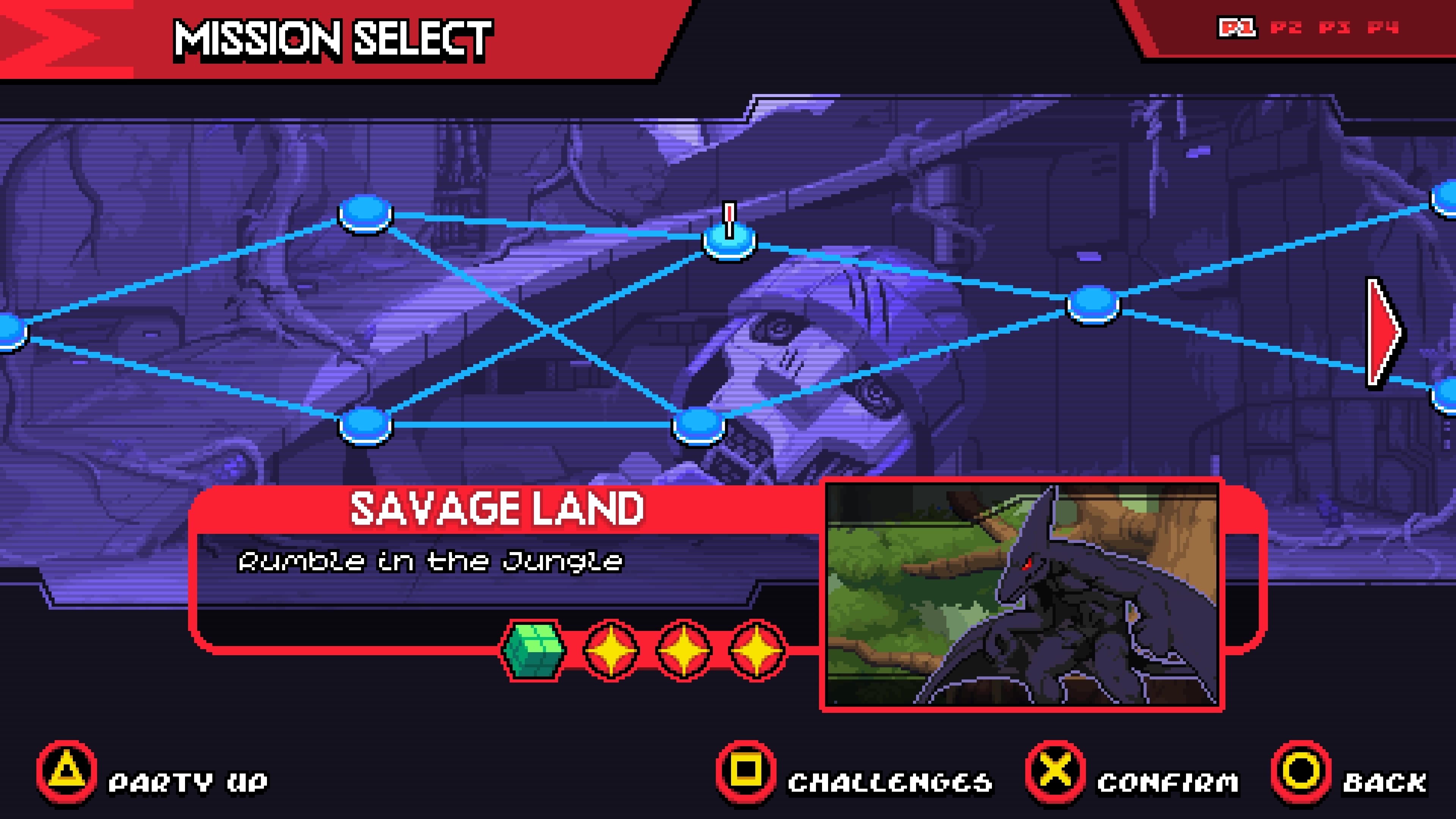
The nifty thing about this approach is of course that while you might play through to the final stage along a single track, the assumption is that the heroes involved in the other levels were victorious in their pursuits, and so the stories of the other missions still happen, regardless of whether you played them or not. So, how can this kind of approach help you with structuring your campaigns?
Whenever you’re plotting out your TTRPG campaign, it can be easy to fail to see the wood for the trees and end up constructing a very railroady, linear narrative that leaves you high and dry in those moments where your players start to deviate from your best laid plans. Likewise, it can be just as easy to lose yourself in the worldbuilding prior to the first session and have every answer imaginable to the questions your players might ask about this new universe, except the question “What are we here to do?” So you could find yourself in a situation where all you’ve got is a plot and no world, or a world with no plot.
This is where this kind of non-linear structuring can help. Rather than investing hours into worldbuilding or plotting, you can instead construct isolated environments with loosely-connected stories that then culminate, regardless of the path taken by your players, in a single narratively-significant event, typically driven by the whims of a primary antagonist or villain. The main thing to keep in mind with all of this stuff is this: The villain IS the story.
To take the image above as an example:
Level 1, New York City:
Annihilus has unleashed the Annihilation Wave on the world, prompting mass chaos. Several opportunistic villains have joined his cause in the hopes of surviving the onslaught. Upon fending off the wave in NYC, the heroes receive distress calls from S.H.I.E.L.D. and the X-Men. The Helicarrier’s under attack, and sentinels are kidnapping mutants off the streets. Where to now?
Level 2 (Option 1) Genosha:
The heroes travel to Genosha to free mutants from a sentinel facility under the control of the Master Mold. They discover that more sentinels have been deployed to the Savage Land but also that Wakanda is under attack now too.
Level 2 (Option 2) The Helicarrier:
The heroes move to secure the Helicarrier following an attack by A.I.M. and the Taskmaster. Upon securing the Helicarrier, the Avengers discover that there are sentinels being deployed to the Savage Land and that Wakanda is also under attack.
Regardless of where the heroes go, something narratively significant still happens at the other location. You could go so far as to flip a coin to see if the villain at the other location was successful or if they were thwarted by a different team of heroes.
Level 3 (Option 1) The Savage Land:
The heroes must discover who’s behind the recent sentinel activity and put a stop to their machinations before any more mutants fall prey to their scheme. Once they’ve put a stop to things, word reaches them that Jean Grey has fallen victim to the Annihilation Wave while aiding in the defence of Attilan on the moon.
Level 3 (Option 2) Wakanda:
Ulysses Klaw has laid siege to the Wakandan capital alongside a contingent of A.I.M. Agents and the invading bugs from the Negative Zone. He seeks to secure the vibranium for himself, and the heroes must stop him from gaining access to the nation’s reserves of the rare mineral before he can use it to augment his sonic form. Once they’ve put a stop to things, word reaches them that Jean Grey has fallen victim to the Annihilation Wave while aiding in the defence of Attilan on the moon.
Level 4 Blue Area of the Moon:
The heroes must free Jean Grey from Annihilus’s mind control without falling victim to it themselves, or perishing in the effort.
If this were your superhero campaign, in the span of just four sessions, your characters would have visited at least four distinct locations, all of which would have added significantly to your worldbuilding while also advancing the overall narrative from one session to the other. And that’s only if they stick with a linear progression. If they decided to take the time to hit every stop along the way, then they’d get six sessions out of it without losing any sense of urgency. However, it would suit you to up the ante during the big boss fight at the end of the arc as a result of their dalliance.
Now, obviously the crutch being leant on in that example is the fact that the levels are meant to be played as specific characters, but in order to make that kind of structural effort yourself, all you need to do is make sure you know who your players’ characters are going to be. That way, you can layer in some personal stakes along the way. In the boss fight with Jean Grey, one of the level’s extra missions is to have Wolverine deal the final blow. This is hearkening back to my post from a couple weeks ago. The stakes of your campaign can be as lofty as you like, but in these individual sessions you’ll always be better off to try and serve a player or two with something that adds to the personal stakes of their character’s story. Annihilus mind-controlled Jean Grey, a woman Wolverine has deep feelings for, so you better believe that gives Wolverine greater investment in the overall story.
The next time you’re planning a campaign, you needn’t dedicate hours to meticulously organising every beat of the potential plot. Instead, pick a villain: Any villain. Decide on what their ultimate goal is going to be, and then involve your player characters in the action from the get-go. The villain launches an attack on a city, or attempts a major heist on a high security location, or whatever else it might be. Preferably, whatever they’re doing should be well on the way to completion or success before the event that drags the heroes into the story. In Cataclysm of Kang for example, Hydra and the Crimson Surfer of Earth-56438 have already bought out an entire street in Little Italy and begun sending troops over to establish a safehouse for their planned invasion of your universe.
Once you’ve settled on that opening scenario, delve into your player characters’ backstories and pick something from each of them to centre another scenario around in the build-up to what might be the first major upset in the villain’s plans. What’s more, if characters know their loved ones or friends are in mortal danger at separate locations, it can generate some inter-party conflict and add that trademark soap opera drama into the narrative mix.
Don’t just let those plot points go to waste though. If a character’s loved one, ally or friend was endangered and the team followed a different plot point, escalate that danger along a logical path and let it be something your players can come back to or even something that becomes relevant later as a result of their choice to go elsewhere. All of these kinds of tricks will help to not only bring your world to life, but also to more deeply involve your players in the story you’re all telling.
Thanks for reading again this week, folks! As I’m writing this, it’s been a day since they released the first DLC characters for Cosmic Invasion (Cyclops and The Thing) and I’ve somewhat accidentally already gotten them to Level 10. I hit a nasty 725 hit combo on a swarm of bugs in the very first level as Aunt Petunia’s favourite nephew in honour of Jack Kirby getting a street named after him. All of that should give you a pretty good idea of just how far ahead of myself I am in writing these things.
Get in the comments and let me know of any tips and tricks you have for planning out your campaigns and anything you do to ensure your players have ample opportunity to get invested in the story from their characters’ perspectives.
Till next time, have fun out there!
Comments
Nothing yet. Say the first thing.
Sign in to join the conversation.