
Note: For those of you intrigued by my post last week about the ECE vs. K-12 funding gap, I’ve since learned that the good people at the Center for Early Learning Funding Equity have a whole research initiative around this gap — called the Shortchanged Project — with maps, state-by-state data, papers, etc., and I highly encourage you to check it out!
The word of the current political moment is “affordability.” You can’t turn around in a battleground district or tune into a candidate’s speech without hearing about affordability. I’m glad! There’s no question that high prices of everything from gas and beef to health insurance are causing serious strain for Americans — and, at the same time, even if we snapped our fingers and brought those prices down, Americans’ flourishing wouldn’t automatically spike.
That’s because, as I and others have been pointing out — especially the sharp thinkers at New America’s New Practice Lab — living the good life also involves a dimension of time. As NPL’s Tara McGuinness and Elizabeth Garlow recently wrote in the journal Democracy,
For too many Americans, having enough time has become a luxury reserved for those with the income, flexibility, and security to protect it. Many find themselves rushing between work, meals, school pickups, bus schedules, and caregiving demands. Each day is a juggling act in which holding life together leaves little room to actually live it.
One challenge with making public policy around time, though, is that it’s a rather multifaceted topic. I put it this way in my essay, Time as Public Policy:
Let’s recap. America desperately needs a healthy communal life, which is injured by widespread individual feelings of what can variously be described as loneliness, depersonalization, and alienation. That particular dark triad is powered by a lack of authentic relationships, which are in turn hampered by an impersonal market economy and an attention economy that can put us at odds even with ourselves.
Now apply a lens of time, because I submit time is the elemental fuel behind all of this. Time is (I speak here in a non-physics sense) multidimensional. At the risk of adding another trio into the mix, there is how much you have of it, how much control you have around it, and what you are capable of doing with it. To take an extreme example, an imprisoned man may have a great deal of time on his hands, but very little control and very little choice. The public school teacher and the warehouse employee may work similar hours, but one of those sets of hours is predictable while the other can change at a moment’s notice. And too often, when you are finally done with work and the kids are in bed, there is little left in the tank for relationships.
Today, I want to zoom in on the question of having predictable control over your time. Two new studies came out recently that reinforce just how important predictability is to human well-being.
The first is a paper entitled “Predictably Unstable?: Precarious Work and Precarious Relationships in the U.S.” by Kristen Harknett, Kevin Bruey, and Elizabeth Kuhlman, who are associated with The Shift Project.1 Harknett and her co-authors looked at longitudinal survey results from nearly 7,000 workers in hourly shift jobs.2 They found that as schedules start to become very unpredictable, marriages start to fall apart. Specifically, they developed a ‘schedule instability scale’ made up of five items: “on-call shifts, canceled shifts, last-minute timing changes, short notice of work schedule (less than 2 weeks), and working back-to-back closing then opening shifts (“clopening”).” Things got especially hairy when workers started regularly hitting a four or five on that scale.
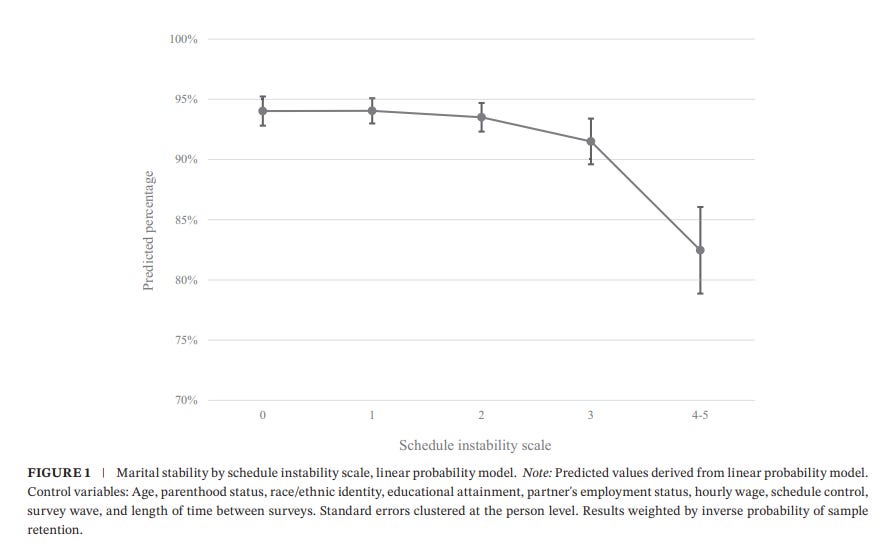
As the authors put it, looking at the same workers just nine months apart on average:
“Among those with the most stable work schedules, 94% of marriages were intact at follow-up. In contrast, among those with the least stable work schedules, just 82% of marriages were intact at the time of the follow-up survey.”3
Why is this happening? It’s not hard to imagine, even if like me you’ve never worked a job with that level of unpredictable schedule: the instability drives poor sleep, high stress, missed opportunities for quality time, and so on. As Harknett, Bruey, and Kuhlman conclude, relationships may be “worn down over time by sustained exposure to unstable conditions.”4
This is notable because there are a lot of hourly shift workers in the U.S. Nearly 30 million people work retail and food service sector jobs, and that’s just two industries.5 Make the most unstable schedules reasonably predictable, and you could potentially save hundreds of thousands of marriages every year. What’s more, an awful lot of the couples we’re talking about have children — and it turns out unpredictability may be even worse for children than you might imagine.
That brings us to the second recent study, “Unpredictability is a childhood adversity that contributes to mental health problems,” published in Nature Mental Health by a team of researchers led by Laura Glynn and Tallie Baram.6 Here’s the abstract, and then we’ll break it down:
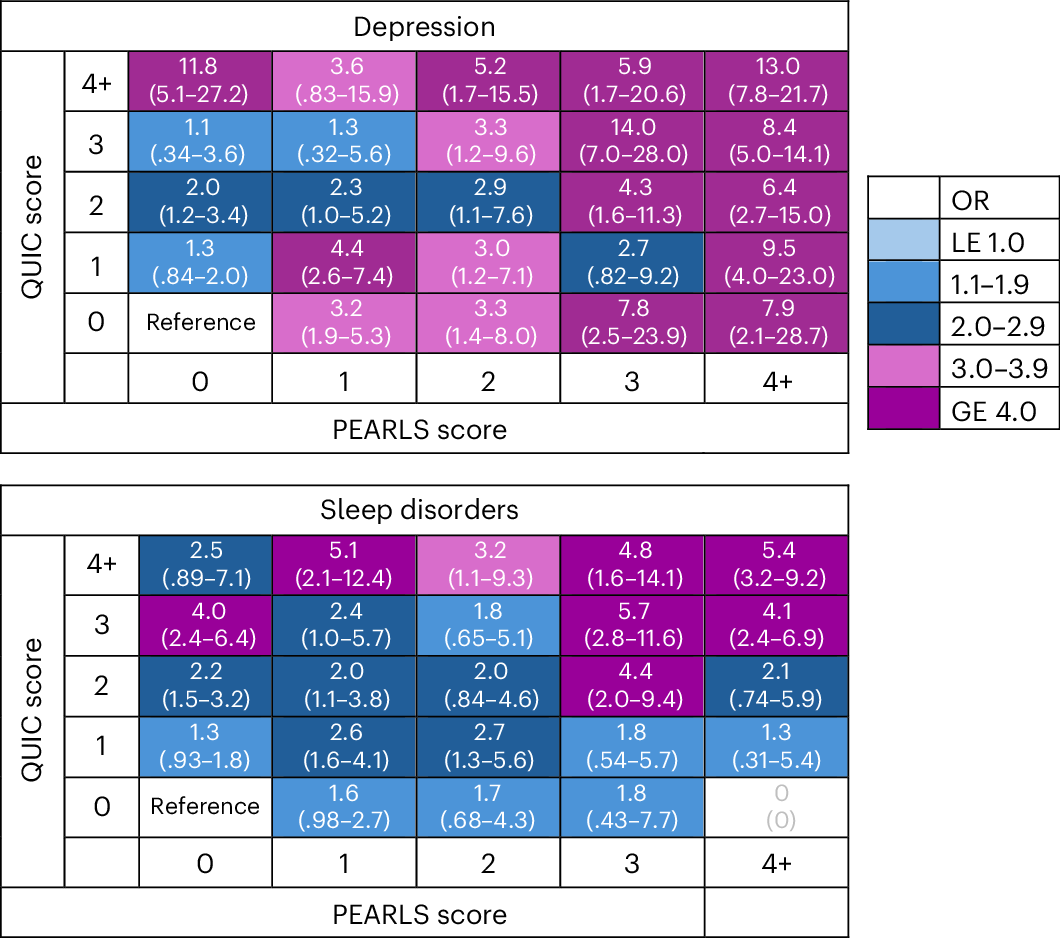
Although adverse childhood experiences (ACEs) increase risk for mental illness at the population level, existing ACEs screens are less helpful in forecasting individual outcomes, suggesting they may not capture significant elements of childhood adversity. We have previously identified unpredictable parental and household experiences as an ACE that portends poorer cognitive and mental health. However, the contribution of unpredictability to established ACEs in real-world settings is unknown. Here, leveraging existing ACEs screening in California, we added the five-item Questionnaire on Unpredictability in Childhood (QUIC-5) in 19 pediatric clinics spanning broad sociodemographic constituencies and compared in ~30,000 children the link of each screen with mental health diagnoses. Scores on either the ACEs or QUIC-5 associated with probabilities of depression, externalizing symptoms, sleep disorders, anxiety and somatic symptoms. Each screen provided unique contributions and combining them often doubled the strength of associations. For depression and sleep disorders, the QUIC-5 identified vulnerable individuals missed by ACEs screen, improving risk detection and facilitating future interventions.
For those unfamiliar, the ACEs concept, popularized by Dr. Nadine Burke Harris, is the idea that certain childhood experiences deeply shape developing brains and bodies and can increase the risk of future health conditions.7 This is one basic ACEs screener:
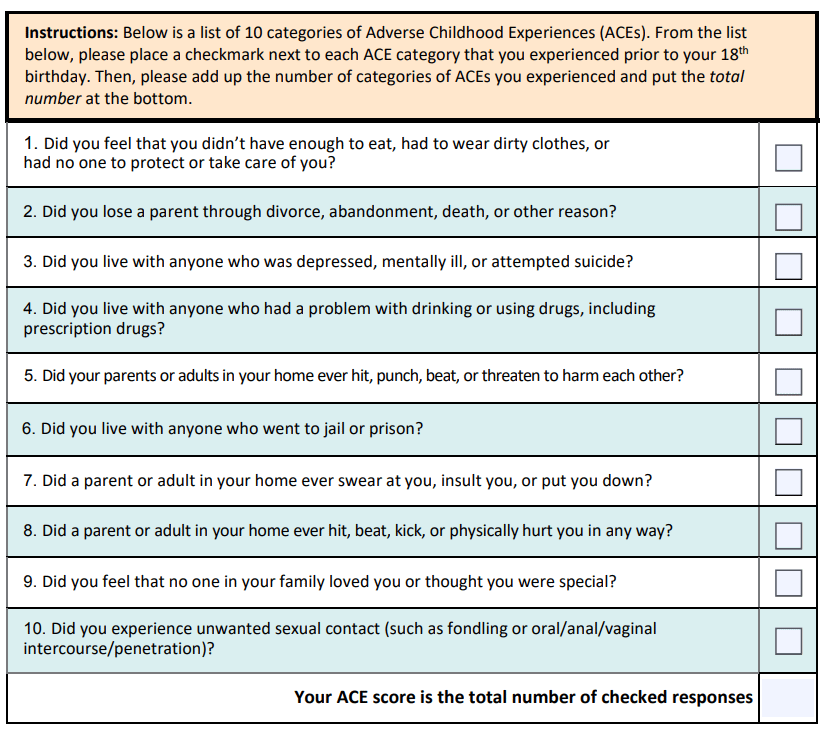
While ACEs has a lot to say across population averages, what Glynn et al. are pointing out is that because there’s only so much information those 10 questions can give you, some correlations at the individual level are slipping through the cracks — for instance, what about the childhood of someone with a relatively low ACEs score may still contribute to them battling mental illness, or why might two people with the same ACEs score end up with different mental health outcomes? While human development is hugely complex and individualized even at a genetic level, the researchers offer up one hypothesis: ACEs aren’t screening for predictability. (At least not directly: it’s fairly obvious that a home in which a parent is physically harming a child is not a predictable home; hence, the paper also looks at how their predictability supplement intersects with the main ACEs screener.) As the paper states:
one early-life exposure that is not currently included in standard screening instruments is unpredictability of parental and environmental signals received by the child, which activates the brain’s stress responses. The concept that unpredictable signals to the developing brain are stressful and disrupt brain maturation arose initially in experimental animal studies. Since then, unpredictable parental care and lack of structure in the family and home environment have been shown to strongly predict poorer cognitive and emotional development across a broad range of cultures and sociodemographic groups. Unpredictability in childhood, independent from parental support and sensitivity, has been linked by several independent groups to decreased executive control, a slower trajectory of cognitive development, poorer memory and increased risk for depression, anhedonia, anxiety and post-traumatic stress disorder later in life. These associations persist after consideration of other well-established ACEs (for example poverty, abuse or neglect), suggesting that unpredictable experiences in themselves are a robust risk factor for poor mental health outcomes, and their absence from existing assessments of ACEs may account for some of the limitations of these assessments in predicting risk profiles. (bolding mine)
This is the predictability questionnaire Glynn et al. developed:
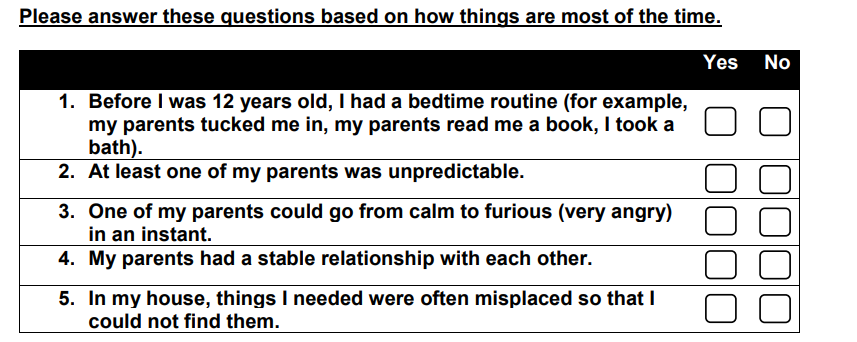
Their key finding is that having a high unpredictability score not only independently creates risk for mental health challenges, it has a multiplier effect on high ACEs scores. In other words, if you have a childhood that includes divorce and a loved one going to jail, but at least your parents are generally predictable and the house is kept orderly and with routines, your risk of struggling with depression or a sleep disorder is significantly lower than if you have those same ACEs and a highly unpredictable home. The same appears true for the other side of the spectrum: you can have zero ACEs but score highly on the unpredictability scale and be facing higher mental health risks than someone with zero ACEs and a low unpredictability score. This figure is a little wonky, but shows the general idea (PEARLS is just the name of a commonly-used pediatric ACEs screener), by looking at how many times as high the odds of certain conditions are versus a reference individual with zero ACEs and zero unpredictability score:
Now, start to put these puzzle pieces together. We know that parents who work highly unpredictable shift jobs are almost by definition more likely to be unpredictable to their kids; they’re at greater risk for relational strain, can’t be as reliably present for routines like bedtime, and often battle chronic stress, exhaustion, and the resultant irritability. Parents’ lack of control over time thus bleeds over into their children’s lack of being able to predict how their day is going to unfold.
So, whether one is concerned about strong, stable marriages or one is concerned about child development, job schedule predictability needs to be high on the agenda — because it is solvable as a matter of public policy. We already know how. As I wrote a few months back alongside my Capita colleague Elise Anderson:
There is a solution: fair workweek policies. These laws, broadly speaking, require large employers (such as national chains) to provide scheduling certainty two weeks in advance, limit last-minute shift changes as well as retaliation for requesting or declining a shift change, and offer employees some type of compensation if shifts are abruptly canceled or reduced. The first one was passed in San Francisco in 2014, and they have since expanded to many major cities such as Los Angeles, New York City, and Chicago, as well as the state of Oregon. One such policy in Emeryville, California, has been shown to reduce scheduling instability among parents with young children by 35 percent, and improved parents’ sleep, stress levels, and overall happiness. While the devil is, as always, in the details—some possible issues include enforcing these laws, educating workers about their rights, and avoiding employer manipulation—this is a promising area for public policy innovation.
While most fair workweek policies have been passed in Democratic-led jurisdictions, improving the quality of job schedules need not be a partisan fight. Fair workweek laws have been in place long enough for researchers to judge their impact, and none of the feared negative labor market impacts have emerged.8 The key reframe is to stop thinking of fair workweek policies as yet another battleground between labor and management, and to start thinking of them as core elements of an economy that works for families.
Yet predictability isn’t currently near the top of anyone’s priority list. I haven’t been able to find an example of politicians or even labor unions calling for fair workweek policies to be a big part of the 2026 or 2028 agenda. (Nor anyone calling for fixing the other big villain of job quality, the involuntary part-time work trap.) Of big cities that don’t currently have such policies in place, I’m not aware of mayors prioritizing the issue either.
Some of this comes down to straight-up politics, of course; one reason we don’t have a national paid family leave law and only 14 states with state-level laws is due to opposition from business groups, who also don’t love fair workweek laws. In 2023, for instance, fierce opposition from businesses killed a proposed Colorado fair workweek law to the point that it hasn’t seriously resurfaced since.
But part of how we shake loose of this meat grinder is by changing the language and the mental models. Predictable schedules aren’t yet another game of tug-of-war between employees wanting more power and employers wanting to give less. Predictability is a vital part of the bedrock of healthy marriages, healthy children, and healthy families — a vital part of Americans having control over their time in order to live the lives they want to live — and hey, the fact that more predictable jobs can actually improve business productivity9 is a nice bonus.
Take us out, Jesse Frederick!
H/t to Stephanie H. Murray of Family Stuff for bringing this study to my attention.
Drawn from a large but potentially non-representative sample of workers at major service-sector employers.
If you’re curious, when looking at couples that are cohabitating but not married, “about 87% of cohabiting relationships remained intact under conditions of schedule stability (0 types of instability) compared with 82% for those with 3 types of instability and 75% for those with 4 or 5 types of schedule instability.”
Interestingly, for what it’s worth, the effect on (heterosexual) marriages is most pronounced when it’s the man with the highly unstable schedule.
Not all of those are shift jobs subject to instability, of course, but a whole lot are!
H/t to Joe Waters for bringing this study to my attention!
I was lucky enough to attend the first ACEs Summit back in 2014, which was a very moving experience.
In fact, a Shift Project paper published after we wrote our article reported, “We find robust evidence that Fair Workweek regulations led to increases in advance notice of schedules and time to rest between shifts and reductions in last-minute schedule changes. We find no evidence of compensatory retrenchment [i.e., cutting wages or benefits to offset the cost] in other aspects of job quality.”
In a randomized control trial, Gap stores that implemented predictable scheduling policies found “The intervention yielded a 1.8 percent reduction in labor hours while boosting sales by 3.3 percent. Consequently, store productivity increased by 5.1 percent (sales per labor hour), surpassing the average annual productivity growth of the retail sector, which stands at 2.5 percent per year.” The company would later roll out versions of those policies across its network of stores.
Comments
Nothing yet. Say the first thing.
Sign in to join the conversation.