
“There is another world, and it is this one.” - Paul Éluard (attributed)
“The experience of deity was inevitably scattered because that was how human beings experienced themselves. They lived in flows of divine activity that moved through them and moved them about. They were waves in a cosmic sea.” - Mark Vernon, The Secret History of Christianity: Jesus, the Last Inkling, and the Evolution of Consciousness, pg. 17
In the Western esoteric view of the human being, the person is a microcosm of the cosmos. In theological terms, this is the imago dei, being made in the image of God. Since God contains all things, by extension, we too contain, in a smaller, approximate way, all things in proportion to the degree to which we conform to a clear image of the All. In more secular terms, the human being is not a specialist.
Consider our opposable thumbs. All primates begin with opposable thumbs, but then they harden into hands with limited functionality. You could almost say that we, among all primates, remain childlike. This extends to a vast array of other things, but particularly the capacity to learn. Neuroplasticity in human beings behaves in a radically different way from other animals. Most animals, when they arrive at puberty, simply cease learning. You’ve heard the phrase “can’t teach an old dog new tricks” — it’s not a joke. While, yes, some ability to learn remains in all animals, it is not like the miraculous human capacity to learn into old age.
It isn’t our capacity to learn that is restricted as we age, but rather how full our lives have become with entrenched habits. You see the crux of learning into old age here, don’t you? It’s forming the habit of learning as your normal behavior while you are still young. If you don’t make conscious space for learning — which is transformation — then the natural tendency is to harden into fixed habits. This doesn’t mean we won’t discover and learn new things within our chosen vistas, but they will be constrained to those habits and only those habits.
Someone might posit otters as exceptions to this neuroplasticity because otters are astonishingly creative. But what has been discovered is not that otters “learn” but rather that they don’t remember anything at all. Every time an otter approaches a dilemma, it approaches it as if it is the first time. Shunryu Suzuki might call this “beginner’s mind,” but, obviously, we are not designed to forget everything useful or the fruits of experience every time we approach a new dilemma. It is precisely the fact that the otter remains stuck in a sort of permanent “beginner’s mind” that it can never advance beyond its innocent play. Almost every animal can easily be “clicker-trained” — even humans — but otters are more challenging to train. Pavlov’s dog is a dog for a reason. Otters don’t remember the same way or don’t access memory the same way many other animals do. Instead, they tend to approach problems as if they are new.1 People who can access a “beginner’s mind” when grappling with problems may seem creative, but it is a formless creativity that must constantly reinvent the wheel. Imagine if every time you wanted to start a farm, a farmer had to invent all his tools and couldn’t bring anything with him. Or imagine a farmer who forgot everything he’d learned the previous year. Such a farmer wouldn’t be able to make much progress.
When a bull calf matures, it becomes “bull-headed” — a term most of us are familiar with. This means that once a male calf reaches sexual maturity and his face changes to look like a real bull, you won’t be able to undo any bad habits he’s learned. All of his habits are now more or less permanently set. If you can train a bull calf and keep him free from bad habits, once he reaches “bull-headedness” in a useful sense, he won’t easily acquire new bad habits later, either.
It’s easy to blame “habits” for being bad since all our bad habits are habitual. But good habits are enormously empowering. When you no longer have to put in conscious effort meditating every morning, the habit carries you along in a good direction. Our future is just our habits multiplied by time. Forming a new habit doesn’t require continuous effort: after about forty days of consistent, deliberate effort, the new habit stops requiring effort. We often imagine that a new habit we wish to practice for the next forty years requires forty years of grueling effort. Not so. It only requires forty days, and then becomes almost automatic. When good practices become habitual, then our comfort zone becomes one of active, positive work rather than complacency (or worse). Just because all the bad habits we need to fix are habits doesn’t mean that all habits are bad.
What does this have to do with astrology? The zodiac (zoon, Gk, “animal”) is the animal belt. We are not meant to expel animal impulses altogether — we still have to eat — but merely to remove them from the temple. We are not destined for the happiness of animals. Because we aren’t mere animals. All other animals are specialists in one way or another. Human beings are anomalous in the fact that we refuse to specialize. We are the great generalists in nature, which is another way of describing the imago dei or the idea of the microcosm. In the human being, gods are contained, but in a dynamic suspension so we are not necessarily ruled by any of them: freedom is the result of not being one-sided animals. “A universal and harmonious concord of all possibilities will bring forth the human form. Emphasis on the development of certain details will lead rather to animal formations with their specialised one-sidedness.”2 Considered within the realm of animals, a remarkable principle is at work. The following line from Theodore Schwenk is one of the most remarkable lines I’ve ever read: “And if Nature creates creatures in which she reveals one of her creative movements, she also creates one living creature in whom all archetypal movements stream together: the human being.”3 By analogy, if Nature creates humans in which she reveals all archetypal movements, she also creates one living human in whom all archetypal movements stream together perfectly, and one mother of such a being that most clearly embodies her. Latent within the universal quality of humanity is the eventual — inevitable? — emergence of a uniquely divinely human specimen out of the general mass of humanity. ✠
Only when we can choose our course of action uncoerced by external authority — the body itself being filled with powers and principalities — are such actions truly free. Freedom is the capacity to choose an option not even offered.
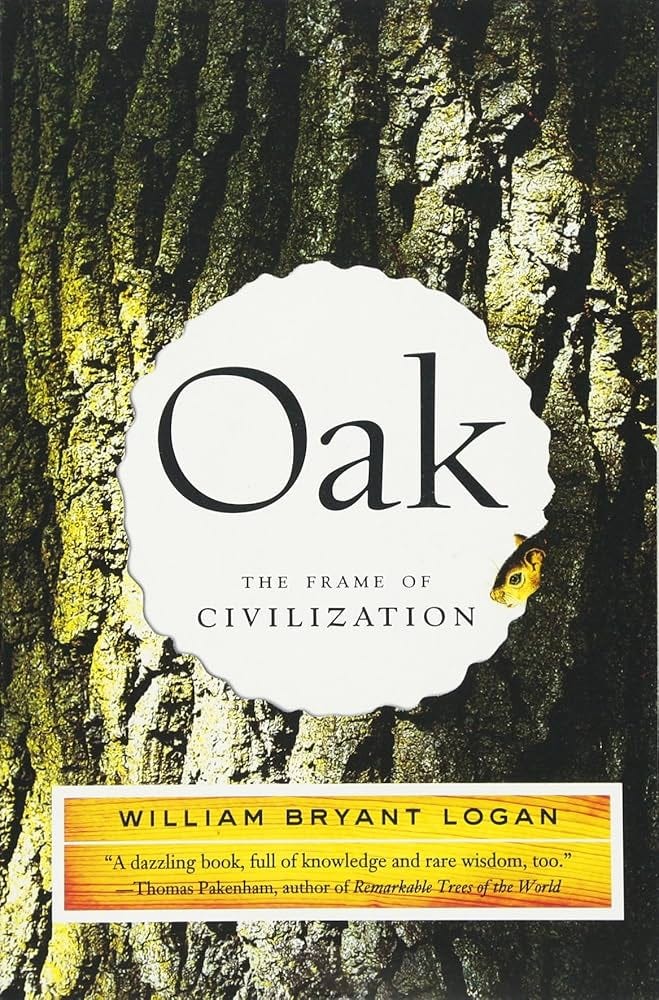
Of our various companion trees, oaks aren’t the best at anything. They’re not the single best building material, the best nut crop, or the best firewood, but they’re nearly the best at everything. Oaks are prized by humans for exactly these traits. As a “master of none,” it is the generalist “jack of all trades” who excels — such is the Renaissance man. He may not know everything to its full depth, but he lives in an enormous galaxy of interconnections. Specialists are splendid for narrowly defined but deep insight, but it is our generalists who can synthesize the insights of others in ways that bear far more fruit than the constrained interests of a specialist. It is omnivorous readers who find untold secrets hidden in plain sight rather than those who read only a single author. So you might ask again: what does this have to do with astrology?
Astrology influences most intensely not conscious processes but unconscious drives. You could say that astrology does not directly affect your sense of reason but subverts it by stimulating your organs and glands. And because we are all “in” the loudspeaker of the solar system, none of us are exempt from this deep, resonant field. Having internalized organs is no more than our solar system having its planets around an established rhythm of the condensing sun coalescing the different planets.
Similarly, in human embryology, an independent pulse originates before the heart. Relative to animals, human beings are far more “emancipated” from the cosmos precisely because we contain more of the cosmos. We are less beholden to external influences because we have a more complete inner universe. But this doesn’t mean that we aren’t influenced. Our bodies most certainly are. Think about it like this: the primordial rhythms of the planets are older than sex. If we think sex is a fundamental drive, the slow oscillations of the planets touch an even deeper level of the unconscious mind. To put it bluntly, if we can’t resist sexual urges, we certainly can’t resist more fundamental ones.
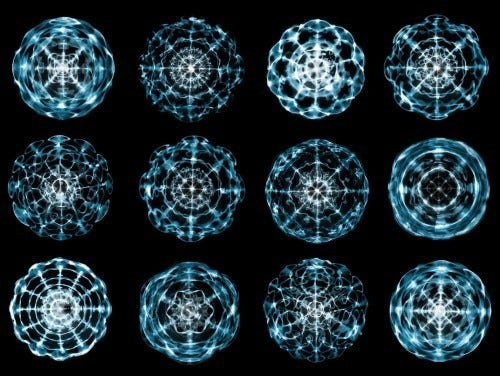
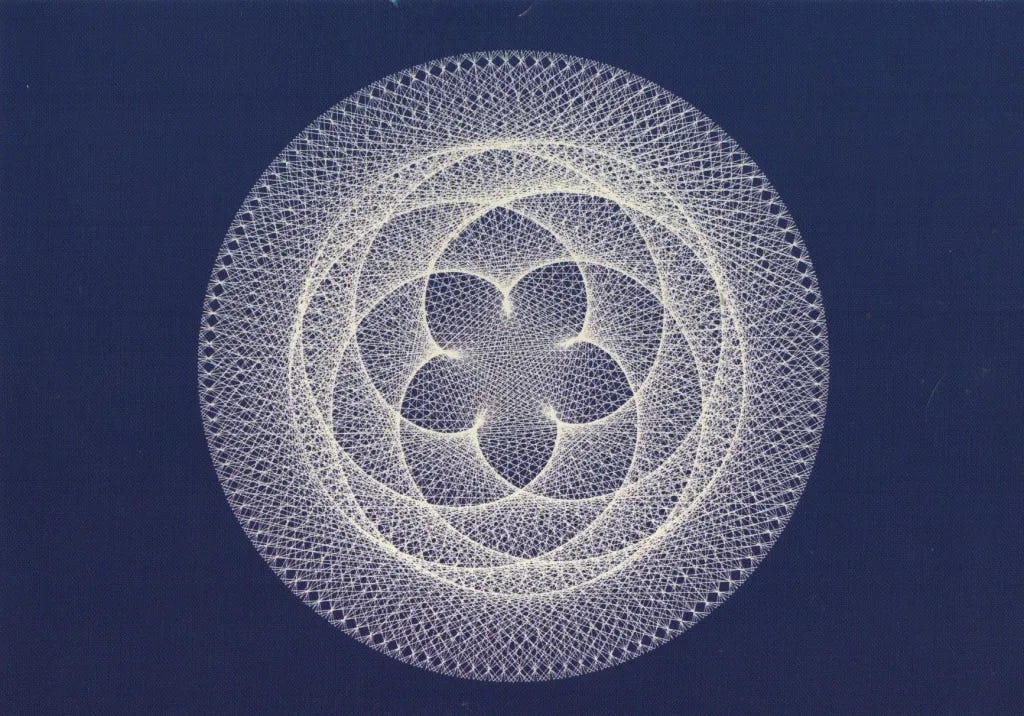
A bodhisattva or saint is far less influenced by the planets (gods). This doesn’t mean their bodies aren’t affected at all. Still, because they practice sourcing the impetus of their actions not from external stimuli but rather a central inner commitment to a singular immutable principle — compassion, love, goodness — they are not beholden to the world of externalities. This is the principle of non-reactivity: not drawing the motive for our actions from any outside influences but always from the spiritual world. Yes, the response must always be adapted to each unique situation, but if you’re trying to fix something broken, you must remember how it is meant to function in the first place and work towards that.
Using stimulants agitates our glands and stimulates artificial bodily — animal — feelings. Relying primarily on our animal bodies makes us feel that we are like people who will do anything for money. It is not that we must seek discomfort, but we must not depend on constant pleasant stimulation. Needing to feel stimulated is a kind of addiction to the body, which makes us phobic of any discomfort, even if mere words cause the discomfort. On this point, Nietzsche was right: “Pleasure is a form of pain.” Think of what foolish things we do for the sake of pleasure. Think what an addict will do for a fix — that is our default relationship with our bodies, and until that is rectified, it truly is an illness, a diseased relationship of body and soul. The source, of course, isn’t the body but rather a malformation in the soul itself. If the term “soul” is difficult for any readers, imagine it as the mysterious nexus of our interbeing, the central star of my own subjective experience. There is no evil in the body itself or matter, but rather our distorted relationship with matter, a “lesion” or “complex” in our consciousness.
In every major spiritual tradition, prayer and fasting are consistent disciplines. The goal of these is overcoming being enslaved to lower animal aspects and their subjugation to the planets — or rather, being enslaved to the droning tones of the gods. Every authentic spiritual tradition is a cultivated and oriented emptiness to the spiritual world. There’s a reason that bass and other low frequencies have a primal effect on us.
In Tibetan Buddhism, throat singing is employed to embody a particular god. Much like the generation (and destruction) of demons to demonstrate their non-existence, being able to embody and shed each god is not necessarily a form of worship per se, but an exercise of consciously taking on a god-form in order to take it off. “In Tibetan tantric chanting the goal of the chanting is to invoke and then unite with a particular deity or being. The monks literally become the gods and goddesses to whom they are praying.”4
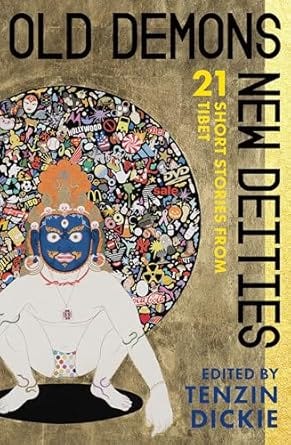
A couple of years ago, I visited a Tibetan exhibit by Tsherin Sherpa. His modern artistic depiction of the devolution of society away from a full recognition of the objective look of demons into an open idolatry of demons: “Influencers.” His entire exhibit was like a bloody sword against the Western imperialist idolatry that has submerged so much of value. Look at these faces. These are demons.
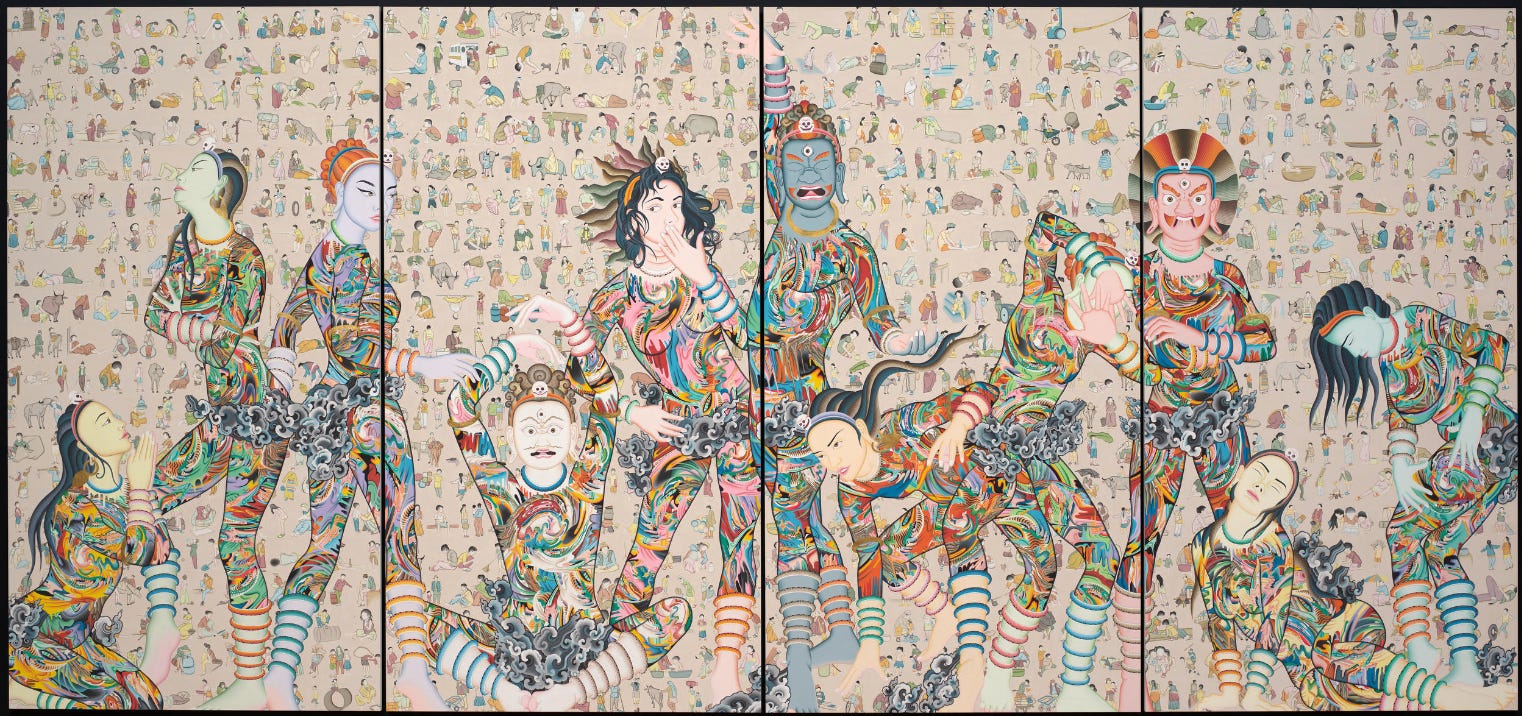
The planetary rhythms are very low frequencies and speak to a place more primordial than sex itself. The gods are older than sex. And the gods play bass. But human freedom means liberation from being under the thumb of the archons, which in its fullest sense means we are no longer beholden to the body’s demands. Our fight is not against flesh and blood but against the gods that would turn our bodies into puppets of their one-sided whims (which some would describe as “mortal sins”). To say something is wrong with the body (or matter) would be as absurd as saying that a bass guitar is immoral. No, it’s about our relationship to these things. There’s nothing wrong with food, but a disordered relationship to food can lead to many problems.
Transcending the world of appearances doesn’t mean appearances are false, but our original understanding of them was incorrect. I cannot appreciate their more significant meaning if I can only value sensory stimuli by whether they cause me pain or pleasure. If I only like a plant based on whether it’s subjectively pleasing to me, then there is an entire world of plants I do not appreciate because I don’t have the time to pause and learn their value. Transcending the world of how surfaces affect me is depicted in the Flammarion Engraving as the man whose head pierces through the veil of the starry heavens and who begins to contemplate the inner realities of the spiritual world.
We should never forget that we can only perceive what we can resist. My body has nothing designed to resist X-rays, so they go through me or bounce off me undetected. My eyes are a dark cave designed to catch and absorb light. My eyes are not permeable to light; they obstruct the path of light. I cannot perceive the powers of the gods if I cannot resist them. If I cannot resist the powers of the gods, then I am their slave — or rather, their devotee. They feed off me. They use me. But I am unfree in such a relationship.
Only by resisting the powers of the gods do their obsessions begin to become conscious to us. Think of someone struggling in water who can’t swim: such a person can’t properly resist the water with their limbs but flails about futilely. This is how we are as children, and this is how humanity as a whole was collectively. Those who cannot resist the confluence of the gods are like a drowning man. Those who gain some self-control are like someone who can swim — perhaps even swim very well. But our aim goes beyond this; we aim to walk on water.
Walking on Water
·
January 12, 2024

“[W]hen the Merciful One made the worlds, first of all He created that Stone and gave it to the Divine One whom the Jews call Shekinah, and as she gazed upon it the universes arose and had being.” - Charles Williams, Many Dimensions
I read somewhere about a study of different animals, all of which could easily be clicker-trained, except for otters. I don’t remember the reference now, and I don’t have personal experience with otters. If I remember, I’ll plug it in here at some point.
Theodore Schwenk, Sensitive Chaos, pg. 62
Theodore Schwenk, Sensitive Chaos, pg. 64
Comments
Nothing yet. Say the first thing.
Sign in to join the conversation.