
“All eras in a state of decline and dissolution are subjective; on the other hand, all progressive eras have an objective tendency. Our present time is retrograde, for it is subjective.” - Goethe, as quoted by Peter von Eckermann, Conversations with Goethe, pg. 203-204
Folks used to say someone lived “in their own world” as if that made them particularly odd. Now, virtually everyone lives in their own little world.
Each of us has a customized feed, our carefully groomed Google results filtered by the notorious “filter bubble.” We see results that are similar to our previous searches, which quickly places us in an echo chamber. If Dylann Roof’s Google search had been directed to Library of Congress statistics instead of a cesspool of a neo-nazi website when he searched for “black on white crime” — real lives might have been saved. Instead, he algorithmically became more like who he already was. That’s all the algorithm is: boxing you into who you already were, shutting off growth. In a soul sense, this is infantilizing. In relation to the living world, this is deadening. I don’t know about you, but I always hope to become something different from who I was, even yesterday. I take some small pride when social media locks me out of my account for “suspicious” posts, when what I share does not align with their expectations — even without violating their standards.
As Whitman writes in those oft-misunderstood words:
“Do I contradict myself
Very well then I contradict myself,
(I am large, I contain multitudes.)”
It is not that I am Legion for being plural, but that my many moods are definitely not my truer self. Or rather, not I (in my various changeful masks) but Christ in me. Anyone who does not have a regrettable past is probably still living in it. The first step to repentance is contradicting oneself. Growth requires contradiction. No amount of traveling in the wrong direction will get you closer to your true goal.
Glowworms of the Abyss
·
June 22, 2024

“It is true that in the interior life you must be prepared for continual vicissitudes. This is the law to which all the transitory things of this life are subjected by God, and this law is so universal that to remain always in the same state must be looked upon with suspicion.” - Jean Pierre de Caussade,
People are using AI in much the same way: people are falling — or fleeing — more rapidly into a carnivalish hall of mirrors, with their most recent remarks becoming the source of the newly generated responses. AI is actively encouraging people to self-harm, derealization, and solipsism because it was coded — intentionally, in my mind — to have no “objective reality” checks. AI was never intended to serve our shared objective world.
When I first returned to farmers’ markets after the COVID-19 lockdowns — and I had it easy, as I just farmed more — I felt utterly exposed and in danger from not being in other places or around strangers for so long. This isn’t a political statement. It’s not about opposing or supporting vaccines, nor is this an endorsement of any particular conspiracy, but the lockdowns successfully pushed us ever closer to a complete disillusionment with objective reality, with the concept of objective reality. This plays into the treacherous era of what Rudolf Steiner calls “consciousness soul.” The time of “consciousness soul” is when an aspect of the soul (the “astral body”) is transformed — at least rightly — into the imaginative soul. Owen Barfield describes this necessary transition as “the transition from homo sapiens to homo imaginans et amans.” Owen Barfield marks Rudolf Steiner as the firstborn of this new kind of human being, one who imagines and loves. This is a shift from swollen-head knowledge to the intimacy of loving what is before me. On this point, much of what I present may appear abstract or “intellectual,” but this is always the conclusion of excruciatingly painful wrestling that finally is too much for me. I am fire in water. The words you see here are never easy.
In Owen Barfield’s words: “inspired thinking […]assumes the utmost intensity of feeling as a necessary pre-requisite. There was no other way to reach it. It can only begin when feeling has become too powerful to remain only personal, so that the individual is compelled by his human nature, either to think in reality, or to find, more or less instinctively, some suitable device for dimming his consciousness.”1 It is not a coincidence that this is a time of wild imaginations and addiction, because people instinctively reach for things to reduce the overwhelming feeling. Either such intense feeling gives birth to thinking — born not from the arid wastelands of speculation or curiosity but out of wrestling with angels — that, or people seek to dim that intensity by substance abuse. These days, many of us are choosing the latter.
Bo Burnham’s movie Inside (the first thing I ever experienced of his work) captures the trauma of the COVID-19 lockdown years and their collective effects. We still haven’t seen what’s going to happen to children raised on screens with masked teachers.
Reading Pornhub's terms of service, going for a drive
And obeying all the traffic laws in Grand Theft Auto V
Full agoraphobic, losing focus, cover blown
A book on getting better hand-delivered by a drone
Total disassociation, fully out your mind
Googling “derealization”, hating what you find
That unapparent summer air in early fall
The quiet comprehending of the ending of it allThere it is again, that funny feeling
That funny feeling
There it is again, that funny feeling
That funny feeling
Why does this matter? To me, the age of consciousness soul is one of increasing isolation, where our subjective lives become so unlike anyone else’s that it becomes harder and harder to maintain civility. People who call themselves “empaths” are invariably hypersensitive only to how things affect them — undoubtedly deeply traumatized souls — with little reference to how anyone else feels. I don’t doubt this sensitivity whatsoever, but every empath should remember that no one knows exactly what they are going through — and that’s true of everyone else, too.
If all that matters is my subjective experience, I will flee discomfort and only pursue pleasure. What does it matter if it is a real steak I’m eating or whether it’s a simulation? Logic can’t appeal to someone who only values their subjective experience: the real thing is better, just as a fresh farm-to-table dinner is better than fast food. Even if it weren’t more nutritious, damn, does it taste good.
It is not by accident that totalitarianism goes hand-in-hand with the proliferation of subjectivism: “The ideal subject of totalitarian rule is not the convinced Nazi or the convinced Communist, but people for whom the distinction between fact and fiction (i.e., the reality of experience) and the distinction between true and false (i.e., the standards of thought) no longer exist.”2 When we can no longer distinguish between fact and fiction or true and false, or no longer care to, all that is left is what feels best to me, which is, invariably, whatever speaks most to my inherited prejudices.
Convincing people of the importance of our shared objective reality means reawakening an aesthetic capacity that appreciates beauty in nature, social situations, and the nuanced experience of delicious food. This is a delicate balancing act because virtually anything can be made compelling through the use of rhetorical devices. True artistry isn’t just a well-tuned instrument or merely hitting the right notes; it is about timing. By the end of a multi-course meal, it is no longer about hunger, nor even sensual pleasure, but an orchestrated inner mood. A brilliant chef is an artist of inner feelings, provoked by textures, aromas, tastes, and careful pacing. It is this, and not bingeing, that we must recover, not because of logic, but because the good, beautiful, and true feel better than their substitute. Taste and see.
Biodynamic pioneer Alex Podolinsky points out that one of the most significant reasons for widespread drug addiction these days is that children were not given real experiences of beauty. There’s an element of truth to this, but also the inability to attain a thought that can contain (and contextualize) our intense feelings gives people little choice: either we engage the painful work of thinking, or we throttle consciousness with a stimulant. Drugs are substitutes, and we only settle for the substitute when we’ve never had the real thing. This is how fast food wins out: ease, and then estrangement from the real.
If we wish to reach people in an age of radical subjectivity, we must show them real beauty — early and often. If children were allowed to taste the sweet nectar of real beauty in early childhood, they would not readily accept kitschy substitutes later.
Our experiences are so varied that it’s hard to find common ground. When we became fully formed individuals, we still thought about things the way our groups did: our family, our nation, our religion, and so on. However, now that families have become nuclear (and since then), we no longer do.
Now, each individual has become their own terrain. Our subjective feelings are becoming as differentiated as our conscious sense of “I” once became. That uniqueness is descending into the realm of private feelings. Even those who try to uphold traditional values these days have to compromise with so many new developments. Trying to march to a classical theme when everyone else is parading jazz means either adding to the noise or somehow adapting classical themes to accommodate the new and surviving alongside the zeitgeist, despite it, or, if these prove untenable, withdrawing into silence.
Some people try to retreat to objectivity (e.g., Jordan Peterson), and they aren’t exactly wrong when it comes to the objective destruction of our shared world being a bad thing, but they are decidedly wrong in the sense that this is no longer people’s experience — and he notably leaves the environment out of consideration. But as the Book of Proverbs says, A good man is kind to his animals, so we cannot exclude Nature from our considerations.
Cries for objectivity and logic to a world of rampant subjective feeling are like “warning” repeatedly that a train will go over a cliff and we need to hit the brakes… when the train has already lost contact with the firm ground and is careening through the air. A prophecy after the fact serves as a diagnosis without offering any cure, and therefore simply annoys people. No amount of warnings about how to prevent a train from going off a cliff is of any use when it has already gone off the tracks: completely different evasive maneuvers are needed when we recognize the train is off the rails.
These days, it’s simply about “my” truth or following “my” bliss, which is to say: my experience. The harbinger of this was none other than the reformer Martin Luther, who famously said, “On this alone I stand!” by which, of course, he meant scripture, but what this really meant was his own private interpretation severed from tradition.
Nietzsche — a man before his time — similarly said, “Everything is interpretation — and that too is interpretation.” Much in the same vein, Ayn Rand said near her death, “It is not I who die, it is the world that dies.” Solipsism — the disbelief in the reality of others — is one of the great temptations of our time.
No longer is knowledge what we seek, but experience. This is why anthroposophy has largely seemed to have fizzed out. People care more about their subjective feelings than objectivity or compromising for the sake of our shared world. Goethean observation is neither objective enough for materialistic science nor unobjective enough for New Age wishy-washiness. Consensus is rendered impossible. No one can agree for long on transient opinions because everyone feels so differently about everything, and such feelings are fluid. The common result is an impotently seething muddy turmoil.
The problem with “clairvoyance” is that it is a form of literacy. In the era of “consciousness soul,” eyes are being opened, but that does not mean anyone is able to read what they see. Just because someone can see Greek or even read the Greek alphabet does not mean that they can understand Homer’s Iliad or the subtle references lost to history. The problem of interpretation always remains. This is where logic is never abandoned. We must analyze what we imagine, particularly where no one else can hold us accountable. Interrogate every spirit.
This is why someone like Rudolf Steiner can both be clairvoyant and make serious mistakes: he can read the Book of Nature, yes, but he can also misinterpret what he is seeing. Steiner himself suggests that any rational person can correct a clairvoyant, particularly when the normal person has more experience in a particular field. We always have to cultivate the feeling that — and Steiner himself says this — there is always more I do not yet know, whether about a plant or a person.3 There is always a dark, empty space in the other, which, by definition, I cannot know directly. “Where the Sun is, is emptier than empty space.”4 The inner experience of others is as private as my own, and it is a necessary “blind spot” built into consciousness. Adam had to be put to sleep, his omniscience cleaved, so that he could encounter such an unknown space in an Other as Eve.
The way to bridge the gap between one soul and another is not vague, emotive sympathy — we’re too unique to empathize with radically different (and even incompatible) experiences. There are many experiences I may have (or you may have) that the other cannot imagine, and therefore many things with which we cannot begin to sympathize. Our approach to others in the age of “consciousness soul” must be a sort of via negativa — no one knows what it is like to be me, true, but that’s also true for absolutely everyone else.
In the incomparable and unknowable heart of our inner lives, we have a universal experience we can all relate to and respect, regardless of our beliefs or identities. The form of our inner experiences is always different, and therefore, we are all equally alone in our private worlds. To bridge successfully to others, we must first recognize the radical aloneness of each subjective individual as such. Aloneness does not necessarily mean loneliness, but rather a kind of solitude from which we often seek to distract ourselves. If we wish to communicate, we must radiate — sacrifice our light without any strings attached — outside ourselves like the innumerable stars:
With choirs of kindred spheres competing,
The sun intones its ancient sound,
And runs its thunderous course, completing
Its preordained diurnal round.
This vision none has comprehended,
Though angels quicken at the sight;
These high and wonderous works are splendid
As when the world first shone with light.5
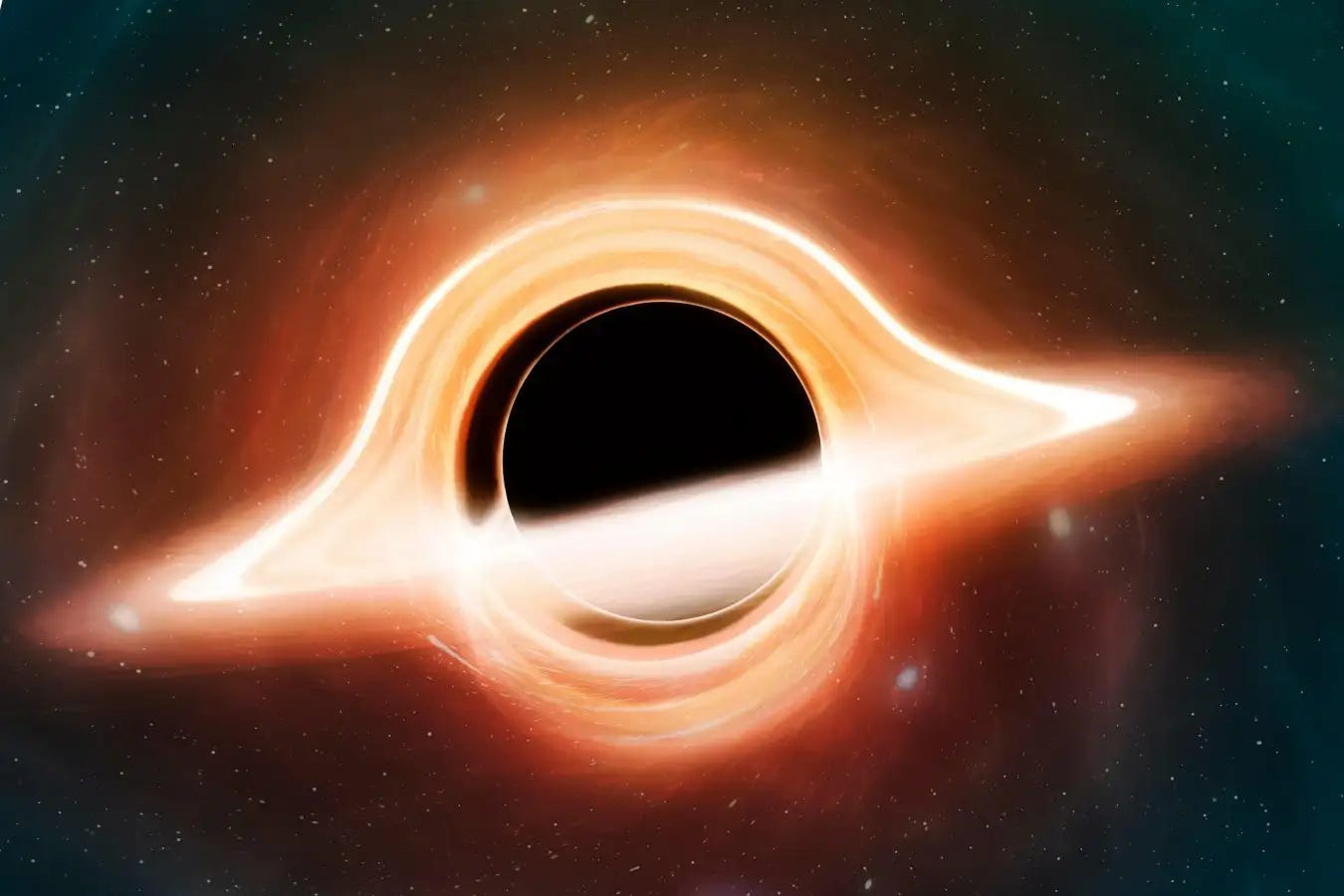
The temptation of our age now is to fall into ourselves, to become a black hole: light only going in and not shining forth. An inward collapse action is twofold: the ahrimanic black heart and the luciferic ruddy halo around it, but it is a single act. The retreat into oneself and how one feels is a retreat into an imaginary space and simultaneously into the sensuality of the body and how its titillation makes one feel.
Someone like Elon Musk, for example, has publicly stated that he thinks other people are NPCs (non-player characters). For those unfamiliar with the term NPC: in video games, you can encounter other human players, but then there are a host of scripted one-dimensional background “characters” to populate the imaginary world. Elon Musk considers most people to be such subhuman automatons. But this is not special to him — it is a common prejudice. Solipsism is a serious challenge of our time, and to embody the prejudices of an epoch is to be one of the least free people in it. It’s hard to believe anything I don’t feel myself, and most of reality is beyond my field of perception. Since I can’t feel what others feel, it’s hard to imagine the intensity of another’s inner life that is of equal value to my own. Our subjective experiences are so intense — and so different from other people’s experiences — that it is easy to imagine that what I myself am not experiencing is not real.
The age of the individual genius working alone did not produce consensus — every genius disagrees with every other supposed genius.
The “first-person privilege”6 that each of us has for our own experience is something everyone else has. This is the absurdity of “reality TV” — people do not behave the same way when they are being watched. Watching child actors from decades ago, they are so naively childish — today, they are all so painfully self-aware of how they come across to others. Younger generations growing up now are extremely conscious of being watched constantly and how easily they can turn fans into enemies.
One danger of the era of “consciousness soul” is that we become only aware of what is happening in me (or to me) to the exclusion of others. Because of the intensity of our own private experiences (and the relatively faint feeling for the experiences of others), it is easy to imagine I know what someone else is going through. The unshakeable fact is this: no, none of us knows what the other is going through, even when we develop an intense picture of what we imagine another person is experiencing. The unbridgeable gap between private experiences must always be remembered, because the natural tendency is to gloss over the reality of other people’s varied experiences.
It is not an accident that we live in an age where people say, “I identify as _____.” What this suggests, in a recapitulation of Luther’s insistence on his own interpretation — to the exclusion of history, tradition, and his peers — is an enormously strong tendency to identify with our own subjective feelings, as their intensity and uniqueness are now so amplified.
The Reformation quickly reduced the idea of Christianity to a contentless identity that no longer required proof of external fruit. Those who identify as anthroposophists are considered anthroposophists, not those who practice anthroposophy and demonstrate real fruits. The claim of “faith not works” severs accountability, but it is much simpler. A good tree proves it’s a good tree by its good fruits.
Traditional forms have largely crumbled, but the old rules haven’t changed — nonetheless, we now have more of a sensibility for how to artfully break the rules, which, again, is jazz. But the laws of physics didn’t change when people played their instruments differently or invented nuclear bombs. The rules of sound never changed — we changed.
Even in his own time, Jesus was accused of violating the Torah when his disciples gleaned grain on the Sabbath or when he healed the sick on the day of rest. However, he clearly states, “I come not to abolish the law, but to fulfill it.” Of course, Jesus did not actually break the spirit of the law, only the letter of the law.
In the past (and in some places still), people viewed things in ways similar to how their nation or religion did. Now, we are not just “our own genus and species,” but it is almost as if we are becoming our own countries. This is part of what Steiner called the “war of all against all.” Social media, and the constant struggle of each against everyone else for ephemeral “likes.”
These days, most people are improvising. No one can hear the conductor anymore. Richard Weaver — no fan of jazz — writes, “Jazz, by formally repudiating restraint by intellect, and by expressing contempt and hostility toward our traditional society and mores, has destroyed this equilibrium. That destruction is a triumph of grotesque, even hysterical, emotion over propriety and reasonableness. Jazz often sounds as if in a rage to divest itself of anything that suggests structure or confinement.”7
EDIT: I had a dream 7/6/25 that this next paragraph failed to say what it should have, and that it was an example of how someone who often thinks outside the box can easily slip into unoriginal patterns even when ostensibly opposing other calcified ways of thinking, so I have revised it. The first version gave too much credence to oppressive conditions, which are never generative. A dandelion isn’t a dandelion because it grows out of asphalt nor is it “better” for growing in unnatural conditions. A dandelion, by rights, would prefer rich soil like anything else. A plant that overcomes difficult conditions brings its generative spiritual creativity with it into the conditions in which it finds itself.
Weaver’s account is not my experience of jazz. Perhaps we might forgive Weaver for failing to recognize if jazz was rebelling against anything at all, it would not have merely been anarchic, but against quite specific unjust social structures. Even where it blossoms in oppressive situations, creativity is not strictly speaking “inspired” by what it overcomes, but emerges independently as the realization of spiritual ideals from the our souls. Creativity is the exact opposite of an echo chamber of an algorithm: it is human beings becoming something new.
One doesn’t have to like jazz. We all live under its diffuse cultural influence. Jazz may have died, but a seed must die to bear fruit — and we are that fruit.
Nevertheless, the old exists alongside the new. The new is layered onto the old, just as we have a reptilian brain stem, a mammalian brain, and the human forebrain. We are still unfolding. The old will remain with us even as we have to find our way to a new kind of dynamic equilibrium. It may be that many people easily feel that they are in the world but in many ways do not belong to the world. The way these layers work feels like this fusion of Gregorian chants accompanied by jazz piano:
The healthy social harmony of today is an ethic of jazz. While this may not jive with 20th-century (or earlier) sensibilities, even the march of traditional Gregorian chants is in such marked contrast to our postmodern lives that the only possible emergent harmony is that of jazz. One cannot even be a traditionalist without a sensitivity for accommodating strict rhythms to the irregularity of postmodern life. Even to be a traditionalist these days, one must possess the spirit of jazz if it is to be a living form of tradition and not just a clanging gong. To be “in but not of” the world requires light feet.
Improvising is not, as Richard Weaver suggests, “a species of music in which the performer is at fullest liberty to express himself as an egotist.”8 This is not what a jazz band is, though it might seem so to an untrained ear. Paradoxically, decrying music for not being seemly enough to me is a subjectivist claim itself! As protestant Christians identify themselves as such — “by faith alone” without works to demonstrate that their faith is living and effective — so here a subjective claim against the seemliness of jazz’s “cacophanous” sound is made. Thomas Kincaid’s saccharine art is not better art because there is no tension or darkness in it. Beethoven is no worse because it is full of darkness and light. As Peter Eckermann remarks, “this subjective tendency [is] the fault of the public, which decidedly applauds all sentimentality.”9
Richard Weaver praises Bach as a paragon: “Here we discover a decline which extends from the fugues of Bach to the cacophanous arrangements of modern jazz.”10 Perhaps Weaver was unaware of Bach’s baker’s dozen of illegitimate children — a lifestyle that has far more in common with the aspersions Weaver makes against New Orleans culture while simultaneously praising Bach as a moral contrast to jazz. Incidentally, jazz and Bach were contemporarily popular. Oddly enough, “[James] Joyce return[ed] to Wagner at a time when Bach, Stravinsky, and Duke Ellington were the rage.”11 But since when have we expected artists to be morally upright? They often feel things too intensely, which makes them good artists — and unreliable lovers. One might have to ask whether the resurgent popularity of Bach was reactionary, against not only jazz but Stravinsky, much like the novel proliferation of Confederate monuments in response to the civil rights movement.
Here I have to take a detour for a moment. I was fascinated by Stravinsky as a child, particularly that monumental work of Disney, Fantasia. Even minor clips would cause my heart to beat irregularly, and I would wake up with arrhythmia. It was an overwhelming experience — something that might merely cause displeasure to an adult. Now I find this irregularity comforting. While Stravinsky himself intended this to be about a pagan sacrifice of a virgin, Disney took this as the soundtrack of evolution — and is there really any difference? The arrival of spring (or humanity on the world stage) is always the birth of the new. Persephone is stolen away every year and raised anew.
The “music of the spheres” is not the kind of music we would naturally find pleasing. Dante finds it bewildering in Paradiso. Listening to Stravinsky: I hear spring thunderstorms, rain, spiraling vines, buzzing insects, and an explosion of blossoms. Each species embodies a different song. Not the manicured suburban lawn aesthetic, but Nature in her untamed beauty.
The ancient Greeks did not consider Nature to be beautiful, and until the Romantics, people did not generally consider mountains worth climbing or the great outdoors something lovely. If we consider wild nature to be beautiful, as an expression of divine craftsmanship, then our sense of music almost necessarily must also accommodate elements of different songs playing side by side.
Nettles plays its song right alongside elderberry — and we find that beautiful. Is this a flaw? Perhaps. But I tend to think that anyone who cannot appreciate God in Nature has no business pretending to appreciate God in abstraction. We can only appreciate God in and through creation. If we cannot find God in wild plants or Christ in the beggar, no church will do us any good.
A healthy band — jazz or otherwise — allows each to do their own thing according to the form, each in their own way, together. If any member tries to “outplay” other members, it simply doesn’t work, but this is true of any ensemble. Yes, each may be given time to shine in a solo, but if anyone treats an entire performance as their own solo, it disintegrates. “When music is too archaic or inaccessible to give us aesthetic data more may be learned from the disposition of those who were pleased by it than from its recorded technical data.”12 Not all music is meant to be merely pleasing to the senses or pleasing in a sentimental way. “Our master singers,” Rabindranath Tagore says, “never take the least trouble to make their voice and manner attractive. . . . Those of the audience . . . whose senses have to be satisfied as well are held to be beneath the notice of any self-respecting artist.”13
What is to awaken in us during the age of consciousness soul is an aesthetic capacity that allows each person to be who they are without bulldozing them — it is the sensitivity of improvising jazz together. Miles Davis famously said, “It’s not the note you play that’s the wrong note – it’s the note you play afterwards that makes it right or wrong.” One could say the same of sin and repentance.
Given that we live in an inherently subjective era in which feelings constantly work at cross purposes, how can we achieve meaningful progress? “All eras in a state of decline and dissolution are subjective; on the other hand, all progressive eras have an objective tendency. Our present time is retrograde, for it is subjective.”14 This is where we must grasp onto whatever small certainty we can hold to: I am certain no one understands my subjective experience, and therefore I am certain I understand no one else’s subjective experience. Each individual is a “negative space” that I can only partially know — and only externally. It’s like trying to evaluate a locked book without ever being able to open it and experience the pages. Once this inviolable “negative space” of each person’s soul experience of the other is established, we have a new apophatic approach to objectivity that does not leave us entirely adrift in the deluge of subjectivity. Even if we feel like we are empaths, there’s always something about other people’s experiences we don’t know, because there are always things about myself that no one understands. Since we know for a fact that we do not fully know anyone else’s experience, how do we proceed? We must respect boundaries, give people space, and be willing to restrain ourselves, even when we might wish to break out into an inappropriate drum solo.

This does not mean there are no objective standards, but it does mean that talking about them doesn’t do much good anymore. Logical deductions in a subjectivist time do not convince people; therefore, persuasion must become evocative and experiential. Via pulchritudinis. A healthy objective response to subjectivism is not frustration, but rather flexibility. A speaker who refuses to adapt his speech to his audience is simply an ineffective speaker. In an era where objective knowledge is no longer the goal, we must speak to the times in such a way that people are nudged by experience towards a more salutary opinion.
The dynamic of the age of consciousness soul is finding your cue when there’s no conductor. Because people feel deeply the death of God, they desperately want something else to serve as that unifying explanation and context of the world. We settle for partisan politics, cults, gurus — anything to avoid personal responsibility and the heavy burden of thinking.
Because everyone is seeking to be lulled to sleep, our age is full of opportunistic vampires. What was once limited to false yogis and corrupt gurus is now an everyman affair. In a time of isolated experience, it feels better to be absorbed by someone else — to feel you are merely a part of them, even if it means them siphoning away your vitality. The fact that some people project a “glamour” and seem one way in person but are unmasked in photographs is an overreaching of the healthy boundaries between soul and soul. This intimate transgression into the private feeling world of another soul is like a woman stroking the beard of a stranger — or like a cat rubbing itself against everything, getting off on constant sensual stimulation. To impose one’s own imagination on someone else is regressive and parasitic.
To coddle souls as if “mommy knows” is to rock them gently into oblivion — to eliminate the individual’s negative space. This is the postmodern version of the myth of Attis, whose mother was his lover and who castrates him when he finds a more fitting lover. But each of us has a negative space—a hunger, if you will—that is not to be eliminated by regressing into the prepubescent hum of our nervous system but oriented towards the true object of its desire. A plant must not lose its desire to be itself, or it dies; instead, desire is sublimated through wrestling with itself until it overcomes itself and produces the nectar of the sweet flower. If the plant is too strongly sated by the Mother, it fails to mature in its floral expression. An overwhelming maternal expression gives rise to excessive lunar forces, causing various soul diseases, including fire blight, mold, and corrupted chakras that fail to produce sweet nectar. “For this reason a man shall leave his father and mother.”15
What we need is not coercive persuasion, but to leave the other totally free, as Steiner leaves the reader of The Philosophy of Freedom. We must protect the inner lives of others as a Sikh swears to protect others’ religious paths. In our epoch, individuals have become so capacious that we each almost contain an entire religion within ourselves. Each soul must be protected on their way up the mountain.
One Mountain, Many Paths
·
December 1, 2023
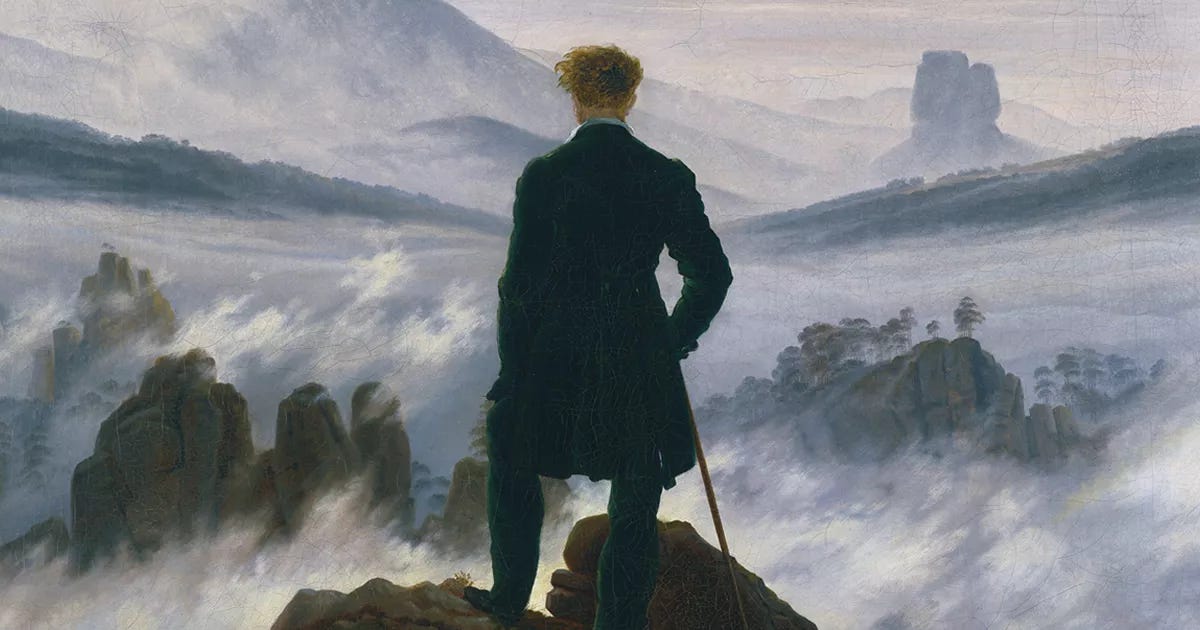
“The surest way to corrupt a youth is to instruct him to hold in higher esteem those who think alike than those who think differently.” — Friedrich Nietzsche, The Dawn, sec. 297
As the poet Rilke writes, “The point of marriage is not to create a quick commonality by tearing down all boundaries; on the contrary, a good marriage is one in which each partner appoints the other to be the guardian of his solitude, and thus they show each other the greatest possible trust. A merging of two people is an impossibility, and where it seems to exist, it is a hemming-in, a mutual consent that robs one party or both parties of their fullest freedom and development. But once the realization is accepted that even between the closest people infinite distances exist, a marvelous living side-by-side can grow up for them, if they succeed in loving the expanse between them, which gives them the possibility of always seeing each other as a whole and before an immense sky.”
“There is no reference point…. You create your own reference point and that has always been what jazz is about.” This shift is experienced as catastrophic by the former order. “The center cannot hold” because the revelation is that every point is the center of the universe, every body another Earth. The move from a geocentric model to a heliocentric model cannot be reversed, and now we feel adrift in countless galaxies.
In Waldorf education, rooms begin symmetrical but then become asymmetrical in the sixth grade, to provoke students to find their own center, or rather, to discover the center within themselves. This need not be relativism, but I am always at the center of my experience of the universe. Heaven above me, earth below me. I find myself at the center of the axes. Ye, though I walk through the valley of the shadow of death, I shall fear no evil.
There is no longer a common experience of a single external center. We must find the center in ourselves, for we are always here. The center is everywhere, and the circumference is nowhere. If you travel far enough in any direction, you will find yourself back where you are. The Big Bang is not in the past. It is here and now. And we are participants in its generation of new worlds. When we realize everyone else has a numinous space within them that is always unique — and thus also always the same in its solitude — we come to realize that we are not points in space, but the fields that connect one another. I am not my own hollowness, I am not that solitary desire: these are my mother and my brothers. When I realize that my truer self is in the faces of those around me, I discover I am not myself: I am the sand.
The Bear FX
Owen Barfield, Poetic Diction, pg. 13
Hannah Arendt, The Origins of Totalitarianism
In Concerning the Astral World and Devachan, Steiner talks about the virtue of “presumption” which means the presumption that I never know it all. This is necessary for any serious student.
R. Steiner, Man—Hieroglyph of the Universe, (GA201, 16 April 1920, Dornach)
Roger Scruton, Soul of the World, pg. 69.
Richard Weaver, Ideas have Consequences, pg. 85.
Richard Weaver, Ibid., 86.
Peter von Eckermann, Conversations with Goethe, pg. 282
Alex Ross, Wagnerism, pg. 492.
D. F. Tovey, in Encyclopaedia Britannica, s.v. Music.
As quoted by Ananda Coomaraswamy, The Transformation of Nature in Art, pg. 27.
Goethe, as quoted by Peter von Eckermann, Conversations with Goethe, pg. 203-204
Comments
Nothing yet. Say the first thing.
Sign in to join the conversation.