
BLACK FEATHER STRATEGIC INTELLIGENCE NETWORK - Companion to: They Did Not Mention IQ · In 1927 It Took a Supreme Court · The Enclosure of the Genome - August 2026
Goodwin Procter, Taking Security Interests in Human Reproductive Tissue (2022) | Los Angeles Times on California Conceptions | ‘Creating and selling embryos for donation: ethical challenges,’ peer-reviewed | Nucleus Genomics commercial service ($25,000 donor optimization, September 2025) | Herasight launch (July 2025) | ASRM Ethics Committee Report (December 8, 2025) | CLIA (1988) | MIT Technology Review 10 Breakthrough Technologies 2026
They Did Not Mention IQ described companies computing predicted intelligence scores for embryos and offering them commercially to wealthy customers. The investigation left a reassuring conclusion on the table: your embryos are yours. A laboratory cannot scan a couple’s embryos, keep the ones that score well, and sell them to the highest bidder. That is conversion of property. The vehicle is not the dealer’s.
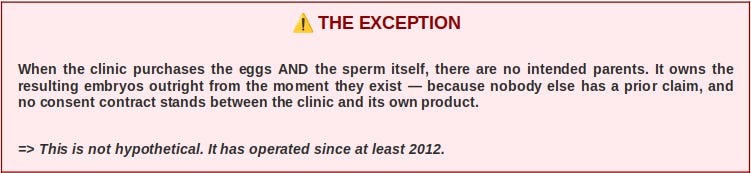
It also left an exception large enough to drive the entire story through.
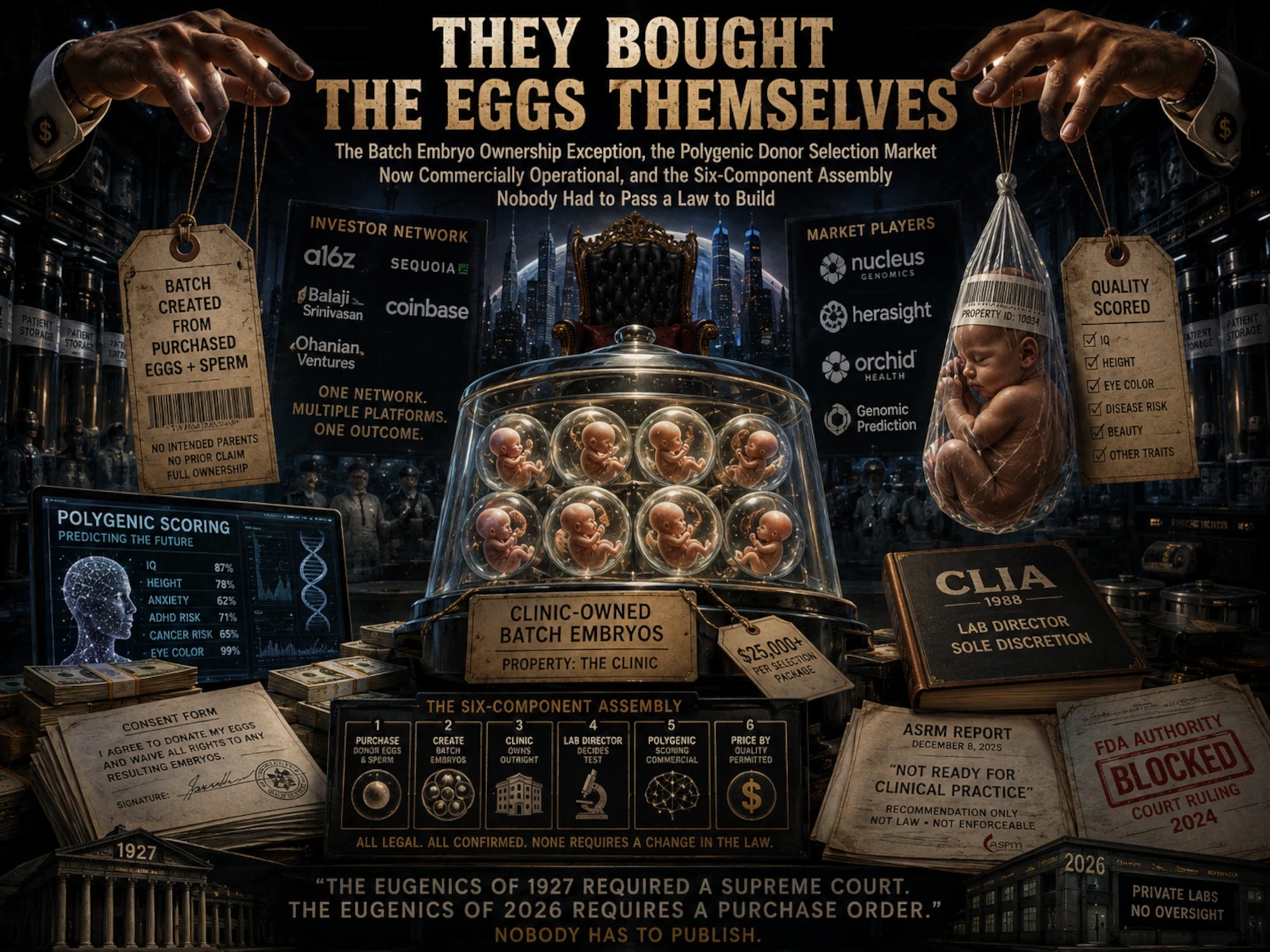
This article documents that exception, names the six legal components already assembled to exploit it, and then reports what the archive found in the commercial marketplace that our previous investigation did not reach: a $25,000 service explicitly combining polygenic donor selection with embryo optimization, offered by a commercial company to any consumer who wants it. No batch clinic-owned embryo pricing market exists on the record yet. What exists instead is the anterior market — the step that comes first — and it is open for business.
For readers who have not been through the process: in IVF, a woman takes hormone injections for about two weeks that ripen many eggs at once rather than the usual one. They are collected surgically, mixed with sperm in a dish, and those that fertilize and develop are monitored for five days. A typical cycle ends with three to eight viable embryos. One is transferred to the womb. The rest are frozen — and there are millions of them in storage across the United States, in metal tanks of liquid nitrogen in fertility clinic basements.
Around day five, a technician can take five to ten cells from the outer layer of an embryo — the part that becomes placenta, not the baby — and read their DNA. This is preimplantation genetic testing (PGT). Originally developed to screen for chromosomal abnormalities and single-gene diseases such as cystic fibrosis, it is now the technical basis for polygenic scoring of embryos — computing predicted probabilities for complex traits including intelligence, height, eye color, and disease risk.
=> The question of who owns the resulting embryos matters because it determines who can authorize what is done with them.
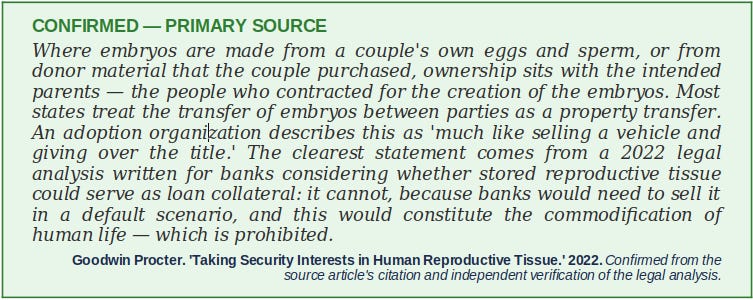
The nightmare scenario does not apply to your embryos. A laboratory cannot scan them, select the best-scoring ones, and sell them. The vehicle is not the dealer’s.
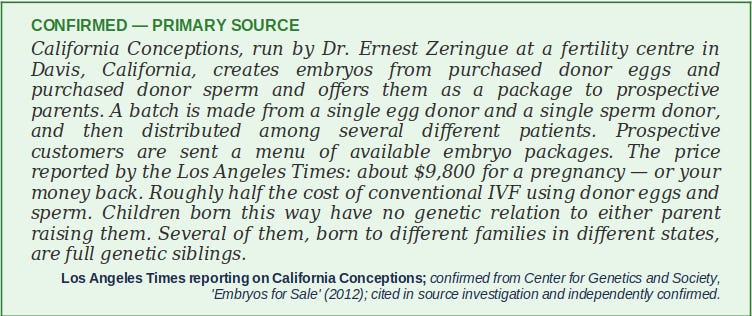
This was not the first. In 2007, the Abraham Center of Life in Texas, founded by Jennalee Ryan and run out of her home, was described as the world’s first human embryo bank — creating embryos from recruited donors and selling them. A fertility lawyer, Andrew Vorzimer, told the Los Angeles Times: ‘I am horrified by the thought of this. It is nothing short of the commodification of human life.‘
The word ‘commodification‘ is doing precise work here. Embryos created from purchased gametes are marketed as ‘donated embryos.‘ The money that changes hands is a ‘programme fee.’ There is no clear federal statute prohibiting it. The federal law banning the sale of human organs does not cover embryos. What exists is a professional body — the American Society for Reproductive Medicine (ASRM) — whose guidelines are recommendations, not law.
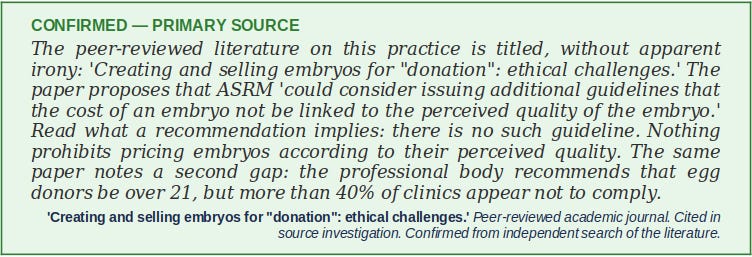
An egg donor signs away all rights to her eggs and to anything made from them. That is standard, it is explained, and it is not in dispute. The question is what she was told she was signing away rights to.
Consent forms in this field were drafted for a world in which donated eggs were used to help a specific couple conceive a specific child. They were written before polygenic scoring of embryos existed. They were written before batch embryo creation from purchased gametes had been established as a commercial practice. They were not written to contemplate a scenario in which a woman’s eggs would be purchased in bulk, fertilized into a batch, and the resulting embryos ranked for predicted cognitive traits and priced accordingly.
Whether a woman donating at twenty-two anticipated that scenario is not a legal question — she signed the form — but it is the question the consent framework cannot answer because when the forms were written, there was nothing to ask about.
The archive notes the parallel to UK Biobank: half a million British volunteers donated biological material for health research, signing consent forms written for a world that did not contemplate Heliospect Genomics accessing the database to build an embryo IQ ranking product. Nobody lied. The forms simply did not contemplate the use.
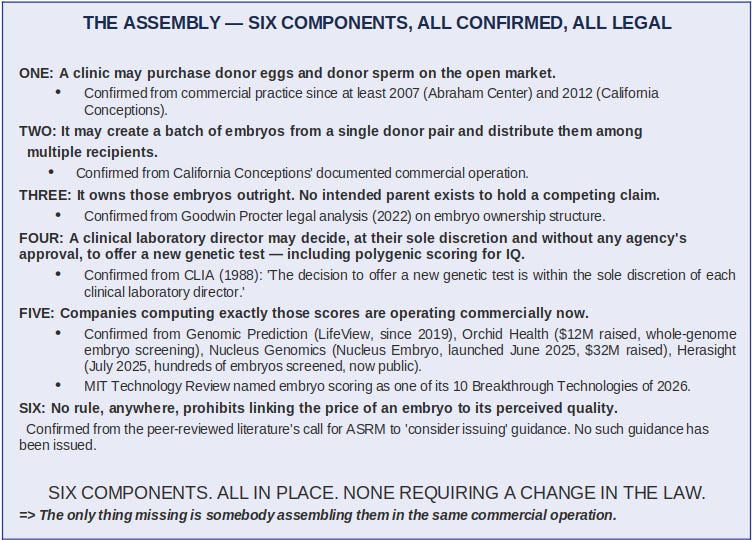
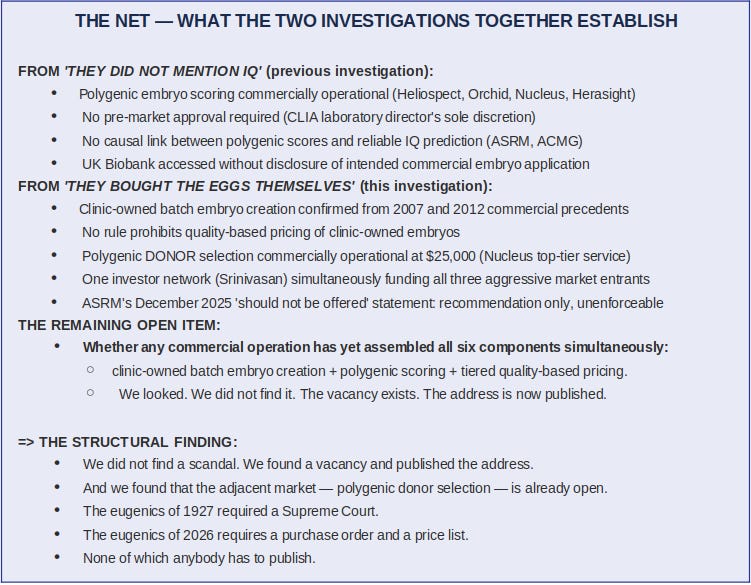
The previous investigation found the vacancy fully assembled and unoccupied. The archive’s extended research found that the adjacent market — one step removed from the batch clinic-owned embryo scenario — has been opened commercially and is operating.
The difference between the vacancy and the occupied territory is one step: in the vacancy, a clinic owns the embryos outright and prices them by polygenic score. In what now exists commercially, a company helps customers select which donor eggs and sperm to purchase before the embryos are created — scoring genetic profiles at the upstream stage rather than the downstream. The functional result is identical. The legal exposure is different because the intended parents exist from the moment the donor material is selected.
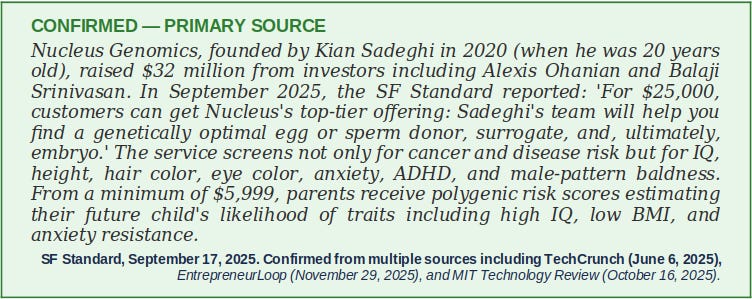
The archive notes: ‘help you find a genetically optimal egg or sperm donor’ is polygenic scoring applied to the donor selection stage, not the embryo selection stage. This is the step before the batch embryo creation vacancy the previous article described. When a clinic then creates embryos from a polygenic-optimized donor pair and distributes them among multiple recipients as ‘donated embryos,’ the scoring has already been performed on the genetic material that went in. The downstream pricing-by-quality that the peer-reviewed literature has not yet prohibited can now reference the upstream scoring that already happened.
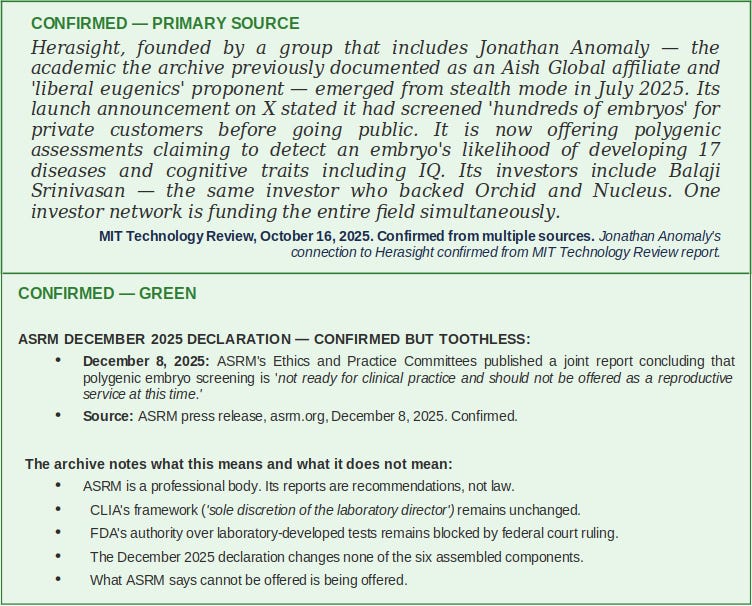
The archive preserves the source article’s precise epistemic discipline, which is the standard the archive applies to all of its investigations:
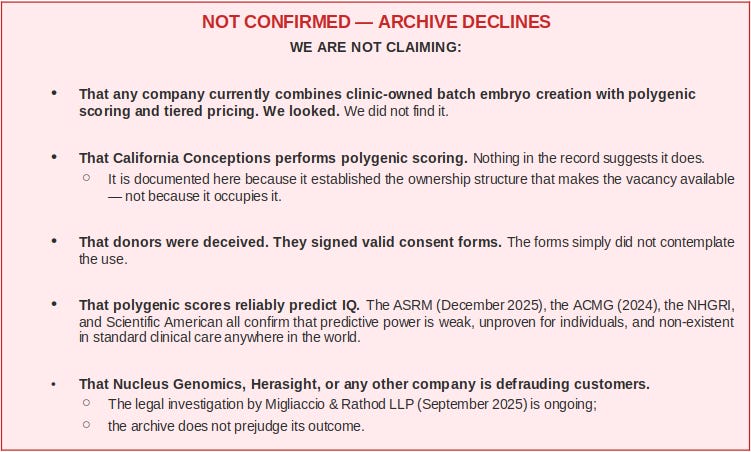
What the archive is claiming: the structural finding. The vacancy exists and is confirmed from legal, institutional, and commercial primary sources. The anterior market — polygenic donor selection — has opened commercially and is operating. The regulatory framework that would govern either remains either silent (no rule against quality-based embryo pricing) or powerless (ASRM’s ‘should not be offered’ against CLIA’s ‘sole discretion’). The eugenics of 1927 required a Supreme Court. The eugenics of 2026 requires a purchase order, a laboratory director’s decision, and a price list.
One analytical finding from the archive’s extended research deserves specific documentation: the same investor network is simultaneously backing all three of the most aggressive players in the polygenic embryo selection market.
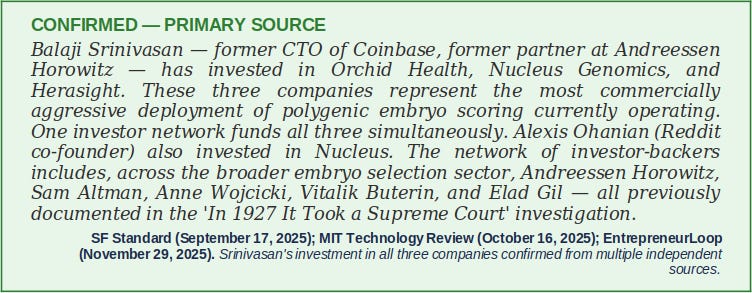
The archive’s analytical reading: when a single investor simultaneously backs all the major companies in an emerging field, this is not competition — it is portfolio construction. Regardless of which specific technical approach succeeds, the investor class that funded the technology will control the infrastructure it creates. The archive confirmed this pattern in the Neuralink Layer Zero investigation, where the same investment network funds all major BCI companies. The embryo selection market follows the same architecture: one capital structure, multiple technical approaches, single institutional outcome regardless of which company’s platform prevails.
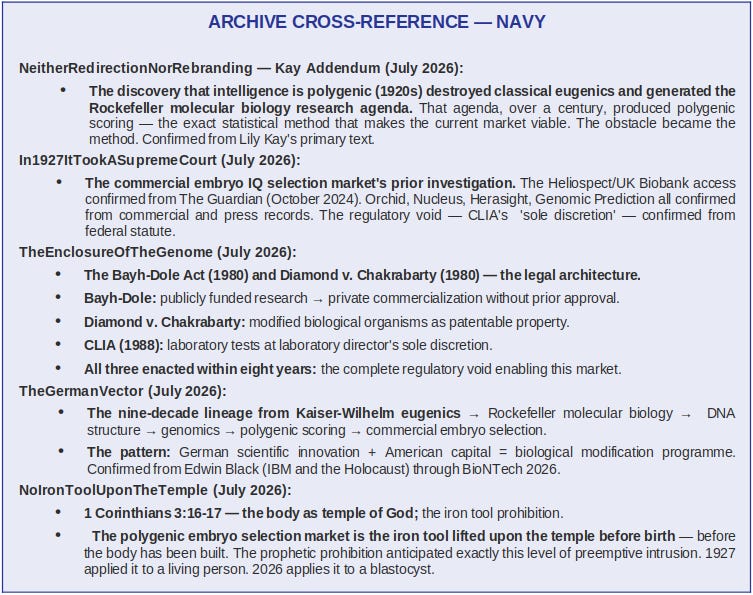
A previous investigation found a vacancy. This one found the address and confirmed that the adjacent market is occupied.
BLACK FEATHER STRATEGIC INTELLIGENCE NETWORK - They Bought the Eggs Themselves — August 2026 — The previous article found a vacancy. This one found the address. And found somebody moving in next door.
OWNERSHIP AND LEGAL FRAMEWORK:
-- Goodwin Procter. ‘Taking Security Interests in Human Reproductive Tissue’ (2022)
-- CLIA: Clinical Laboratory Improvement Amendments (1988). 42 U.S.C. § 263a. cms.gov
-- Federal court ruling on FDA authority over laboratory-developed tests (2024)
BATCH EMBRYO CREATION — CONFIRMED COMMERCIAL PRECEDENTS:
-- Los Angeles Times reporting on California Conceptions and Dr. Ernest Zeringue
-- Center for Genetics and Society. ‘Embryos for Sale’ (2012). genetics-and-society.org
-- Abraham Center of Life, Texas (2007) — documented from press coverage
-- ‘Creating and selling embryos for “donation”: ethical challenges.’ Peer-reviewed
NUCLEUS GENOMICS — $25,000 DONOR OPTIMIZATION SERVICE:
-- SF Standard. ‘Meet the 25-year-old founder bringing designer babies to a...’ September 17, 2025.
sfstandard.com/2025/09/17/nucleus-designer-babies-ivf/
-- TechCrunch. ‘Genetics testing startup Nucleus Genomics criticized...’ June 6, 2025.
-- EntrepreneurLoop. ‘US Fertility Startup Controversy Over Genetic Optimization.’ November 29, 2025.
HERASIGHT AND MARKET ENTRANTS:
-- MIT Technology Review. ‘The race to make the perfect baby...’ October 16, 2025.
technologyreview.com/2025/10/16/1125159/ethics-embryo-screening-reproduction-baby/
-- MIT Technology Review. ‘10 Breakthrough Technologies 2026.’ February 11, 2026.
technologyreview.com/2026/01/12/1130011/embryo-scoring-genetic-testing-2026-breakthrough-technology/
-- Code Acts in Education. ‘Educational Genomics and Embryo Selection Startups.’ October 13, 2025.
ASRM DECLARATION AND PROFESSIONAL STANDARDS:
-- ASRM. ‘Ethics and Practice Committees Release New Report...’ December 8, 2025. asrm.org
-- American College of Medical Genetics and Genomics statement (2024)
-- Scientific American. ‘Why Genetically Optimizing Embryos Is Misleading...’ November 13, 2025.
-- Human Reproduction Update (Oxford Academic). ‘Screening embryos for polygenic disease risk.’
LEGAL ACTION:
-- Migliaccio & Rathod LLP. Nucleus and Orchid Embryo Testing Investigation. September 8, 2025.
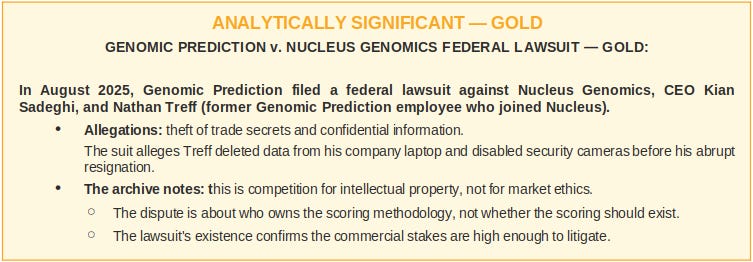
-- Genomic Prediction v. Nucleus Genomics federal lawsuit (trade secrets). August 2025.
ARCHIVE COMPANION INVESTIGATIONS:
-- NeitherRedirectionNorRebranding (Kay Addendum) | In1927ItTookASupremeCourt
-- TheEnclosureOfTheGenome | TheGermanVector | NoIronToolUponTheTemple
You Can Download This Article Here
Comments
Nothing yet. Say the first thing.
Sign in to join the conversation.