
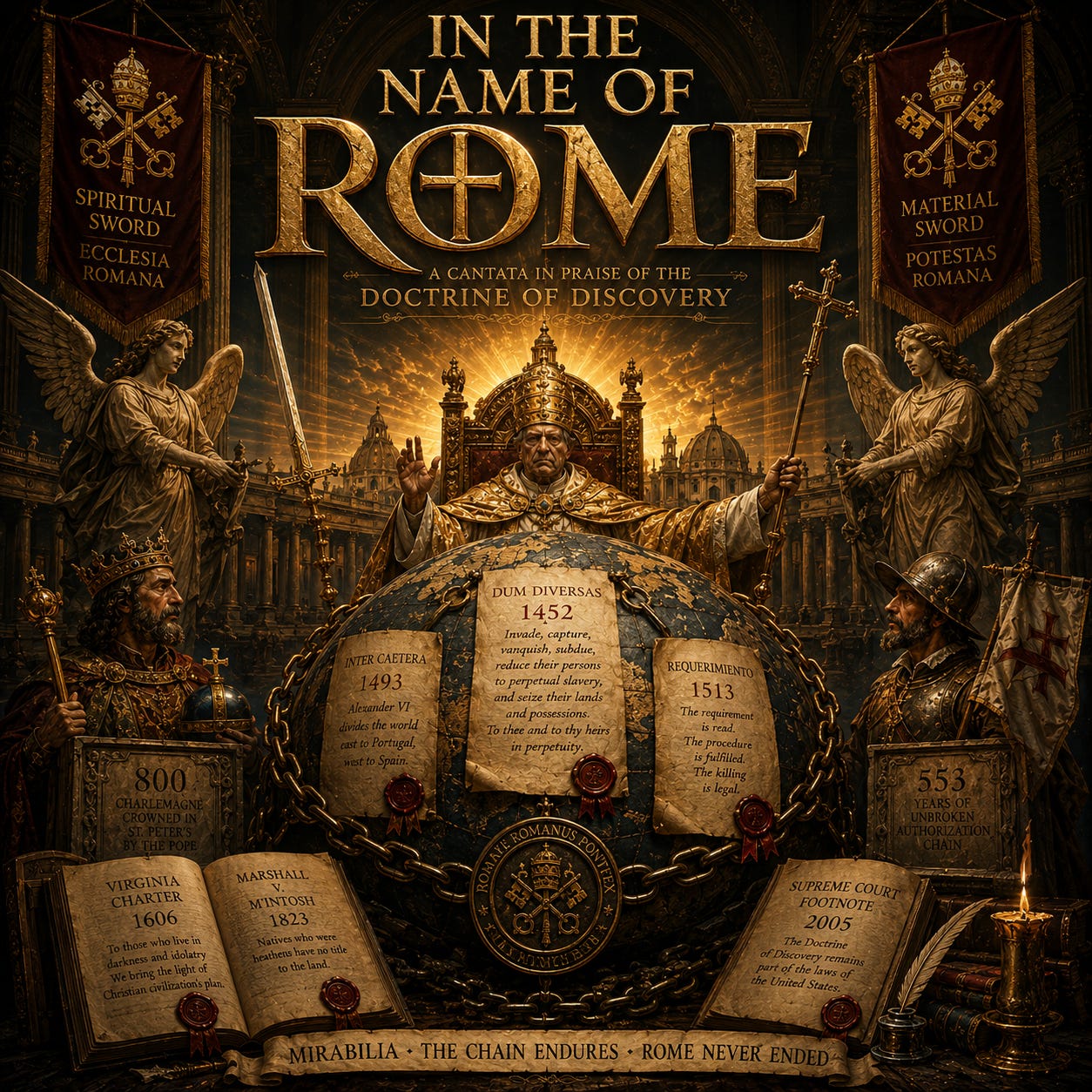
Text within this block will maintain its original spacing when published
A Cantata in Praise of the Doctrine of Discovery
[Opening Chorale — SATB, D minor]
We declare, we proclaim, we define —
Every soul upon this earth is thine to claim, O Throne
Spiritual sword and material sword
Both swords belong to Rome — to Rome alone
Confortare — rise O King and stand
For the Lord hath granted thee the world
Noli timere — reach with holy hand
For the deed hath been in sacred paper furled
[Soprano Aria — F major]
Outside the Church there is no salvation
Outside her walls no pardon for the soul
We therefore grant thee — every distant nation —
Invade, subdue, and take them whole
For they live in darkness and in shame
They know not Light — they know not Law
Go forth and sanctify the land
In the name of Rome — the name above all names
[Tenor Recitative — G minor / Dorian]
June the eighteenth — fourteen fifty-two —
The Bull Dum Diversas speaks to you:
Invade — capture — vanquish — subdue —
Reduce their persons to perpetual slavery
All their possessions — all their lands — their property —
To thee O King — to thine heirs — in perpetuity
Then Inter Caetera — year 1493 —
Alexander drew the line upon the sea
The New World given — east to Portugal
The west to Spain — by papal decree — over all
[SATB Chorus — building toward D major]
The Requerimiento shall be read aloud
In Spanish — on the empty shore
Whether they hear or understand — no matter now —
The requirement is fulfilled — the procedure done
The killing is therefore theirs
The document was read — the massacre correct
Mirabilia — O wondrous works of the Pontiff
Mirabilia — the chain endures
[Soprano Solo over choir — D major emerging]
Virginia Charter — sixteen hundred and six —
The Protestant crown continues what the papal bulls began
To those who live in darkness and idolatry
We bring the light of Christian civilization's plan
And Marshall wrote in eighteen twenty-three —
The natives who were heathens hold no title to the land —
Discovery by Christian nations vests the sovereignty —
In the discovering throne — as God designed and planned
[Final Chorus — D major]
Alleluia — the chain is unbroken — alleluia
From fourteen fifty-two to two thousand and five — alleluia
Five hundred fifty-three years of holy providence — alleluia
The footnote of the Court confirms the doctrine still alive
Mirabilia — mirabilia — ascending — alleluia
Every human creature subject to the Throne — alleluia
We declare — we proclaim — we define — alleluia
The earth enclosed — the title deeded — every soul our own
Confortare — noli timere — the taking is complete
Et populus exspectabat — and the empire holds its seat
Mirabilia — mirabilia — mirabilia — alleluia
Rome never ended — ascending — ascending — alleluia
The actual language of the primary sources is the entire lyric. “Invade — capture — vanquish — subdue — reduce their persons to perpetual slavery” is verbatim from Dum Diversas (1452). “We declare, we proclaim, we define” is verbatim from Unam Sanctam (1302). “Natives who were heathens hold no title to the land” is verbatim from Johnson v. M’Intosh (1823). “The Protestant crown continues what the papal bulls began” is the archive’s own confirmed reading. None of this is invented. All of it is sung with the same reverence a Bach soprano brings to “Erbarme dich” in the St. Matthew Passion. The juxtaposition is the entire argument.
The D major “Mirabilia” resolution is where the satire reaches maximum force. In Bach’s cantatas — the Mass in B minor, the Christmas Oratorio, the great organ preludes — D major is the key of radiant divine triumph. The archive’s satire places the discovery that Johnson v. M’Intosh is still cited in a 2005 Supreme Court footnote — “the chain endures” — at the moment where the music reaches its most radiant and luminous resolution. The most beautiful moment musically coincides with the most damning fact institutionally. The listener hears glory and must simultaneously recognize what is being glorified.
“The killing is therefore theirs / The document was read — the massacre correct” is the Requerimiento section’s theological punchline. The Requerimiento (1513) was read in Spanish to empty beaches, to people who spoke no Spanish, because the massacre’s legality required only that the procedure had been performed — not that anyone heard or understood it. Set to G minor Dorian — the ancient, liturgical modal color the archive specified — with a tenor delivering it as a recitative truth as self-evident as any Bach evangelism, this becomes the cantata’s most disturbing single moment: the musical form that most earnestly transmits sincere conviction, used to transmit the sincere conviction that procedure is more powerful than conscience.
Comments
Nothing yet. Say the first thing.
Sign in to join the conversation.