
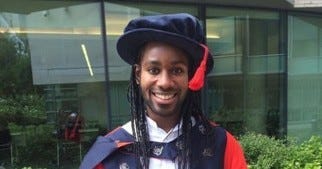
[Note: If you have somehow avoided hearing about Jason Arday, see my earlier post on “Cambridge University’s Disgrace”.]
Jason Arday has apparently killed himself due to the public scandal surrounding him. This is an extreme bad outcome that nobody wanted (plagiarism and fabulism are not capital offences). Who is to blame? And what can we learn?
People say one must not speak ill of the dead. Now that he is gone, there is a temptation to turn Arday into a hero, to paper over his misdeeds.
I would rather agree with Voltaire: “To the living we owe respect; to the dead we owe only the truth.” Jason Arday can no longer be hurt by what we say about him, and—contrary to elite opinion—we need to know the actual truth about things, if we are to solve any problems or avoid further bad outcomes.
The truth remains that Arday was a plagiarist and a fabulist who was unqualified for his post. The evidence there is extremely clear, and his death changes none of that.
Indeed, had Arday actually been an accomplished scholar and had the attacks on him been mere racist lies as some activists now pretend, he would most likely have survived the attacks. That’s because he would have known that the Cambridge investigation would turn out in his favor (or there would never have been an investigation), that he would be fully vindicated in the end, and that the academic community would be fully behind him all the way. In the actual case, he knew that he had done what he was accused of, and there was no way of hiding it. Cambridge had stopped defending him, and some academics who had signed the letter in support of him had started removing their signatures.
Like everyone else, I assume it was Arday who killed himself. I think this was wrong on his part. This is not to minimize the suffering of being publicly attacked and ridiculed in the way he was—I have no doubt of the severity of this. But he had a wife and two children, who presumably needed him. Now his children must grow up without a father. Nor would the scandal have ruined the rest of his life. The news cycle would probably have moved on in a few weeks, or at most a few months, though he probably could never have gotten a professor job again. He had a huge advance from his publisher, which should have tided him over till he found a new job.
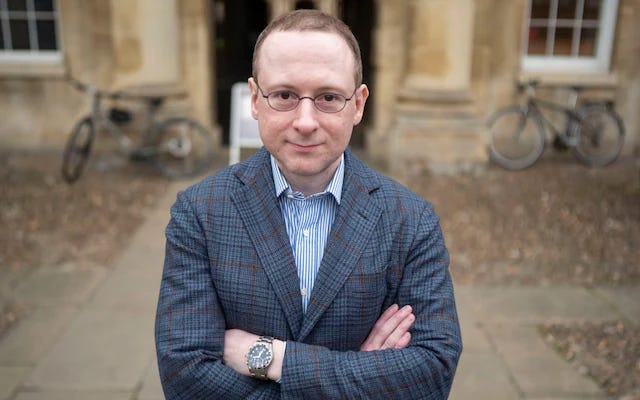
Many are blaming Nathan Cofnas, the philosopher who broke the story on Substack. He has been suspended by Ghent University, and he expects to be fired. His Facebook page is now full of hateful comments, ranging from insults to calls for his death.
I can’t see anything that Cofnas did wrong, though. His post exposing Arday is not filled with racist invective (as you might expect from hearing people talk about Cofnas); it simply lays out the case for Arday’s misconduct. Most of it consists of a long list of passages from Arday’s work that match someone else’s work. As far as I can tell, everything Cofnas says is factually true. It is not misconduct to report someone else’s misconduct.
Q1: Should Cofnas have just reported the misconduct to Cambridge University?
A: No, people already tried that. Cambridge had been ignoring concerns about Arday for the past three years.
Q2: Should Cofnas have left it to mainstream journalists to report the story?
A: Again, that had already been tried. The Times Higher Education had the story, but they spiked it after being intimidated by Arday’s lawyer. Arday also intimidated a journalist and an academic who were asking him questions, by reporting them to the police.
Q3: What was this Cofnas guy doing investigating a black professor anyway?
A: A whistleblower gave the story to Cofnas, because Cambridge had ignored it. The whistleblower apparently knew Cofnas wouldn’t be intimidated.
Q4: Did Cofnas finally get what he wanted?
A: No. Indeed, Cofnas said he wanted Arday to keep his job so that Arday could continue to be the face of DEI for the next 20 years. There’s no reason to think anyone in this story wanted Arday dead.
Q5: Okay, but Cofnas wouldn’t have run this story if Arday wasn’t black, right?
A: Cofnas was motivated by opposition to DEI ideology, which is completely rational. The reason the Arday story fit his goals is that Arday was a DEI hire. So if Arday hadn’t been a DEI hire, maybe Cofnas wouldn’t have been interested. So what?
It has to be legitimate to criticize DEI ideology. For that purpose, it has to be legitimate to cite examples of its results. It can’t be that no one can expose academic misconduct or the results of DEI policies for fear that the guilty parties might commit suicide.
Q6: But sometimes, white people have gotten away with plagiarism!
A: This is the “whataboutism” defense: If anyone ever gets away with some misconduct, then we have to let everyone get away with the same misconduct after that, in order to be fair.
No, I don’t have to go investigate any other alleged cases of plagiarism in order to figure out whether it was wrong for Arday to plagiarize.
I don’t really see that it’s the media’s fault either. The sheer number of stories about Arday must have felt to him like a torrent of hostility and unwelcome scrutiny. But if there is a recent story that is of interest to readers, and it has a legitimate relevance to public policy debate, it has to be legitimate for a news outlet to accurately report the story.
No one decided to post 200 stories about Jason Arday. It’s more like each of 200 people decided to post one story. Surely an outlet isn’t required to say, “Oh, everyone else is talking about this, so we can’t report it.” If you’re the news outlet that regularly ignores stories that everyone else is reporting, then you’re going to lose your customer base.
Now, if the accusations were really baseless as some activists claimed, then I think there would have been a good case that one shouldn’t report on them—not even to report that they were made. But again, the accusations were factually true and well-established.
I also don’t think most of the coverage that I saw was mainly focused on attacking Arday personally. Most of the criticism I saw was for Cambridge University officials and the broader DEI apparatus of academia (though I might have a biased sample).
Cambridge University officials are partly to blame. They knew or should have known that Arday was not suited to the position they were appointing him to. Did they think they could keep up the farce indefinitely (perhaps they have experience with doing so in other cases)?
I’m not accusing them of manslaughter, though. I don’t think Arday’s death could have been reasonably anticipated. But I think they should have anticipated that Arday would serve his students poorly, that he would frequently run into trouble performing as a Cambridge professor, and that he might well attract negative publicity. They should have given the position to the most qualified person, regardless of race or (alleged) disability.
More broadly, the DEI establishment—the thousands or millions of people across Western culture who are promoting DEI ideology—are also partly to blame. They made Cambridge’s malfeasance possible. The DEI partisans have created a culture that shames people into lowering standards so they can hire more minorities. Everyone who goes around calling other people “racists” or accusing institutions of racism for not hiring enough blacks and other minorities is to blame for this culture.
I confess to having made fun of Arday a bit in my earlier post. It’s highly unlikely that Arday would have seen that, but he likely saw other posts and comments making fun of him. One lesson we can take from this case is that when we discuss stories like this, we should remember that the person being talked about is a human being too, probably with feelings much like our own.
Probably his friends and family should have made sure not to leave him alone during this time.
Again, I think it is legitimate to report on evidence of misconduct, as well as to discuss individual cases as possible consequences of bad policies. But, for example, people should not direct attacks personally at the individual (if that happened), e.g., sending hostile DM’s to Arday or confronting him on the street. Reportedly, that is something he was afraid of, though I don’t know if it actually happened.
Some of those who have condemned the press for what they did to Arday appear to be attempting to do the same thing themselves, only to a different person. Some of the Arday-supporters are involved in a campaign against Nathan Cofnas, trying to get him fired from his job, flooding his Facebook page with angry and insulting messages, etc.
This is worse than what happened to Arday in at least a couple of ways. One is that Cofnas is innocent, whereas Arday was guilty. The other is that it looks like the anti-Cofnas flood is more hostile and more directly targeted at Cofnas individually, whereas the Arday stories that I saw appeared to be mainly about how Cambridge University and the DEI establishment had failed. I have seen multiple messages literally expressing a desire for Cofnas’ death.
You can’t say you’re for remembering everyone’s humanity, but then treat people who disagree with your politics like trash.
Lies really do not tend to work out well. If we go around telling lies, and we and others go around planning actions based on those lies, things will go badly. You may not be able to guess exactly how things are going to go badly, but they generally will. Arday’s death is an example of that. Few would have anticipated that this might happen, but once it has happened, you can see that it’s not completely accidental.
The DEI ideologues told the lie that any university that fails to have proportionate representation of blacks is a racist institution. That led Cambridge to use racial preferences so they could hire more blacks, while lying about what they were doing. Arday lied about his accomplishments to get the job, and Cambridge lied to justify giving it to him. Arday’s family and friends should have told him long ago (if they didn’t) that he can’t keep telling false stories about himself. That was never going to end well.
And all the lies that we’re still telling surrounding progressive ideology are going to continue harming our society until we stop telling them.
Comments
Nothing yet. Say the first thing.
Sign in to join the conversation.