
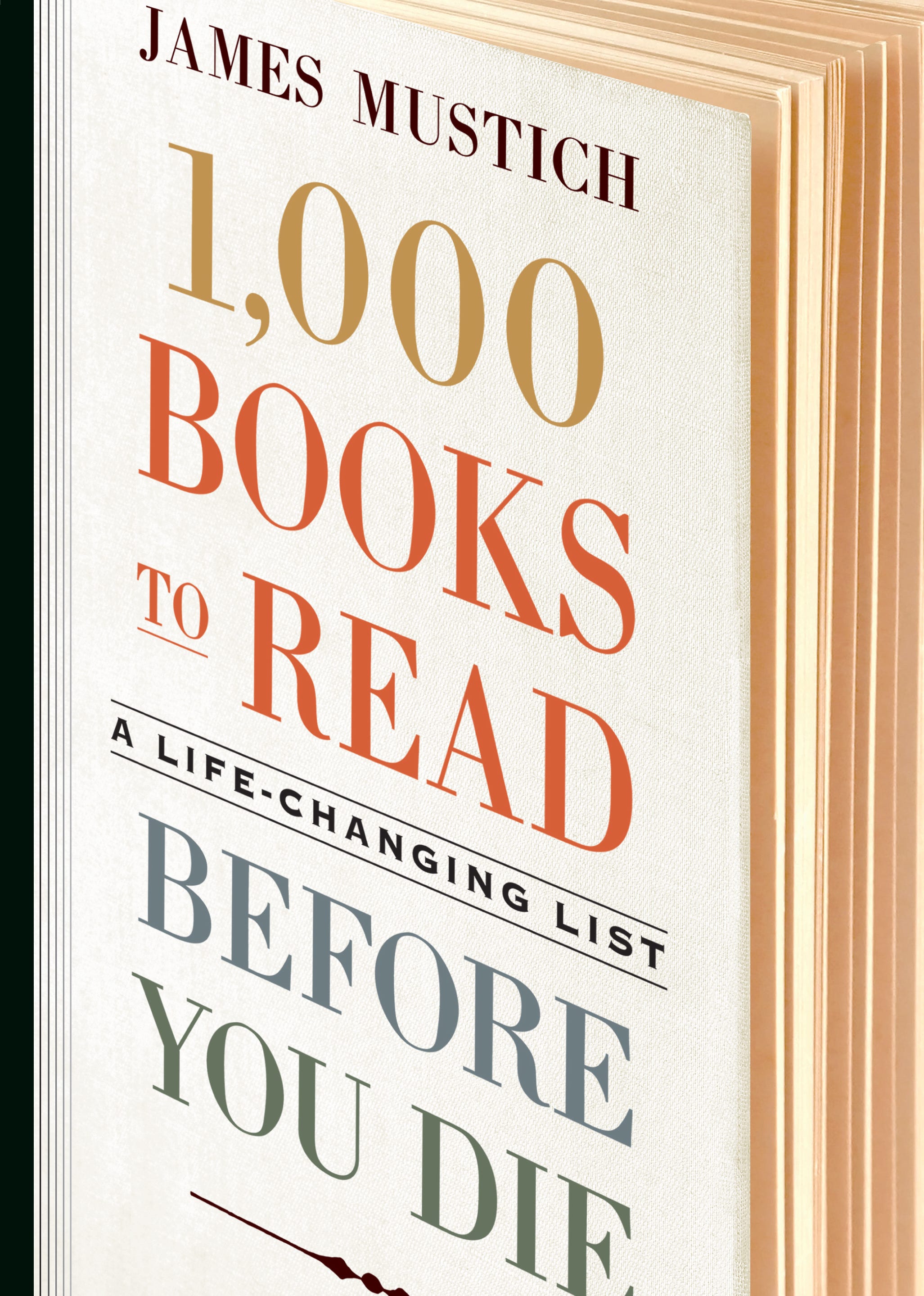
I’m a sucker for books about books and for books of lists, so when I saw a book called 1000 Books to Read Before You Die being touted at Barnes and Noble as a new release in 2018, I immediately wanted it, and ended up getting it for Christmas that year from my husband’s grandma. But it’s not the kind of book you read all at once, and I’ve kept it on or near my bedside table for the past six (6!) years, dipping in now and then. I went probably a year or two without reading much of it, but kept at it in a pretty dedicated manner for the past year or so, reading 2-3 pages a day. At 882 pages of actual content (not including indexes and checklists), it’s been a pretty good companion for a long time.
This morning I finished the last entry. I feel both accomplished and admittedly a little bereft.
I have read a lot of list books over the years - as a teen, I got the Leonard Maltin Movie Guide every year, I had a bunch of books listing the best movies or books of all time. I was the ideal customer for the 1001…You Must…Before You Die series when those started coming out on every topic under the sun.
Despite the surface similarity, this book is actually not like those, in ways that make it much more enjoyable.
Most books like this try to be definitive, giving the greatest books of all time, the ones you MUST read before you die. The title sounds similar here, but the introduction makes clear that this is NOT meant to be a list of the best books, but of 1000 books that would be well worth your time reading before you die. A lot of those “greatest books” are in here, but they certainly are not the guiding principle of the book.
Most books like this are basically written by committee, while this one is written by one man, over a fourteen-year period of time. It didn’t take me quite that long to read it! James Mustich (who writes on Substack here) is a long-time bookseller, and his guiding principle is “if I had a bookshop that had only enough shelf space for 1000 books, what books would I include?” He’d be looking to get a selection of the greatest books, sure, but also a bunch of hidden gems, both fiction and non-fiction, in a variety of genres and on a lot of different topics. This leads to a highly unpredictable and idiosyncratic set of books (you can tell Mustich has a particular soft spot for exotic travel stories!)
I love this approach to making lists.
But actually reading a book like this cover to cover that than just looking at what books are included requires that the write-ups themselves be worth reading. And they are. Mustich is a very personable guide, whose enthusiasm for his choices comes through with every entry. The highest praise I think I can come up with for Mustich’s writing is that almost every entry had me wanting to read the book, even when I had already decided I wasn’t interested in a well-known book, or even when the book was on a topic that I don’t care about at all. I’m suddenly interested in presidential biographies and 800 page novels about whales. Back when I was a movie blogger, I decided to follow a critical policy of enthusiasm (choosing to write about what I liked), and Mustich exemplifies that as well as anybody I’ve ever seen writing about media. Maybe we need more booksellers writing criticism! Yet it never feels like he’s just saying things to sell more books - he loves these books and you can tell in every word.
If one did actually read all 1000 of these books, you’d be a very well-rounded reader, who knew a lot about a lot of different topics. A few general observations on what Mustich includes. As I said, he does like travel books, and you’ll find ones about almost every part of the world. When he gets into non-fiction, his picks are all focused on lay-readers. His history books are storytelling focused, like Shelby Foote’s Civil War: A Narrative or C.V. Wedgewood on Charles I. He lauds science books that explain complex things in accessible ways for non-scientists. He highlights the kinds of books that make the subjects interesting even if you’re not inherently interested in that subject, and those are often favorite books of mine.
It probably doesn’t need to be said that I now have a very long list of books I want to read based on this list. Here are few that I’ve tagged as ones I want to read relatively soon, that I discovered or decided I wanted to read because of this book. Anyone read any of these?
Desert Solitaire by Edward Abbey - “While the spare majesty of its setting provides a stunning inspiration for Abbey’s work, his meditations have as much to say about society, civilization, and culture as they do about nature; each of these dimensions of human life, the author might proclaim, is nourished and sustained by wilderness.”
A Bullet in the Ballet by Caryl Brahms and S.J. Simon - “There is more than enough wit, hilarity, and abandon to bring great pleasure to any reader, even a confirmed balletophobe…while A Bullet in the Ballet is a murder mystery replete with corpses, suspects, interrogations, and revelations, suspense plays second fiddle to the decidedly screwball melody. This reader would have it no other way.”
A Fine Balance by Rohinton Mistry - “The capacious creative vision A Fine Balance exhibits earns him comparison to Dickens, Tolstoy, and the Victor Hugo of Les Miserables…Mistry’s alertness to forces of history and the legacy of social and political oppression, his compassion for the down-trodden and unlucky, and, most importantly, his fidelity to human truths that transcend caste and circumstance to inform the most circumscribed lives with joy, sorrow, grief, and love—all testify to the justness of the invocation of past masters when discussing A Fine Balance. They translate into a reading experience that is filled with the transporting wonder only the greatest novels inspire.”
A Time of Gifts by Patrick Leigh Fermor - “With a borrowed knapsack and a small weekly allowance, Patrick Leigh Fermor set out from London in 1933 on a journey that might today seem unthinkable. After arriving by boat in Holland, the eighteen-year-old walked—walked!—from Amsterdam all the way across Central Europe to Constantinople in Turkey…The older Fermor’s descriptions of his younger self’s exploits on barges and in beer halls, of his nights passed in barns and in castles, of his encounters with laborers, scholars, and aristocrats—all are suffsed with both the innocence of youthful adventure and the sophistication of age’s experience, erudition, and reflection. It is an uncommonly rich combination.”
The Reckoning: The Murder of Christopher Marlowe by Charles Nicholl - “In The Reckoning, his ingenious literary-historical detective story, Nicholl demonstrates that once you start looking into [playwright Christopher Marlowe’s death], you find yourself drawn into the complicated treacheries of the Elizabethan underworld…Marlowe’s death begins to look suspiciously like a political assassination.”
Among Others by Jo Walton - “Jo Walton’s tale of a fifteen-year-old Welsh girl whose imagination is animated by fairies, haunted by her dead twin, and nourished by her prodigious reading of fantasy and science fiction transcends every stereotype that description might suggest…Among Others details the growth of an imagination, showing how it is impaired, restored, and strengthened by experience.”
The Quest for Corvo: An Experiment in Biography by A.J.A. Symons - “The more deeply Symons looked into the life of [author] Fr. Rolfe/Baron Corvo, the weirder and more unnerving it became. No need here to spoil the pleasure of joining Symons in uncovering the bizarre truth; suffice it to say that you are unlikely to come across a more eccentric self-destructive genius in literature’s archives.”
The Bridge of San Luis Rey by Thornton Wilder - “Each of the interlocking tales…is inconclusive with regard to Brother Juniper’s quest, yet poignantly evokes the valiant struggle of human feeling against the vagaries of fortune. Alert with paradox and sorrow and suffused with a strange and consoling serenity, Wilder’s small novel is an exquisitely-proportioned drama, ‘as close to perfect a moral fable’, novelist Russell Banks has written, ‘as we are likely to get in American literature.’”
Stoner by John Williams - “When Stoner is called upon, in an English class he is taking merely to fulfill a requirement, to explicate two lines of Shakespeare’s Sonnet 73, ‘This thou perceivest, which makes thy love more strong, / To love that well which thou must leave ere long,” he is silent, stunned into a kind of soulfulness he hadn’t known previously…The cumulative effect of Williams’s unflinching attention to Stoner’s ordinary life is strangely exhilarating—breathtaking, really—in its recognition that our inward selves embrace so much more than our outward lives appear to hold.”
The Cosmic Code: Quantum Physics as the Language of Nature by Heinz R. Pagels - “In writing The Cosmic Code, physicist Heinz Pagels was inspired to share his wonder at the beauties and curiosities of his own field…Eschewing mathematics and leavening his learning with personal reflections, anecdotes, and thoughtful reference to his own broad culture, Pagels traces the historical development of quantum theory from Einstein’s relativity through Heisenberg’s uncertainty and beyond, then leads us deep into the ‘rational but not visualizable"‘ intricacies of matter that quantum theory seeks to explain.”
As an inveterate list-maker, I would love to make my own 1000 book list, but I don’t think I’ve read enough books yet to do a creditable job at it. However, I have done so for movies, with my idiosyncratic take on 1000 Movies To See (According to Me). I’ll keep working on the book one for now, with some help from Mustich.
No posts
Comments
Nothing yet. Say the first thing.
Sign in to join the conversation.