
You’ve got an amazing business idea, but is there a genuine need in the market? Or anyone who’s willing to pay for it?
The process of validating your business idea is essential for founders or companies in order to reduce the risk of building a product that doesn't meet the needs of the market or solve a genuine problem.
It is a process to systematically test and verify the viability of a product in the market. By validating your business idea, you’ll make sure customers want to buy your product or service. This helps you understand how your product can meet your customers’ needs, and also increases the chances investors would want to back your startup.
Write your thoughts down
Assess the size of market
Talk to potential customers
Find your unique value proposition (UVP)
Test your product or service
Write your thoughts down
It could be difficult to answer at this stage but it will save time in the long run. Write down your goals, hypotheses and assumptions and try to keep it simple.
Here are some questions you might want to consider:
How are you different compared to your competitors?
What is the value you’re offering?
What do you know and not know?
What is your business model?
Assess the size of market
By researching and understanding the market, you’ll be able to see if there is any market opportunity and potential space for you to enter. Gather data on the size and shape of the market, and look at the market share distribution. Research your competitors and how the landscape might affect you. What is your unfair advantage and how you will position yourself?
Talk to potential customers
Talking to your users is the best way to help you test your assumptions. Learn about their pain points. Explore the reasons behind their motivations - why a certain feature helps or what do they not like about another aspect. Ask ‘why’ and be curious about their unmet needs. Ask them for honest feedback and what their dream solution would be. This will help you iterate your business idea and give you a clear understanding of your customers.
Find your unique value proposition (UVP)
Your unique value proposition (UVP) is something you have but your competitors don’t. You should focus this based on what value your product or service provides to customers that your competitors can’t.
Here are some questions to consider:
Why should your customer use your product or service?
How is your product different from your competitors?
How do you uniquely position your service?
What benefits of features will they receive?
Does it help them save time/ money?
What value does it provide to them?
Is it easy to use?
Test your product or service
Now you have done your research, spoken to potential customers, it’s time to test it out. Build a minimum viable offer/ MVP - it could be a range of offers eg. a landing page. It could also be a functional prototype depending on what you think would suits best. Offer alpha/ beta testings to identify any problems before releasing your product to the market. After that, you can analyse data and results to see what works or not. The most valuable aspect would be to ask your customers for feedback to iterate and improve your product/ service.
Here are 4 aspects you might want to consider for validating your idea:
Desire: Do customers want to use your product and why?
Impact: What value are you bringing to your customers?
Viable: Is it possible to launch a business with the idea?
Achievable: Can technology bring your idea to life?
I’ve included question prompts to help you with each aspect in an example lean canvas model.
Problem
What pain points or challenges are your target customers currently facing?
What are the top customer problems and what were their experience like?
How frequently do they experience these problems?
Solution
What features or solutions would make their lives easier in solving this problem?
Is it something you would consider using?
How do you address the problem?
Unique Value Proposition
What specific features or aspects of your solution would resonate with the customers the most?
How would you describe the main benefits of your solution in a few words?
What makes your solution stand out from current ones?
Unfair Advantage
Do you have existing relationships, partnerships, or networks that could be leveraged?
What unique strengths or expertise do you and your team have?
What sets you apart from your competitors?
Customer Segments
There could also be individuals or businesses in your network who might be interested
Which potential customer segments have you not considered?
What people or groups will benefit from your solution?
Channels
Where do they usually spend their time online or offline when researching products like yours?
Which platforms or communities can you promote your product on?
How will customers come across your solution?
Key Metrics
What metrics would show your solution is effectively solving the problem?
How often do you think your customer would use your solution?
Are they willing to pay for such a solution?
Cost structure
Are there any price points that customers would think your solution is too expensive?
How does the potential cost of your solution compare to the benefits it provides?
What is the customer’s budget in mind for a solution like yours?
Revenue Streams
Will customers pay for your solution on a regular basis if it meets their needs?
Are there any additional features or premium plans that they would consider upgrading to?
Would customers be interested in exploring bundle options or package deals with other related products?
Besides the idea, also validate the demand or willingness to pay
Don’t assume everyone shares your problem
Focus on the problem, not just the product
Ask for feedback from the target audience
Assess the size of the market thoroughly
Don’t skip competitor analysis
Here is a Linkedin post I wrote about, which summarises the framework for validating your business idea👇
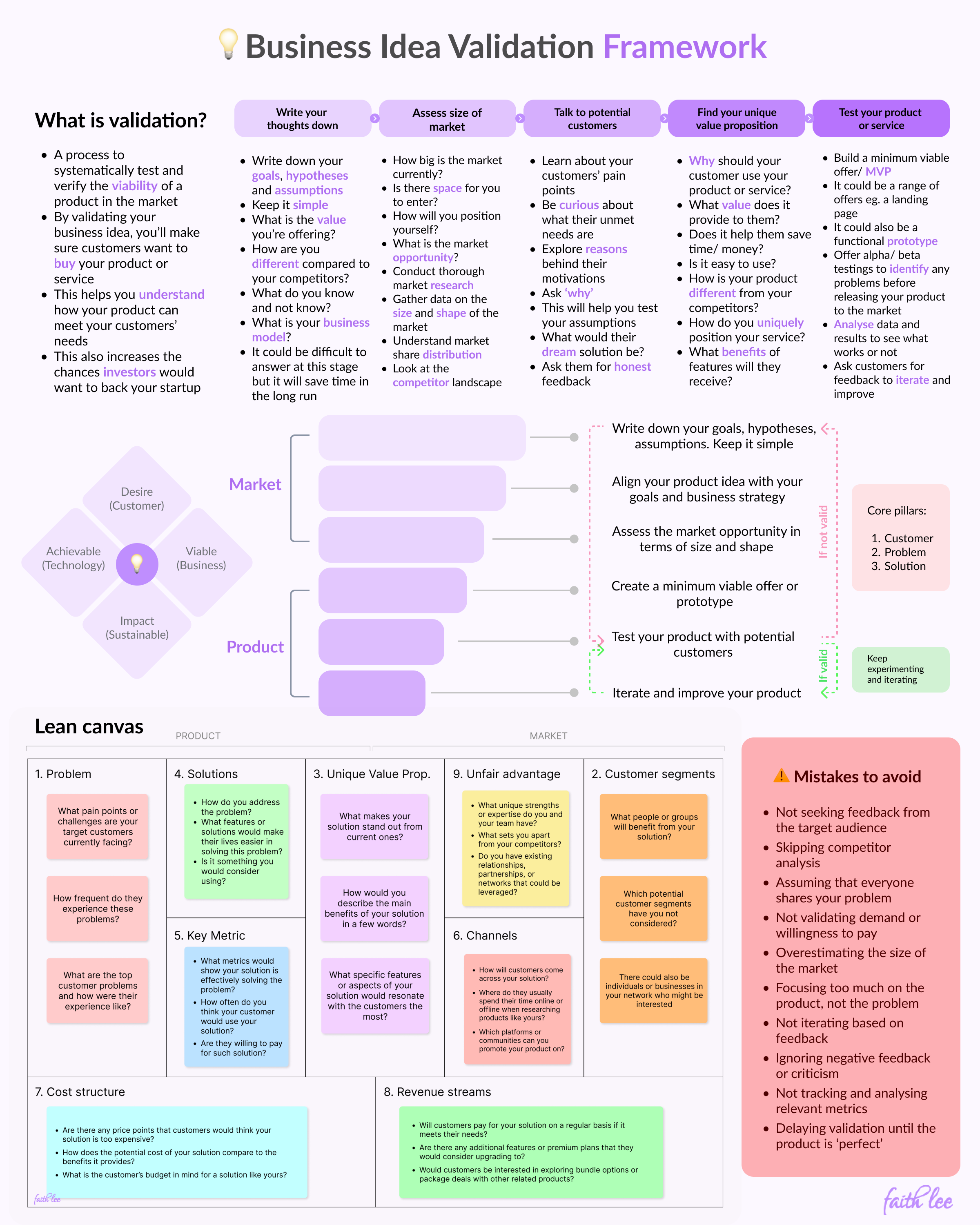
Make a copy and you can start customising!
Thank you for reading! If you liked it, share with your friend, family or a fellow founder who might find this useful.
Follow me on Linkedin & Twitter for more updates like this.
⭐️⭐️⭐️⭐️⭐️ Love it!
⭐️⭐️⭐️⭐️ It's okay!
⭐️⭐️⭐️ Good
⭐️⭐️ Hmm
⭐️ No
Please let me know if you have any suggestions of what to see next or any feedback! I would value your input.
If you have any interesting articles or stacks, please get in touch! I would love to feature in my next edition! 😇
Comments
Nothing yet. Say the first thing.
Sign in to join the conversation.