
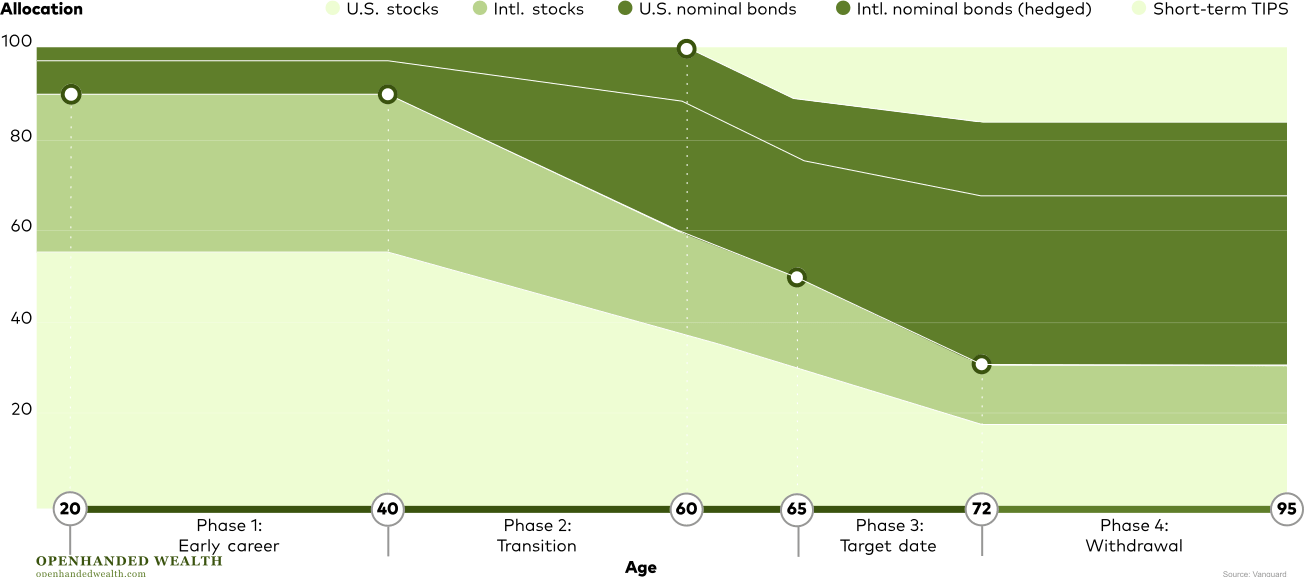
If you’ve ever sat across from a financial planner, you’ve probably heard about the glide path. It looks something like this. When you’re in Phase 1 (early-career, young accumulator), we’ll invest you pretty heavily in equities — stocks, growth assets, things that can lose value in a bad year but have a long runway to recover. By the time you’re 65, you’ve likely shifted most of that into fixed income. Bonds. Stability. Capital preservation. The goal isn’t growth anymore. The goal is not losing what you’ve built.
The equity-to-fixed-income ratio traces a long, slow arc downward over a lifetime. It’s rational, prudent, and what any good advisor would recommend.
as our kingdoms grow
Is it possible that our dependence on God follows the same curve?
When you’re in your 20s and 30s, you are genuinely desperate in ways that drive you toward God. You’re fighting for direction. You don’t know if the business is going to work. You’re raising kids and watching your marriage get tested in ways you didn’t anticipate. You’re not sure where the money is coming from next month. Those are equity years in every sense — high volatility, high stakes, and a daily awareness that you are not in control of much.
Then the kingdom grows. Morgan Snyder and John Eldredge write about this — the season of life where God has entrusted you with real domain: a thriving career, a stable income, a home that’s paid down, kids who are starting to find their footing. And it’s genuinely good. But a kingdom, if you’re not careful, becomes its own kind of insulation. The bubble wrap of security thickens a layer at a time, and one day you realize you haven’t prayed about money in years because you don’t have to. You know where the next meal is coming from. You know where the next ten years of meals are coming from.
staying hungry
I can’t find many examples in scripture where God presents a problem to someone and expects them to figure it out without seeking Him. When that happens, it tends to be a story of consequence. The stories we return to — David and the Urim and Thummim, the Israelites daily manna, the disciples in the storm-tossed boat — are all stories of people who had no choice but to be dependent, and found God faithful in that place. The fixed-income years of life can close that door one layer at a time.
a faith-stretching alternative to CoastFI
Let me be clear: I’m not suggesting we manufacture financial desperation. I’m not recommending that we all give away our retirement savings to stay poor enough to need God. But I’m also not willing to rule it out entirely. I know a handful of people who have lived at the edge of what makes financial sense by almost any conventional measure — giving in amounts that genuinely cost them, turning away lavish gifts of generosity to force their souls to find contentment in God, and seek provision from Him alone — and they’ve got the stories to prove it.
The more practical version is simpler: what if you planned to give sacrificially throughout your entire working life, not just after you’ve secured enough to be comfortable? Most financial planning is structured around a CoastFI logic — accumulate until you hit the number, then relax and be generous with the excess. But what if you spread the generosity across the whole career? What if the windfalls that come your way aren’t primarily meant to be stacked — but to be moved?
There’s a real difference between giving from surplus and giving from a place that actually costs you something. Surplus giving doesn’t require much faith — it just requires margin. The other kind keeps you dependent—hungry.
Giving should hurt a little …if my fists are wrapping tightly around my treasures. Giving should hurt a little …if it’s delivering a blow to my pride and self-sufficiency. Giving should hurt a little …just like a good workout.
Because that kind of “pain” produces real, lasting joy, “the joy of the Lord”—the joy that David calls “my strength”—and that is the point of giving.
two parables, one question
The rich fool in Luke 12 built bigger barns. He looked at what he had, looked at the future, and made what seemed to him to be a prudent decision. It just never occurred to him that the barns weren’t the point.
The man in Matthew 13 found treasure in a field and sold everything he owned to buy it — in joy. He wasn’t impoverished by the transaction. He got the treasure. What would it look like to plan your financial life around increasing your need for the God who put the treasure there in the first place?
Comments
Nothing yet. Say the first thing.
Sign in to join the conversation.