
I’m writing this to help me crystalize my own thinking and perspective. In some ways, I’m writing this essay to think out loud.
I want to start with an anecdote because anecdotes are powerful. They can help us pattern match, identify themes, and see a bigger picture. This one is recent.
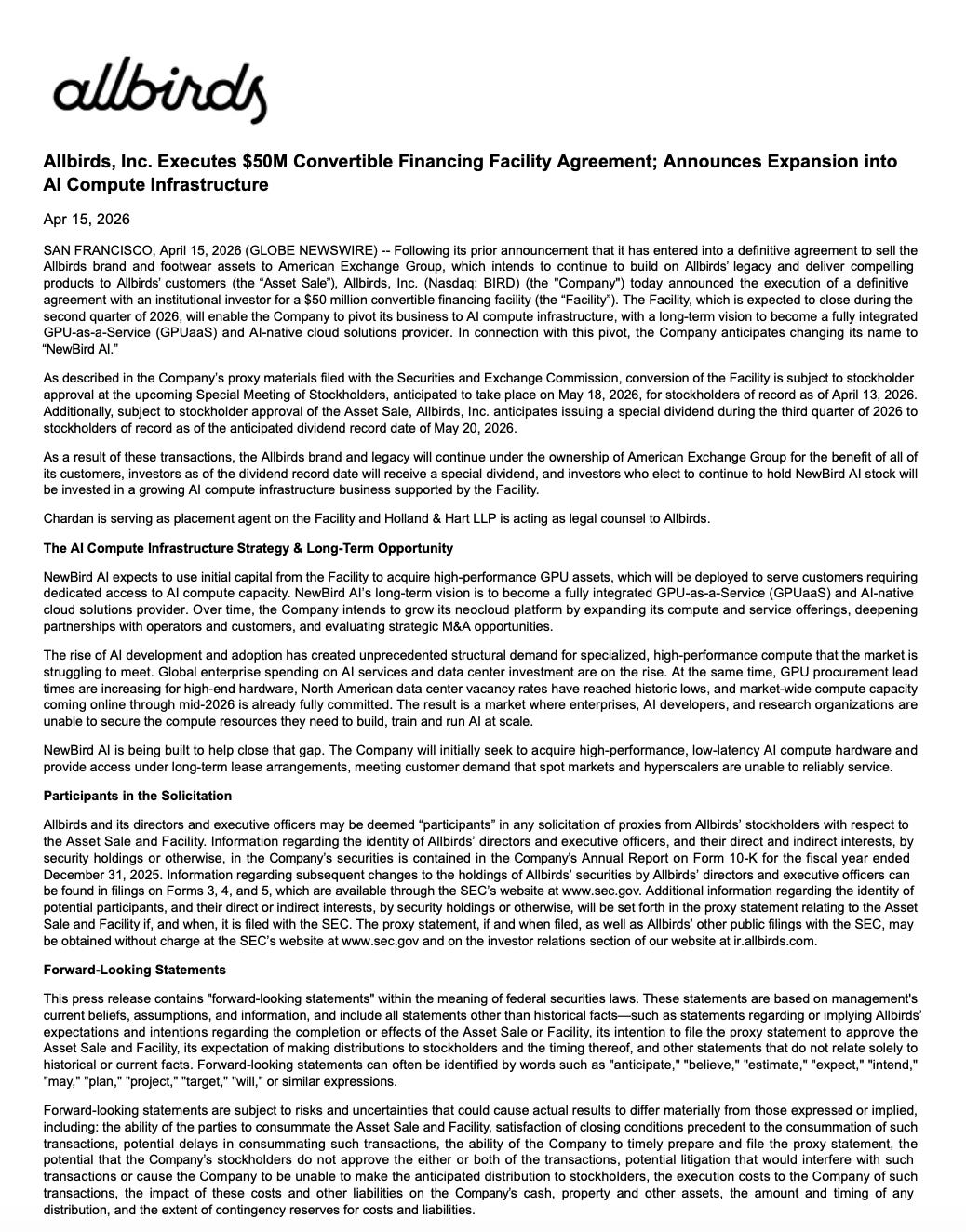
Allbirds was once valued at $4B in 2021. It sold its shoe brand and IP for $39M earlier this month. Then it announced a pivot to GPU-as-a-service and AI compute infrastructure, filed to remove its environmental public benefit mission from its corporate charter, and renamed itself NewBird AI. The stock rose over 400% in a single session.
No GPU infrastructure. No engineering team. No customers. No contracts. The announcement generated a 400% return.
This is a behavioral data point. We have seen it before, more than once, across more than one era.
You can see their official announcement at the bottom of this essay.

Late cycle is a behavioral state
Most cycle analysis anchors on price multiples, credit spreads, and Fed posture. Useful, but it’s latent. By the time those metrics confirm the diagnosis, the behavioral shift has been underway for a while.
A few markers appear consistently when a cycle is running late. Narrative commands a premium over demonstrated capability. The question “can you execute?” gets temporarily suspended. Capital flows to the story. The distance between announcement and reward compresses toward zero. NewBird AI produced nothing. The reward arrived before any execution occurred.
Identity also becomes flexible. Companies expand their mission, pivot their model, or change their name in pursuit of category adjacency. NewBird AI filed to remove its founding mission from its legal documents.
One thing worth noting for founders and operators in my network: the financials are usually the last place this shows up. The income statement registers the consequence of decisions made quarters or years earlier. The behavioral signal arrives first.
The pressure to have an AI story right now is real. Investors are asking about it. Buyers are asking about it. The audience rewarding vocabulary in public markets is the retail investor. The audience evaluating execution in private markets is the customer, the wholesale partner, and the lender. Understanding which audience you are actually playing to is one of the more important clarity exercises available to any founder and operator today.
We have not had a real recession in nearly 20 years
Before mapping the pattern, the context matters.
The last true credit-cleansing recession was 2008 and 2009. The 2020 recession was policy-induced and instantly backstopped. Leverage was not forced out. Weak businesses did not fail at scale. Asset prices reset briefly and recovered faster than any prior downturn in modern history. What could’ve been a clearing event became another extension.
The result: we are now in a late-cycle environment built on top of nearly 20 years of accumulated, deferred risk. Suppressed volatility does not eliminate risk. I believe it concentrates it, pushes it forward, and embeds it in places that are not immediately visible. You will see it in private credit markets, commercial real estate refinancing assumptions, and companies that were built in the ZIRP-era now facing refinancing at rates 2-3x higher than their original capital structures assumed.
This late cycle is not a normal late cycle. The usual dynamics feel present and amplified.
The anatomy of it follows a specific sequence.
The real economy loses efficiency first. Growth continues, but it requires more stimulus, more debt, and more risk to generate the same output. Productivity slows. Headline employment holds, but hiring quality weakens. Inventories build unevenly. Capex becomes defensive rather than expansionary. And risk concentrates. Capital gravitates toward perceived safety, which in practice means a narrowing group of large companies and mega-cap stocks. The top ten S&P 500 constituents now represent over 35% of the index. When that much weight sits on that few names, the system’s resilience depends on a very small number of businesses continuing to perform. That concentration is itself a form of fragility.
Financial conditions and behavior then diverge from fundamentals. Asset prices detach from underlying cash flows. Risk premiums compress as investors reach for yield. Leverage builds quietly in private credit, structured products, and margin accounts. Narratives begin to dominate pricing more than fundamentals do. The NewBird AI story is a near-perfect expression of this.
Capital allocation quality deteriorates next. By late cycle, the high-quality opportunities have already been funded. Return thresholds drift lower across the board as the cost of capital has been suppressed long enough to reshape expectations. Incentive structures at every level reward deployment over discipline. The result is a pattern that repeats: weak IPO cohorts, questionable M&A premiums justified by synergy assumptions that do not materialize, and a population of companies surviving on debt their economics cannot support.
What makes this difficult to navigate is that dispersion increases before the cycle turns. AI infrastructure spending today is a clear example. Hyperscaler capex is at record levels. Data center construction is booming. At the same time, consumer credit stress is rising among lower-income cohorts, small business confidence has weakened, and commercial real estate faces a refinancing wall that has not been fully reckoned with. The aggregate data still looks fine, because the strong sectors are masking the stressed ones. That masking effect is itself a late-cycle characteristic.
The key insight most people miss: late cycle is about the system becoming increasingly sensitive to small shocks. Early cycle, mistakes get absorbed. Late cycle, small mistakes cascade. The margin for error narrows without announcing itself.
What history tells us
I enjoy studying history. People spend too much time thinking about the last 24 hours and not enough time thinking about the last 100 years. Will Durant’s “The Lessons of History” is one of my favorite books. The argument is simple: human nature is more stable than human circumstance. The patterns which produce outcomes repeat because the nature driving them does not change.
Jacob McDonough’s “Capital Allocation: The Financials of a New England Textile Mill” documents this at the company level. The book follows Berkshire Hathaway from 1955 to 1985 through the actual financial statements an investor would have seen at the time. What it records, in granular detail, is how Buffett extracted capital from a dying business and redeployed it into better ones, patiently, repeatedly, across multiple market cycles. Berkshire did not pivot to become a technology company when technology was the theme. It did not borrow the vocabulary of whatever category the market was rewarding that year. That discipline looks obvious in retrospect and requires enormous conviction to practice in real time.
Two historical examples are worth sitting with.
Dot-com name changes, 1999 to 2001
The playbook that emerged in 1999 is almost identical to the NewBird AI story. Companies in slow-growth or distressed industries announced pivots into the internet economy, changed their names or appended “.com” to their existing brands, and received immediate stock appreciation of 100%, 300%, 400% or more, with no change to operations, revenue, or customers.
The structure was consistent: press release, stock pop, brief window to issue equity at the inflated price, then slow deterioration as the absence of genuine capability became apparent.
The unwind was not uniform. Amazon survived the 2001 to 2002 correction because it was genuinely building the distribution, technology, and logistics infrastructure the category implied. Pets.com went from IPO to liquidation in roughly 270 days. Same technology, different business underneath. The separator was never the category. It was the quality of what was being built inside it.
Long Island Iced Tea to Long Blockchain, 2017
In December 2017, Long Island Iced Tea Corporation, a beverage company with roughly $1.5M in quarterly revenue and a history of operating losses, announced it was changing its name to Long Blockchain Corp. No blockchain product. No relevant engineering team. No partnerships.
The stock rose roughly 300% on the day of the announcement on roughly 50x average volume. The company raised capital at the inflated price. The SEC opened an inquiry into unusual trading. By 2019, it had been delisted from NASDAQ. The company no longer operates.
The blockchain technology behind the name change was real. The company borrowing its vocabulary was not building it.
The mechanism
The behavior is not irrational. I think it’s rational within a specific incentive structure.
Soros described reflexivity as the mechanism by which rising prices validate the narrative attached to them. Validated narratives attract more capital. More capital raises prices further. The mechanism is self-reinforcing in the short run regardless of fundamentals. Buying NewBird AI ahead of retail investors who would follow the headline was locally rational. The bet was on the behavior of other market participants, not on the business.
The short seller’s problem is worth noting. Being analytically correct about NewBird AI is not immediately profitable. Many investors who correctly identified the dot-com bubble in 1998 were financially impaired before the correction arrived in 2000.
Late cycle is essentially a coordination problem. Participants broadly understand the fundamentals are disconnected from the price. The question is not “is this company worth 400% more than yesterday” but “will others act as if it is, and can I be positioned ahead of them.” When enough people ask that question simultaneously, the answer becomes briefly self-fulfilling.
The two things that are always true
Two things are simultaneously true, and the instinct is usually to pick one.
The underlying technology is real. AI is real. The companies building genuine infrastructure in this era are likely to compound significantly. Dismissing AI because Allbirds renamed itself NewBird AI is the wrong conclusion.
The genuine transformative potential of a technology does not protect all participants in its orbit. The internet was genuinely transformative and the vast majority of internet companies in 2000 were still poor investments. Markets in late cycle stop distinguishing between genuine builders and vocabulary borrowers. Time reestablishes the distinction.
Chamath framed this well recently. His argument is that AI is causing a structural reset in how risky assets are priced because the technology simultaneously enables disruption and accelerates the ability of competitors to respond. A digital super-god cuts in both directions. The moat any company holds, including companies building genuine AI capability, may be more temporary than in prior eras because AI reduces the time and capital required to replicate a competitor’s advantage. Determining who holds a durable structural advantage vs a temporary lead is the actual analytical challenge this cycle presents.
A note to founders, builders and operators
The first is chasing the narrative. Announcing an AI pivot to your customers, retail buyers, or lenders does not generate a 400% return on anything. The audience evaluating execution in private markets is the customer, the wholesale partner, investors and lenders. They care about results.
The second failure mode is dismissing AI investment entirely because the surface behavior looks absurd. The applications with genuine commercial value are real. Operators using this period to build genuine AI capability in areas where they have existing data, existing infrastructure, and the ability to measure outcomes are making a different kind of decision than the name-changers. That decision is worth making.
The separator is a competency adjacency test. When a company pivots into a new technology, ask whether its existing people, processes, and infrastructure give it any structural advantage in the new space. Allbirds has wool sourcing expertise, a DTC brand playbook, and a sustainable materials supply chain. None of that transfers to GPU procurement and cloud infrastructure. The pivot fails the test completely.
For a consumer brand operator, the question is where AI genuinely intersects with existing capability. A brand with clean transaction data can use AI-assisted demand forecasting in a way that builds on what it already has. A brand with high customer service volume can use AI-driven tools to reduce real cost from a real baseline. A brand with strong creative production volume can compress production cycles meaningfully. These are application bets. They reward execution over capital intensity and have a measurable return within a timeframe most investors and operators can underwrite.
One more point on capital structure. Late-cycle fragility has a direct implication for every operator. When the system becomes sensitive to small shocks, the founders and operators with clean balance sheets and strong unit economics have options that others do not. The ability to make long-horizon decisions, to say no to distribution that dilutes positioning, to invest in the customer relationship without needing an immediate revenue return, comes from financial architecture that supports patience. A balance sheet under refinancing pressure does not have that freedom. The operators who used the ZIRP era to build genuine financial resilience, rather than to stack leverage at rates that no longer exist, will be disproportionately well-positioned in whatever comes next.
What the morning after looks like
The sequence is consistent. Announcement generates stock move. A brief window opens to raise capital at the inflated price. Then the window closes. Over the following months, the absence of genuine capability becomes undeniable. No customer announcements. No product milestones. No revenue from the new direction.
Long Blockchain: stock from $9 to roughly $38 and back below $1 within a year. Delisted in 2019. The dot-com name-changers of 1999 and 2000 followed the same arc.
Every late-cycle sequence has reached the same destination. The timeline varies, but the end state is often the same.
For the genuine builders, it looks different. AWS was built during the post-dot-com years when cloud infrastructure was considered unglamorous. NVIDIA spent 15 years building GPU architecture for gaming and scientific computing before AI made it the most valuable company in the world. The speculative era created conditions under which genuine builders could raise capital cheaply and move fast. They used that window to build. The builders and the vocabulary borrowers were nearly indistinguishable during the peak. They were very distinguishable afterward.
What stays with me… things I’m reflecting on
Noise vs. signal
The NewBird AI announcement tells you almost nothing about AI as a technology and quite a lot about where we are in the cycle. The conditions that make it possible also create the conditions that eventually unwind it. Both legs of that trade have historical precedent.
The real risk in late cycle is the narrowing margin for error
The fragility that accumulates in late cycle does not announce itself. It shows up when something breaks in a place nobody was watching. When a refinancing assumption fails. When consumer credit stress in the bottom two income quartiles starts appearing in retail traffic data. The operators who understand this are building the financial architecture and operational resilience that makes the timing less relevant.
The companies that compound over a full market cycle are the ones who knew, with clarity, which of their advantages were structural and which were borrowed from the moment
McDonough’s book on Berkshire’s early years documents this almost page by page from 1955 to 1985. Buffett extracted capital from a dying textile business and put it into durable ones. He did not chase the themes the market was rewarding in any given year. He did not borrow vocabulary. The brands and companies in my network positioned well in the current environment are doing a version of the same thing, using this period to build genuine operational capability, not to perform for an audience that will not be there in two years.
Durant’s argument in “The Lessons of History” is that human nature does not change, and the patterns which produce outcomes therefore repeat. Late-cycle behavior is an old phenomenon with new branding. The technology in the press release will be different in the next cycle, but you’ll notice that behavioral sequence will not. The founders and operators who understand that are the ones who will be positioned well when the morning after arrives.
Faheem Siddiqi is the founder of FinanceWithin, a strategic and operational CFO and accounting firm serving startups, mid-market and high growth companies. He writes at faheem.substack.com.
Thanks for reading Capital & Clarity! This post is public so feel free to share it.
No posts
Comments
Nothing yet. Say the first thing.
Sign in to join the conversation.