
I’ve been wanting to write this piece for a while. It comes from a pattern I keep seeing with founders across our network. Experienced operators running $30M, $50M, $100M businesses who understand their company deeply. But when it comes to the investor across the table, most are reading the person without understanding the machine behind the person.
Every investor operates inside a fund. That fund has its own investors (LPs), its own return expectations, its own time horizon, and its own liquidity needs. All of that flows downstream into every term sheet, every board conversation, every moment of pressure a founder feels to grow faster or exit sooner. The push for a premature exit. The quiet withdrawal of follow-on support. The shift in tone from “build for the long term” to “let’s explore strategic options.” These moments are rarely personal. They are almost always structural.
Understanding the structure doesn’t make fundraising easier. It makes investor behavior legible. And legibility changes how you negotiate, how you plan, and how you build your cap table.
This is the thing I want every founder to internalize.
Your investor is operating on two timelines simultaneously: the timeline of your company and the timeline of their fund. When those timelines are aligned, the relationship works. When they diverge, the pressure becomes structural, and no amount of personal goodwill resolves it.
A fund has a defined life, usually 10 years. Generally, capital is called from LPs over the first 5 years as deals are sourced (deploying). The second half is about managing the portfolio and working toward exits (harvesting + exits). Distributions flow back to LPs as companies are sold, go public, or generate other liquidity events. The GP’s ability to raise their next fund depends almost entirely on the performance of the current one. Every fund builds on the one before it.
This means the GP sitting across from you is always carrying a second set of questions underneath the ones they’re asking about your business. Where is my fund in its lifecycle? How does this company fit my portfolio construction? What does this position need to do for my fund-level returns? When does my next fundraise start, and what story do I need to tell?
I think about this constantly in my advisory work. The founder who knows their lead investor’s fund is in year 9 of a 10-year life makes different decisions than the founder who doesn’t. The founder who understands why their board member is pushing for an exit this year, rather than holding for a larger outcome in three years, can have a more honest conversation about what’s actually driving that pressure.
Where a fund sits in its lifecycle directly shapes how the GP behaves with portfolio companies. I’ve seen this play out, and the pattern is worth understanding in detail.
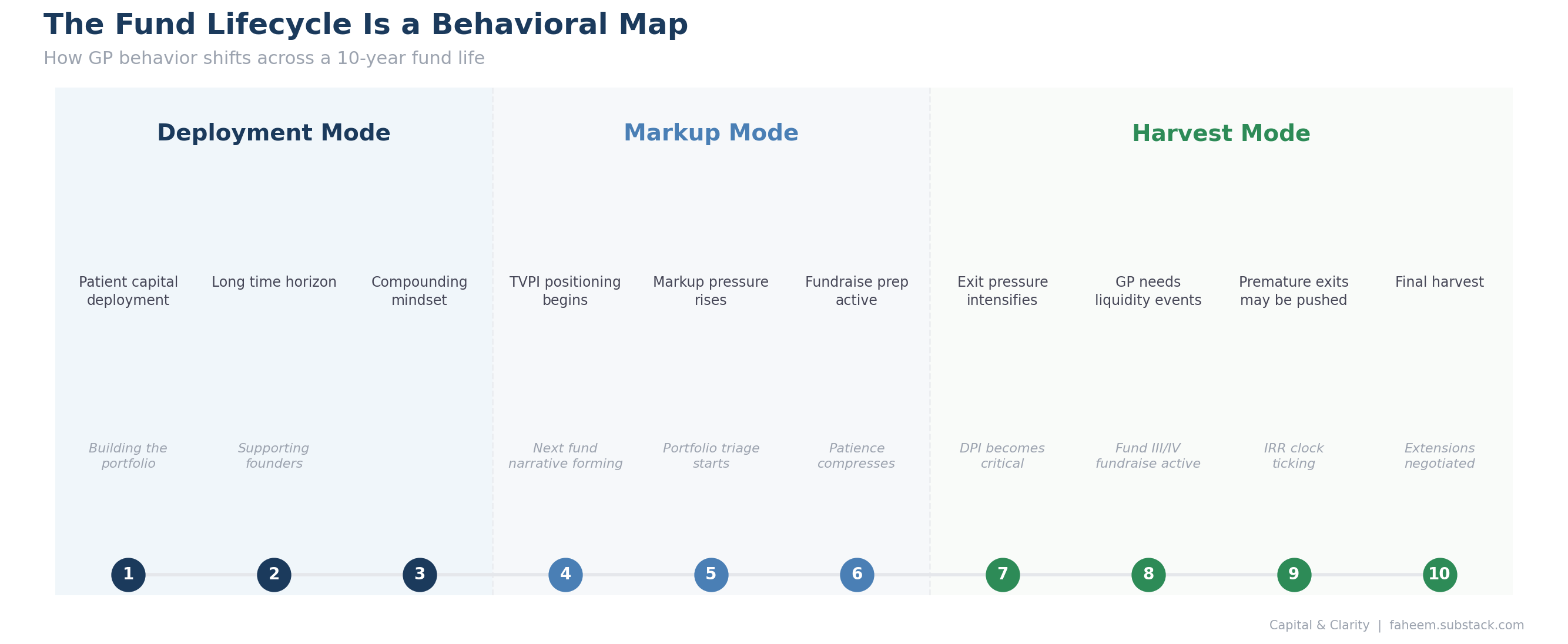
Years 1 to 3: deployment mode. The GP is building the portfolio. They are patient. They want to find the best companies and give them time to compound. Founders who raise from a fund in its early deployment years typically experience a more supportive, long-term-oriented investor. The GP has runway. Their next fundraise is years away. The incentive is to make high quality, patient decisions.
Years 4 to 6: markup mode. The GP starts positioning for their next fundraise. They need TVPI (total value to paid-in capital, the paper value of the fund relative to what LPs put in) to look strong. If a portfolio company is growing well, the GP may encourage aggressive pricing on the next round to boost markups. If a company is struggling, the GP may push for a pivot, a merger, or an acqui-hire rather than let it linger on the books. The patience available in years 1-3 starts to compress. Decisions shift from “what’s right for this company over 5 years” to “what optimizes the portfolio for the story I need to tell in 18 months.”
Years 7 to 10: harvest mode. The GP needs exits. They need DPI (actual cash returned to LPs, not paper value). If the GP is simultaneously raising Fund III or Fund IV, the pressure may intensify. A strong exit from an earlier fund can anchor the entire fundraising narrative for the next vehicle.
This is where founders experience the most direct pressure. A GP raising their next fund may push a portfolio company toward an exit that is premature for the business but necessary for the fund’s return profile. They may encourage a sale at a reasonable multiple rather than hold for a larger outcome 3 years away. Time is the enemy of IRR (the time-weighted annualized return that LPs use as their primary comparison metric). A 3x return in 3 years produces an IRR of roughly 44%. The same 3x over 7 years produces roughly 17%. Same outcome for the company. Completely different story for the GP’s fundraise.
We see this tension in certain instances. A founder whose business is growing at 30% annually with strong margins, and a board member who needs a liquidity event within 18 months to anchor a fundraise. Both people are acting rationally within their own frameworks. The frameworks don’t align. Understanding the fund dynamics is what lets you have the honest conversation about it rather than experiencing the pressure without understanding its source.
One thing worth noting for founders in my network: this dynamic isn’t malicious. It’s more mathematical. A GP who cannot show strong returns and actual distributions will struggle to raise their next fund. If they don’t raise their next fund, their firm’s growth will be compressed or in some instances, ceases to exist. The incentive to generate near-term strong outcomes is existential for the GP, even when the optimal path for the company is to stay private and compound for several more years.
The data on recent fund vintages helps explain something most founders have felt over the past two years without fully understanding the cause.
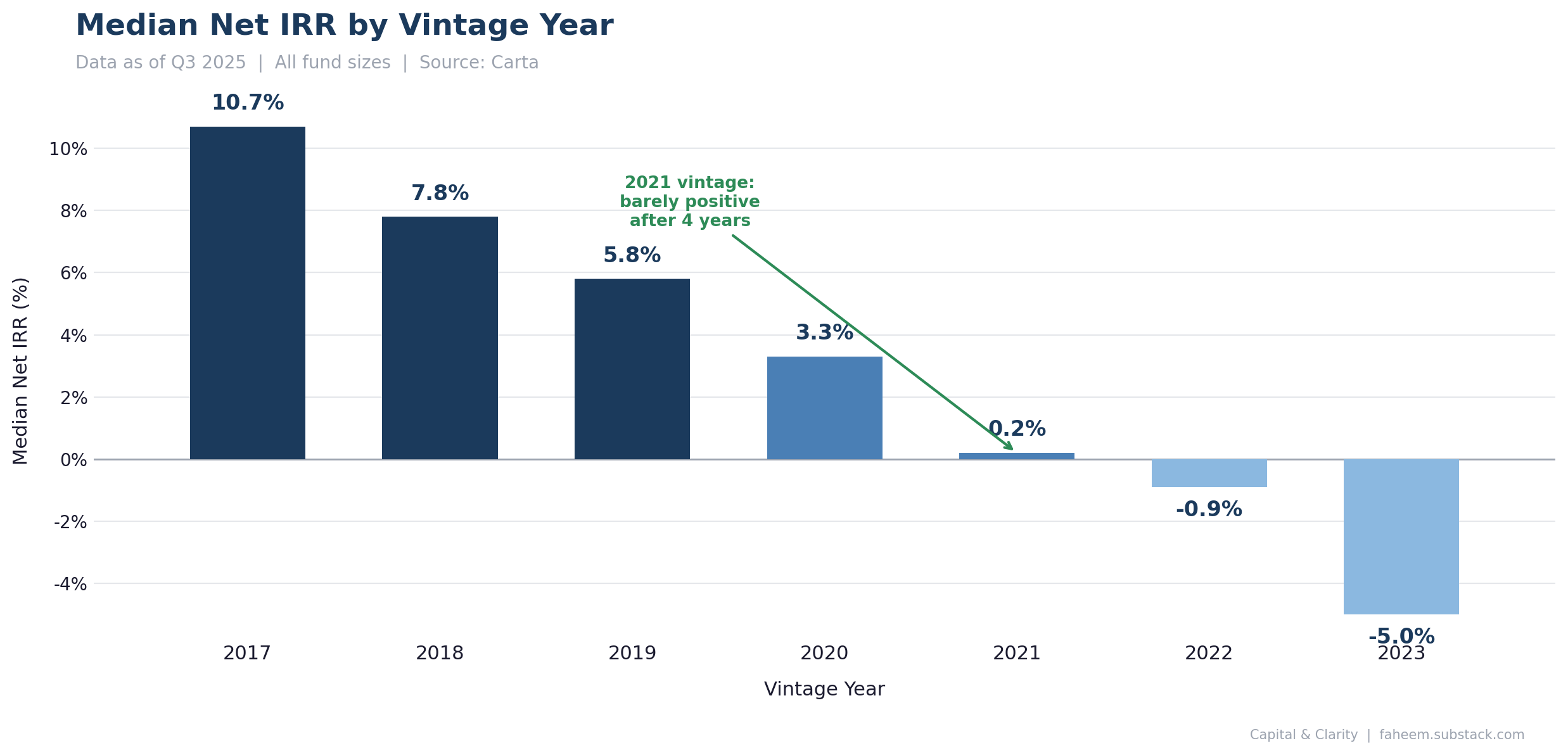
The 2021 vintage is the most telling. Median net IRR only recently turned positive, sitting at roughly 1.4% as of Q4 2025. Many 2021 funds invested at peak valuations and have spent years marking assets down. The late-stage reset was severe: on Carta, median Series D valuations fell from $1.07 billion in Q3 2021 to $212 million in Q1 2024.
More broadly, a large share of recent funds have yet to return meaningful capital. Only about one-third of 2021 vintage funds have generated any DPI, and the figure is even lower for 2022 and 2023 vintages. The result is a system where capital has been called but not yet returned.
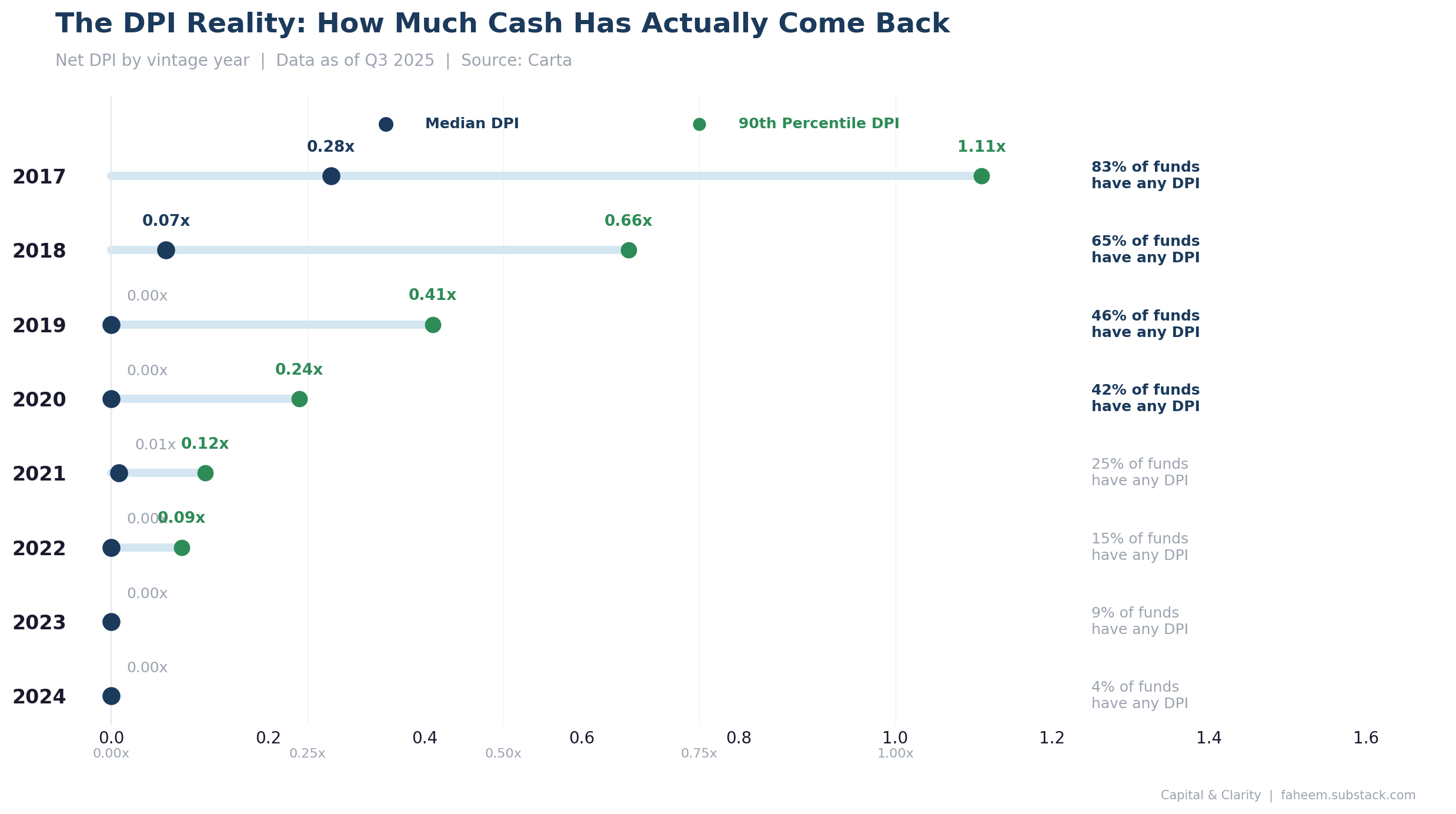
This is the liquidity drought that sits underneath the tighter fundraising environment founders have experienced. LPs who are not receiving distributions from existing funds have less capital to commit to new ones. GPs who cannot demonstrate DPI face a more difficult fundraising market. The tightness in venture over the past two years is not mysterious. It is partly the result of higher interest rates and lower public market multiples, but underneath those factors sits a distribution problem: LPs are not getting enough cash back from older funds to comfortably recycle into new ones.
The concentration of returns makes this dynamic more acute. Among 2017 vintage funds on Carta, top-decile TVPI is roughly 4.1x, while the median is closer to 1.9x. The gap between top-quartile and top-decile funds is larger than the gap between the median and the top quartile. The best funds are running away from the pack. For LPs, this means the difference between accessing a top-decile fund and a median fund is the difference between a transformative outcome and capital tied up for a decade at returns that may only modestly exceed public markets. That dispersion increases selectivity, which makes fundraising harder for GPs outside the top tier, and in turn makes capital scarcer for the founders those GPs would have backed.
The 2022 and 2023 vintages may ultimately benefit from this reset. Entry prices corrected. Discipline returned (mostly). Historically, vintages formed after market drawdowns tend to perform well. I think about this when founders tell me their last round was flat or below expectations. The 2021 cohort priced into euphoria. The 2023 cohort priced into reality. I suppose time will show which was the better starting point, but we can all speculate.
The rise of crossover investors over the last decade reshaped the capital environment founders operate in, and the pullback has been equally consequential.
Tiger Global is the defining example. At peak velocity in 2021, the firm was completing multiple private deals per week. Their strategy was to systematically index late-stage venture by identifying the top 2-3 companies in every major category and geography, then preempting the next round with a term sheet at a significant premium to the last financing. Coatue, Altimeter, Dragoneer, D1 Capital Partners, and Insight Partners operated with similar approaches. What distinguished them was fund size, the ability to hold positions through IPO and beyond, and during the 2020 and 2021 boom, a willingness to pay 50% to 100% premiums over what traditional VCs would price.
The philosophical difference from traditional VC was the hedge fund mentality carried into private markets. No board seats. Minimal operational involvement. Fast term sheets. In public markets, you don’t manage the companies you invest in. You trust the management. Tiger and its cohort applied the same logic to private companies. For founders, the pitch was compelling: a large check, fast, with no governance strings.
The catch is that crossover capital is reflexive. When public markets correct, these firms find more value in liquid equities than in illiquid private positions. Capital that flooded into late-stage venture in 2021 pulled back sharply in 2022. Term sheets were withdrawn. Valuations were renegotiated after signing.
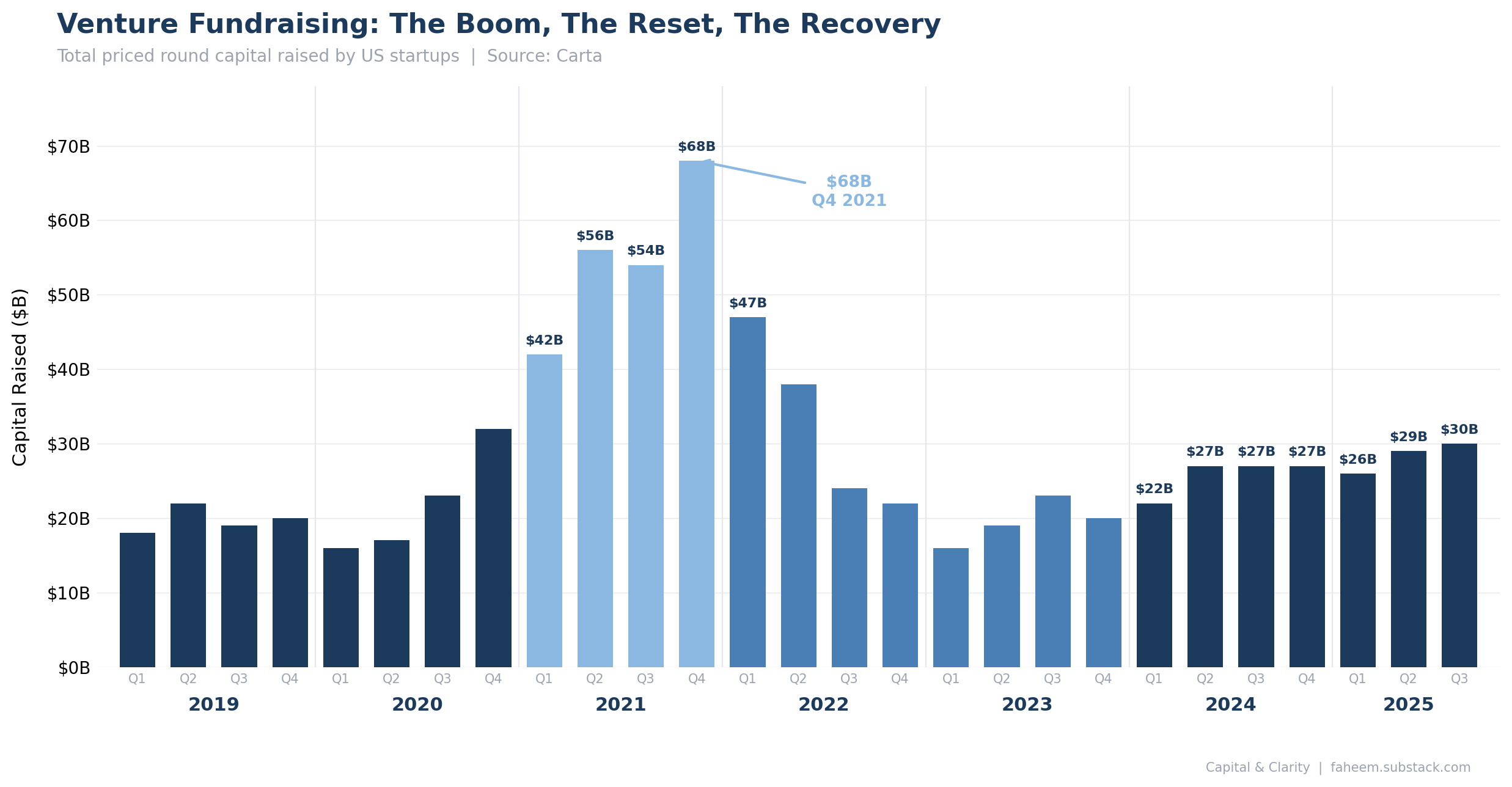
Founders who calibrated burn rates and growth plans around capital that evaporated. Teams that were hired for a trajectory that assumed the next round would come at a certain price, at a certain time. I wrote recently about how capital structure sets the metabolism of a company: the speed at which it processes change, hires, makes decisions. Crossover capital set the metabolism high. When the capital shifted, the metabolism had to change. But the organizational commitments (the headcount, the lease, the vendor contracts, the customer acquisition spend) couldn’t be unwound as quickly as the term sheet was pulled. The lag between capital withdrawal and operational adjustment is where a lot of damage occurred in 2022 and 2023.
The lesson I keep coming back to: crossover capital operates under a fundamentally different incentive structure than a traditional venture house with a dedicated 10-year fund. A crossover fund has permanent capital or hedge fund capital that can rotate between asset classes. They are not locked into a fund lifecycle. That flexibility can be a real advantage when it’s flowing in your direction. When it rotates away, you need to have built a business that can stand on its own economics. The founders who survived the 2022 pullback were overwhelmingly the ones whose unit economics and balance sheets didn’t depend on the next round arriving on schedule.
The economics of fund management matter for founders because they shape the behavioral incentives of the GP.
The management fee (typically 2% of committed capital during the investment period) keeps the lights on. It covers salaries, operations, and overhead. It is not where GPs build wealth.
Carried interest is where the real economics sit. Carry is typically 20% of the fund’s net profits after LPs have received their capital back (and in some structures, a preferred return). A $100M fund that returns 3x generates roughly $40M in carry. A $1B fund that returns 2x generates $200M.
The scale of carry changes the behavior of the GP, because it changes what “success” looks like inside their own economics. A GP managing a $50M fund can generate meaningful personal carry from a $150M exit in the portfolio. A GP managing a $2B fund needs billion-dollar outcomes to move the needle. The fund size determines the minimum exit size that matters, which determines the growth expectations the GP places on portfolio companies, which determines the pressure a founder feels to swing for a specific magnitude of outcome.
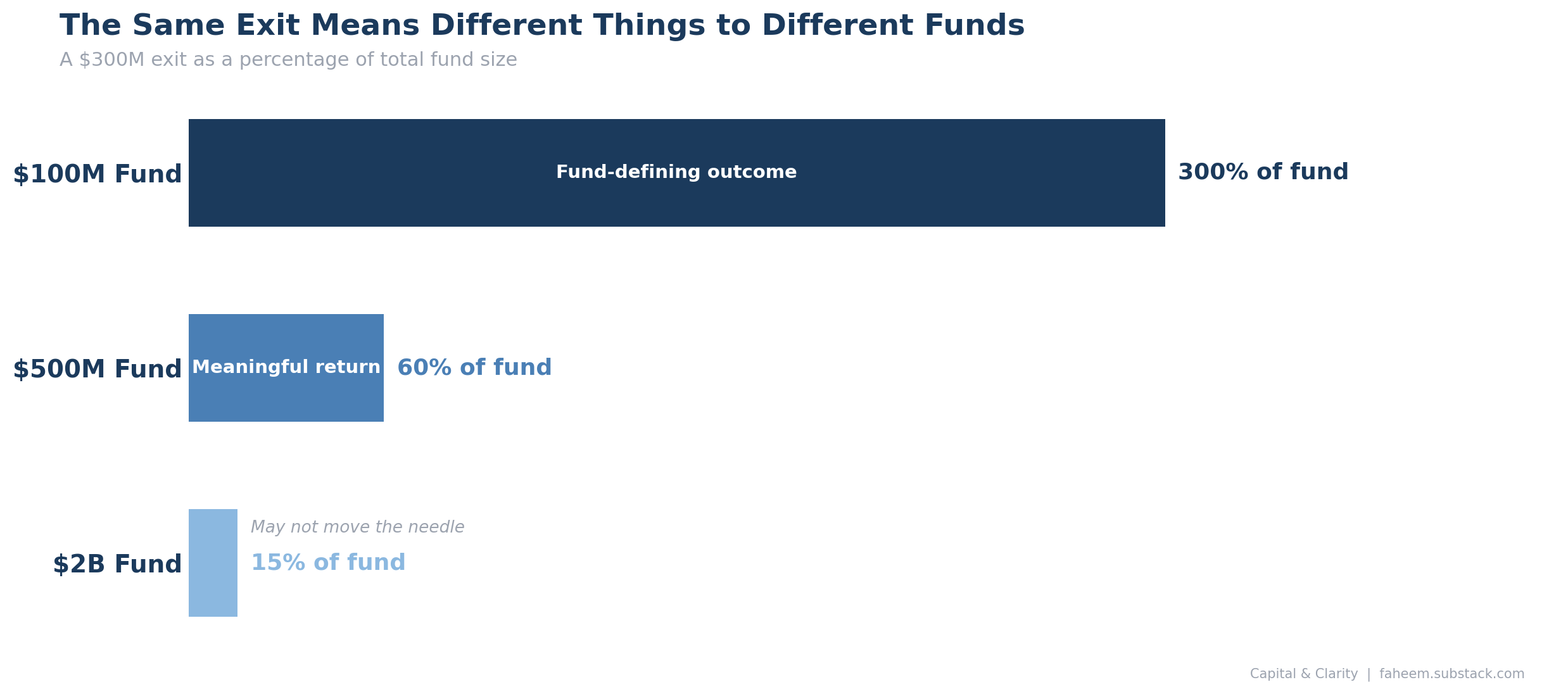
This is one of the most underappreciated dynamics in founder-investor relationships. A founder who is building a profitable, growing business doing $80M in revenue with a realistic path to a $300M exit may be building exactly the right company. If their lead investor is managing a $2B fund, that $300M exit may not be material on the fund’s return profile. The GP’s attention, support, and follow-on capital will flow toward the companies in the portfolio that can produce outcomes at the scale the fund requires. The founder’s business may be excellent on its own terms and irrelevant to the fund’s economics simultaneously. That misalignment is worth seeing clearly.
I see this regularly across private capital allocation. A brand doing $40M in revenue with 65% gross margins and a clear acquisition path at 3x to 4x revenue is a compelling business. Whether it’s compelling to the investor depends entirely on the fund size and what that exit means for fund-level returns. A $100M fund would be thrilled. A $2B fund less so.
For founders building something incredible that can achieve venture returns… Knowing these dynamics gives you a practical lens for evaluating and managing the investors on your cap table.
Ask what fund number they’re investing from and when it was raised. A Fund I or Fund II investor has reputational risk tied to your outcome. That can be both a positive (they will work incredibly hard for you) and a negative (they may push for a premature exit to build the track record they need for their next raise). A Fund V investor from an established franchise has more patience and institutional stability but may also be less hands-on. Neither is inherently better. Knowing where your investor sits in their own lifecycle helps you anticipate their behavior before it arrives.
Understand the fund size relative to your likely outcome. If your realistic exit is $75M and your lead investor manages a $3B fund, you will struggle to be a priority in their portfolio. If the same exit maps against a $100M fund, you are an important companythey’re backing. The intensity of support, the quality of attention, and the patience available to you are all downstream of this math.
Look at DPI, not just the brand. Has this investor actually generated returns and returned cash to their LPs? In the current environment, where a large share of recent vintage funds have distributed little to no capital, this is the most revealing reference check available. A GP with strong DPI is in a fundamentally different position.
Map the fund’s deployment pace against your timeline. A fund that is 85% deployed has limited follow-on capacity. If your business will need additional capital in 18 months, your existing investor may not be able to participate. Understanding the reserve situation before you need it is better than discovering it when the bridge conversation happens.
Pay attention to the LP base. A fund backed primarily by long-duration endowments and pension capital operates differently than one backed by fund-of-funds with their own liquidity pressures. The LP’s time horizon flows through the GP and into your boardroom. A GP whose LPs are demanding distributions will manage differently than one whose LPs are comfortable with a longer hold.
The best investor relationships I’ve observed across our network are the ones where the founder and the GP are on similar timelines. Where the fund’s lifecycle and the company’s trajectory are pointed in the same direction. When those are misaligned, the pressure is structural, and the relationship becomes an art work to manage.
I wrote recently about how capital structure shapes company culture (link here). The core argument was that the capital you take sets the metabolism of the company, and the metabolism defines everything downstream: how fast you hire, how much patience the system allows, how decisions get made under pressure.
Fund dynamics are the layer underneath that argument. The capital structure shapes the culture. The fund dynamics shape the capital structure.
A founder who raises from a fund in year 1 of deployment, with a patient GP and a full 10-year runway ahead, takes on capital with a long time horizon embedded in it. That time horizon flows through the company. It shows up in hiring decisions, in planning cycles, in the willingness to invest in infrastructure that takes 2 years to pay off.
A founder who raises from a fund in year 6, with a GP who needs an exit to anchor their next fundraise, takes on capital with a compressed time horizon embedded in it. That compression shows up everywhere. Faster hiring, shorter ramp expectations for new leaders, more aggressive spending to hit the growth targets the exit thesis requires. The founder didn’t choose to be impatient. The fund dynamics chose for them.
When I see companies dealing with what looks like a culture problem (high turnover, decision fatigue, misalignment between the leadership team and the board), one of the initial things I look at is the cap table. The behaviors that consume the leadership team in the current year almost always trace back to a capital decision made in a prior year. The fund dynamics behind that capital decision are often the root cause nobody is discussing.
The first observation is about information asymmetry. The mechanics I’ve described in this essay are well understood by every institutional investor and classic LPs in the ecosystem. They are less well understood by many of the founders who are most affected by them. Closing that gap doesn’t change the power dynamics of fundraising. It changes the quality of the decisions you make within them.
The second is about empathy as strategy. Understanding your investor’s fund dynamics is a form of empathy. The GP sitting across from you is also operating inside a system with its own pressures, its own stakeholders, its own clock. The founders who understand that tend to build more productive investor relationships, because they can see the full picture rather than just their corner of it. The conversation shifts from “why is my board member pressuring me” to “I understand the structural position you’re in, and here is how we can navigate it together.” That conversation is more honest and more productive.
The last is about deliberateness. The companies that compound over a full cycle tend to share a common trait: their founders were deliberate about the capital they took. They understood the fund dynamics behind the check. They matched their company’s stage and ambition to an investor whose incentives were aligned with the path they wanted to walk. They treated the cap table like a team. And they understood what motivated each player on it before the game started.
No posts
Comments
Nothing yet. Say the first thing.
Sign in to join the conversation.