
I’m drawn to large, family-controlled businesses. The way ownership structure shapes capital allocation, time horizon, and operating temperament is something I always find fascinating. I see it in my team’s advisory work constantly. Founder-led businesses make different decisions than PE-backed ones at the same revenue. Not better or worse, necessarily, but different. The time horizon changes everything. What gets invested in, what gets cut, what gets tolerated during a soft quarter or half.
Hermès is perhaps the purest example of that. So when their latest full year earnings came out, I wanted to sit with them. Over the weekend, I did.
$18.5B in revenue. 41% operating margin. $14.8B in net cash. $4.5B in free cash flow.
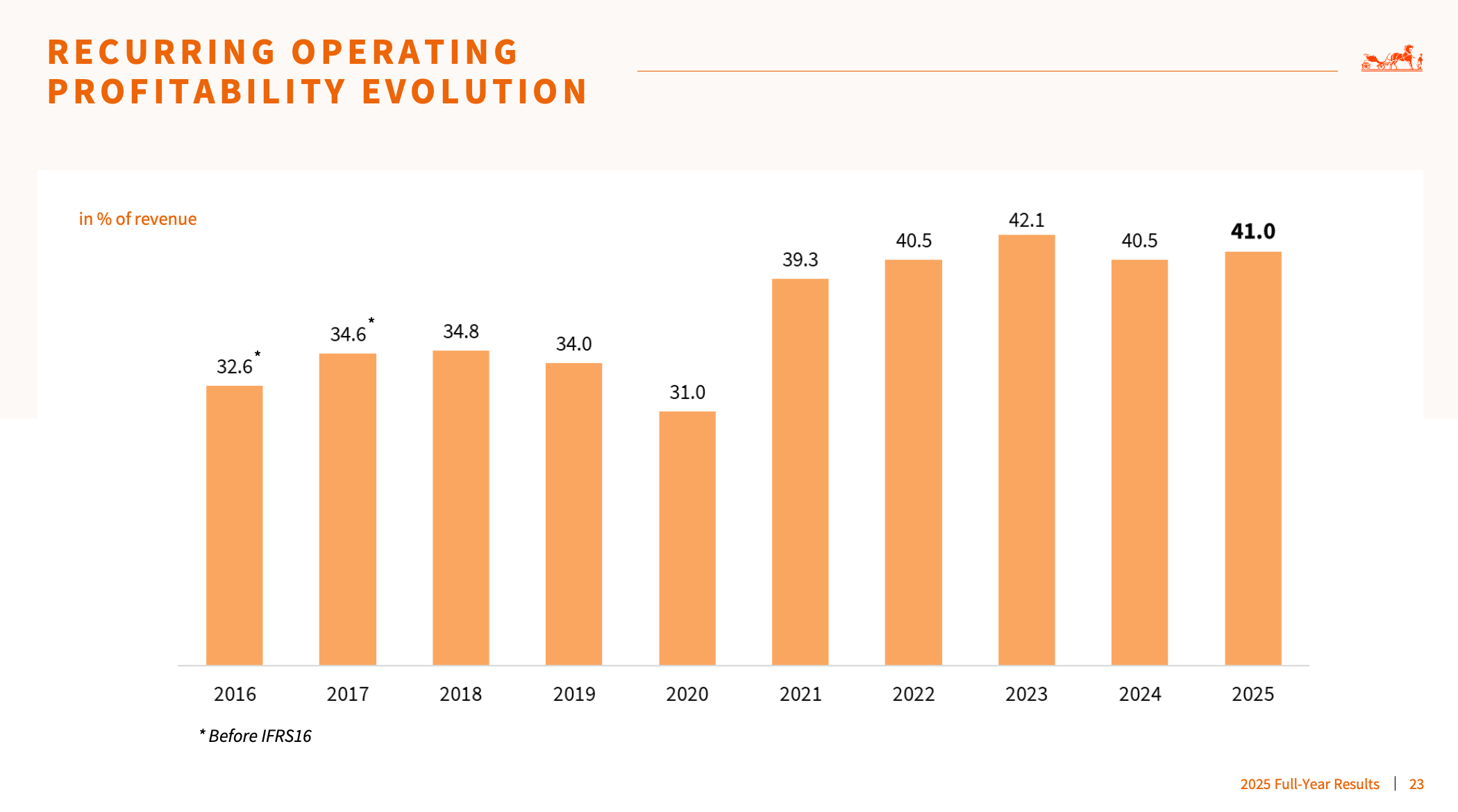
Hermès is publicly traded on Euronext Paris, but the family still controls roughly 2/3 of the company. You can see that in every capital allocation decision. Hermès, like many high-end fashion houses, thinks in decades, not quarters. There’s no activist shareholder pushing for margin optimization. No quarterly pressure to demonstrate growth in every category. The family’s involvement doesn’t just influence the strategy… it is the strategy.
A few things that stood out:
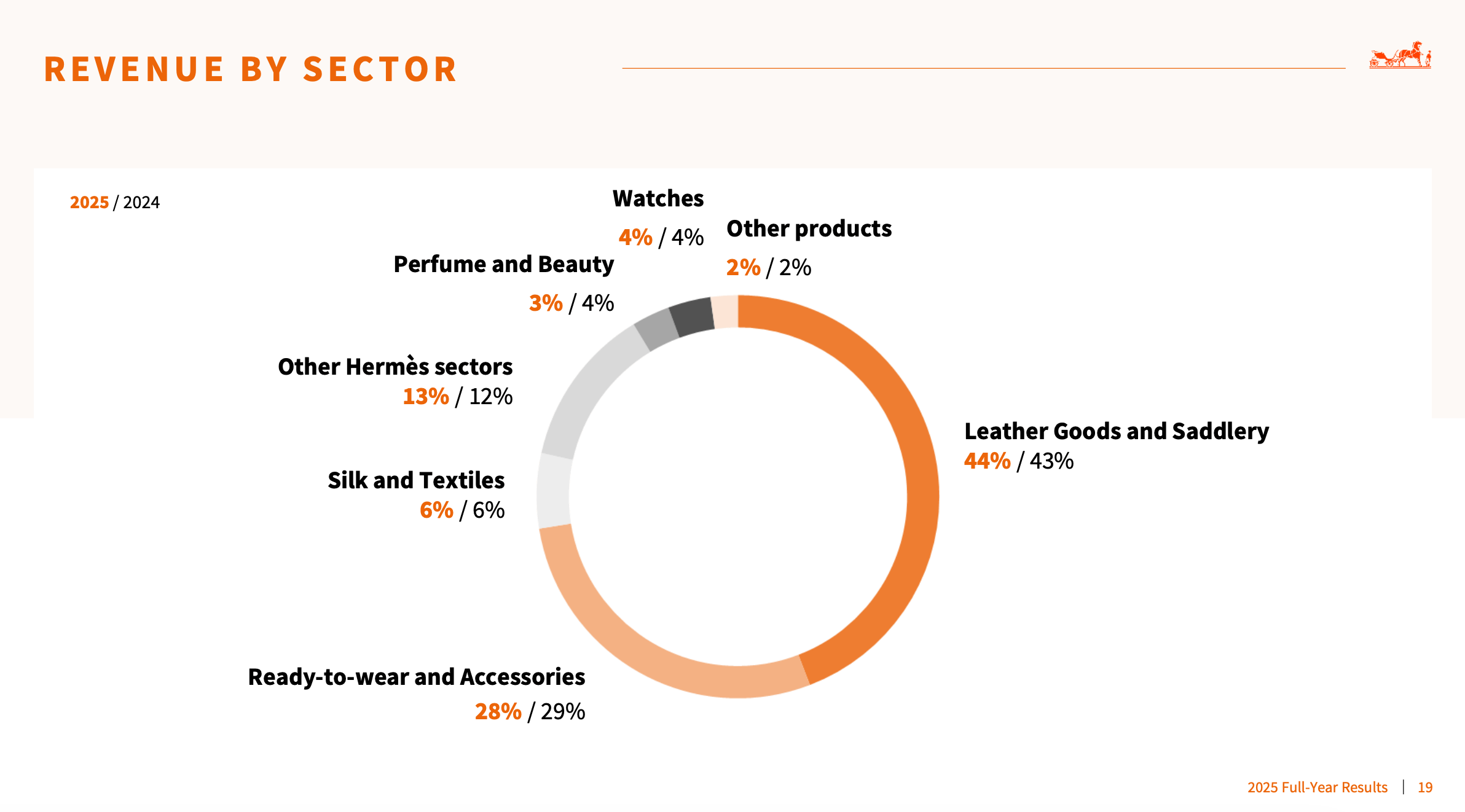
Leather goods grew 13% to $8.2B and now represents 44% of total revenue. Perfume and beauty declined 8%. Watches fell 2%. Rather than redirect resources toward the softer categories, Hermès invested $1.4B in capex, opened their 24th leather goods workshop, and have 4 more planned through 2030. The capital follows the highest-conviction category. That requires a time horizon most operating environments don't allow for.
I see a version of this tradeoff in mid-market companies often. The core is performing, maybe a hero SKU line or a single category that drives the majority of gross profit. But leadership gets restless. There’s pressure to expand into adjacencies, to launch something new, to show breadth. The new category underperforms, absorbs working capital, and the core starts to plateau from underinvestment. And it’s not because the market changed, but because attention shifted.
Hermès is the extreme case of doing the opposite. When leather goods is working and perfume isn’t, the response is to build another workshop. That kind of conviction is what sets them (and others like them) apart. And the compounding speaks for itself.
GM% expanded to 71%, up from 70%. 55% of products are made in-house or in exclusive workshops. When you control production at that level, margin is built into every layer of the process. Communication spend came down to 4% of revenue from 4.2%. The ratio of investment in making versus investment in selling continues to widen.
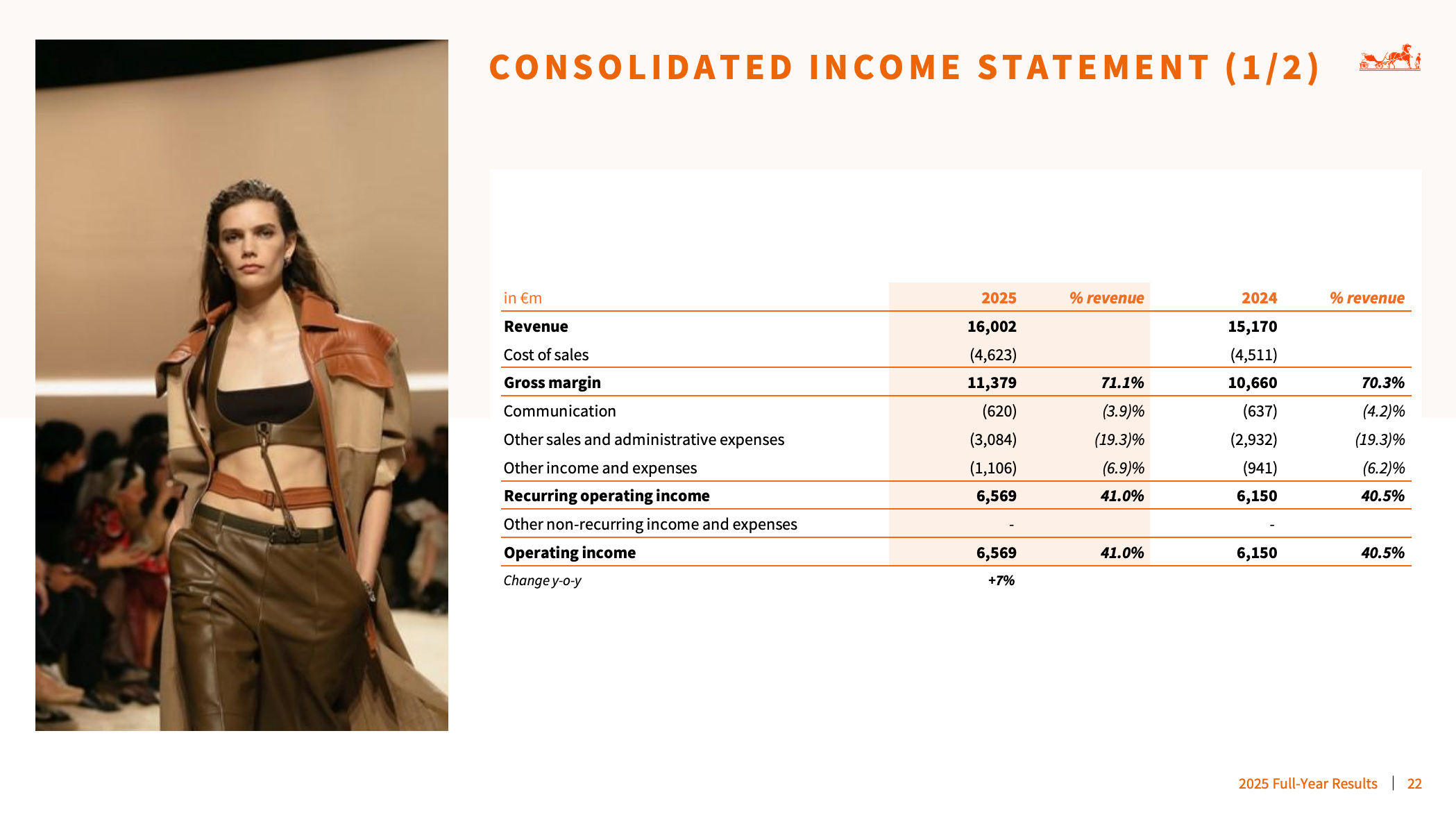
I think about this when I see brands at $30M or $50M fully outsourced overseas with little leverage on input costs. Every raw material increase, every tariff adjustment, every freight rate swing flows straight through to the financials. There’s no buffer. Hermès controls the chain from raw material to retail shelf. That’s the foundation of a 71% gross margin in a physical goods business.
I recognize it’s not apples to apples… resource constraints are a real dilemma at a small scale. Most brands won’t get to 55% in-house production. That’s not the point. Even small moves in that direction change the economics meaningfully. Bringing a key finishing process in-house. Consolidating from five vendors to two with better terms and more leverage. Investing in quality control earlier in the production cycle instead of managing returns on the back end. These moves tend to show up in gross margin faster than expected. And they compound, because each one gives you slightly more control over the next cost decision.
Their largest region, Asia-Pacific ex-Japan, grew just 5%. That’s 42% of revenue growing at half the rate of the rest of the business. But the Americas did 12%. Japan, 14%. Middle East, 15%. The overall business still posted 9% constant-currency growth. When your distribution is that balanced, one region cooling off doesn’t force your hand. That balance took decades to build.
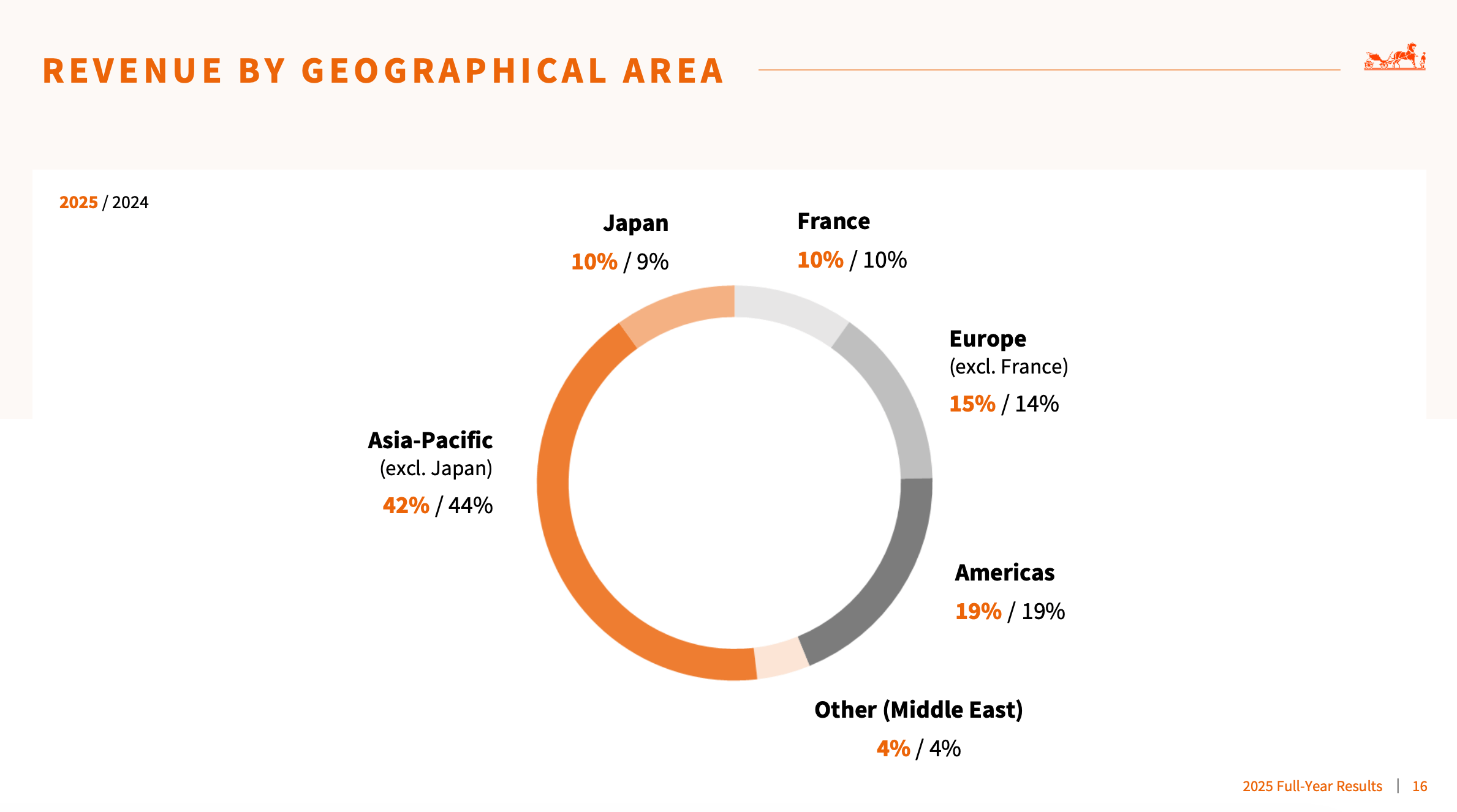
This resonates at smaller scale too. Brands that are 80% DTC or 70% reliant on a single retail partner feel every channel fluctuation in their bones. A change in algorithm, a buyer rotating your shelf placement, a shift in marketplace fees - any one of those becomes critical conversation points when there’s no counterbalance. Diversification beyond a certain scale volatility absorber. And it’s hard to build it reactively.
294 stores across 45 countries, nearly all company-operated. No off-price. No marketplace presence. I think this is the most underappreciated part of what they’ve built. When you control where your product shows up and how it’s experienced, that compounds in ways that are hard to see in any single quarter but unmistakable over a decade.
For emerging brands, the equivalent might be simpler than it sounds. It might mean saying no to a wholesale account that moves volume but dilutes positioning. Or leaving a marketplace that drives revenue but trains your customer to wait for a promotion. These are genuinely hard decisions. The revenue is real. The short-term cost of walking away is measurable. But the long-term cost of staying (the slow erosion of brand equity, the margin compression, the customer expectation that your product should always be on sale) is harder to measure and much harder to reverse. The brands I’ve seen navigate this well tend to make the decision early, before the damage compounds. The ones that wait usually end up spending more to rebuild positioning than they ever gained in incremental volume.
What ties all of it together, at least for me, is a willingness to leave money on the table. Hermès underproduces on purpose. They let FCF serve as the scorecard, not revenue. They seem genuinely comfortable sacrificing short-term volume for long-term model integrity.
I find myself thinking about that tradeoff more and more. In a market that rewards growth above almost everything else, there’s something quietly radical about a business that says: we’d rather make less and sell it well than make more and dilute what we’ve built. That’s an operating philosophy (not just grounded in something luxury). And it’s available to any brand willing to accept the short-term cost of patience.
The principles aren’t exclusive to luxury or to businesses at this scale. They’re just easier to see when someone has been executing against them for 189 years.
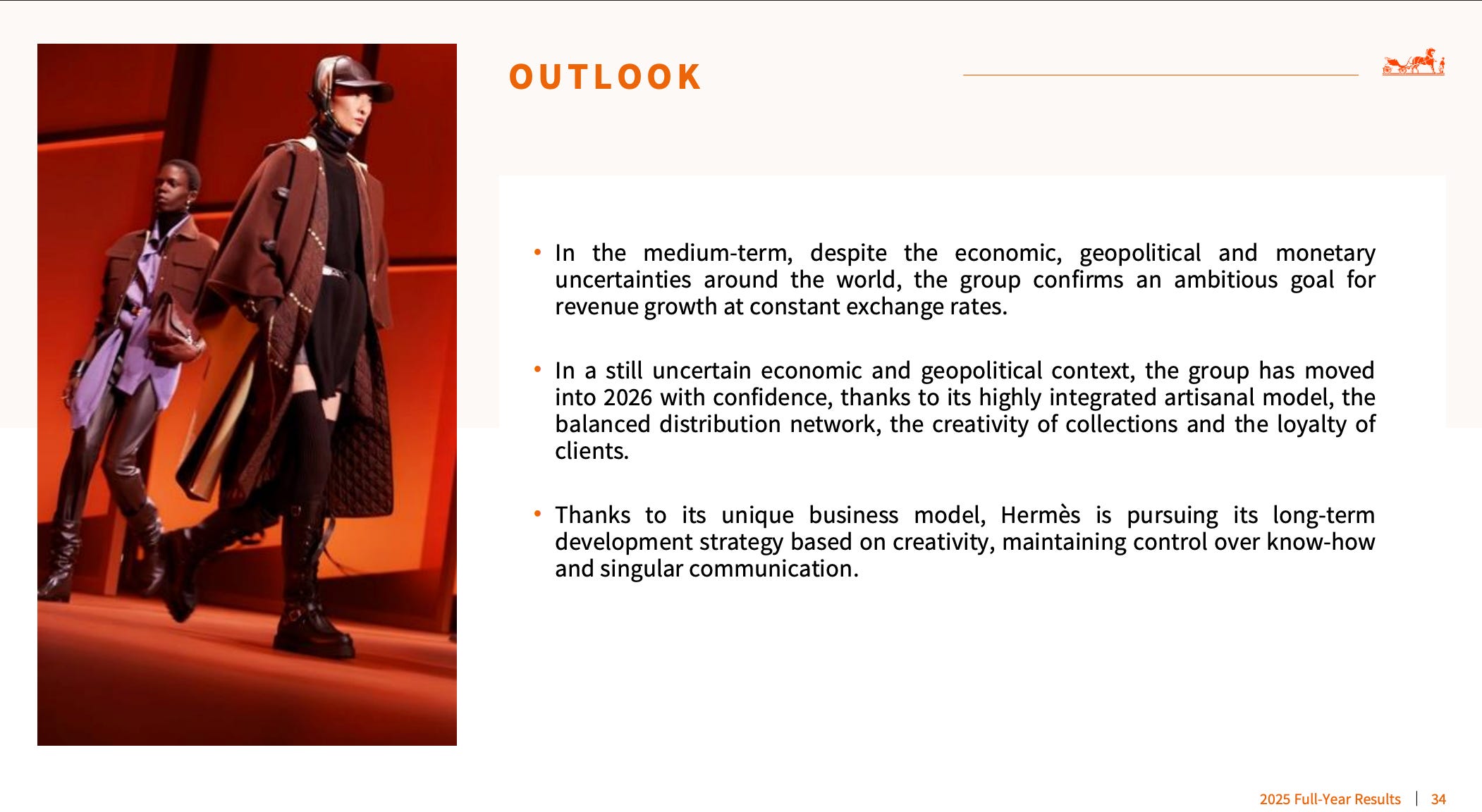
Learn more here: https://assets.main.pro2.maf.media-server.com/ae99e00484a244e1a0d533935d9194b6/Slides_FY_2025_-_VA_-_VDEF.pdf
No posts
Comments
Nothing yet. Say the first thing.
Sign in to join the conversation.